Are the Seahawks digging around the college quarterbacks?
Apparently so — but I wouldn’t overreact to this.
According to Pete Thamel, who covers college football for ESPN, the Seahawks will be one of 10 teams frequenting the various press boxes (for those who don’t know, the scouts tend to share the space with the journalists bizarrely):
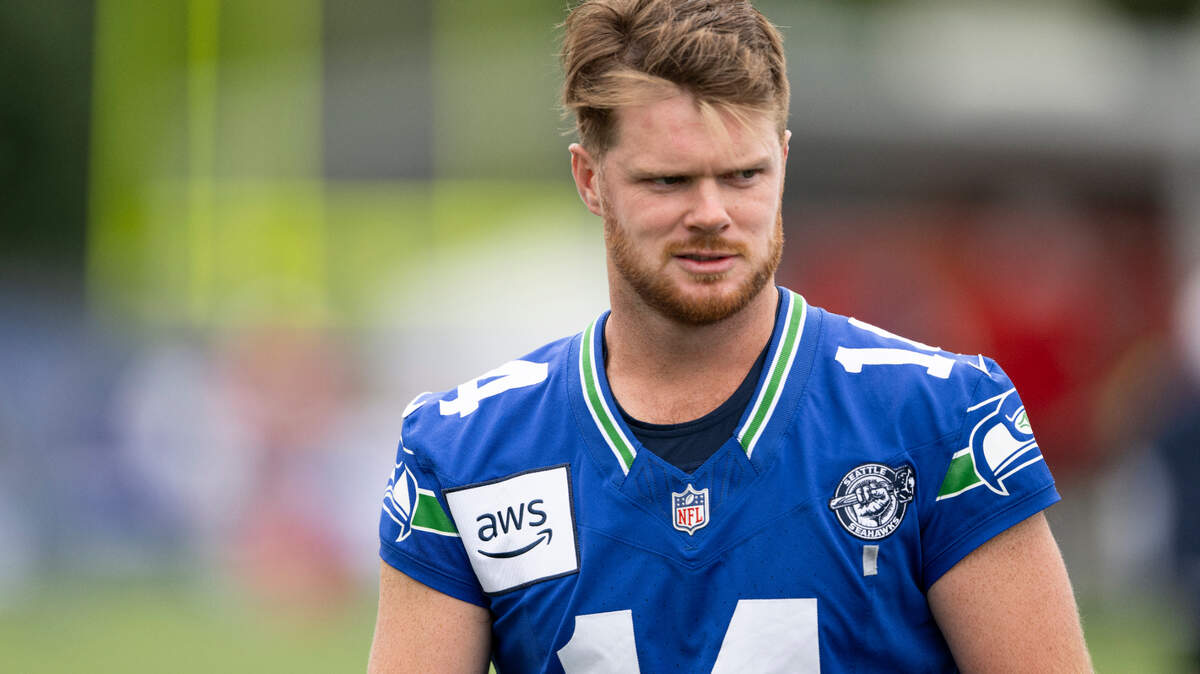
A crew of 10 obvious teams will have their scouts and executives filling college press boxes due to an immediate need at quarterback: the New York Jets, Miami, Pittsburgh, Cleveland, Indianapolis, Minnesota, New Orleans, Atlanta, Arizona and Seattle. (Seattle is because of Sam Darnold’s age/contract, the rest are for performance and need.) There are also some non-obvious candidates that could end up in the quarterback market, depending on performance, contract situations and management preferences. That group would include Baltimore, Tennessee, Carolina, Houston and Philadelphia. (This is a good year for a winning team with an aging starter or uncertain situation to wait to see what’s available late in first round or perhaps trade up, as there’s a bigger menu of options.)
It’s interesting that the Seahawks are described as an ‘obvious’ team to be scouting quarterbacks. I’m not sure if that’s a personal view from Thamel or something he’s heard doing the rounds within league circles. His piece includes various quotes from league personnel.
It still shouldn’t be surprising. As brilliant as Sam Darnold has been for the Seahawks, there’s a financial tactical game to be played in the very near future. We’ve just seen Baker Mayfield agree an extension in Tampa Bay that’ll put his cap hit in the $65-66m range for each of the next three seasons, starting in 2027.
If Darnold successfully returns from his glute injury and the Seahawks continue to thrive, he and his representatives could, and should, ask for more.
Even if this ends up being a mixed season for Darnold, he’s now a Super Bowl Champion and the unchallenged starter. Replacing him will be a major challenge. He will have a lot of leverage.
The Seahawks have to keep their options open. They have to know what the alternatives are. Or the potential pivots. That doesn’t mean preparing for life without Darnold — he’s contracted through 2027 anyway — it just means covering for all future eventualities.
We’re entering an era where quarterbacks of varying levels are being paid incredible amounts of money. It’s very possible teams will need to learn how to game the system — potentially switching to cheaper alternatives when necessary, unless they have a Josh Allen or Patrick Mahomes type, who you have to keep at all costs.
It is possible to move on and still succeed. The 2017 Eagles had a great roster. Carson Wentz got them to the playoffs. Nick Foles took over when Wentz injured his knee. The same roster, more or less, then returned to two more Super Bowls when the Eagles moved on from Wentz having drafted Jalen Hurts.
The Seahawks have a very strong roster and might have to weigh-up retaining that strength versus committing $60-70m a year to a quarterback. It’s a painful conversation to have and one I’m sure everyone would rather avoid. But this is the reality of football and a hard cap.
In an ideal world Darnold returns, the Seahawks continue to thrive, both parties come up with a very creative arrangement to reward the quarterback and limit the cap hit and all is well. In the meantime, you’re going to scout quarterbacks.
They did it during the peak years of Russell Wilson and they’ll do it now too.
So it’s not a big deal. It doesn’t mean anything at the moment. It might do in the future. But if you’re wondering why I’ll be including chunky quarterback analysis within the draft content this year — this is why.
And on that note, let’s discuss…
The deceptive way people are talking about the 2027 quarterbacks
Well done to Mel Kiper for finally presenting some sanity. In a piece published on ESPN today, he discussed the disappointing performances of the quarterbacks before adding this:
“So far, this quarterback class — one that was widely expected to be amazing — has underwhelmed. There’s still a lot of time. We’re only through Week 2. But I want to see the group level up and play with more consistency. This is the reason I don’t do rankings until October — we have to let these guys play a bit.”
Exactly this.
Years ago we’d have one or two high profile ‘way too early mocks’ published for a bit of fun (the clue is in the name). Now, in a world where clicks are king, everyone does one. And the same pundits feel obliged to publish ‘big boards’ and further mocks throughout the college football season.
Kiper is right. It’s too early. Todd McShay’s new top-50, published this week, is a great example. I take no pleasure in saying this but it’s not a good list. Demond Williams — the Washington quarterback who, frankly, probably won’t be drafted — is ranked 43rd. Oregon’s A’Mauri Washington — getting by on athletic upside when in reality he’s not a good football player — is at #22. There’s a long list of quarterbacks elevated well above their station. I don’t think the board is of any use to anyone.
Let the season play out. As Jeff Simmons rightly reminded everyone on our stream earlier this week — if you go back to week two of college football in 2019, most people would’ve had Joe Burrow down as a day three pick. A few weeks later he was in the middle of one of the all-time great college football seasons, he won the Heisman, LSU won the National Championship as they went unbeaten and Burrow ended up going first overall.
Big boards and mock drafts published now are designed only to titillate bored football fans. That’s all they are good for.
Meanwhile, the way this overrated quarterback class is being discussed is designed purely to generate excitement among the masses for — you guessed it — content and clicks. The idea of having a Manning family member as a headline act is too tantalising that it’s being ignored that he’s far too hesitant in the pocket, is not pulling the trigger when he has open receivers running across the field, is not throwing with timing or anticipation, or anywhere near enough accuracy, and does not look like a first round pick currently, nor ready for the NFL.
Dante Moore looks like Josh Freeman, the former Tampa Bay Buccaneers quarterback. Darian Mensah — a player nobody saw as a high first round pick when he was at Duke — is about to benefit from the Miami boost that jumped Cam Ward from non-Senior Bowl invite and expected day-three pick to first overall and now the latest quarterback struggling for the Tennessee Titans.
Oklahoma State’s Drew Mestermaker is one to monitor. He played well against Oregon in a big win but has also thrown four interceptions in two games and is a week removed from losing to Tulsa. He has very limited experience (one season at North Texas) and there’s increasing evidence suggesting players benefit from playing more games before turning pro.
LaNorris Sellers and Sam Leavitt are not remotely close to playing at a high first round level through two weeks. Trinidad Chambliss has easily been the most impressive so far and when combined with how he played at the end of last season, the Ole Miss quarterback is the one who deserves more attention.
Right now this is more a class based on depth than top-end talent — with players needing to show they’re developing and improving. We’ve consistently said that throughout the summer, when the messaging has often been simply that this is an amazing class of QB’s.
But the point is — all of this could change over the next six weeks. So let’s talk through the process, analyse as we go along and avoid the temptation to rank everyone or mock players well beyond their means. If for no other reason than the players themselves seeing these wild projections and can be influenced, often not in a good way.
Scouting notes
Here are some of the players I’ve studied this week…
Reed Harris (WR, Arizona State)
He has a big frame (6-5, 220lbs) but is still able to create relatively decent separation. He’s not sudden and dynamic, exploding into his routes, but he’s not a lumbering big-man as you often see at this level.
Harris has great body control and ball tracking skills. He can read the flight of the ball then contort to make difficult catches. He also catches away from his body and doesn’t let the ball come into his frame. He regularly makes acrobatic catches when throws are not ideally placed. He had zero drops in 2025 and you can see why.
When he’s running a deep route he can sprint away to create late separation downfield. He’s extremely difficult to cover 1v1 and if you throw it up to him — his size and superior ball-tracking usually means he comes down with it. He’s adept at coming back to the ball and will trigger PI penalties at the next level if he can retain the ability to get in behind.
He’s not bad running with the ball in his hands but he’s not a YAC threat really. You’re not doing much in the way of screens with him. Neither is he likely to take a crossing route the distance when he turns upfield.
It’s believed he’s capable of running a sub-4.5 at his size and that will likely be the acid test for his stock.
To his credit he has produced for a struggling Boston College team last season and now an Arizona State offense breaking in a new quarterback. Harris has natural ability and now it’s just a question of seeing what his upside level is with his frame.
One other thing to note is he’s working with Hines Ward at Arizona State. This is turning into another strong class of receivers and Harris is definitely one to watch.
Reed Harris has a blend of fluidity, long speed, and nuance that is RARE for a 6’5, 220lb WR 👀
9 REC, 189 YDS, 2 TD vs Texas A&M in the first of many big games—massive potential to rise up boards for the 2027 NFL Draft: pic.twitter.com/Et1XZLHCIb
— NFL Draft Files (@NFL_DF) September 13, 2026
Trevor Lauck (T/G, Iowa)
Lauck plays like a bouncer at a club, in a good way.
Firstly, his frame and playing style appears tailor made to move inside. That was my first instinct. He doesn’t seem to have great length and we’ll get on to his kick-slide in a bit. I just think he’ll make a heck of a left guard, rather than a highly drafted left tackle.
For Iowa he consistently gets into the right position to seal off the edge but he does it in a way I’m not sure will definitely translate. He doesn’t possess dynamic, explosive steps to kick-out and set into his drop. He uses extremely measured, shorter steps.
This helps him, at the moment, stay in control. As he’s not really exploding to the outside, he can adjust to combat any attempted inside-counter with ease. Yet it does mean when a defender comes screaming off the edge, he has to resort to trying to shove them off the bend of the arc and disrupt their path to the quarterback that way. I don’t think that’ll work at the next level.
Ideally you have those explosive, highly athletic movements in your drop combined with the length to play inside-out. Whilst he’s very competent playing this way in college (he didn’t give up a sack in 2025) I’m not sure it’ll continue in the NFL.
One big positive is he always stays square to the defender. It enables him to take-on opponents from a strong position. He doesn’t always have the ideal engagement technique and he’ll need to be more consistent shooting his hands into the right areas — but he’s brutish and aggressive enough to battle anyone and win.
He will leave it on defenders, sometimes after the whistle. He has also shown the ability to hip-toss players to the turf. Like most Iowa linemen, he gets out into space and the second level with ease.
There is a tendency to drop his head and bend at the waist at times. Again, all of the weaker areas can be masked by moving inside. Then you just let him maul people and get after it. I think he can be very good in that role.
Trevor Lauck is next in a long line of amazing Iowa offensive linemen pic.twitter.com/xSSHpTpV9z
— NFL Draft Files (@NFL_DF) May 4, 2026
Devan Thompkins (DL, Alabama)
The improvement Thompkins has made since his USC days stands out. He was always athletic, disruptive and had talent. Now he looks like a far stronger, grown-man defender.
He’s also quite unique. He lined up off the edge for Alabama at 6-5 and 300lbs against Kentucky. He had one sack where he actually dipped under the attempted block and ripped through to finish. On that play he showed better ankle-flexion than most of the pure EDGE rushers in college.
Thompson then had a second sack in the game where he used brute force to drive back the left guard into the quarterback.
He’s shown he can hold the point off the edge, keep his frame clean by extending his arms and pressing the block, then release to play the run. At his size that’s impressive. He’s also always going to be a threat to help set an edge at this size.
At USC he would sometimes get pushed around. Occasionally even when he made plays he’d get pushed back then counter to release and then run to the quarterback. He looks more powerful, bigger and rugged now. His run defense has certainly improved.
There are things he can do better. His arm-over still needs a bit of work and that has to be a staple for him at his size. Even so — he flashed a good spin-move at USC and against Kentucky he showed he can certainly convert speed to power. He even had a play in the game where he effectively dropped into coverage. At 300lbs.
He’s a fascinating player who can be creatively used across the line. He’s a massive ball of clay waiting to be moulded. He had six sacks last year and he should be able to top that after a strong start. This is a heck of a prospect.
Wow..I was not familiar with Devan Thompkins’ game. 6047/290 pic.twitter.com/FkxMYicGLM
— James Foster (@NoFlagsFilm) September 14, 2026
Kingston Lopa (S, California)
He’s tall (6-5 is his listed height although I’m thinking more 6-3/6-4) and well sized (210lbs). Despite this, he’s quick. He’s not stiff like a lot of bigger safety prospects. In fact he can be really shifty when he steps on the gas and it shows with the tight coverage situations he finds himself in when he’s in the slot.
Lopa plays everywhere — free safety, the box, the slot, special teams. He’s the modern day player for the league that most teams will be looking for.
He’s really instinctive and has a knack for making the right read and being in the right position. He’s clever with it too. So often in college, quarterbacks are merely tasked with holding the safety then throwing to one half-field read. Lopa will often shape his body to mask his intention — for example, shifting to face the left sideline, then rocking his body to a the middle and racing to break on a ball thrown centrally.
He had a three-interception game against Syracuse and all three picks were different, highlighting his skill. Simply put — it’s not often you see a player with this frame with his range.
He can stick in coverage when playing in the slot far better than you’d expect for his size. At times his coverage is absolutely water-tight, it’s like he’s wearing the receiver. Even so, you can also line him up as a deathbacker and have him drop with ease, and also run to the line and deliver a tackle.
Aside from the picks there was one excellent play against Syracuse where he covered his man to the right sideline, read that the ball was going somewhere else and as the pass was being thrown, he’d already set off to attack the intended target. He was the one who ended up breaking up the pass. He covered two separate players on one play.
There is evidence of him coming up and hitting running backs in the hole. He ran into the Syracuse left tackle at one point and dumped him on his back, Kam Chancellor style.
This is a very interesting player — an Oregon transfer who they could probably really do with at the moment.
Kingston Lopa had 3 interceptions, 1 pass breakups, 3 stops, and 6 total tackles vs Syracuse
UNREAL performance pic.twitter.com/6WjUHYm4gS
— NFL Draft Files (@NFL_DF) September 16, 2026
Finally, if you missed the Seahawks Collective this week, check it out here: