Category: Main (Page 22 of 103)

Some thoughts on the Seahawks off-season as we prepare for the combine

Seattle’s biggest off-season challenge is pretty clear. They need to go into next season with the same kind of rounded, complementary roster that enabled them to win the Super Bowl. It’s easier said than done.

They will lose players. How they replace them will determine their ability to contend at the highest level.

I would suggest it’s almost certain Boye Mafe will depart in free agency. There’s a question about Uchenna Nwosu, given his cap-hit is $19.9m next season. That will need to come down and if not, they can save $11.5m by cutting him. Even if Nwosu stays they will almost certainly need to reduce his 2026 cost.

Then there’s DeMarcus Lawrence. He seemed to suggest at the parade that he’d be back next year. Listening to the excellent Brady Henderson on Seattle Sports on Thursday, it might be more in the balance as to whether he retires or not.

Seattle’s EDGE depth could seriously reduce. In order to get back to the Super Bowl, they will need to find ways to keep this as a strength of the team.

There’s a lot of talk about this being a loaded draft for EDGE rushers. I would urge caution there. This is a thin draft overall and there just happens to be more names at EDGE compared to other positions. So yes, we’ll likely see a large number of pass-rushers go in the first two rounds. That doesn’t equate to those players being quality, impact starters though. It’s about quantity, not necessarily quality.

I’d go as far to say this — there are a ton of question marks about the 2026 pass-rush class. You’ve got players with untypical body types, really short arms, a lack of twitch and a central focus on power, you’ve got players who are a liability vs the run. It’s very hard to bang the table for any.

I would suggest that at pick #32 the chances of landing a top replacement or addition at EDGE is remote.

That’s not to say there aren’t any appealing potential Seahawks in this draft. I can easily imagine interest in Michigan’s fierce Jaishawn Barham. He’s an excellent, physical run defender who can easily handle the edge-setting duties as an OLB. He has some upside as a pass-rusher having only recently converted from linebacker. He has the feel of the Seahawk.

Can you take him at #32? No. There’s far too much of a projection about what he can become at the next level. He’s the type of player you hope lasts to the end of round two, perhaps.

If Seattle’s main motivation is to address the EDGE position, I come back to my favourite topic (only briefly though, don’t worry). They enquired about Maxx Crosby at the combine a year ago. Per Brady Henderson, again speaking on Seattle Sports, there was a feeling their offer of Geno Smith and DK Metcalf for Crosby might actually get done — until the Raiders put the kibosh on it.

We also know that before the trade deadline both Jay Glazer and Adam Schefter said to watch out for the Seahawks making a splash. Both went to great lengths to hint that something big was brewing. There’s a strong belief the Seahawks went back in for Crosby but were again turned down. Adding to this is Schefter’s report after the event that the Seahawks had a tentative arrangement to send Mafe to Kansas City, a deal that was eventually cancelled.

It’s pretty easy to imagine that was set up on the proviso Seattle landed Crosby.

I’m going to keep saying this while ever there’s a chance it could happen — acquiring Crosby is the single most impactful addition the Seahawks can make this season, to further increase their Championship window and give them a legitimate shot of returning to the Super Bowl. If there’s ever a time to go big, this is it.

I think they will try again and those talks will likely take place next week. At the end of the day, it looks like they’re going to have to do something at EDGE. Competition will be fierce and they might not win a bid for Crosby. But I think they will try.

If it doesn’t happen what’s the solution? I think probably to try and make sure Lawrence and Nwosu return, to establish consistency, presence and leadership. Box clever in free agency to replace Mafe. Who gets cut, for example? Could Arnold Ebiketie, someone they reportedly liked and was taken just before Mafe in 2022, be a cheaper alternative to the man they’re likely losing? Plus potentially they can use the depth at EDGE to their advantage. Players are going to go on day two who are, frankly, no worse than the EDGE defenders going in round one.

With your top pick, you will have options. I’m stunned to see the popular draft media mock drafts putting the likes of Peter Woods, Kayden Mcdonald and Caleb Banks in the late first or out of the first frame altogether. That will be malpractice. The main ‘national’ mocks rely on scouting sources rather than projection, so that is at least the prevailing thought by those who talk in league circles. If players of that quality drop to #32, you should take them.

If the league sees sense and they’re gone, you might have a shot at one of the top cornerbacks. However, it’s such a premium position I would imagine the top group, including Avieon Terrell, Jermod McCoy, Colton Hood and Mansoor Delane, will be gone. The next tier, for me, are not worthy of your top pick.

I’m not convinced at all they’d take a receiver. I expect Rashid Shaheed will be kept, just as Leonard Williams and Ernest Jones were. Tory Horton will be back. You’re going to invest millions in Jaxon Smith-Njigba and Cooper Kupp appears ready to continue. This feels more like a depth situation. Day two, perhaps? There’s enough depth if they want to.

This leads me on to the player I really wanted to discuss today.

It seems pretty clear that the situation with Ken Walker could go either way. Next week, at the combine, the Seahawks are going to find out what his market is. If it’s too high — and that could simply be +$10m a year — they will probably move on. If it’s in their wheelhouse, he’ll stay. It’s going to come down to other teams and their willingness to pay Walker to get him out of Seattle. I don’t think the Seahawks will chase this.

If he departs, what then?

They do still have Zach Charbonnet and I’m not convinced by all of these people saying he’ll be back in the middle of next season. Modern technology has rapidly reduced recovery time for ACL injuries.

Jimmy Graham suffered what I think is considered the worst knee injury — a torn patellar tendon — on November 29th, 2015. He returned to practise in August 2016 and played in week one.

You can’t bank on Charbonnet being ready though. They’ll need to do something.

Free agency provides slim pickings. So does the draft. This is not a deep group of running backs.

However — there’s one player who not only could be in their sights, he could be an option with the #32 pick.

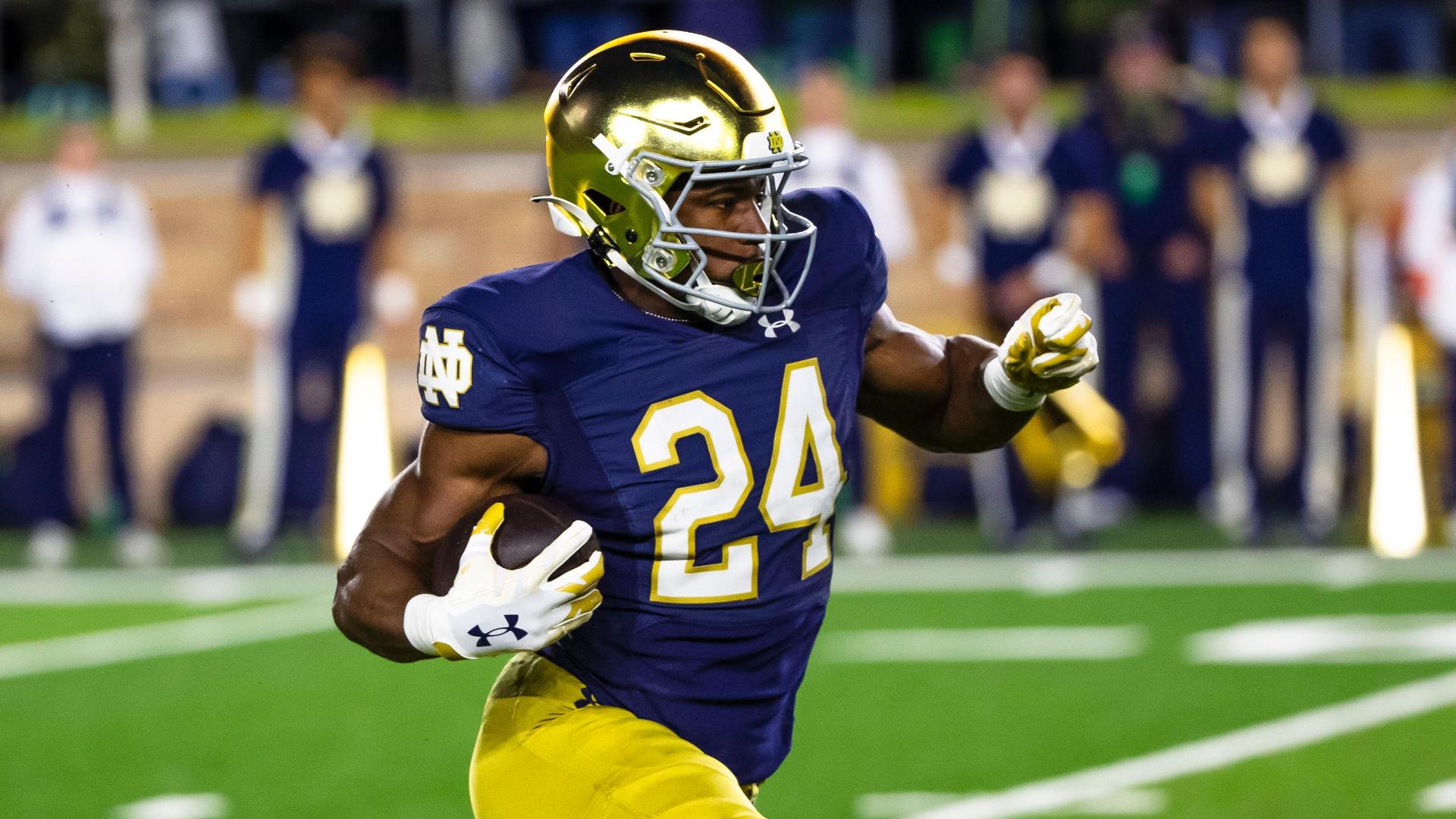
This week I went back to study Notre Dame’s Jadarian Price. This time I only watched ‘his’ tape. In the past I’d had to fast forward through Notre Dame games to get to his reps, given he was backing up Jeremiyah Love. It’s very hard to get an angle on a player working like this.

Once I had tape of his just his runs, I was able to get a much clearer picture of who he is. And who he is, for me, is one of the 20 best players in this class.

Price’s acceleration and burst hints at major NFL potential, particularly in a zone system. He consistently runs to the outside, hits the edge and then with decisiveness, explodes upfield. He absolutely loves to get outside in zone, stick his foot in the ground and get vertical. I was sat there watching these zone reps one after the other thinking — wow, he could be a star in this system.

Unlike Walker (sorry, Ken) there’s no hesitation or dancing. There’s no wasted movement. The runs to the outside are sharp, he gets to where he needs to go and then when that crease opens up, bang. He’s like lightning. When he’s running up the middle he gets downhill quickly, breaking through the opening if you give it him and that’s when the fun starts.

If he breaks to the second level he’ll be a threat to score any time. He is so fast. His acceleration leaves defenders in the dust. He’s an explosive play waiting to happen.

Despite being spelled for Love, he still managed a +20 yard run in eight games last season. He also breaks through attempted tackles to produce his big gains. He averaged 3.92 yards after contact per attempt in 2025.

Not only that, he’s a major threat as a kick returner — averaging 37.8 yards on conventional college returns last season and scoring two touchdowns.

Price is ideally sized at about 5-11 and 210lbs. That’s typically what the Seahawks have looked for. Having watched several of his interviews, his personality also feels like a big-time fit in Seattle.

I’m just saying — this is a team that has been willing to spend high picks on running backs. Ken Walker and Zach Charbonnet were recent second round picks. They spent the 27th pick on Rashaad Penny in 2018.

They might be willing to save money on Walker, to ensure they get everything else done that they need to do. Then, spend a high pick on Price — whose year-one cap-hit would be around $2.6m if they used the #32 pick on him.

Some people will hate this suggestion. They won’t be able to compute the idea of taking another running back early. I understand that — but I would just say that Price, to me, looks like the real deal. He isn’t his Notre Dame team-mate but he’s not a million miles behind. There’s a reason why he feels confident declaring for this draft having never been a starter in college.

It’s very easy to imagine him playing in outside zone and being an absolute killer. If he tests well at the combine, don’t be surprised if he starts getting buzz about being off the board before Seattle’s pick.

Why isn’t that already happening? It’s probably because he didn’t start. There are also some unknowns. He only had six catches on seven targets in the passing game. Can he do anything for you there? I suspect he can but you just don’t know. Can he pass-protect? Again, a bit of an unknown.

I’m fascinated by the idea of him in Seattle though, if they don’t retain Walker. I think he’s someone we should talk more about.

It would leave the Seahawks needing to be creative to fill other gaps on the D-line and at cornerback but you can’t just force those needs. That’s how you end up making mistakes. It’s no guarantee anyway that rookies at EDGE or corner would be ready to start.

If Terrell, McCoy, Hood and Delane are gone you aren’t likely going corner first anyway. Not unless you’re so convinced by the upside of Brandon Cisse (at the moment, I’m not — let’s see after he tests).

You might be forced to take a chance on Marlon Humphrey after he’s inevitably cut. You might need to see if you can help Montaric Brown take the next step. You might have to rely on your defensive staff, including secondary coach Karl Scott, to develop some players and find hidden gems as they did with Josh Jobe. There is depth at corner in the draft.

And as I mentioned, maybe it’s Ebiketie for Mafe at EDGE, or a choice cut from another team. If they acquire Crosby, obviously that takes care of that and removes any prospect of them using their first round pick on anyone, let alone a running back.

It’ll be interesting to see how they take on the challenges of this off-season. Things get interesting in Indianapolis next week.

Curtis Allen: John Schneider — Quarterback Maverick

This is a guest article written by Curtis Allen

Winning his second Super Bowl with a new coach and completely remade roster surely has cemented John Schneider’s place among the all-time great General Managers in the NFL.

There are several ways he has done it, but I wanted to discuss what he has done over the years at the game’s toughest position.

Schneider has guided the Seahawks through several different iterations at Quarterback.  He has left no stone unturned and been able to find success in the most unconventional of places.

It is true that not every single move he has made at Quarterback has been an absolutely smashing success.  But when you look across the landscape of the NFL, the league is scrambling to keep up with John Schneider’s thought processes.  And when they decide not to, they are often stuck with extremely thorny challenges that can inhibit their entire roster while the Seahawks take advantage of market inefficiencies.

How has Schneider done it?  In a word:  guts.

He has not been afraid to cut against the grain.  To forge an unconventional path that might not ultimately lead to success.  The moves he has made carried the potential to cost the franchise opportunity, money and draft picks.

But in doing so – and doing it extremely well – he has blazed a trail that many have tried to emulate.

Let us briefly count the ways.

The Russell Wilson Four Pack

First, the selection of Russell Wilson in the Third Round of the draft.

Schneider and Pete Carroll had been stirring the pot at the position prior to April 2012.  Matt Hasselbeck, Seneca Wallace and Charlie Whitehurst had been moved on from.  Tarvaris Jackson was with the organization and Schneider moved to sign Matt Flynn to a 3-year contract with good guaranteed money in a move reminiscent of years earlier, when Hasselbeck was brought in from the Packers to be the starter for Mike Holmgren.

The team appeared rather settled at the position.  And yet there was something about this Quarterback from Wisconsin.  He was short, but not small.  He was thickly built and had huge hands.  The arm was NFL caliber and he had a knack for leadership and clutch play.  He had transferred to Wisconsin and almost immediately took charge of the team.  His legs and his never say die attitude propelled him onto teams’ draft boards.  The Seahawks were sold and after some tense waiting to the Third Round, they pounced.

We know how that worked out.  But think for a moment how that was received in NFL circles.  Mel Kiper was incredulous and sparred with John Gruden on the broadcast about the pick.  Time and again, analysts pointed out how few sub-6-foot Quarterbacks were successful.

It was talked about as a wasted pick.  Some saw it as an attempt to get a ‘running quarterback gadget-type’ player, a guy who would occasionally sub in with a package and try to turn defenses on their ear, but with the expensive price of a Third-Round pick.

Then there was the depth argument.  The Seahawks had many other needs and here they were picking a guy who at best would be a developmental prospect behind Jackson and Flynn.

Schneider saw something completely different:  A mobile Quarterback with tremendous work ethic and leadership qualities.  A player who made use of every talent he had in his toolbox.  And someone who could complement the tough, soul-crushing defense and punishing running game they were building.

Selecting him was just the first step.  Teams select Quarterbacks beyond the first two rounds all the time.  What Schneider and Pete Carroll did next truly set them apart.

Second, the Seahawks gave the rookie Wilson the keys to the team.

Over the course of the summer, it had become clear to the team that they may really have something in Wilson.  His ‘first guy in, last guy out’ approach, his coachability and his skill in putting everything together on the field coalesced quickly.

In the preseason, Wilson looked fantastic.  The Seahawks played him in the second half of the first two games and playing with the third and fourth-string players, Wilson stood out.  He ran the offense well, made good decisions and used his legs to keep plays alive and his arm to find receivers downfield.

By the time Pete Carroll announced he would start Week Three of the preseason against the Chiefs, something was brewing.  This exciting young rookie had played well against backups.  How would he gel with the starters, playing against Kansas City’s starters?  He was masterful.

Now, here is where Schneider and the Seahawks distinguished themselves.

Do they give the job to this rookie?  Or do they take the conventional route and stick with their $26 million veteran Quarterback, who himself had sat behind a veteran for years and was deemed ready to start?  Does their commitment to Flynn overwhelm the evidence right in front of them?

No.  They choose Wilson to start and you know how it went.

Think about this in the moment.  Schneider and Carroll are on the same page.  Now they have to go upstairs and tell the owner, who has just written a very healthy check for Flynn, that they want to bench him in favor of this short, not highly-rated rookie.

Very many General Managers would have urged their Head Coach to commit to the player that was the presumptive starter – the guy whom he had scouted, drafted in Green Bay, signed as a Free Agent and paid a handsome salary to.  We see this often in the NFL.  Everybody knows the team should go with the younger, more projectible player as the starter.  And yet teams doggedly try to justify the resources they committed by playing the player who is not superior but more handsomely paid.

They made the hard but correct choice.

Wilson led the Seahawks to an 11-5 record and a Wild Card spot.  They beat Washington on their home field and then went to Atlanta and nearly upset the Falcons.

The stage was set for a franchise-altering season in 2013.

But one more thing was needed.  Which leads us to the next way that Schneider cut a new path through the NFL.

Third, the Seahawks pioneered the “rookie Quarterback” method of building a contender.

Having found their Franchise Quarterback in the most unexpected of places, the Seahawks in 2013 moved to trade Flynn to the Raiders and bring Tarvaris Jackson back to be the #2.

In doing so, the Seahawks set in motion a tactic that has dominated fan imaginations and has General Managers chasing the easiest, quickest way to contention:  Having a starting Quarterback on a rookie salary.  The game’s most expensive position being capped by a rookie salary structure is like a cheat code.  An easy way to contention if there ever was one.

For a moment, let us go back to 2010, two years before Wilson was drafted.  This was the last draft without a rookie cap.

Sam Bradford was the #1 overall pick and signed a 5-year $65 million contract with the Rams.

That is $13 million per season.  Current two-time MVP and three-time Super Bowl champion Tom Brady was at that time making less than Bradford at $12 million.  The financial burden teams with the #1 overall pick were bearing was getting out of hand.

In 2011, the rookie salary cap was implemented.

In 2012, #1 overall pick Andrew Luck signed a 4-year $22 million contract.  The rookie Quarterback salary got slashed to an average of $5.5 million per season.

Russell Wilson – drafted in the Third Round – signed a 4-year $2.99 million contract.

Bradford’s contract had $35 million in bonuses.  He had more ten times more money in his pocket before suiting up one time for practice than Wilson had in the entirely of his contract.

Schneider took advantage, striking like lightning in 2013 to sign Defensive Line depth in Cliff Avril and Michael Bennett.  The one thing this big, tough, powerful defense was missing was a fearsome pass rush.  Not having been saddled with a huge expense at the position like other teams, Schneider was able to target his cap dollars wisely to build out the rest of his team.

After winning the Super Bowl in this manner, the NFL would witness a number of teams following the Seahawks’ model:  Philadelphia (Wentz), Los Angeles (Goff), Kansas City (Mahomes) and Cincinnati (Burrow) would all field Super Bowl teams with Quarterbacks on extremely affordable rookie salaries.

While the rest of the NFL was in a hurry trying to catch up, Schneider was working on his next move.

Fourth, Schneider sold high on his Franchise Quarterback.

Unable to get Wilson to want to stay in Seattle, Schneider set about getting the best trade for the team that he could.  The return was tremendous.  Two First-Round picks, Two Seconds, Drew Lock and Shelby Harris.

He accomplished what fans dream of and General Managers fear as much as death:  Trading a hugely popular player and a Super Bowl champion for a massive, team-rebuilding haul while Wilson was still near the top of his game.

Wilson was 32 years old.  He was frustrated with the Seahawks and desired a change.  The Broncos had just signed a new Head Coach and were gearing up for a change in ownership.  They paid the price to bring in a player they hoped would lead them to a new renaissance.

Meanwhile, John Schneider was busy scouting and using those picks to restock a depleted roster that had lost its way.

It is not an exaggeration to say the Seahawks would not be lifting the Lombardi trophy last week had it not been for this trade.  Charles Cross, Boye Mafe and Devon Witherspoon (along with all the key players paid or brought in by cap space made available by trading Wilson) all were heavy contributors to the smashing success of the 2025 season.

Geno Smith:  Navigating the Post-Russell Wilson Era

Trading Wilson set the Seahawks on the search for their next Quarterback.  It put tremendous pressure on Schneider to ‘step on the gas’ to find his next great passer.

He had Drew Lock, a talented but flawed prospect.  He moved to bring Geno Smith back into the fold on an extremely modest 1-year $3.5 million contract with an additional $3.5 million in incentives.

This was a strong move for several reasons, not the least of which is it removed the element of desperation to draft a Quarterback he did not rate in the upcoming draft.  It was a weak class and despite strong media and fan pressure to take one, he resisted.

His instincts were not wrong.  No one passer from that class has emerged as a long-term starter, let alone a player you could build around.

Schneider focused on building his roster with his picks and what a class he delivered:  Cross, Mafe, Walker, Lucas, Woolen, Bryant and Young.  Schneider tapped into the depth of the draft and profoundly impacted his roster by ignoring the gravitational pull of drafting a Quarterback he did not view as worthy.

Just to illustrate the path not taken, the Pittsburgh Steelers selected Kenny Pickett #20 overall.  He lasted two seasons before being traded to the Eagles.

Look at the pool the Steelers could have selected from if they had decided to pass on Pickett:

Oof.  Talk about opportunity cost.  The next ten picks are mostly guys that scream ‘I am a Steeler’ and would have fit very nicely on their roster.

By contrast, Schneider had maximized his trove of picks and set this team on a whole new course.

Then something strange happened.  Something strange and – if we are being honest – unexpected by everyone, including Schneider.

Geno Smith had a fantastic season, delivering 30 touchdowns against 11 interceptions with a 69.8% completion rate (best in the NFL) while leading the team to a playoff appearance.  The Seahawks knew better than others that Smith was good.  But this good?

It served to emphasize another core principle in developing a successful Quarterback:  It is not just about him, but the roster.  In previous stops, Smith had never had as talented a roster as the one Schneider was building.

The league sat up and took notice.  Suddenly, needy teams were looking around the league for the ‘next Geno Smith’, a talented player who might just need a shot on the right team after some early-career struggles.

Tampa Bay for instance.  In the 2023 offseason, Tom Brady had retired and they still had a very solid roster but needed a passer.  They signed Baker Mayfield to a minuscule $4 million contract and he delivered 28 touchdowns against only 10 interceptions in leading the Buccaneers back to the playoffs.

For the Seahawks though, the next challenge was presented:  Smith was a Free Agent following that terrific season and had earned a substantial raise.  There was an issue, though:  Smith had started the season red hot, delivering a performance through ten games that garnered some league MVP talk.  He then cooled significantly, taking more sacks, throwing more interceptions and his accuracy rate dropped significantly.

Had the league ‘figured him out’ after getting a few games on tape?  Which Smith would they get in future seasons?

And would they be able to agree to a contract that reflected those concerns?

At that time, the Quarterback market had exploded.  Wilson had signed an extension with the Broncos worth $49 million per season.  Lamar Jackson and Jalen Hurts would top the $50 million barrier in April.

In one season, Smith had played as arguably well as many who were getting that level of money.  Yet the unknown of one good season against the potential of a regression presented real concerns, as did Smith’s age.  He was peaking as most NFL Quarterbacks were starting to wind down their careers.

Again, media pressure was building.  Smith had waited patiently for his opportunity for years.  He had finally gotten it and produced.  Many felt he deserved a contract commensurate with what others were getting.

Schneider needed to thread the needle.  To find a way to recognize Smith’s contributions to the team while protecting the salary cap from a significant regression.

What he came up with in negotiation with Smith and his agent was unique and successful: a 3-year, $75 million contract with only $27.3 million fully guaranteed.  He also was able to hedge against a drop in performance, by working in $30 million worth of ‘escalators.’

Smith was paid $25 million per season – the very bottom of the veteran starting QB market – but had options to increase that to $35 million per season by matching a set of statistics based on his 2022 season.

It was unusual, balanced and reasonable in the face of an insane market.  It allowed the Seahawks flexibility to continue building their roster up.

The league took notice.  Smith’s deal modeled an extension between Mayfield and the Buccaneers.  The next year, they agreed to a 3-year $100 million contract that accomplished the same things Smith’s did:  rewarding great play on a dime while balancing the risk of a regression.

The Seahawks contract with Smith was prescient.  He was not able to match his 2022 the following season and the Seahawks missed the playoffs.

At the same time, Schneider owned the #5 pick in the 2023 draft.  One with potential picks Bryce Young, C.J. Stroud, Anthony Richardson and Will Levis.  With the first three off the board at #5 and Levis still available at #20, Schneider stuck to his analysis and did not reach for Levis.  He secured two absolute cornerstone players in Devon Witherspoon and Jaxon Smith-Njigba.  Again, he was not going to let the tail wag the dog when it came to Quarterbacks.

But the market continued to rage on.  The Cowboys sent shockwaves around the league by agreeing to pay Dak Prescott a whopping $60 million per season in 2024.  Smith was earning less than half that number as a veteran starter.

Smith attempted to get the Seahawks to rework his contract in September of 2024, staging an under-the-radar holdout of sorts, feigning injury and missing practices.  Schneider and the team were in another difficult spot.

The hard truth was he had not been able to live up to the promise of his 2022 season.  Age was becoming a factor, as were locker room and team leadership concerns.  A big raise was just not a wise decision at the time.

Schneider held firm.  The organization would not renegotiate a contract with two full years remaining.  Smith felt he had buyer’s remorse and the Seahawks had achieved exactly what they wanted in the contract:  protection from a regression.

In 2024, Smith rebounded to a degree and earned $6 million in escalators.  He had one year left on his contract.  It was time to talk about an extension.

Smith was about to enter his age 35 season and felt he had earned a big raise.  Schneider and the Seahawks did not agree.

Complicating matters was a deadline:  Smith was due $16 million in non-guaranteed bonus money in March.  Options and flexibility would decrease measurably if Schneider let the contract stay as is beyond that vesting date.

If there was a trade market for Smith, the league would have every right in trying to wait the Seahawks out.  The closer they got to that bonus triggering, the lower the Seahawks’ leverage in any trade talks would get.

How would Schneider handle this?

2025:  Another Master Stroke

Schneider set about determining Smith’s market value.  He gathered intel from around the league at the Scouting Combine and worked with his front office.  They came up with a number that would work with them.  They decided that ‘that is just what you have to pay a Quarterback now’ was not a reasonable argument to spend more than what they were willing on Smith.

However, in the runup to these negotiations, Schneider had done his homework about other options at the position.  “Pivot” would become his new catchphrase.  Given Smith’s unhappiness with his contract the prior season, his age and his emotional outbursts during games, Schneider directed his team to be ready for these negotiations to be difficult.  They would need to have ready-made plans in place should Smith’s team want to play hardball in negotiations.

That proved to be very shrewd.

He made his extension offer.  And as the clocked ticked down towards the beginning of the new league year and Smith’s $16 million bonus locking in, the phone was not ringing.  Smith’s team had decided to not even try to negotiate with Schneider.  They were playing the long game, knowing that the bonus coming was a deadline of sorts and felt that Schneider would be the first to blink.

The Raiders called.  Their new Head Coach was Smith’s biggest advocate by far and they needed a Quarterback.  And so, a deal was struck:  The Seahawks would send the 35-year-old Smith with his contract as is to Las Vegas in return for a Third-Round pick.  The Seahawks would gain $31 million in salary cap room and a solid draft pick, but now needed to replace Smith.

You know how all this worked out.  Sam Darnold, Super Bowl.

But consider again Schneider’s actions in the moment.  He was not willing to trade the comfort and continuity of keeping a Quarterback that wanted more pay than what he was willing to give.  He drew his line in the sand and refused to cross it.

Taking a stand like this usually comes with a cost.  A big one.  You just accept a sunk cost and move on.

Consider an alternate universe where the Raiders never called.  Smith had gone silent in negotiations and the clock was ticking.

An argument could be made that Seattle would have still signed Darnold and then put Smith on the trading block for whatever they could get.  And failing that, would have simply cut Smith before the bonus vested and saved $31 million in cap space.  It would accomplish the same thing that actually happened, just without the draft pick in return.

Yet Schneider was able to talk the Raiders into eating that entire $16 million bonus that was due in a few days and give Seattle a pick for the privilege.

He then moved quickly to secure Sam Darnold – again, at a price at the very bottom of the veteran starting Quarterback market – and was able to build a team around him with the prodigious amount of cap saved by trading Smith.

The response to this series of moves was mixed at best.  Analysts panned the move, unable to grasp that John Schneider had – just three seasons prior – scored a major victory by reclaiming an undervalued Quarterback asset and got a huge return for pennies on the dollar.

Many fans were also upset.  Geno Smith – a natural successor to the ‘we all we got/we all we need’ underdog mentality of the Legion of Boom players – was just as much a local folk hero as he was a football player.  His contrary nature and prodigious talent struck a deep chord with fans and moving on from him felt like a betrayal of that thought process.

Meanwhile, the league was surprisingly lukewarm on Sam Darnold.  After a brilliant season that ended with great difficulty, the Vikings unsurprisingly did not Franchise Tag him, but they did apparently offer him a healthy contract.

The Raiders decided not to pursue him and instead focused their efforts on trading for Matthew Stafford and then Geno Smith.  Other teams were rumored but none staked a claim and most shrugged when news of a contract with Seattle broke.

Teams were not lining up to pay Darnold unreal money as many thought they would.  The Vikings liked him, but were trying to sign him while keeping the door open for J.J. McCarthy to earn the starting job.

The specter of the way his season ended drove his value down – and right into the Seahawks’ waiting arms.  Darnold had familiarity with Klint Kubiak’s system and desired a job unburdened from looking over his shoulder.

Schneider had found a better fit for his team ethos, a supremely talented younger player he could potentially work with for two or three contracts and at a price still at the very bottom of the market.  That is the Triple Crown of positives General Managers need to be successful.

And now, his latest Quarterback discovery sits at the bottom of the pay scale for veteran players, having accomplished more than nearly everyone above him.

Sam Darnold sits in a class of Quarterback not unlike Jared Goff, Brock Purdy, Jalen Hurts and Jordan Love:  players who are not otherworldly talented and can singlehandedly deliver a win every single week.  Rather, they are players who are the ‘final piece of the puzzle’, ones who tie the team together and make the offense run smoothly, while occasionally taking a game over in the clutch.

Only, he is making about 60% of what those players are making, freeing his team to keep adding more talent.

So, while teams like the Dolphins, Cardinals, Cowboys, Browns and even the Raiders scramble to manage passers their cap and roster with massively overpriced QB contracts, Schneider sits, with a second Lombardi trophy on his desk and three Quarterbacks he likes on his roster.  A fine testament to the work he has done in the last 16 years.

What Does the Future Hold?

Due to his acumen, Schneider has a multitude of options.

Starting at the back end of the roster, the Seahawks have a project in Jalen Milroe.  After a handful of disappointing package plays early on, the team essentially benched him and made him the Emergency Quarterback most weeks.  We do not know how Milroe has developed during the season.

But Schneider does.  Has the coaching staff been able to take his tremendous talent and personality and mold him into a player?  Might it take a couple of seasons to mold him into a starter?

It is possible.  It is also possible that the team may have taken a shot with the ‘bonus pick’ they got from the Geno Smith trade and in the next season or two, could be ready to move on.

Backup Drew Lock returns on the roster with an eminently flexible contract:  He is owed $2.25 million in non-guaranteed salary for 2026.

And Darnold.  How will he and his agent react to winning the Super Bowl?  Time will tell.  It is possible there are conversations happening right now on a reworking.  His cap hit stands at a reasonable $37.9 million for 2026, with much potential to restructure it to push some cap hit into the future should Schneider deem it necessary (perhaps to talk trade with the Raiders once more?).

The search for undervalued assets will not stop simply because the team is the reigning champions.  Schneider’s job will enter that next phase, just as it did with Geno Smith and Russell Wilson.  Chasing edges.  Finding value and exploiting his fellow General Managers’ flawed decision-making about the position.

Perhaps this year, it will be working with Darnold on his contract.  Or promoting Milroe to the backup job.  Or finding another prospect in the draft pool he can work with.

It could even be exploring the marketplace for a young veteran player like Richardson or Levis – a talented guy who has gotten off track and needs a breath of fresh air.

All options are on the table.

And given John Schneider’s track record, we should let him work and anticipate the fruits of his labor as he takes this team into another bright, starry future.
Players to know ahead of the 2026 NFL Draft (part three)

If you missed the first two parts of the series, check them out below:

Part One — Players I rate for the Seahawks

Part Two — Players I think are a bit overrated

Before getting into part three, a couple of quick notes on topical Seahawks subjects…

— I’m seeing a lot of talk about what positions the Seahawks should draft. Let’s remember, drafting for pure need is how you make mistakes.

This team will inevitably have some holes to fill this off-season. The aim should not be to rely on the draft to fill those holes. Drafting the best players, the most talented players, is critical. There are certain positions where you’d be indulging too much to draft another (eg tight end) but typically you will have three or four similarly graded players and you won’t be stacking too much in one area.

The key is to try and retain as many of your players as you can, first and foremost. You have the cap space to get this done. Then you hedge your need positions so that you are not forcing things on draft day.

There’s also a very real possibility of filling needs with quality, not settling in the draft, by executing trades.

That has to be the plan. Not assuming they take an EDGE or cornerback because that’s where we expect they will lose players in free agency.

In Daniel Jeremiah’s latest mock draft, he had Kayden McDonald and Caleb Banks both available at #32. I doubt that happens but if it did, it would be absolutely criminal not to draft one of them.

— The Seahawks are now up for sale, officially. This has been inevitable and was only a matter of time, per the terms of Paul Allen’s wishes for the two teams he owned (the other being the Trailblazers).

People are going to talk about who they do or don’t want. For me it’s simple. Someone who is not inclined to interfere but will hold key people accountable. Someone who is interested, engaged and invested in what is happening on and off the field. Someone who understands he is inheriting a GM and Head Coach combo that need backing and trust. Someone who is aware of staying ahead of the game and, to coin one of Macdonald’s phrases, ‘chasing edges’ in any way for the product on the field to succeed. Someone with the ambition and drive to become a franchise that continues to compete for and win future Super Bowls.

Also, ideally, it is someone who understands and respects the traditions of this franchise and the worldwide fanbase. You don’t need to reinvent the wheel, just be conscious of what you’re buying.

If you can address all of these things, I really don’t care who the name is.

Now onto today’s scouting notes…

Blake Miller (RT, Clemson)

I only properly sat down to watch Miller in the last few days, with only tentative initial notes previously. I was very surprised by what I saw upon further study.

I don’t think I’ve seen a better tackle on the pull in terms of sharp, quick movements. Yet Miller’s calling card is an ability to then cut upwards through the line, working through traffic, to target second level defenders.

I’ve seen plenty of linemen who can get up to the second level or pull into space and execute blocks on the move. I don’t think I’ve ever seen a lineman get on the run then navigate through through the bodies like a running back, showing excellent vision and decisiveness, to get up to a linebacker or safety to execute a second level block.

Reportedly he runs a 5.18 (I expected better) at 6-6 and 315lbs. He gave up 14 pressures in 2025 which was the lowest number among college tackles in 2025 playing at least 80% of the snaps. He gave up two sacks.

In terms of other positives, there are reps where his footwork enables him to efficiently get into position to wall off the edge rush. Often by simply getting to ‘point A’ before the defender, he puts the blockade up and it’s job done. His ability to get to ‘point A’ so quickly and with no wasted motion, is a critical feature in his college tape.

He’s capable of clubbing defenders to the ground and he’s a very willing finisher of blocks. He can be a punishing blocker at the second level — playing with a nasty, violent edge. He will rub opponents the wrong way. Miller has also shown the ability to drive defenders right off the screen to finish his blocks.

His recovery athleticism when he doesn’t make great initial contact is superb and I would also describe it as rare. There are not many players who can recover like he does when he struggles early in the down.

His kick-slide can be ‘wow’ good at times too. It often looks highly explosive and sudden. His feet also pepper backwards nicely.

I’m very confident he is going to be a first round pick and with good testing, could go earlier than people think.

There are some issues to note too. I’m concerned that at times he’s too easily pushed backwards. He needs to stop letting pass rushers get into his chest. Too often he mirrors brilliantly but doesn’t use his hands to control blocks. Initiate contact and take charge of the situation. What are you waiting for?

His feet can sometimes get away from him and his body gets into awkward positions forcing him to use his good recovery skills. He clings onto and grabs the outside shoulder too often, meaning he could be a holding liability in the NFL.

His combo blocks are decent, not great. His hand placement needs major work — too often it’s outside the frame. He catches too many blocks rather than instigating contact. There are also reps where he allows defenders to bend and straighten from his side too easily.

These are all technical fixes though that a good O-line coach should want to work on. The raw tools are there to develop Miller into a top pro with the right guidance.

De’Zhaun Stribling (WR, Ole Miss)

This was a really pleasant surprise. I like Stribling — and his Ole Miss team mate Harrison Wallace — more than a lot of the bigger names in this class (with the obvious exception of top players like Makai Lemon and Carnell Tate). Apologies to the Cougs out there, Stribling is really good.

He only had one drop in 2025 and nine total drops in a five-year college career. Some players have that many drops in a season. That’s nine drops in 345 career targets, by the way.

He’s listed at 6-2 and approximately 210lbs. He settles into intermediate pockets nicely, knowing when to ramp down the speed. If you give him a cushion he’s good at selling the deep route and coming back to the quarterback to present an open target.

His release can be really sharp — especially when he has space to run around a defender from an inside position. When he can’t separate he’s shown he can make contested 1v1 catches including some that are high difficulty.

Stribling looks the part with his frame and movement/actions. If you give him a shot, he can make things happen. He turns upfield quickly when presenting his hands and eyes back to the QB. He has a stutter step move off the snap that is well executed.

He shows good concentration skills on challenging/contested passes and his tracking seems decent. His big frame can box off opponents on quick hitting routes and slants. He could be a real asset on slants and in-cutting routes on critical downs.

He catches the ball away from his body and as noted by his lack of drops, he shows good hands. He was predominantly used as an outside threat (326 snaps out wide vs 71 in the slot).

He also had a 76.6 grade for run blocking — the third best mark behind Nyziah Hunter & Denzel Boston. This is a big bonus.

There’s no doubt in my eyes Stribling can play in the NFL, we just need to see what his upside is when he tests. I would draft this guy.

Emmanuel Pregnon (G, Oregon)

He’s built like a machine. There are interviews where he’s in a low-cut vest and his arms look like a pair of anacondas connected to the front end of a tank. You’d think he was sculpted out of a boulder.

This translates to good power on contact. He can bully opponents straight up.

He has a big thick base that enables him to plant the anchor and let his upper body do the talking, which it often does. He works his hands inside quickly to control defenders. He instigates contact and wants to be the enforcer — he’s not passive in his blocks.

When he locks on he tends to finish. His footwork is nimble enough in pass-pro when he has to drop to set.

His massive 6-5, 318lbs frame is hard to get around. He’s a larger man than his weight suggests — and it’s mostly muscle.

He’s not Grey Zabel on the run, or Blake Miller, but for his frame he can move well. He had PFF’s second best zone-blocking grade for guards in 2025 (93.0). I’m not convinced he warrants ‘that’ high a grade for zone blocking. It’s very good on tape but they’re basically saying he’s elite. I’m not sure he moves well enough to justify that.

He’s no slouch but for a pure outside zone scheme you probably want greater mobility. He’s somewhere between Zabel and Anthony Bradford for mobility I’d say (remember — Bradford tested well).

Pregnon played left guard for Oregon (840 snaps) but filled in at right guard vs Minnesota (55 snaps). He also had a season at right guard at Wyoming.

I do wonder how he’ll fair against top-end quickness attacking his outside shoulder but it would only mean he’s not the perfect guard (and who is?).

He gave up one sack all season (vs Texas Tech) and only five pressures. Those five pressures meant he had the sixth fewest among guards in college who played 50% of snaps in 2025.

It’s very easy to imagine him starting quickly and being at least a decent starter. This is the definition of a low risk pick.

The hands, base, power are really good and he will generate movement in the running game. He’s strictly a guard so he might find his range limited on draft day but you’re unlikely to be cursing the decision to take him. It’s just a case of how badly do you need a guard?

Zabel jumped a 36.5 inch vertical and a 9-3 broad. He was explosive and fast. Most players can’t match that level of athleticism. Pregnon’s ability to shine in testing will likely determine how early he goes.

EDIT — Those questions were firmly answered at his combine and pro-day. Pregnon jumped a 35 inch vertical and a 9-3 broad. By adding 32 reps on the bench press he secured a 3.40 TEF score — one of the highest scores we’ve recorded since we started measuring a decade ago. It puts him in elite company as a tester and many of his testing peers became top-level NFL starters.

On top of this, his combine on-field performance was also really good. His mirror drill was excellent, showing great lateral mobility. He moved very freely on the pulls drills and his kick-slide was strong.

When you consider his physical profile, grading and experience — he is ready made to come in and start quickly. This is what a first round guard looks like.

Jeremiyah Love (RB, Notre Dame)

I wanted to talk about Love today simply because he’s one of the very best running back prospects I’ve seen since starting the blog in 2008. I would be totally fine with any team opting to take him in the top-five. This isn’t a good draft but Love is an exceptional talent within this mediocre class.

His change of direction skills are highly dynamic, leading to ankle-breaking cuts. He has long legs but a thick rear —- creating longer strides within an explosive frame.

He’s highly creative to avoid tackles and does a bit of everything to create extra yardage. He has a patented spin-move that he breaks out right on contact to avoid being tackled.

He has the top-end speed to accelerate away from defenders and be a home-run hitter. He has a lot of massive, big-time runs. His 39 +10 yard runs were fourth most in 2025 and his 726 breakaway yards were second most. He also had 896 yards after contact —- sixth most in college football and I believe most among draft eligible players.

Love only had one fumble in his three-year career at Notre Dame. He also had only four dropped passes on 74 targets — not bad for a running back.

He’s so quick to work through traffic with no hesitation to take what’s on offer. When he’s stopped in the backfield he frequently finds a way to get out of trouble. His vision is top notch to identify and find holes in the defense. He punishes opponents if you give him a crease.

Love shows soft hands and he’s a very capable route runner. I think he can be great in the passing game and there’s more to come from him there.

He has really good size (6-0, 214lbs) and he frequently falls forward on contact. His contact balance pairs beautifully with his speed.

We’re talking about a highly impressive, uber-talented prospect.

Avieon Terrell (CB, Clemson)

I’m surprised he doesn’t get more attention. I think there’s every chance he emulates his brother in the NFL and has a successful career.

Let’s start with the unexpected. He plays the run a lot better than you’d think for his size (5-11, 180lbs). He genuinely has a top run defense grade of 85.2. He’s also a good tackler. He missed only five tackles in 2025 (10.4%) and three came in one game against Louisville.

He competes and shows a legit ‘want-to’ on the field. The attitude matches up to the talent. For the Seahawks, who run a lot of zone coverage, he managed a 74.9 grade. That’s sandwiched between Mansoor Delane’s 76.7 and Chandler Rivers’ 74.5.

If you want to see Terrell at his best, don’t watch that Louisville game. He also gave up a big 48-yarder. Generally though his tape is very good.

He’s sticky downfield and seems to have recovery ability. He’s used in a variety of ways but predominately stayed outside (464 snaps at outside corner, 110 in the slot, 67 in the box, two at free safety).

Terrell always seems to be in the hip-pocket in coverage. He has a very natural feel for the position, which isn’t a surprise given his NFL bloodlines. He’s very comfortable in zone, triggering to the throw while showing great closing speed. He just looks like he can seamlessly play at the next level.

He was used as a blitzer with some success (had three sacks in 2025). He reads play well, can work through traffic and he’s capable of planting a hit on an opponent even at his size.

He will come off his man to make instinctive plays in coverage successfully. He times his contact well when in close coverage to avoid being penalised (flagged only twice in 2025).

There’s plenty of evidence of him running routes for receivers. He can cover large areas of the field and you can see him taking one half of the field away in unsupported 1v1 coverage from a snap taken at the opposite hash.

Terrell is a very talented, competitive cornerback with natural ability. He should go in the first round in this draft.

KC Concepcion (WR, Texas A&M)

He’s crafty, quick, intelligent and has good size for his playing style (5-11, 190lbs).

The caveat is his hands. He has 19 drops in three seasons (294 targets). When he does complete catches he does it with his hands not his body. He does present his hands to the ball. There’s no getting away from it though, too many passes hit the ground.

He’s not a 4.2/4.3 runner who stretches the field — I think he’s more of a 4.45 type in terms of speed.

He knows how to settle into gaps in zone to present easy targets for the quarterback. He’s quick enough to get open on slants and quick-hitters. This is useful on key downs and in the red zone where he has success.

You can’t give him a free release over the middle. If you don’t disrupt his route more often than not he’ll take you to the cleaners. He sells a stop-start brilliantly.

Concepcion is quick to stretch the field and he’s particularly dynamic running across the middle. He reacts to the ball well and is capable of making plays in traffic. He has plus YAC ability and can line up anywhere and be a threat.

He’s dangerous on jet sweeps and receiver screens. He’s so good at getting open quickly in his route. He can also hang in the air and contort his body to make difficult catches.

There are plenty of things to like but his true testing speed will be interesting and the drops will need to be considered.

Brenen Thompson (WR, Mississippi State)

Draft media’s latest favourite but I think a bit of perspective is needed, even if there are things to like.

Thompson is a smaller receiver listed at 5-9 and 170lbs. He has more than enough speed to run right by defenders. I do not think he is going to break the combine record, though, as Daniel Jeremiah has suggested he might.

He had an even distribution of deep (26), medium (29) and short (30) targets in 2025. His completion percentage was 72.4% on 10-19 yard passes (42.3% +20 yards) and five of his touchdowns were +20 yard throws downfield.

Thompson had five drops in 2025.

He reaches his top speed quickly when he sets off running. If you don’t jam him at the line he’ll just run by you. He beat defenders deep even when they gave up a big cushion. He chews up off-coverage to make the defender guess on whether he rounds off or goes deep. He also did this against Florida and Georgia (good opponents).

That said, it’s bizarre how teams defended him. Had they not watched the tape? It felt like every game was a ‘what are you doing?’ moment. They’d just let him run with no attempt to disrupt. They made his life easy.

He adjusts to the ball well — his tracking appears to be good. He’s not going to win many contested catches at his size though. Will the speed be enough to challenge the physical elements of the NFL game? I’m not convinced. He is going to need to get open because there’s almost no catching radius here. Is he really quick enough to constantly get open at the next level to be a threat?

He can provide a good speed option as a complement but I would say he’s unlikely to be a WR1 or WR2.

Isaiah World (T, Oregon)

He had an embarrassing performance against Texas Tech in the playoffs. Highlighting how it was absolutely staggering that some members of the draft media ever thought he was a first round possibility.

It’s been revealed in the last 24 hours he tore an ACL against Indiana in the Peach Bowl. We won’t see him tested and there’s a chance he now goes undrafted.

He’s listed at 6-8 and 318lbs. He has heavy feet and his movements are laboured. When attacked to the outside he resorts to being a big-time waist-bender. He’s too passive with his blocks and isn’t a tone-setter.

On a 4th and 1 vs Indiana he basically ducked into contact. They didn’t convert for a first down. He doesn’t hit his targets often enough when trying to block in space. I don’t like his angles at all defending the edge. He’s not violent enough on tape and needs to be more of a finisher.

World will struggle with pad-level due to his height. He gave up one sack and 18 pressures in 2025. He was a flag machine — penalised 40 times in four seasons (for Oregon & Nevada).

He’s not good in pass-pro and even worse vs the run. His zone-blocking grade was an awful 55.5 in 2025.

For me he’s just a player I am very happy to let someone else draft or sign. At best he is a swing tackle and even then I need to see good testing to believe in his upside.

Jaishawn Barham (EDGE, Michigan)

He converted to the EDGE in 2025 from linebacker and had 304 snaps on the D-line, 56 in the box and 15 at slot corner.

The switch didn’t lead to immediate pressure production — he had three sacks and 21 pressures in 2025. His win percentage was a weak 13.1%. He also missed seven tackles (17.1%). He definitely needs to learn to wrap-up with his tackling.

He is an excellent run defender though with a 90.4 grade — top among EDGE rushers in this draft. You can see why. He’s listed at 6-3 and 243lbs. He plays with legit violence and aggression on some snaps (to the point he can go too far — he was flagged six times in 2025 and avoided a weird incident where he appeared to clash with a referee).

His technique is unrefined but he has shown the needed characteristics to be a good rusher — speed, bend, aggression. Although he seemed to be unblocked or badly blocked a lot in 2025. Tight ends are no match for his quickness when they’re asked to block him.

He’s a very capable OLB type in a 3-4 — he can drop and excels when he rushes in space. He can easily fill-in at off-the-ball linebacker when needed. He gets off the line with genuine quickness and can shock linemen with his burst.

His hand-technique when taking on blocks needs work and there’s very little evidence of speed-to-power moves — he wants to work in space. Barham’s closing speed as a tackler is great.

The worst case scenario you’re going to get with him is a good run-defending OLB who doesn’t really offer much in terms of pressure and wins. The best case is he works out his rush technique and becomes a dynamic threat on the outside. It will be interesting to see how teams judge his ability to do that with their projections.

I like him. There’s something here. Yet until he tests you’re talking about unanswered questions on upside within a project player with positional flexibility. For now, that has to cap his stock somewhat. But he brings a tone to the field that fits the Seahawks.

I will keep posting these reviews and will soon create a tab where you can click on a player’s name and it’ll take you to the article where they are discussed.

Report: Seahawks won’t use franchise tag on Ken Walker

It didn’t take long.

Seemingly minutes after Adam Schefter tweeted out a list of franchise tag candidates, including Ken Walker, he followed up with this:

It’s unlikely the Seahawks will use their franchise tag on running back and Super Bowl MVP Kenneth Walker, per league sources. The Seahawks have multiple free agents they want to retain and sign. They also will try to extend WR Jaxon Smith-Njigba. There are enough Super-Bowl tax costs that now make using a franchise tag this off-season unlikely.

Clearly a certain someone noticed Schefter’s tweet and wanted it to be known the Seahawks wouldn’t be using the tag. He got a call and now we know the situation.

It’s not a surprise. At an estimated $14.5m it would’ve been an expensive one-year arrangement. It also would’ve set the bar for any discussions over a longer-term deal. The Seahawks were never going to pay Walker $14.5m a year minimum.

They’re letting his camp know what the situation is with this report. Now it’s going to be a waiting game until the combine as all parties work to find out his actual market value. Having multiple runners reach free agency (Breece Hall, Travis Etienne) might help the Seahawks.

This is a useful exercise anyway. Letting Walker’s representatives find out his actual market makes sense before working out a potential deal to stay.

If there’s a team out there willing to pay huge money they’re probably going to be looking for a new running back. If it’s a more modest arrangement, there’s every chance he’ll be back.

This feels like it could go either way.

The other interesting thing in Schefter’s follow-up is the note on having multiple free agents they want to re-sign, plus a JSN extension.

We already know they have a few key players reaching the end of their contracts. This might be a hint that they’ll prioritise others first, such as Rashid Shaheed. Or that they at least need to be able to go into those negotiations without Walker having a locked-in $14.5m for 2026 on the books.

The note on Smith-Njigba caught my eye because there’s no mention of Devon Witherspoon, who they likely also want to extend this year. My hunch on this is they want to get JSN done quickly, given the state of the receiver market and how expensive it is. They might not want to wait to see, for example, how much Alex Pierce gets on the open market. They also might want to get in before the Rams extend Puka Nacua — because whoever is paid second between Smith-Njigba and Nacua is probably getting a little bit more.

There’s not as much pressure on the cornerback market and it’s theoretically something they could do nearer to training camp with Witherspoon.

Either way, we can see the challenges ahead for the defending Super Bowl Champions. There’s work to do here. They very efficiently dealt with the offensive coordinator search. Keeping the roster together is their next mission as teams prepare to head to Indianapolis next week.

One other final note. Ian Rapoport today backed up Adam Schefter’s suggestion that we could see a lot of trades when the new league year opens. I remain convinced the Seahawks are going to dig around the trade market.

Look at how they haven’t just settled for an in-house hire for their new offensive coordinator. They will want to find ways to get better this year, not stand still. It is going to be very difficult to get value out of this draft class.

Maxx Crosby won’t be the only player they inevitably check-in on at the combine. In relation to the Ken Walker discussion, keep an eye on De’Von Achane. He’s only 24. He is one of the NFL’s best runners and a brilliant fit for a zone-blocking team. They won’t have to pay him until next year.

The Dolphins appear to be wiping the slate clean and starting again based on their moves this week. I’d be surprised if they wouldn’t have a cup of coffee to discuss their options on the trade market. Could the Seahawks show some interest in Achane? I wouldn’t bet against it.

Brian Fleury will be the Seahawks’ new offensive coordinator

Per Adam Schefter, the Seahawks are set to hire Brian Fleury as their next offensive coordinator, replacing Klint Kubiak.

There had been some expectation that Mike Macdonald would hire internally. He hinted at that when he spoke to Brock & Salk after the Super Bowl and respected reporters like Brady Henderson also suggested this would be likely.

So what changed?

Firstly, let’s consider the possibility that Fleury just blew them away during interviews. I didn’t really understand the many suggestions online that their meeting was a fact-finding mission. It’s hardly like Fleury was going to rock up, spill all the secrets from Santa Clara, then get the plane back to his old job.

Teams don’t operate this way. Besides, the Seahawks had ample intel on Kyle Shanahan’s way of doing things from Kubiak. There’s no real secrets in the NFL anyway.

The Fleury interview was always going to be a serious opportunity for him to impress. It appears that’s what he has done.

It could also be that the internal candidates didn’t stand out during interviews as much as perhaps the Seahawks expected. I’m less inclined to feel that way though. Macdonald doesn’t need to interview these guys. He’s worked with them for at least a calendar year (two years in the case of Jake Peetz and Mack Brown). The fact he spoke so confidently about their internal options to me suggests Fleury nailed his opportunity and won the job.

That shouldn’t surprise anyone. Fleury is highly respected by the 49ers and has long been touted for an offensive coordinator role.

Two years ago, Peter King listed him among a collection of ‘next-gen’ candidates — which funnily enough also included Kubiak, Peetz and Justin Outten:

Brian Fleury, 43, tight ends coach, San Francisco. Unknown outside the Niners, valued highly inside the building as the run-game authority trusted by Kyle Shanahan. You get points with Shanahan for knowing the complete game, and Fleury has been a linebackers coach, director of football research, quality control coach and assistant position coach in his NFL years. Shanahan will not want to lose him.

It perhaps speaks to the Seahawks having their finger on the pulse of upcoming coaching talent that within King’s 2024 list they now employ three people, having just won a Super Bowl with another as their offensive leader.

Fleury’s reputation with the 49ers should be noted. Shanahan might’ve had a dry spell in 2024 when he tried to replace his defensive staff but he’s otherwise done a good job identifying coaching talent. Robert Saleh, Mike McDaniel and DeMeco Ryans are good examples, not to mention Kubiak.

San Fran’s tight ends and running game have prospered with Fleury’s guidance. I’ve listened to interviews he’s done and he seems well tuned to the importance of good communication, clarity and being on the same page.

Fleury will also have an existing relationship with quarterback Sam Darnold after their time together in Santa Clara. He’s been with the 49ers since 2019 which means he also spent two years on the same staff as John Benton, which could be helpful.

The big question is whether he’ll be able to call plays and essentially be the Head Coach of Seattle’s offense. That’s a huge unknown and will make or break whether this is a success. The Seahawks might lean heavily on their running game moving forward, given that’s Fleury’s level of expertise.

He was made run-game co-ordinator last season. Despite a cluster of injuries, San Francisco finished 8th in EPA per run.

That was going to be the big question with Peetz, Outten, Janocko or Brown too. There was no obvious, experienced, home-run to be hit here. The Seahawks were going to have to take a chance.

The Eagles hired internally for their offensive coordinator a year ago and it didn’t work out. They made the same error with their defensive coordinator after losing the Super Bowl after the 2022 season. I don’t blame the Seahawks at all for looking externally.

Fleury will know the Shanahan system very well. He can continue the work previously undertaken by Kubiak. If it doesn’t work out, so be it. They’ll just have to go back to the drawing board.

Macdonald has earned a trust factor here and his three coaching appointments in the last few days — Fleury as OC, Zach Orr to coach linebackers and Daniel Stern to help the passing game and analytics — all look impressive on paper.

This is a very intriguing hire. That’ll be even more true if they can keep together most of the existing staff, minus Janocko who is set to re-join Kubiak with the Raiders.

Players to know ahead of the 2026 NFL Draft (part two)

In part two of this series, I’m going to look at players I’m not as high on as draft media appears to be. For part one, click here.

Monroe Freeling (T, Georgia)

He’s a pure pass-pro tackle and not a great run blocker. His height (6-7) means he struggles with leverage and he has a high centre of gravity. He gets beat through the chest because he can’t sink and anchor well enough. He is not strong enough right now — he is a finesse player.

Freeling can also get out over his toes when he gets on the move — lunging at blocks. He has a very upright blocking style.

However, he has enough athleticism to seal off the edge with his footwork. His foot-speed on the kick step is a positive. He showed he can contain Colin Simmons with his kick-step and peppering hands. That’s no small achievement.

He’s a bit of a waist bender which does see him overextend sometimes. He lunges at EDGE defenders with his arms extended too much — making him easy to counter off.

I’m worried about his blocking technique when he extends his arms — he has no balance and it hinders his base. His technique with his hand-use is better when blocking square-on

Just to look at him, he has a good offensive tackle frame and seems to have length. He needs technique work across the board and has a lot to clean up — but the body is there as is the athleticism. His combine testing showed he’s very explosive and teams pay attention to that.

He needs to get stronger though and find an edge. He isn’t going to be able to start quickly and handle grown-man edge rushers. There’s not a nasty side to his game and he’s unlikely to set a tone up front.

I can see why a team could take him early for his pass-pro ability but he’s not a complete blocker. He’s a project with upside but there’s a lot of work needed. I can understand why he’s being mocked in round one based on upside but for me, I just want a bit more of an edge if I’m taking a project. I would not be comfortable taking him in the top-10 like some of these mocks are saying.

David Bailey (EDGE, Texas Tech)

He doesn’t have typical size or length for an EDGE rusher. He looks smaller and squatter than would be typically ideal. I’d also say his frame looks pretty maxed out — there’s no room to gain more weight here. He just doesn’t scream ‘elite NFL rusher’ to look at.

Bailey combines multiple moves to get away from chips/blocks. He is clearly productive but in unconventional ways. He drives wide of the tackle before engaging, rather than trying to bend/straighten. He takes very wide angles to run around tackles and I’m not sure at the next level this will work.

He never wins with pure get-off and then just bend and explosion to the quarterback. He can dip under attempted blocks nicely and tackles need to engage him or he will slip them.

He bullied Oregon’s Isaiah World at times but I’m tempted to say who doesn’t?

Bailey uses a spin-move as an effective counter to escape blockers. He can push back tackles when he gets into their chest and gains pad level. You also see him be controlled and dumped when tackles get into his frame.

His run defense grade was good (81.5) in 2025 but I wonder about his anchor power and ability to transfer this to the next level. Only Rueben Bain had more pressures than Bailey’s 81.

I kind of get the feeling this could go either way for him. What is his testing performance to reveal his upside? It’s easier to live with the way he plays/wins if there’s massive physical upside here. If he isn’t a great tester — is he just a very solid, very productive college rusher?

A challenging evaluation — I’m worried he might be average at the next level. I’m not sure why he’s being talked about like a top-five lock. Draft media loved Dallas Turner and I never saw what the fuss was about. I’m getting a similar vibe here, even though they are different types of player.

Rueben Bain Jr (DE, Miami)

He has short-arms (30-31 inches) at 270lbs on a stocky 6-2/6-3 frame. This is not ideal. First and foremost you have to ask — how many players in the league succeed looking like this? Is Bain so unique that he’s an outlier? Or do we need to embrace the reality of what he is?

It’s very difficult to place him in a NFL context and it’s why there’s talk of day two grades and needing to play inside/out. He reminds me of AJ Epenesa, Boogie Basham and Myles Murphy — all players heaped with praise in draft media but didn’t have the physical profile to succeed at a high level in the NFL.

He struggles to get off certain blocks due to his lack of length and can’t hold off blockers or rip through. His game is based on power. When he squares up against tackles and it’s a battle of power — he can be the bully and he looks physically impressive. He has forceful hands and can really control blockers. There’s tape where he delivers a crushing blow to the chest to jolt tackles off balance. He can work off this and has enough agility to capitalise.

Bain doesn’t show much in the way of a counter when his initial plan fails. He’s also not a hair-on-fire stomper to the sideline to chase down ball-carriers.

He does show occasional bend for his size but is he twitchy? Not really. He is not a sudden player with amazing get-off or chase-down speed. I wouldn’t expect great testing numbers. Yet he did have big games in big moments (eg Ohio State). He tended to jump off the screen in some games and be fairly anonymous in others.

I fear he’s going to be the next ‘great in college, not great in the NFL’ type. Again — when you look at his body, do you see a brilliant NFL rusher? I don’t. I see a player who is going to struggle to find a permanent position.

Zion Young (DE, Missouri)

I think Young is a challenging evaluation. There are a lot of positives in terms of his power and maniacal playing style. Yet there are physical limitations and things that need checking out too.

For starters, he was recently arrested on suspicion of DWI and speeding. His coach at Missouri said it was disappointing given he was a team captain. That’s stupid enough at the best of times but to do it weeks before the NFL draft process begins? Come on.

Secondly, he has a quirky personality. Listening to his interviews, he might not be for everyone. I can’t tell how he’d be received. Is he too much, or is he going to fire everyone up?

Finally, his speed. He was only the 21st fastest defensive lineman at the Senior Bowl, running 15.04mph. That was slower than defensive tackles Darrell Jackson and Rayshayn Benny, plus five-tech LT Overton. It doesn’t bode well for a particularly dynamic 10-yard split.

Yet on tape, including in Mobile, the more I watched of him the more explosive he appeared to be. He just looks like he can play in the NFL. He’s very disruptive with a motor that keeps churning.

He’s not going to win consistently with a bend/straighten and he’s more power based. He’s not twitchy and fast bending the arc but he has shown sharpness stunting inside. His inside counter can be deadly. He plays with a ‘bull in a china shop’ approach to rushing the passer.

He stalks quarterbacks like a predator when he gets a free run to them. Nobody can deny he plays like he loves the game. He will run through your chest if you give him a chance.

I’d like to see him work inside and attack the outside shoulder of the guard. Tight ends will not be able to match-up to him in the running game. His run defense grade was a very good 86.6 in 2025. He’s most effective creating pressure when he tries to run through, not around, blockers.

I’m not sure he’s going to test well enough to justify all the first round placings in mock drafts. There’s something here — but his upside is to be determined and you’ll need to check out what happened with that DWI.

Cashius Howell (EDGE, Texas A&M)

Let’s start with the positive. He could be a quicker Yannick Ngakoue. If that proves true, great. Ngakoue had 70.5 NFL sacks.

However, that’s a best case scenario. And even then, Ngakoue bounced around eight different teams in his career because he was more of a situational rusher than someone who could play all of the time.

Howell is similarly undersized with a genuine lack of length. He’s athletic enough to avoid college tackles and he’s a high effort player. He needs to win with quickness though. His hand-use is non-existent and he lacks power. He will try to avoid contact rather than engage and rip through.

There is very little chance he will win with speed-to-power at the next level.

He feels one-dimensional and I’m not sure he’s athletic enough to warrant rolling the dice in round one like some are suggesting. Can he stay on the field? He could be a liability vs the run in the NFL. Is he really going to be able to set an edge?

Back to the positives. He can catch tackles on their heels with his quickness. He’s developed a euro-step move to beat tackles. He can sprint to the edge and dip around contact. Yet he doesn’t really have a counter when his initial plan stalls, he doesn’t drop into coverage with ease and can you live with one big shove ending a lot of his pass rush attempts?

Like Ngakoue he might be a player who collects sacks winning isolated reps but his overall impact is a net-negative as an every-down player.

I think draft media is starting to get a bit carried away talking about this EDGE class. There are a lot of names, sure. But that doesn’t necessarily mean there’s a lot of quality. Players are getting pumped up in a weak overall class. We need to be realistic about what these players are — and in some cases, aren’t.

Lee Hunter (DT, Texas Tech)

I was pretty surprised at the rave reviews Hunter got at the Senior Bowl. I felt like I was watching a different player. There were too many reps where he was upright and either stalled or controlled. Beau Stephens served him dinner on one 1v1 at the end of a practise that found its way all over the internet. What was I missing?

He’s definitely athletic in a surprising way. By that I mean his frame is unappealing and a bit sloppy. You expect a power player to look at him but he’s a quickness player.

Hunter has surprising shiftiness and an ability to dodge blocks to penetrate. He will sift down the line to get a feel for the blocks then slip through gaps. When he gets a sniff of a gap he’ll shoot through it. He also displays a good arm/over move.

But again, he is way too upright in his stance and gets easily blocked when it happens. He’s also not a bully versus the run which for a player looking like he does is a turn off. He doesn’t take the game to the opponent with violent hands. He’s more of a scrapper when engaged. There are reps where he pushes the pocket but you’d like to see it more often.

His lateral agility is lacking and he’s more about straight-line quickness

I worry about the frame and the look and question whether the quickness translates? Will he do a good enough job with the harder parts of playing defensive tackle to thrive? Can he anchor down? Can he drive through leverage to push the pocket? Can he absorb double teams?

Or is he a gap-shooter with an untypical frame for that type of player?

He only had five sacks in four seasons in college. Last year on a successful Texas Tech defense he only ranked 34th among defensive tackles for pressures in 2025 (26).

He’s the kind of player on day two who is worth a shot. The first round talk is too rich for me.

Emmanuel McNeil-Warren (S, Toledo)

Firstly, per Tony Pauline: “Sources from Toledo said McNeil-Warren purposely skipped the Senior Bowl fearing his lack of speed would be exposed.”

Let’s see if he runs at the combine. I would suggest if he doesn’t, that would go some way towards confirming this report — which hasn’t been denied to my knowledge.

EDIT — he ran a 4.52 at 201lbs which confirms his speed is lacking.

Players from Toledo over the last two years have used Mobile to propel their stock. Quinyon Mitchell ended up being a first round pick in 2024, while Darius Alexander secured a high third-round placing last year. It therefore doesn’t make sense that McNeil-Warren wouldn’t attend.

There were signs of physical limitations on tape. He seemed to play his best football in two split safety looks and there wasn’t much evidence of single high safety play. He doesn’t seem to have an amazing vertical jump based on the way he competed for the ball — but his long arms helped break up deep passes.

He’s tall and wiry. To be fair — there was evidence of him being an easy mover in transition and his backpedal is better than most players operating with his frame. There were some plays on tape where he showed range but you do wonder if the competition level helped there.

On the plus side, his read-react ability was sharp, breaking on the ball to disrupt passes. He will read the quarterback’s eyes to try and undercut routes. He identifies wheel routes and tracks with ease. He can run down the seam and stick in coverage, at least for Toledo.

He was the #1 graded safety in zone coverage (92.5) in 2025. Given how often the Seahawks run zone (77.5%) that is something to be aware of.

He’s not an in-the-box type who is going to play up at the line and deliver a punishing hit. He’s not someone you want being faced with second level blocking from NFL linemen. He can also be a little bit hesitant to trigger downfield at times.

He missed 13 tackles in 2025 (15.5%) and bad angles are an occasional issue. He does have eight career forced fumbles.

The testing question mark is a thing now but regardless, I’m really not sure about these mocks putting him in round one.

Kenyon Sadiq (TE, Oregon)

There is talk of a legendary testing profile and he’s touted to jump a 41.5 inch vertical. Yet he has a tweener body type and doesn’t look like a typical tight end or receiver. He reminds me of a more athletic Irv Smith Jr.

Creative play-calling could make him a major target at the next level and to his credit he’s such an easy mover with the ball in his hands. He could shock second level defenders with his athleticism. He’s shown an ability to line-up in multiple positions to make plays.

His route running needs a lot of work. He did have some focus drops — six in total in 2025. His production at Oregon, playing in a successful offense, was mediocre. Why was he TE2 until 2025 if he’s a high first round pick? Is Terrance Ferguson really all that?

Everyone kept talking him up and then you’d watch Oregon and often come away thinking — what’s all the fuss about?

I’m not sure he has the length or size to excel working in-line. Is he going to be a dog in the trenches or is he strictly a big target? His blocking in the running game was hit and miss. His effort appeared inconsistent. He’ll be best blocking as a H-back, attacking gaps and contacting on the move.

On the plus side, he manages to uncover with ease and made some big plays during the season. He has big slot ability that could make him a seam dynamo. The deep red zone could be where he makes his money.

In the right offense with the right quarterback he could be a marvel. In the wrong offense you could easily see him being a wasted, luxury pick.

Fernando Mendoza (QB, Indiana)

He plays in a fantastic, prolific system that has driven Indiana to two highly successful seasons. You have to give him credit for being the quarterback for an unbeaten unexpected powerhouse. But it’s difficult to decipher how much of the system played a part here.

To say there’s a lot of back-shoulder and RPO stuff that Indiana do over and over again would be like saying it’s quite wet in the Atlantic ocean. That’s the offense. It’s not the kind of thing he’ll be able to lean on in the NFL.

Against Miami in the National Championship they ramped up the RPO and back-shoulder throws, as they did against Oregon in the regular season. The biggest wins featured an offensive system that didn’t feel particularly NFL-like.

I do think he needs to go somewhere where the system is similarly quite regimented. That seems to be his super power — execution. The Shanahan offense run by Klint Kubiak could be a good match in that regard. If it can take Jimmy Garoppolo to a Super Bowl, Mendoza can probably succeed too. You don’t typically draft those types of player #1 overall though.

I don’t think he’s a quarterback that is going to walk into a building though and lift everyone around him. He is going to need the system to be on-point and he’s going to need a supporting cast. That, currently, is not the Raiders — they have one of the worst rosters in the NFL and it could be about to get worse if they trade Maxx Crosby.

Let’s break down other positives and negatives.

He seems committed and dedicated to master the system if he’s given the chance. His arm is good (not great). The ball does carry some zip when he fires to the sideline. For all the talk of back-shoulder/RPO throws, he has also shown he can layer passes. Mendoza is also capable of touch passes +35 yards downfield.

He does have some movement skills to elude certain pressures to stay alive and he can take off and run for a first down. He is surprisingly athletic in that sense and surprises defenses at times as a runner. He has good height but could do with adding 10lbs.

Mendoza deals with blitzes well — something that will stand him in good stead early on in the NFL. He has won big games, beating big-time opponents. He clearly helped elevate Indiana to the next level. I suppose you could argue, though, that when he was at California previously he had 30 touchdowns and 16 interceptions in two seasons and they went 12-14. Without the great system and great roster, what was he?

There are occasional signs of hesitation when he locks on to his primary read. He’s not really an improv artist and he’s at his best playing with timing and rhythm. He doesn’t consistently challenge downfield with a big arm but does have a smooth delivery. There’s not a ton of progression-based quarterbacking at Indiana and he doesn’t operate under center — he will need to learn how to do this and this is an underrated issue for some quarterbacks.

His footwork needs cleaning up when he comes off his initial read too.

He’s an accurate passer by and large and a regular season QBR of 89.5 was second among college quarterbacks in 2025. His EPA was only 13th best — speaking to the situation at Indiana.

For me there’s not enough difference making traits or obvious transferable tape to feel like I could take him in round one. I think the Raiders are better off building an actual roster instead. Too many teams just end up on this treadmill of trotting out young quarterbacks who have no chance of succeeding because they’re playing on crap teams. Mendoza alone isn’t turning around the fortunes in Vegas. They should build up their trenches and overall talent level, add an experienced quarterback who can run Kubiak’s system and draft someone like Garrett Nussmeier later on.

They probably won’t do this and I fear Mendoza, once he’s outside of Curt Cignetti’s juggernaut, will find life very difficult.

I get the impression that any reasonably talented college quarterback is going to succeed at Indiana and elevate their stock. Josh Hoover made a smart move transferring there for next season and we’ll see if he similarly elevates himself up the board.

Players to know ahead of the 2026 NFL Draft (part one)

As we move towards draft season, I wanted to talk about some of my favourite players in the class. Some are players who will go in the first round, some will be available later on. This is my first batch of these profiles. More will follow.

Players who probably won’t be there at #32 (but I like them a lot anyway)

Kayden McDonald (DT, Ohio State)

An exceptional run defender and a complete bully 1v1. This is a proper player — someone who is almost certainly going to have next level success.

The eye test matches PFF’s #1 ranking for defensive tackles vs the run (91.2 grade). He succeeds not just as a gap plugger or container of single blocks or double teams. He wins by engaging contact, destroying blockers by throwing them away, then tackling the runner.

McDonald slams his hands inside and controls linemen. He throws off blockers with violence once engaged. His anchor is elite and he has a thick lower body with great balance.

Despite his height (6-3) he plays with great pad level and wins leverage battles. He constantly keeps his eyes in the backfield to make his play off the read.

If guards try to dip inside to run on the move he can be unblockable —- he’s too quick for that. Single blocks are food and drink for him. You are going to have to double team him a lot. Even then, he handles double teams and often creates interior pile-ups.

He will push the pocket and win with power over and over again. He also has surprising get-off for his size —- he is a good athlete at 325lbs. As a consequence, there’s untapped pass-rush potential and he offers more than just a typical nose tackle would. Good coaching could unlock a greater arsenal of pass-rush moves.

You can build a defense around players like this. I think he’s another Derrick Brown and should be a top-10 pick. He’s being underrated by draft media. Great teams have monsters like this winning in the trenches.

Caleb Banks (DT, Florida)

There are not many human’s with Bank’s enormous size and length (6-6, 325lbs, 35-inch arms). He also has massive 10 3/4 inch hands. This is the physical profile of someone who could be special, especially when you consider how well he moves at this size.

He can play across the line in different positions —- nose, 1-tech, 3-tech, 5-tech. He barges his way into the backfield. He can swipe blockers’ hands away to keep his frame clean and skip into the backfield. Banks throws off linemen with disdain when playing at his best and he can bully mediocre interior blockers in the run game.

He shocks interior blockers with his quickness and movement. He shows an effective push-pull move and his lateral agility on some reps is astonishing. He does try a slightly laboured spin move at times. His straight-arm is better — allowing him to control blocks and plot a course to the quarterback or play the run.

The fact he barely played in 2025 due to injury issues will need checking. He also has an upright style at times when he gets tired and you see his form slip. There is some laziness on tape and he’s an occasional waist bender.

However, he also shows surprising quickness if you don’t get into his frame quickly. He’s very capable of running around blocks when gaps are created through stunts and he has a great swim move to penetrate. He shows a jolting punch which can shock linemen.

Banks is a ball of clay ready to be moulded into a disruptive, brutish force. The uniqueness of his frame and profile should ensure interest early in this draft. If he lasts, you end up taking a chance on a major talent. I think he should be a top-15 pick.

Colton Hood (CB, Tennessee)

The more I watched of Hood the more he grew on me. There are just so many snaps where he’s running right alongside the receiver. As a pure cover man there’s a lot to like.

Initially I worried he might be a flag machine at the next level. Often when he’s stuck to the receiver he’s making contact. It’s true that he needs to be able to run in the hip-pocket without being all over the receiver and I thought he was lucky not to be flagged a lot more in college.

However, the fact is his coverage is consistently tight. That’s what you want. And he wasn’t flagged. So maybe you just need to give him the benefit of the doubt and embrace what he does well?

It also speaks to the fact he’s far more comfortable playing up in coverage and competing rather than sitting back in zone. His 70.1 grade in zone is one of the weakest in the draft and perhaps make him a less likely target for the Seahawks, who run zone 77.5% of the time.

He’s reasonably sized (6-0, 188lbs, 31.5 inch arms). He likes contact. There are a few examples of him appearing a bit flat-footed on his release at times but his recovery speed appears to be very strong. There are plenty of snaps where he’s running right alongside the receiver. He’s like a shadow in coverage.

His run defense is not a strong point and his tackling form needs a lot of work. You also need to look into the fact he’s played for three teams (Auburn, Colorado, Tennessee). He was also only the 11th fastest cornerback at the Senior Bowl (19.48mph).

Even so, the aim of the game is to draft strong cover corners who can stick. Hood can. That makes him a very intriguing player. You can work on the other issues — what he brings to the table already is very appealing.

Dillon Thieneman (S, Oregon)

He has eally good size yet still has highly impressive range. Thieneman covers ground tremendously as a roaming free safety. He had one of the all-time good combine on-field performances — moving as freely across the field, in transition and with his changes of direction as any player I’ve seen since starting this blog in 2008.

He has a nose for the football (six interceptions as a freshman at Purdue). He can launch downfield from deep and fly through space to hammer ball-carriers. He shows a quick trigger to sniff out plays in front of him.

Thieneman is an excellent downfield attacker and he’s willing to charge into vacant gaps and make a tackle. In multiple games he showed he’d done his homework — anticipating routes correctly. It is very evident he’s in the film room studying tape.

It’s easy to imagine him lining up anywhere. He’s a chess piece. He dodges blockers when playing in attack mode with great agility and good luck stretching out runs or bouncing outside if he has you in his sights.

He can start as a single-high safety and run 25 yards downfield to deliver hits for minimal gains. There are not many players with his size and range. He can take away a half of the field.

There’s evidence of jarring hits on tape and he plays with some violence. Centre-field players like this are not typical. There’s no hip stiffness in transition and he changes direction quickly.

There’s room for him to add more muscle without losing speed. He’s seen as one of the vocal leaders for Oregon. Reports suggest he is a football junky completely committed to his craft.

Attractive options who might be considered with Seattle’s first pick

Gennings Dunker (T/G, Iowa)

One of my favourite linemen to study in 18 years of doing this blog. It’s been comical to see the internet nit-picking his mobility at the Senior Bowl or looking at the tape of the game after he suffered a grade-two MCL tear, played anyway, but didn’t move that freely when zone blocking.

He showed two years of consistently good tape. He can be a nasty finisher when given an opportunity and I like that. Dunker shows huge power on contact and is able to control blocks with brute force.

He can flow down the line to create cut-back opportunities for the running back. He blocks well on the move even when tasked with striking defenders at awkward angles. He loves to dump opponents on their back and then plaster them on the ground.

When he blocks square-on he is a people-mover in the running game. He can get out on the move, latch on to a target and control using his length which is impressive — 34-inch arms with a 6-5, 320lbs frame and big 10-inch hands. This is what an O-liner is supposed to look like — thick lower body, powerful upper body, long arms.

His combo blocks are sharp and effective. He’s very comfortable reaching up to the second level and knocking a linebacker out of position. His initial punch on contact carries violence. He keeps his feet moving on contact and drives through his blocks well.

His feet move well enough on kick-slide to protect at tackle if you want to keep him there. I think he’ll be a red-zone dynamo in the running game. He can handle counters (spin moves, inside counter) and he consistently executes his blocking assignment.

Dunker seals the edge for outside runs and he re-sets his feet to block off any edge penetration on inside runs.

I do get some of the complaints. He’s not Grey Zabel running to the second level or on pulls. That’s why he isn’t going to be a top-20 pick. Let’s not go overboard though and suggest he can’t play zone. He can.

There were also some moments at the Senior Bowl where he didn’t anchor as well as you’d expect. He didn’t plant and straighten his back when kicked inside and he couldn’t just settle down in position and recover. He was pushed back too easily and was clinging on once he lost initial balance and his footwork disappeared. That might be a lack of recent playing experience at guard but it’s an area he’ll need work to correct.

He clearly loves the game and has a classic O-lineman personality. This is the kind of player I want on my football team. I think he can play right tackle but he’d be an excellent guard. Testing will determine his upside but I can’t see him failing at the next level. He might not be an elite interior lineman but I doubt he’s going to make you regret taking him.

Joshua Josephs (EDGE, Tennessee)

The Seahawks typically value length in their pass rushers. He has it in a way many alternatives within this class don’t. He’s also very physical, plays with intensity and his personality fits this team. I think in time he could develop into a long-term successor to DeMarcus Lawrence.

Joseph’s pass-rush win percentage was 21.2% in 2025. Here’s how that compares to some of the bigger names in this class:

Rueben Bain Jr — 23.5
Romello Height — 21.8
David Bailey — 21.6
Joshua Josephs — 21.2
Akheem Mesidor — 20.8
R Mason Thomas — 20.3

He also had a 77.0 grade for run defending, which is perfectly acceptable at his position.

He is a highly dynamic pass rusher with a bunch of transferable skills to the NFL. He looks the part with great arm length and a long, lean frame. He works to disengage and is capable of initiating contact but he’s slippery to break off a block.

He seems to prefer to sprint into contact and then disengage rather than win with pure bend/straighten. His arm/over can be effective to win 1v1 and he does show quickness off the snap.

His run discipline is evident and he keeps his eyes on the ball-carrier when engaged. He has a spin move counter that succeeds enough to be a weapon.

He could do with adding more weight and becoming more of a power player and he can lose leverage battles at times. However, his acceleration to the quarterback on the chase is impressive and there’s evidence of throwing down tackles with disdain (love to see that).

There is a lot to work with here and I think he should be a top-45 pick in this draft.

Akheem Mesidor (EDGE, Miami)

He will be 25-years-old when drafted and combined with an injury history that’ll need checking out, that could keep him on the board. Some teams will have day-two grades on him, as I have.

He had major production in 2025 with 13 sacks and played a key role in Miami’s run to the National Championship game. He can get round the edge and beat offensive tackles. He’s also willing to drive through tackles to find a different route to the quarterback.

Mesidor is a challenging evaluation given he isn’t a twitchy type but his wins are often done quickly. You do see a level of quickness off the snap but I suspect he won’t run brilliantly — it’s hard to put into words.

He does show some shiftiness getting out of his stance and his arm/over is successful. His pass-rush win percentage was 20.8% in 2025 and his 67 pressures were second only to David Bailey and Bain.

It’s hard to judge his frame because he’s listed at around 6-3 and 280lbs but almost seems undersized to look at. Is he more like 6-2? He does line up inside at times and like Bain can attack outside shoulder of guards and succeed.

He has a really good inside counter where he can quickly get into position and attack with arm/over move. His motor is full-on — he will chase backwards to track ball carriers and sprint to the sideline.

His run defense is a massive positive. He had a 90.0 grade vs the run and only Jaishawn Barham had a better mark (90.4).

He did miss 11 tackles in 2025 and as with Bain his performances seemed to fit two extremes — great or quiet.

Testing is key — with his age, injury history and frame you need to know there’s upside here. The problem is I think if he satisfies the bigger questions he probably doesn’t make it to #32 and if he does, are you going to be the ones to take him off the board?

Players who could provide some value

Malachi Lawrence (EDGE, UCF)

A truly dynamic edge rusher with the skills to get to the quarterback — but there are question marks about his every down viability due to his run defense. Even so, when he attacks the edge he shows a level of dynamism most others don’t in this class — plus he has a good repertoire of moves. He is a skilled and dangerous pass rusher.

He’s 6-4, 247lbs with 33.5 inch arms. He has consistent production with 20 sacks in three seasons, plus 93 pressures. His win rate is 19.2% this season and it was 22.7% last season.

Lawrence knows how to use his length, extending his arms to keep blockers off his frame. He’s very capable of attacking from a wide-9 angle to bend the arc. He also shows signs of an inside counter.

He’s slippery to get around sub-standard college left tackles. When the run game flows wide he can work down the line and positions himself well. However, run defense is not a plus point generally if asked to seal edge or anchor.

When he can run to the ball-carrier he’s a forceful tackler. He’s shown evidence of exploding off the snap and hammering linemen. He has dumped blockers on their back.

Lawrence attacks taller blockers by getting low and driving his arms upwards to gain leverage. His straight arm shows he can drive blockers into the pocket. He can chop away at the arms of blockers to avoid contact and can also rip through. As noted, he has an assortment of moves to attack blockers with and his bend is better than most EDGE rushers in this class.

I do think there’s a little bit of stiffness as he tries to bend the arc, meaning he sometimes loses balance and therefore the rep. It looks like an ankle-flexion issue.

He plays with a high motor and he lined up everywhere including inside (30 snaps in 2025). There is a player here, he is intriguing. The question is whether his run defense can improve or does he have to be a situational rusher?

There’s a chance with good testing he works into the top-50. I’m surprised he ended up at the Shrine Bowl rather than the Senior Bowl. Even if he does just end up rushing situational, he’s intriguing.

EDIT — He tested very well — running a 1.59 10-yard split and jumping a 40 inch vertical and a 10-10 broad. I’ve also discovered recently that his max speed on the GPS during the 2025 season was faster than any of the other big-name EDGE rushers in this draft.

Kendal Daniels (LB, Oklahoma)

He’s a highly versatile chess piece only scratching the surface of his potential. He was used everywhere by the Sooners — D-line/EDGE, box safety, linebacker, slot, free safety. He’s 6-5 and 240lbs but played snaps at safety speaking to how intriguing he is.

He performed well in key games against Ole Miss, LSU, Alabama, Texas. His range at his size makes him a fascinating linebacker project. He has the ability to roam the open field, go sideline-to-sideline and has take-on size.

Daniels recorded 5.5 sacks as an EDGE when playing for Oklahoma State in 2024. If needed to fill in as a big nickel he can do it. His drop ability at his size isn’t natural.

On tape you’d love to see a bit more violence. That is missing a little bit. But he will chase a lost cause. His closing ability is quick once he ID’s the ball-carrier.

It’s almost certain he isn’t Fred Warner — but there are size/athleticism/range similarities. I would draft him to take a shot at developing him. At a minimum he could have some versatility value and play special teams. It’ll be worth keeping an eye on his testing.

His personality would be a fit. He has an old school mentality — he’s grounded, there’s no flash and he fits the Seahawks personality. He’s humble and has talked in interviews about weak areas in his game. He has a good teaching background playing for Brent Venables.

I really like him as someone you take a chance on in the middle rounds.

Harrison Wallace (WR, Ole Miss)

I always like to see receivers show the potential to take over a game in college. Wallace dominated against Georgia in the playoffs, recording nine catches for 156 yards and touchdown.

He presents a good target for the quarterback and goes up to get the football and catches away from his body. He’s capable of high-pointing difficult grabs and he shows good, consistent hands with only three recorded drops in 2025.

He’s silky smooth with his routes and challenges defenders to stick with him. He doesn’t have lightning quickness but his route-running and gliding style get him open. He shows subtle separation techniques thanks to his stylish work on his routes.

The good thing is he doesn’t need to be wide open to make plays — just throw it to him and he is competitive. He also has a hesitation move to trick cornerbacks and a clinical stop-start.

He makes catches in heavy traffic when throws go into tight windows (this translates) and when he’s playing at his best he just looks the part.

His upside is to be determined through testing and it was a shame not to see him at the Senior Bowl. However, he’s a player with plenty of talent and a chance to make it.

In an era where non-elite speed/size receivers are excelling — why can’t Harrison Wallace?

Kyle Louis (LB, Pittsburgh)

Well known for his first-in, last-out approach and said to be completely committed to his craft. He was a team captain at Pittsburgh.

He’s a versatile player and was used in the box (319 snaps), on the line (105) and slot corner (244) for Pitt. He’s undersized (6-0, 224lbs) but electric. He was the 10th fastest player at the Senior Bowl (20.31mph) regardless of position.

Louis has a knack for big plays in big moments. His feel for the game is also impressive and he just has a sense for what’s developing and a nose for the ball.

He’s an explosive blitzer flying to the QB when given a runway. I was really surprised how effective he was starting at the line and creating pressure. He had 18 pressures in 11 games in 2025 for a player playing all over the field.

Despite lack of size he has shown he can play at the line, absorb contact and still make plays. He doesn’t give up on plays either and is always competing.

His downhill ability is underrated for his size and he’s willing to fill a gap and make a tackle. Louis works through traffic with great agility, dodges blocks and shows stop-start qualities.

There’s evidence of legit coverage ability when matched up against tight ends. He’s so loose in his transition for +220lbs. You also see his speed running to the sideline.

At the Senior Bowl he consistently made plays including in 1v1 coverage drills where he’s set up to struggle.

He could realistically play safety, WILL, SAM, big nickel and maybe MLB.

Drake Thomas was 223lbs at his combine and Ernest Jones 230lbs so the Seahawks can live with his lack of elite size.

I’m not sure how early you can take a player with this profile unless he stuns everyone with his testing — but at some point he’s going to be a player worth bringing into your building.

Kaden Wetjen (WR, Iowa)

If the Seahawks don’t retain Rashid Shaheed, I might go as far as prioritising Wetjen. He is an exceptional, explosive return specialist who jumped off the screen in multiple Iowa games.

He had 1538 kick return yards in college, 954 punt yards and six total touchdowns. He’s worth drafting just for the special teams value and given the way the kicking game has changed — I think he becomes a high value player.

Wetjen has stop-start acceleration when assessing options on returns. He’s calm and controlled returning kicks and everything slows down for him. Then he darts through the smallest openings and has shown he is very comfortable running through traffic.

His big returns were not reliant on great blocking — he is a playmaker who makes things happen. He consistently makes people miss. His smaller, sturdy frame makes him incredibly difficult to bring down. His balance in tight spots is remarkable at times.

Importantly he doesn’t make mistakes fielding the football — it’s like he was born to return.

It’s also possible Wetjen has untapped potential as a receiver. Iowa’s passing game is always a struggle. He will obviously make things happen with the ball in his hands and he does possess some quickness getting in and out of breaks.

He consistently created separation in 1v1’s at the Shrine Bowl.

He’s so much of a weapon I would take him late day two if you need a return man.

Logan Jones (C, Iowa)

Sensational athlete who doesn’t seem to be getting much attention in the draft media. Reportedly he can jump a 37-inch vertical, run a 4.09 short shuttle and a 1.53 10-yard split. This is the kind of profile the top centers in the league possess.

On his way to winning the Rimmington Trophy in 2025 (given to the best center in college football) he allowed the lowest pressure rate among BIG 10 centres (0.93%). He didn’t give up a single ‘quick’ pressure all season (defined as any pressure under 2.5 seconds).

His anchor at the point of contact is excellent and he excelled against some impressive BIG 10 foes, controlling several reps against Oregon’s A’Mauri Washington. He also had a reasonable game against Iowa State’s Domonique Orange. As you’d expect he’s extremely well coached at Iowa and led the line calls and his increased experience in college (51 games) will prepare him for the next level.

He drives defenders off the line and angles opponents to stretch out lanes. His combo-blocking is good and he can reach up to next-level blockers. He can get out on the pull and hit blocking targets in space. There is evidence of finishing blocks on tape. If there’s one thing I would like to see from time-to-time it’s better hand-placement to help control blocks in pass-pro.

Centers tend to last longer than they should at times. It’s never been cleared up why he didn’t attend the Senior Bowl or Shrine Bowl so is he injured? If he can’t test, it’ll impact his stock.

It also should be noted that despite being the top graded zone-blocking center last season in college football he fell to #15 this year with a grade of only 74.0.

Brian Parker (C/GDuke)

He is an excellent zone blocker and moves people off the ball with a great physical approach. He shows good technique with the ability to get his hands inside to control blocks.

Parker is very mobile and capable of progressing to the second level. His success rate landing on second-level blocks is impressive. He uses forceful hands to jolt defenders off balance with violence.

There are examples on tape of him springing big run plays due to his primary blocking.
Duke seemed to funnel their run game to his side. In particular he had a big game vs California.

He is susceptible to the inside swim move and his length limits him to moving inside from right tackle. He only has 32 1/4 inch arms and that will be an issue for some. He’s not a big guy either at 6-4 and 306lbs but I like the fact he has nearly 10-inch hands.

Parker also looks better in smaller spaces where he can use his hand-placement and square-on. When he was at tackle he sometimes dropped a bit too deep in his sets, ceding ground to the EDGE rusher.

To me there are some similarities to Graham Barton but there’s very little buzz around Parker. Let’s see if combine testing changes that. I would consider him on day two and think he has a lot of potential at center or guard in the scheme Seattle runs.

If you missed my stream with Jeff Simmons earlier, reflecting on our experience at the Super Bowl, check it out here:

Why Klint Kubiak and the Raiders shouldn’t draft Fernando Mendoza with the #1 pick

I made a mistake with my mock draft yesterday. I suggested it was steered towards what I would do. Yet I wrote I wouldn’t take Fernando Mendoza with the top pick if I were the Raiders and put it in there anyway — because it’s the consensus.

I don’t think the Raiders should do it. What’s the point?

They don’t have a roster capable of supporting him. Their defense is poor and their O-line a mess. They have one genuine weapon to throw to.

Vegas needs to build a roster. They need to embrace the idea of a longer term build. They need infrastructure to succeed.

Plonking a rookie quarterback with only one year of success on the best coached team in college football into the organisation hoping he’s the saviour of the Raiders would be malpractice.

Here’s what I think they should do instead…

1. Shop the pick

See if anyone wants to trade up for Mendoza. I doubt it. I think the likes of the Jets and Browns will be satisfied they’re not facing the prospect of having to consider taking Mendoza at #1. They can do what the Raiders should be doing — building infrastructure and exercising patience at quarterback.

2. Draft an offensive lineman

Whether it’s at #1 or after moving down a few spots, they should focus on building a line. You need to be good in the trenches. This is the kind of class where hitting a double should be seen as success. There aren’t going to be many, if any, home runs.

Francis Mauigoa and Spencer Fano are not typical #1 overall picks — but you have to play the cards you’re dealt. Insert either at right tackle and be happy about it. If you can move down a few spots and still get one of them, even better.

3. Add a new, experienced quarterback

The Geno Smith ‘era’ is surely over. The Raiders fans are not buying what he’s selling. They should move on and find a new bridge quarterback.

If Kirk Cousins leaves Atlanta, he could be an option. We know the Shanahan system favours Cousins. Klint Kubiak could get some passable football out of him for a season, with no pressure to make this anything more than a temporary fix.

Another alternative could be Derek Carr. There’s talk he might come out of retirement. Kubiak coached him in New Orleans and Carr is seen as something of a Raiders hero.

Build your team and let a veteran lead the transition to the future.

4. Draft a quarterback later on

They should continue trying to build the trenches and overall roster with any other stock they have in the first three rounds. Take a quarterback later on. The Shanahan offense reached Super Bowls with Jimmy Garoppolo, Brock Purdy and Sam Darnold at quarterback. Find someone to develop.

Someone like Garrett Nussmeier would be perfect at the top of round four, or via moving back into the third. He’s well suited to the system. There’s no reason why he can’t succeed given time to learn the offense. Sitting him behind a Cousins or Carr, while building up the rest of the roster is a plan that makes some sense.

It’s possible the Raiders convince themselves that Mendoza is a future NFL great. I can’t see it — but they might rate him very highly. If they only see him as ‘good’ and not ‘great’ they should be prepared to do the opposite of what everyone is projecting.

The Seahawks just showed you need a team. Mendoza is not a generational player. Too many teams attach themselves to the idea of going quarterback for the sake of it. It’s time to normalise creating a ‘team’.

Don’t force things at quarterback. Build up your roster. Accept this will take time.

So, here’s a fresh look at round one:

Puck Sports at the Parade & talking Super Bowl with Robbie

If you missed my first mock draft of the year, check it out by clicking here. I wanted to post a couple of videos though. The first is my final visit with Puck Sports for this season. We were joined by the excellent Jim Moore. I embarrassed myself getting a tad emotional at one point but check it out anyway:

Also, Robbie and I came together to discuss the parade, our Super Bowl experiences and what comes next for the Seahawks:

« Older posts Newer posts »

© 2026 Seahawks Draft Blog

Theme by Anders Noren — Up ↑