Category: Scouting Report (Page 34 of 38)

Landry Jones is not a first round quarterback

Landry Jones doesn't look like a NFL quarterback success story

Before I begin this piece, I want to raise attention to the updated draft order following week 11 of the NFL season. According to NE Patriots Draft, Seattle actually improved it’s position from 11th to 10th overall despite recording back-to-back victories with a win over St. Louis. Miami – one of the favorites to pick first overall just a few weeks ago – are now up to #8 after three successive victories. After Indianapolis there are three teams who almost certainly won’t be drafting a quarterback next April (Carolina, Minnesota and St. Louis). That’s a dangerous situation for Washington at #5, who if it ended like this would be sweating about teams possibly trading above them. I’ll be publishing my first mock draft of the season later this week.  

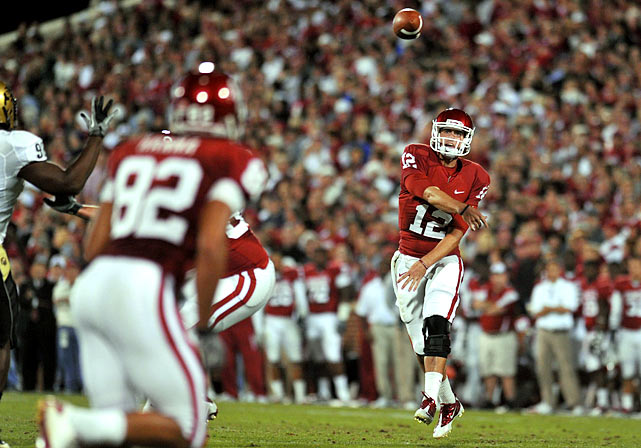
On Saturday Robert Griffin III met Landry Jones in the Oklahoma vs Baylor shoot-out. It ended in a 45-38 victory for Griffin and the Bears. I’ll discuss Griffin’s performance in a future piece (I believe Griffin tape and also Barkley vs Oregon is forthcoming) but today I want to talk about Jones because I’m at a stage where I feel like I don’t need to see any more tape to determine he’s not a first-round talent.  

Oklahoma’s first drive of this game perfectly sums up Jones as a prospect. On his second attempt, Jones takes a play action in the gun before a pre-meditated throw to a receiver running a short in-route. Jones doesn’t make a read after the snap and forces a dangerous throw straight at a covering defensive end. The pass is tipped up into the air and is almost intercepted. He needs to recognise that pass just isn’t on and progress to another option – he’s too handcuffed to the play call and it almost resulted in a turnover. If I’m drafting a quarterback in round one, he needs to have even a basic ability to get out of a call when it breaks down. Watch Matt Barkley and study how well he makes a pre-snap and post-snap read, continuously diagnosing the defense as the play develops around him. Barkley shows time and time again a natural ability to work on the move and still make good decisions. Watch his performance in dismantlin Oregon at the weekend and then watch Jones forcing blind passes, making zero reads and just throwing the ball to the receiver he’s told to throw to. You’ll be watching a player primed to make a quick impact on the NFL and a player who’s not even close to that level of technical ability.  

Jones’ first possession ends with a 3rd and 28 throw into double coverage which is again tipped up into the air and the interception is dropped by a Baylor defensive back. Jones locks onto his receiver early and should know better than to try and force that pass. In this situation, Andrew Luck and Matt Barkley would be checking down through their progressions but Jones is keyed into the play call. It was incredibly fortunate not to be picked off and he can’t afford to make such a dangerous pass with two corner’s draped all over his intended target. The all-22 tape showed a check down to the running back was an option, but Jones never strays from the call.  

Here’s another example – in the second half he takes a snap, rotates his body to the right and without looking just throws it straight into a jumping defensive black who blitzed the right edge. Jones doesn’t even recognise he’s there – he just throws at maximum velocity straight at the guy. There’s no pre-snap read here to detect the corner who had blatantly moved to the LOS ready to blitz the edge. It’s just snap, turn, throw without any read during the play. The ball hits the DB and goes spiralling up into the air and for the third time is fortunate not to turn into an interception. Blind throws are difficult to watch in college football and a major concern when you see it consistently. Jones is a prime culprit.  

I appreciate that scheme is king in Oklahoma and it requires a fast tempo, quick hitting passing game. However, how can you sufficiently judge that Landry Jones can handle a completely different offense at the next level where he’ll be challenged in so many different ways? He’s not alone in that sense – many college quarterbacks work in systems that don’t translate to the pro’s. Yet Jones doesn’t compensate with an ideal skill set physically – his arm is good some of the time (above average touch on deep fade, nice velocity on intermediate slant and occassionally the short post) but it’s not exactly a cannon either. He’s not a mobile player who can extend plays with his footwork. He doesn’t show any kind of improvisation when plays break down. His decision making is frequently poor in college because he’s tied to the play calls, so do you trust him to make good decisions when the shackles are released?  

When he gets protection and the time to let things unfold, he can be precise. He’ll hit the slants, in-route’s, quick screens and such. That’s great, but in the NFL he’s going to be disrupted, he’s going to have much more pressure and he’s going to need to drive the deep ball with accuracy. I suspect defenses will let him hang himself to a degree – he’ll be really susceptible to safety blitzes and interior pressure. Give him a lot of different looks and get into his head. He’ll show consistent traits on tape so I’d project he’ll be an easy quarterback to figure out. Even when he has good protection and he’s at his most successful, he’s not a surgeon by any means. Saturday’s single interception came with perfect pass protection, he simply missed his receiver (high, wide throw) and allowed the defensive back to make a play. The decision was pretty awful too – he had three Baylor defenders surrounding one receiver and although he managed to get the ball over two of the players, the third made the pick. Again, he needs to diagnose that the pass just isn’t on in that situation and checkdown.  

His lack of poise under pressure is a strong concern. Referring back to the first drive, he takes the snap in the gun but a linebacker goes unblocked straight through the middle of the offensive line. The play is effectively over as soon as Jones notices the blitzing linebacker and just throws it away. To some extent he played it safe, but a one man blitz was enough to impact the quarterback to bail. There’s no pre-snap adjustment. There’s no attempt to extend the play or improvise – at the moment the linebacker penetrates the line Jones knows he isn’t going to have the time to execute to his hot read. His tight end had run an in-route and had space to the left – he could’ve been thrown open with a quick pass. Whenever this offense is knocked out of sync, Jones isn’t capable of making things happen.  

It’s not just the way he struggles against pressure throwing, he’s immobile and cannot extend plays. Nicolas Jean-Baptiste had two sacks from the interior where Jones was basically a standing target. This wasn’t a case of an explosive burst off the snap reaching the quarterback before he can react, these were two slow developing routes and Jean-Baptiste had enough time to disengage and break into the backfield. Jones barely moved in both instances. He may not run a time quite as slow as Ryan Mallett managed last year at the Arkansas pro-day, but even Mallett was superior in his ability to extend plays with pocket smarts and footwork. On the rare occasions where he avoids pressure, it impacts his decision making too much. You can tell Jones is thinking ‘I’ve got to get rid of this’ even when he manages to avoid an outside rush and will throw to the first receiver he sees. He struggles to re-set his feet and drive through the ball, and had another pass tipped in this situation just before the end of the first quarter.  

Jones’ pro’s (Good height, fairly quick release, precise in the pocket when protected, decent arm) are outweighed by the negatives (too many blind throws, lack of mobility, struggles to deal with pressure, no evidence of pre or post-snap reads, poor decision making, no threat in space, slight three-quarter release).  

I used to think Jones would be an unwise first round pick – that somebody would take the chance on his college production. Now, I’m starting to have my doubts. He’s always been a mid-round level player in my eyes, yet I believed he’d still find a home in round one. I have to think he’ll struggle to maintain a first round grade on most boards, despite continued high grades by the mainstream media. He needs to land on a team that runs a timing offense that can afford to keep him on the bench while he develops his play to something akin to a pro-standard. That team isn’t Miami, Washington or Seattle.  

The best case situation would be to land in New England or Kansas City as a back-up – but New England has already taken on project-Mallett and Kansas City appear to be keeping their faith in Matt Cassell for the long haul. Does his current injury situation impact that? Who knows, but KC has the kind of offense that Jones needs to be part of. Arizona already made one mistake trading for Kevin Kolb, but if rumors of an ‘out-clause’ for the Cardinals are true, it wouldn’t be a total surprise to see Jones land in the NFC West. Even so, it appears unlikely that Arizona would depart from their investment in Kolb so soon and without even a full off-season.  

This piece reads mostly negative because I’ve intentionally highlighted flaws in Jones’ game that are not being covered in most other places. We’re not talking about a completely hopeless cause here, but then Jimmy Clausen was considered worth the risk in 2010. In hindsight, Clausen would probably command no more than a late round flier now rather than a second round investment. Established scouts were projecting Clausen as a top-10 pick the day of the 2010 draft and for a long time he was considered the likely #1 overall pick. Highlighting issues within Clausen’s game and how they translate to the next level somewhat explain why he’s struggled to make an impact. I suspect the same for Jones and while he’s physically superior to Clausen, they also share several limitations and could end up having similar careers.  

For me, Jones will probably end up competing with Ryan Tannehill to be top of the second group of quarterbacks after Andrew Luck, Matt Barkley and Robert Griffin III. His floor is probably round two based purely on reputation and the stigma of a big-name quarterback remaining on the board. However, like Clausen he could easily go in the second round and prove ineffective at the next level.

Lamar Miller could be a high first-round pick

Lamar Miller: Healthy competition for Trent Richardson

Running back’s have quickly become an endangered species at the top of round one. It’s only six years ago that three runners were taken in the first five picks of the 2005 draft (Ronnie Brown, Cedric Benson and Cadillac Williams). It’s not a big surprise that times have changed – plenty of teams are finding ways to get serviceable backs later in the draft. Only two of the league’s current top-ten rushing leaders are first round picks (Adrian Peterson and Steven Jackson). The very nature of the position encourages a tough work load leading to shorter careers, almost always ended by the time the player hits 30. When you add the extreme cost that accompanies the top few picks, it’s no wonder the NFL moved away from running backs and looked closer at long term investments at quarterback and both the offensive and defensive lines.   

Could that might be about to change?   

The rookie pay scale is going to have a greater impact on the draft than maybe some people think. Let’s look at the difference in salary for the 1st, 5th and 10th picks in 2010 and 2011 – before and after the pay scale arrived.   

#1 overall

Sam Bradford (2010)
6-year contract worth $78m with $50m in guarantees and a maximum value of $86m

Cam Newton (2011)
4-year contract worth a fully guaranteed $22m   

#5 overall

Eric Berry (2010)
6-year contract worth $60m with $34m in guarantees

Patrick Peterson (2011)
4-year contract worth a fully guaranteed $18.5m   

#10 overall

Tyson Alualu (2010)
5-year contract worth $28m with $17.5m in guaranteed

Blaine Gabbert (2011)
4-year contract worth a fully guaranteed $12m   

Players drafted within the top ten are now making as much money as players previously taken in the 15-20 range. Maurkice Pouncey’s rookie contract is worth only $1.65m less in guarantees than Blaine Gabbert’s, despite an eight-pick difference. If you were considering a running back with a top ten pick, in 2010 you would almost certainly be investing around 20-30m in guarantees at a position carrying a severe injury risk. Post-2010, that’s completely changed to a much more affordable number. We may be about to see a u-turn with teams now returning to the position as an early first round option, tapping into the short learning curve at the position for rookies.   

Of course, there will always be teams who take the stance that drafting a running back in round one is a luxury. I suspect the Seahawks could fall into that category, given they passed on Mark Ingram last year (offensive coordinator Darrell Bevell was a big fan) and considering the previous appointment of Alex Gibbs and his philosophy that believes runners can be found without the high-end investment. That’s not to say they too won’t change their mind in this new climate, but Seattle’s priorities will probably continue to lie elsewhere.   

Trent Richardson should go early next April, offering a cornerstone playmaker to a struggling offense. But what about Lamar Miller? Could he too leave the board early?   

There’s a lot to like about the redshirt-sophomore from Miami. For the year he’s on 1108 yards with eleven touchdowns. Miller has ideal size for the NFL (5-11, 211lbs) and the kind of breakaway speed that will intrigue teams early in the first round. Perhaps his best attribute is patience – it’s reminiscent of Shaun Alexander’s days in Alabama. While Miller hasn’t got that same natural, smooth running style and elusiveness that made Alexander a star, the way he let’s the play develop before exploding into a cut is at an elite level. He seeks out running lanes and explodes through the gap, often making angles with a neat cutback or rounding the edge. He’s the kind of running back that makes things happen and won’t rely totally on good line play.   

His ability to change direction quickly without losing speed is also unique. He glides in and out of cuts to avoid tackles and in the open field he can extend runs for big gains that would otherwise just be first downs. The fluidity of his open-field running style is comparable to Jeremy Maclin’s, albeit it in the body of a running back. On short yardage runs he’s got enough size and power to be effective and he’ll keep carries in the red-zone. If there is one concern about his running style, it’s quite upright and he exposes a lot of his body to the tackle. So far he’s avoided injuries, but it’s something to consider – not that it’s hindered other players who run this way.   

Miller is a non-factor in the passing game, which is a slight concern. He only has 24 career receptions and a single touchdown – you’d like to see more considering how often running backs are used split wide and on screens these days. Neither is he a thriving blocker, but on the tape evidence I’ve seen so far he’s at least willing and this is an area that will improve with pro-coaching. These are minor concerns given how rounded he is as a runner and while he may not have the same brutish running style and size as Richardson, he looks faster on tape and has shown the same ability to dodge or break tackles consistently.   

There’s no doubt he’s ready to have an impact on the NFL and he could provide a team with a young offensive core a nice weapon at running back. He may not join Trent Richardson among the first ten picks next April, but he has every opportunity to go in the top-15. That’s the range I expect to project Miller in my first mock draft for 2012, to be published soon.  


Robert Griffin III scouting report

Introduction

Below you’ll find four videos featuring Robert Griffin III (QB, Baylor). The first video is every snap Griffin impacted in last year’s Texas Bowl where Baylor were defeated convincingly by Illinois. The next three videos feature tape from 2011 – every snap Griffin took in the games against TCU, Texas A&M and most recently, Missouri. I’ll break down and analyse the Tigers game from last Saturday later in this piece as it’s the freshest example of what Griffin’s going to bring to the NFL if he chooses to declare as a fourth-year junior. However, before you read on I would urge you to watch tape of the Illinois game and then watch at least one of the 2011 videos. Compare and contrast what you see.   


Thanks to JMPasq for supplying the game tape

Robert Griffin III provides one of the great mysteries of this year’s potential draft class. I’m struggling to grade Griffin, despite the fact I’ve watched more of his tape this year than the vast majority of players eligible for the 2012 draft.   

If you took the opportunity to watch the Illinois tape, you’ll probably come to the same conclusion I did. I’d seen Baylor a few times in 2010 and never been particularly taken by their quarterback. It’s a heavy screen game – lot’s of passes into the flats, a high percentage for completions but not a lot of real productivity. Essentially, Baylor’s offense was built around getting the ball to track-star athletes playing receiver and trying to create outside space to use that electrifying speed. Griffin was the middle man and very rarely was he asked to make any passes you could grade down as evidence of next-level ability. His skills as an athlete to run with the ball offered a zone-read option – another feature that doesn’t translate to the NFL. Overall, it wasn’t very impressive if you’re a team looking for a franchise quarterback.   

I came into the 2011 season wondering if Griffin was even draftable. Maybe someone would give him a try, but who? In fairness I suspect he had similar realistic ambitions which is why he talked during the summer about staying for a fifth year at Baylor and attending law school, having already completed his degree in political science. He’s an intelligent and personable individual and while football made him a star in college, it wouldn’t necessarily make him a star as a professional. Nobody was talking about Robert Griffin III as a pro-prospect, let alone someone that could potentially be a first round pick.

Now, everything has changed.   

The reason I wanted to highlight that Illinois tape from the Texas Bowl is simply to emphasise the development Griffin has gone through. Look at any of the three subsequent videos and you could be forgiven for thinking you’re watching two completely different players. Suddenly he’s driving the ball downfield with great consistency, he’s making touch throws at every level (short range, intermediate, deep) and he’s progressing through a couple of good, quick reads. I’ve talked a lot about the footwork and mechanical improvements he’ll need to make, but this is just about as good as it gets in terms of a twelve-month improvement.   

All kinds of questions eminate from that. Is it testament to a man who’s worked at his craft knowing he needed to make several improvements for a shot at the NFL? Do we credit the coaches? Ultimately this development will have needed some tuition. Is it simply down to experience? How much better can he get either with further playing time at Baylor or by moving to the NFL to work full-time on honing his skills?   

It’s that final question that intrigues me the most and makes Griffin such an unknown. Right now he has some attractive pro-features and there are also some things to work on. However, if we can see this level of improvement as he grows at Baylor – what level could he achieve being managed in the NFL? Are we looking at a player with elite potential here? Are we looking at a player who just works harder than everyone else and has clicked for one great year and actually may struggle to make further gains? Is he maxed out?   

The only time we’ll find the answer to that is the day Griffin is standing in a NFL stadium and he’s throwing the football. I suspect some teams will be enamoured by the potential, yet others will avoid the unknown. Someone will believe in this guy, probably enough to make him a relatively early pick. So that leads to two further obvious questions – will Pete Carroll be that man to believe in Robert Griffin III and just how high would a team be willing to draft him? Top ten? First round? Early second round similar to Colin Kaepernick?   

We know the Seahawks had some interest in Kaepernick last year – enough to put him at #2 on their list of quarterbacks behind Blaine Gabbert and just above Andy Dalton. We also understand that had they been able to trade down into the early part of round two, they would’ve considered drafting Kaepernick who eventually went in that range to San Francisco.   

Griffin has some similarities to the former Nevada passer – they’re both athletic player with running ability, both own strong arms but require mechanical tweaks to their technique, they’ll both enter the league considered longer term projects than some other quarterbacks but there’s also lot’s of physical potential and both are considered strong characters, good leaders and hard workers. There are, of course, strong differences between the two and I believe Griffin is a more polished overall passer, but he’s less of a threat as a runner. If the Seahawks rated Kaepernick as a potential early second round pick, would Griffin get a similar grade? Or is the mere interest in Kaepernick to begin with enough to suggest that maybe this team would possibly take Griffin earlier given the growing need to solve the quarterback dilemma?   

I’m going to move on from Kaepernick for now and leave that comparison – mainly because he’s yet to even start a NFL game and there are differences between the two that I won’t go into here. I’ve not seen anyone in the NFL I can logically compare to Griffin. More on that in a moment, but for now let’s get into the Missouri tape…   

The first play that stands out comes at exactly the 1:00 minute mark. It’s a 4WR set with two go routes on the outside. Griffin takes the snap in the shotgun before making an initial red to his left, then coming back to the right hand side to search for a second target. None of the receivers run a good route in fairness and the offensive line are unable to maintain a clean pocket for any suitable amount of time to let the play develop. Griffin detects the pressure after the second read and is able to step up into the pocket and scramble to the right hand side. He can run here but instinctively holds up at the LOS to make a pass, throwing back across his body. The throw is high and asks a lot of Kendall Wright, who jumps at full stretch but only manages to get a finger tip to the ball. If you were being kind to you could say he put the ball in an area only the receiver could get it, but ultimately the receiver doesn’t because it’s marginally inaccurate.   

What I liked about this play though was the ability to feel the pressure without letting it impact the play. He still makes two reads and he doesn’t linger on a target when it’s time to move. Buying time for throw gives him the chance to make a completion and he doesn’t sell out on the play to make a run for it. The pass was difficult across his body, but almost completed. With a degree of better accuracy, that could’ve been a play scouts return to when trying to make a strong case for drafting Griffin. It may remain a good example anyway.   

Running with the ball is a concern for me. In fact, I’d go as far to say Griffin is a bit of a liability here. Yes he’s an athlete who can get the first down when the pass breaks down and potentially even make the big unexpected play. However, ball security is a major problem and his lack of bulk and upright running style could make him an easy target. The Missouri game isn’t the first game he’s fumbled the ball carrying it in a bad position. If we’re going to talk about Griffin as a threat running in space, he has to avoid turnovers by doing a better job of protecting the ball. His running style involves a lot of arm movement, but he needs to tuck the ball closer to his chest and not leave it open to be punched out. I counted three fumbles in this game, two from running plays. It’s something I’ve noticed in other games this year and I suspect it’ll happen again.   

He’s got excellent straight line speed and he’s definitely an athlete but whether he’s holding back due to his previous knee injury or whether he’s just not that elusive, Griffin never seems to break open the huge gain with his legs despite having the opportunity to run on a number of plays. That’s not a big deal, because you dont want the quarterback running too much at the next level anyway. However, I think it brings some reality to Griffin’s status because he’s not going to be an explosive Michael Vick-type runner. He may be a better passer than Vick though and his on-field IQ certainly matches the strong academic intelligence he’s shown with his studies.   

What I really like about Griffin is the way he reacts to the environment around him and undoubtedly that’s one of the reasons he’s limited turnovers this year. When he needs to he can get out of a bad situation or play call. If a pass rusher gets in his face just as he’s ready to release, he won’t just jam it in there regardless. Instead, he’ll pull the ball down and look to extend the play for a better passing lane or a run. When he’s in the pocket and the protection fails, he won’t bail too soon and he keeps his eyes downfield. Griffin has consistently shown he understands when to move out of the pocket to buy extra time and when it makes sense to stand tall and deliver the football. When you’re constantly aware of what’s unfolding in front of you, a quarterback can make better decisions and he can improvise. I need to see a quarterback in college that’s able to make something from a broken play, or at least not be tied to the script. Griffin does that.   

The evidence this season shows his placement is fantastic and he plays the percentages. He’s got a rare and under rated talent – which some would write off as conservative – and that’s to put the pass in a position where either his receiver is getting it or nobody is. He’s not ultra-cautious with this with constant check downs all the time (Kevin Kolb) or fearing any pass beyond 20-yards (Kevin Kolb). He’s prepared to take on a pass in a tight window. However, you notice in the red zone how he throws low and that’s a good skill to have. He limits the take away potential and although it demands more from the receiver, they have the opportunity to respond and make a play. It’s another reason why he has such a low number of turnovers.   

One of my favorite plays from the Missouri game came at 4:25. He takes the snap in the gun and pumps with his shoulder to the outside right sideline before throwing a really difficult pass for a ten-yard gain to a receiver in single coverage. He actually throws over two defenders who both leap for the ball, but the pass is too good. That’s perfect placement and touch.   

The announcer at 5:28 made a slight complaint with a pass featured, where Griffin is hammered by a defensive lineman but still gets the throw off with decent velocity. It’s high and misses the target, but I still think the receiver could do a better job at trying to catch that ball. If he makes that pass, it’d be twice as much of a positive than missing the target is a negative.   

Footwork still a problem and I suspect this isn’t going to be something addressed in 2011. Griffin still dances in the pocket too much and it hurts his ability to get the quick release. I wouldn’t be surprised if he misses the occasional opportunity because he has to keep re-setting to deliver the football. If he drops back and the receiver gets instant separation, by the time he’s taken two steps and then needed to plant both feet the chance might have gone. It’s not just missing chances that will occur through this, the extra time wasted will give defensive lineman a chance to reach the quarterback. The constant re-setting also sometimes puts Griffin’s body shape into an awkward position and while I’ve not seen any instances where this has impacted a throw yet, it’s something I’ve started to look for in each new game.   

This is a big issue, but not impossible to fix quickly. Joe Flacco basically had to learn to drop-back from scratch as a rookie. He also had to learn the whole concept of footwork and how it can help a quarterback, yet he still started as a rookie and has been a regular feature for the Baltimore Ravens ever since. Good coaching helped Flacco and there’s every chance it could help Griffin too. Most quarterbacks have some technical flaws to work on when they enter the NFL – thankfully footwork is easier to fix than a throwing motion or a weak arm. Griffin should be fine if he gets the right coaching, but eliminating the pressure to start quickly would help in the long term (as it would for most rookies).   

The touchdown at 7:25 is a thing of beauty. Shotgun snap and Griffin doesn’t like his first read. He scrambles right to avoid an outside rush to the strong side before throwing a lazer to the receiver in the end zone. It’s a textbook throw on the run, mechanically very good with the exact necessary velocity with two defensive backs in the region. A lot of players can’t put that level of power into a throw while running, it’s often lofted into the end zone, broken up or intercepted. That’s a touchdown because Griffin can put the required zip on the ball in that situation. When you see the all-22 replay you realise what a special pass that is. It’s a tiny window to throw into, he’s made a split second decision to make the pass and he’s executed to perfection. That may be the second most impressive pass I’ve seen this season after Geno Smith’s impossibly brilliant pass against LSU.   

His deep accuracy is very good and remains a positive overall but it’s not perfect. The pass at 8:06 should’ve been a touchdown and Griffin just misses by over shooting. He has to make that throw and it’s as poor as the touchdown mentioned above was exceptional.   

They went back to this play at 10:57 and this time made the downfield completion for a big touchdown. I need to decide if this great deep accuracy translates to the NFL because Baylor’s receivers are all very quick. In the NFL, the cornerbacks are generally quick too and they’ll do a better job disrupting your route early in the play. He’s often throwing downfield to players who can create separation through pure speed. It’ll be harder at the next level, but not impossible. My assessment, having seen so many of Griffin’s deep completions now, is that this is a translatable skill but one that must be tempered. He’s not going to do this every week in the pro’s, but it’s good to know he can keep a defense honest with his deep ball and it’s not just a throw and hope either. There is some thought going into these long passes and it’ll be a weapon to take into the pro’s.   

I’ve watched more Griffin tape than I usually need to see to make a judgement on a prospect and stick to my guns. Even now I’m still confused as to what’s holding me back from just saying, ‘you know what, this guy is a top pick after all’. Maybe it’s time to give him the high grade? Maybe it’s because there’s nobody quite like him already in the league? He’s not Cam Newton, he’s not Michael Vick. He’s Robert Griffin. The simple fact is we may never know whether a Robert Griffin type player will work until we see it with our own eyes on a Sunday. He is, quite simply, a unique football player. Aside from mechanical tweaks and footwork issues, I’m not sure there’s any reason not to take on the RG3 experiment.   

So would the Seahawks be interested? Very possibly. Using what information we have (previously signed players, interviews, previous targets, declared philosophy) I think the Seahawks are looking for a quarterback who can lead a ball control offense. They’re not necessarily looking for a Cam Newton-type. I’m a big fan of Newton’s and was among the first to tout him as a probable #1 pick last year, but he’s the kind of player you cannot manage. He’ll go out to lead a drive and you won’t know what to expect – he’s unpredictable. By the end of this year most of his touchdowns could be on broken plays or improvised decisions. A lot of his turnovers may have happened when he’s stuck to the script and tried to force it. Newton is a rare talent with major potential, but he’s also someone who needs to do it his way.   

The Seahawks may want a little more control over their quarterback. That’s not to say they don’t want someone who can improvise and make something out of nothing, but they proabably want to limit the risks a little more and make a concerted effort to restrict turnovers. They want someone who’s mobile enough to extend plays, but also someone who can sit in the pocket and take what a defense offers. The Seahawks want to utilise a deep ball, but there’s also a lot of orthodox WCO short passes and game management.   

When you sit down and think about it, some of the best quarterbacks in the league fit that bill. Aaron Rodgers isn’t a big risk taker, but he manipulates a defense and can extend plays to improvise. He has an arm to drive the ball downfield. He limits turnovers. It’s not that the Seahawks are necessarily looking for a lesser player – they perhaps just don’t want the unpredictable loose cannon who makes it up as he goes along but is talented enough to thrive in that mould (which in fairness, also represents a portion of the NFL’s better QB’s).   

Griffin fits into what I suspect the Seahawks want from their quarterback. The question that lingers is whether or not they’d see him as a top-ten pick type talent or someone they don’t trust enough to hand over the keys to future success. Pete Carroll may only get one shot at drafting a franchise quarterback, so he has to get it right. I suspect other teams could see Griffin as worthy of the high pick and waiting for him later on may lead to a dead end. Will he declare? If he gets a high grade from the draft committee I think he will and it’ll complete the transformation of a player who has grown significantly in the last twelve months. Whether he continues that development in Seattle remains to be seen.

Landry Jones & Ryan Tannehill not first round QB’s

Landry Jones met Ryan Tannehill in the 'not worth a first round pick' bowl

This was an opportunity for two big name quarterbacks to impress.

Neither did.

Ryan Tannehill (Texas A&M) and Landry Jones (Oklahoma) have received a lot of positive hype this year. It’s far from a consensus, but a lot of people expect Jones to be a top ten pick. Tannehill was a fancied outsider – the kind of player scouts and fans look to in the hope he can add his name to the list of potential stars available in this class. Some high profile draft pundits even touted the possibility that Tannehill may be the second best quarterback eligible for 2012.

Wrong on both accounts.

I’ve seen quite a lot of Tannehill this season (five games) and this was my third batch of tape on Jones (I have a fourth Oklahoma game saved for later vs Kansas State). In each game I’ve seen from the pair this season, I’ve found myself highlighting the same issues. In Jones’ case, a lot of his problems were prevalent last season and there just hasn’t been enough of a leap in 2011 to warrant the kind of grades he’s receiving. Expectations went through the roof for Tannehill – perhaps unfairly – and games like this bring about something of a reality check.

Let’s start with Jones.

It only took until 6:04 remaining in the first quarter before we saw the play. I refer to it as the play because it’s had exagerrated success for Oklahoma this season in the previous two games I’ve seen. I fully expected to see it again today and low and behold, there it was midway through the first quarter. It’s not a hard play to detect – Ryan Broyles and Kenny Stills bunch together on the left and Landry Jones is in the gun. Jones takes the snap, pumps with his shoulder in the direction of Broyles who runs a short inside slant sucking in the coverage to open space down the left sideline for Stills on a fade. It’s the play that won the game against Florida State earlier in the season and it’s become a staple for Jones and the Sooners.

This time it wasn’t so successful – Jones pumped but then strangely floats an under thrown high pass with no touch or direction into coverage and somehow the linebacker drops an easy interception. It was unclear on the replay if the pass was tipped or not, but it was a great precursor to Jones’ overall performance on the day. It was awkward, generally inaccurate and a little predictable. I’ve seen him look a lot sharper than this and I suspect when I dig out the K-State tape that’s what I will find. However, this game raised one of my biggest concerns with Jones.

We saw the exact same play again in the second half and this time it led to a Stills touchdown. As a mere observer when I’m going into a game expecting to see this play once, that’s something. But the Oklahoma offense is based around the same small collection of plays and whether teams can cope with the speed in which they’re snapping the ball to execute these plays. Teams are so scared of Broyles – who is a production machine – they compensate in coverage when he runs anything inside allowing Stills the space to get open in single coverage. Everyone knows they’re gong to run this play eventually yet it still works. It’ll be interesting to see if they go away from it since Broyles unfortunately tore an ACL, but I’d also love to go back through the games since the FSU win and chart how many of Jones’ touchdowns come from this single play. In the NFL, he won’t be able to rely on staple plays. More worrying, I haven’t seen enough evidence of improvisation where Jones is going to a second or third option consistently. Jones is almost handcuffed to his playbook.

We’re not talking about a physically excellent quarterback, or even a big play quarterback who does the unpredictable. This is a guy who generally gets the job done in college – he executes his small playbook well enough to make the most of the talent he has to work with and let’s give credit where it’s due – he has to make this thing tick. He’s achieved that and from a college point of view, he’s done an excellent job avoiding any post-Sam Bradford hangover for the Sooners.

However, I really believe that he’s quite a limited player and at the next level he’ll just be found out like so many quarterbacks before him. When the environment isn’t perfect, neither is Jones. When things break down, he won’t improvise. One of the biggest issues I have is a complete lack of mobility. Ryan Mallett was labelled a statue last year, but he knew how to work a pre-snap read and had the ability to get the ball out quickly with accuracy to avoid outside pressure. He also – surprisingly – flashed ability to extend plays with footwork (he dodged Von Miller twice against Texas A&M last season to complete passes, one for a touchdown). Jones has nothing like this level of technical or mental ability. He takes unnecessary sacks when offered an open pocket to step into to buy time. He won’t round the edge and get out of the pocket. Get him moving on the run and nine times out of ten the ball’s going out of bounds. His footwork is plodding and weighted and if you take away his first read there’s every chance you’ll get to him.

I often get asked for the positive side of things – sometimes we can be too focused on the negatives and arguing why a player doesn’t warrant the hype rather than a balanced review of pro’s and con’s. If you want me to write down a handful of nice things to say about Landry Jones, I can do that for you. He has passable arm strength, decent height and a throwing motion that’s slightly 3/4 but he doesn’t have many passes batted down at the LOS (unlike Tannehill, more on that later). Like most quarterbacks with any reputation in college, he does a good job when afforded a clean pocket and he flashes his ability to throw his hot read open. There are a lot of blind throws in the OU offense, but there are also several passes that do require some touch and when given time he can be accurate at times it just isn’t consistent enough to be the positive it needs to be. His production is excellent and had Oklahoma stayed unbeaten he could’ve been a Heisman candidate. His two touchdown passes were both nice plays on the day – one coming on the wide open fade to Stills and the other a catch-able back shoulder throw to Jaz Reynolds who made a spectacular one-handed grab.

Here’s the bottom line though – I wouldn’t draft Landry Jones. I cannot see him ever succeeding at the next level. His best situation would be to land on a team with an experienced offensive coaching staff and a defined scheme that doesn’t require a lot of pocket mobility (most teams see mobility as being crucial these days). Allow him to master a playbook and groom him to replace a succesful veteran who still has miles on the clock. Of course, that’s an ideal situation for any quarterback entering the NFL – but for some it’s more necessary than others and Jones fits into that category. If he starts early, he’ll struggle. He won’t be able to digest complex defensive reads, he’ll take too many sacks and with greater pressure and a less fluid offense he’ll turn the ball over. There are no logical reasons for any team to touch the guy in the top half of round one and I suspect by the time April arrives his stock will be lower than it is right now.

What about Tannehill?

I’ve been more negative than most about his play so far this year. He entered 2011 a really intriguing prospect – this was a guy who took over the starting gig at Texas A&M last season converting from receiver and he just won games. He beat Jones and Oklahoma, he beat Oklahoma State, Baylor and Texas. His only defeat came in the Cotton Bowl to LSU – currently the #1 ranked college team before tonight’s game against Alabama. He’s big, he’s athletic and he appears to have the right attitude. Understandably, people bought into his potential.

The hype went too high, too soon. A guy who ended last year with modest round 3/4 range grades was suddenly touted as possibly the second best QB to Andrew Luck – ahead of Matt Barkley. Big plays were being received with nods of approval and premature ‘I told you so’s’ about his potential, while negative plays (and there have been a few) were greeted by naysayers calling out those creating the hype. The truth lies somewhere in the middle. Tannehill has physical qualities that are attractive, but he’s not anywhere close to anything like an established or technical passer. There is so much he has to learn to play quarterback in the NFL and the question is whether or not he’ll be able to do that considering we only have 1.5 seasons of college tape to make a projection.

Here’s what happened today and this was as poor a performance I’ve seen from Tannehill so far.

With 2:31 left in the first quarter, Tanehill takes the snap in the gun and locks on to his primary receiver. He stays with the receiver for three seconds – which was too long – and really needed to progress to another option. He sticks in the pocket and eventually turns to the sideline and unwisely forces a pass into double coverage which is easily picked off for a big interception return. It was a very poor decision to attempt that pass, at no point should it have been an option and it was proof of a quarterback feeling pressure from his blind side, panicking and making an avoidable mistake.

It highlighted a significant issue I have with Tannehill – he locks on to his primary target too often and for whatever reason (experience or because he’s incapable of doing it) he doesn’t do a good enough job getting away from his hot read. In each game I’ve watched Tannehill this season I’ve seen a quarterback too attached to the first option that he becomes tentative, sometimes waiting for clear separation before attempting the pass. If it doesn’t come, he’ll panic and sensing pressure (that isn’t always there) he forces mistakes. He needs to show much greater poise, timing, awareness of not only his position and that of the defensive lineman and better decision making. On this particular play against Oklahoma he could’ve easily run a bootleg to the right getting out of the pocket – it would’ve bought as many as 4-5 extra seconds to complete a pass or as a secondary option he could’ve chosen to run with the ball – the space was that substantial on the right boot leg. Instead he forces the throw and turns it over.

There are two technical complaints I have. Firstly, he’s quite robotic in his throwing motion and looks stiff. It doesn’t appear to be a natural motion and while this is something he can improve with a good quarterbacks coach (and by simply relaxing a little) he doesn’t have a natural flow in the same way a lot of high first round picks have shown. Secondly, he has a 3/4 release which is too low for my liking. At his height, he shouldn’t be having the number of tipped passes we see. Some quarterbacks (like Landry Jones) get away with it, but not Tannehill. His second interception came from one of these tipped passes and he almost had another in the second half. He’ll need to straighten out that delivery during the senior bowl and subsequent work outs.

The third interception may have been the worst of the lot – a desperate throw chasing the game just lobbed up for grabs down the right sideline. This just isn’t good enough in general, it was maybe the worst throw I’ve seen this season. He’s under no pressure and breaks out of the pocket this time with a clean line of vision to Jeff Fuller. He can clearly see the receiver is not only covered, but he’s got into a bad position with his back turned and the DB is facing the football. Tannehill cannot throw that pass under any circumstance. At least with the first pick there was moderate pressure from Frank Alexander and it was just a bad decision on his second read. He’s locked onto Fuller here and just forced an interception. It’s the kind of play you just don’t see from Andrew Luck, Matt Barkley, Robert Griffin, Landry Jones, Austin Davis or Brandon Weeden. It’s the kind of lazy turnover Nick Foles makes.

Again we can run through the positives and unlike Jones we’re not talking about a limited physical prospect. Tannehill is a mobile player who can extend plays while also making significant gains on the ground. His touch on deep passes is generally good. His poise is inconsistent but on a key 3rd and 6 from inside his own end zone I liked the fact he was patient enough for Ryan Swope to get open before making the completion for a nice gain. On the touchdown pass just before half time, Tannehill has perfect protection and must’ve been tempted to run the ball when nobody was open initially – the first down may well have been achievable running the ball. However, he keeps his eyes downfield and when Swope breaks coverage it’s an easy pass for a big score. That flashed good decision making to contrast the bad turnovers and at least suggests there is something to work with in that regard.

The inexperience issue can be used both as a positive and a negative, but there’s enough of an unknown there to wonder ‘what if’? Of course unknown development holding a clipboard isn’t even a real intangible and while someone like Jake Locker boasted real physical and playmaking potential, Tannehill is far from that level. I wouldn’t rule out Tannehill the way I’d rule out Jones, I just have very little confidence that in a few years time we’ll be talking about him as a starting NFL quarterback. It was incredibly ambitious to ever even suggest he could possibly be graded higher than Matt Barkley – who is far superior in terms of a NFL projection. I’d grade him in rounds 3-4 and whether he goes higher than that in my view will depend on a teams desperation to fill a hole at quarterback.

I do feel slightly vindicated watching a game like this. For me it has always been about Luck and Barkley in round one – hardly an ambitious suggestion, but certainly not a common one given it doesn’t include the likes of Jones, Tannehill etc. Too many people have tried to create problems with Barkley, when the reality is he’s a tremendously accurate and technical passer primed to have a quick impact in the NFL. We all know about Andrew Luck. The rest of the group aren’t anywhere close to the top-two. The one wildcard is Robert Griffin III – a major project but one in possession of a lot of intriguing physical tools, elite character and rare consistency with the deep ball in terms of accuracy, touch and placement. Not every team will be able to draft Griffin early and he’s a long way off Cam Newton type potential, but there is something there. Remember to keep an eye on Austin Davis too – he’s the reason Southern Miss are ranked and another victory today at East Carolina will boost that reputation further.

If you’re looking for a first round quarterback who can come in and have a very real chance to lead your team for over a decade, the list starts with Luck and ends with Barkley. The Seahawks should let someone else take a chance on Jones and Tannehill.

Ryan Tannehill (QB, Texas A&M) vs Baylor

We’ve seen quite a lot of tape on Ryan Tannehill now, at least enough to start forming a fair opinion. Let’s break down his latest performance against Baylor.

Note: It’s important to remember that Baylor’s defense is prolific in it’s poor quality. Tannehill’s stat line looks fantastic – 25/37 for 415 yards and six touchdowns with one interception. The performance overall isn’t quite as good as that looks, but there are strong positives and also some big negatives.

A lot of the issues with Tannehill’s game are blamed on a lack of experience. By the time he enters the NFL, he’ll have played 1.7 seasons of college football at quarterback. Let’s remember that Sam Bradford – as prolific as he was and having just won the Heisman – felt he had to return to Oklahoma for a third year starting to sufficiently prepare himself for the next step. The Lewin Career Forecast (LCF) originally projected that quarterbacks’ success at the next level would be dependant on a specific number of starts (35) and whether they had completed 60% of their passes. The system wasn’t an exact science because it projected success for players such as Kellen Clemens and Brian Brohm, but it was a good indicator in highlighting how college experience related to success at the next level.

Football Outsiders updated the LCF to try and find a more accurate system for the future and now looks at a minimum of 20 starts and other factors such as improvement as a senior to determine success. It’s not flawless – Brady Quinn still scores higher than Matt Ryan – but it scores Philip Rivers, Peyton Manning and Drew Brees highly while undermining the potential of Alex Smith, Brody Croyle, Ryan Leaf and David Carr.

Tannehill will have to play every game this season – including a bowl game – to get to the 20 starts which would put him in the range to even receive a score in the new LCF. What I would say is this – a lack of experience can be blamed on certain aspects, but how are these problems going to be solved holding a clipboard? Or worse if Tannehill is indeed thrown in at the deep end as a rookie starter in the NFL? The lack of experience can be used as an excuse, but it cannot be used as a definite reason for some of the negatives to his game.

One of the things that bothers me about Tannehill is his inability seemingly to get out of a bad play. At 2:42 he takes PA and the play design is to check it down to the running back who’s taking a short route to the left. It’s diagnosed quickly by the defense and one defensive back gets right into Tannehill’s face to break it up. What bothers me is the way he still tries to force the throw, there’s no adjustment given the play isn’t on. The attempt is tipped and could’ve gone anywhere, but with a bit more poise he could’ve stepped away from the DB and looked for Ryan Swope on a crossing route who was actually 6-7 yards upfield and open.

Is that a lack of game experience? Or is it an issue he’ll carry to the next level? I don’t like to see quarterbacks tied to play calls in college. Landry Jones is similar in this respect – he throws blind too often for my liking and when a quarterback is forcing throws regularly it’s usually one of two things – that a quarterback is incapable of improvisation or he’s being prevented from doing it. One of the things I like most about Matt Barkley is the way he rarely forces a pass that just isn’t on, he’ll get out of a play and look to a second or third option. That’s not to say he’s a flawless decision maker, but the NFL will throw all kinds of challenges a quarterbacks way. I have confidence that Barkley will answer those challenges because he’s able to improvise and make things happen, he plays on the move. The evidence so far suggests Tannehill will lock on to one read and if everything clicks (receiver is open, time in the pocket, nobody on defense makes a spectacular play) things work. If it’s not on, he’ll too often try and force things which will lead to mistakes and turnovers in the NFL.

Another example is the shovel pass interception at 1:03. This is another strict play call which goes wrong – the running back’s body language (turns quickly to look for the ball) shows it was always the call and not a checkdown option. Tannehill tosses it into traffic when it simply wasn’t on – bad decision, bad execution and another example of being tied to a play call.

He also misses on some basic throws – at 8:51 it’s a simple dump off to the receiver on the left hand side but he’s a bit jumpy and misses the target. There are a few examples – in this game and others – where his accuracy is slightly off.

Arm strength is generally a positive and I’m loathe to criticise any player for a 47-yard touchdown pass, but he under threw a wide open receiver who had to slow right down and turn to face the ball in order to make the completion. You really want to see that pass thrown into the end zone. Had one of the two defensive backs managed even a mediocre job in coverage that easily could’ve been broken up and a missed opportunity.

He throws with a slightly greater 3/4 motion than you’d like to see. There are tipped passes with Tannehill which is a bit of a surprise given his height. He can work on this and I suspect come the Texas A&M pro-day and after working with a good QB coach he’ll rectify this, but it’s something that does need work.

Onto the positives and certainly Tannehill does a good job taking what a defense gives him. He gets good protection from the Aggies offensive line and he’ll make the most of single coverage. He does take some risks with defensive backs under cutting routes, but there are several occasions this season where I’ve been really impressed with his pass placement finding a receiver who’s just created enough separation between two defensive backs. The connection between Tannehill and Ryan Swope is very natural, although I don’t think they’ve made enough of Jeff Fuller’s overall skill set in this offense. The pass at 8:15 shows he is capable of fitting passes into tight windows in single coverage, he doesn’t rely purely on the talented weapons he has at receiver.

The pass at 12:00 goes for a touchdown but would’ve been no less impressive had it merely been a first down. Poor tackling allows the score, but that’s a very accurate pass in good coverage with the sufficient level of velocity.

I think NFL teams may be split when they review Tannehill ahead of next year’s draft. Some will look at the physical potential and the relative success he’s had so far and back their coaches to turn him into a more rounded player. Others will wonder whether a lack of experience is a good enough excuse to feel confident about some of the issues he has. He’s a lot lower in my personal grades than Andrew Luck, Matt Barkley, Cam Newton, Blaine Gabbert, Jake Locker and Sam Bradford – but he’s also higher than some of the players I didn’t rate highly such as Jimmy Clausen and Colt McCoy. Even so, I cannot grade Tannehill in round one.

Quinton Coples is over rated

Quinton Coples: Unimpressive pass rusher and painful looking tattoo's

I’ve just finished watching the Louisville vs North Carolina game from Saturday, focusing on UNC defensive lineman Quinton Coples. I’ve never been that impressed when I’ve watched him in the past, but this was a game I thought he had a chance to dominate. Louisville are struggling a bit – losing at home to Marshall the previous week and starting a freshman left guard who had only recently converted from defense.

However, much to my disappointment, Coples was again largely ineffective. This is a player everyone is touting as the best defensive prospect for 2012 – without fail. A lot of high profile pundits have Coples ranked very highly – he’s #2 on Mel Kiper’s big board and several others have him in the top five of their mock drafts. Sorry, but I don’t see a top five pick when I watch Quinton Coples. I’m not even convinced I see a player with first round potential period.

One of the biggest problems I have with him is figuring out what kind of player he’ll be at the next level. He’s not a great speed rusher or a player who creates consistent pressure with technique, power or by mastering one particular move. That says to me you’re fighting a losing battle trying to force him into a right end role in the 4-3 (the position he mostly plays for North Carolina). He’s about 275-280lbs which isn’t ideal size to kick inside and play three technique where I think he’d really struggle against the run and would have major problems against interior blocking. I end up looking at the five technique position, but even then I’m not completely convinced because he doesn’t do a great job shedding blocks after engaging an offensive lineman. He can hold the point of attack to free up room for on-rushing linebackers, which is probably why I settle for the orthodox 3-4 five-tech with some remaining suspicion.

Whatever position you think he fits, you’ll have a hard time convincing me that this guy is worth the hype. He might be the most over rated 2012 draft eligible player – which says a lot given who he’s competing with for that honor.

Case in point… it’s third down on Louisville’s 5 yard line in the first quarter and Coples is playing right end. There’s no explosion off the snap and he engages the left tackle but can’t beat him round the edge. He tries a move to pull inside, but the tackle just passes him off to the freshman guard who just completely stones him still with a two hand punch to the chest. It was such a laboured move that didn’t threaten either offensive lineman – initial burst lacking, not enough speed and he’s beaten for power by a guard who’s learning the position on the run.

Coples doesn’t play with any real urgency or fire. He could make up for a lack of edge speed by just competing at 100% and flashing the kind of power you expect from someone at 280lbs and 6-6, but it’s never there. He hasn’t got a bull rush. He hasn’t got a spin move. He hasn’t got a good club or swim. What does he bring to the table other than a big frame and above average athleticism for that size? His hand usage needs to be much better, too often he gets tied up with a lineman when a sudden jolt or a club would free him up to get that extra space needed to work into the backfield. I don’t see a guy who finishes plays – the one time he did have an effective splash it was only to jolt the running back backwards for another defender to complete the move. Coples beat a converted wide out playing tight end who was hopelessly misplaced in that situation, hardly a moment worthy of great praise.

Another big problem I have is how often Coples is subbed out of the game. I didn’t keep an official count but he seems to be in on around 60% of the defensive snaps, switching with Donte Paige-Moss. Really?A top five pick who plays right end but you’re subbing him out for four consecutive plays when Louisville have moved from their own 35 to inside UNC territory? It would’ve been five plays but for a time out. I think back to defensive lineman I’ve watched in recent years and rated highly and how ridiculous it would be to think of those guys stood watching from the sidelines on key first downs. That’s Coples for you. Why? Does he get tired easily? Are the coaches not telling us about an injury? Is it a conditioning issue?

I’ve been critical of other players in the past for relying on speed and not mastering a technical move or owning a strong repertoire (eg another former Tar Heel – Robert Quinn). Coples doesn’t have the speed or the moves. He looks so laboured as a pass rusher, without lacking the obivous qualities to move inside. To some degree he reminds me of a poor man’s Carlos Dunlap – who has almost identical size at 6-6, 277lbs. During his time at Florida, Dunlap was pretty frustrating because he had excellent physical qualities but coasted through games. Every now and again though he’d turn it on for a series and look like an elite prospect. He went from a potential top-10 pick to a late second rounder, taken by Cincinnati, mainly due to attitude and inconsistency.

It was a bit of a wake up call for Dunlap, who registered 9.5 sacks in an impressive rookie season for the Bengals. Coples’ all round play reminds me of the worst of Dunlap, just without the ability to really turn it on every now and again. If the elite potential is there, then maybe I could buy into a little of the hype. Sometimes a guy’s best football really is in the pro’s. With Coples, I just can’t see it. He looks like a player I’d possibly take the chance on in round two (like Dunlap) but wouldn’t invest much more based on his body of work so far.

With regards to the Seahawks, I don’t see how he fits into the scheme and projecting him to Seattle would be a misguided projection in my mind. He isn’t a LEO candidate or a player who could spell the Red Bryant position. I don’t see him moving inside to the three technique.

I’m surprised so many people are willing to throw Coples into the top five of a mock draft or big board. The only thing more confusing to me is how established draft pundits actually give his time-share buddy Donte Paige-Moss a first round grade – a player who at no point during his career has flashed anything but average pass rushing ability and mid-to-late round qualities. Is it the real lack of elite defensive talent and people need someone to invest their faith in? I’m not sure, but I’d keep looking for a defensive player worthy of the grade.

The real stars on UNC’s defense come at linebacker and Zach Brown is a proper first round prospect (see video below, courtesy of JMPasq). In this game he was again all over the field, showing great recognition skills and the physical qualities to react and make an impact as the play develops. He had an interception reading the QB like a book and showed surprising strength when engaging lineman as a pass rusher.

Alongside receiver Dwight Jones, Brown is the Tar Heel who excites me the most in terms of the draft. Certainly I don’t see Coples being an early pick as the foregone conclusion many appear to have drawn. There’s still plenty of time for this assesment to change and certainly he has time to add to the 2.5 sacks he has this year (2.0 came against James Madison in week one). A major improvement is needed however to come anywhere near to justifying the lofty expectations.

Thoughts on Landry Jones vs Florida State

Landry Jones broke the Sooner's all-time passing record in the win over FSU

Oklahoma and Florida State were ranked #1 and #5 coming into this weekend. My lasting impression afterwards was – why?

This wasn’t a great game by any stretch of the imagination, despite the big billing. Florida State’s offense barely troubled all night and looked positively cupcake when the far-from-spectacular EJ Manuel was replaced by skinny freshman Clint Tricket. The Sooner’s never really capitalised, keeping FSU in the game thanks to a lack of killer instinct on offense themselves.

Opinion is mixed on quarterback Landry Jones. On this blog there have been some aggressive arguments in favor of a high draft grade. National pundits are conflicting in their opinions – Tony Pauline has suggested a fourth round mark, while Todd McShay has Jones ranked among the top prospects for 2012.

My own personal opinion has always been that he has a lot of the qualities needed to start at the next level, but this is not a player I’d want to be handcuffed to with a high pick. Regular visitors will know how aggressive I think the Seahawks need to be in finding a franchise quarterback – but I cannot get behind Jones as that guy. That judgement was only reaffirmed in this game.

This was a typical Landry Jones on the road performance. He’s thrown 28 career interceptions, with 22 coming away from home field. Get pressure on him on the road in a difficult atmosphere and he generally struggles. Put a capable quarterback on the other team and Oklahoma struggles – as we saw last year with Blaine Gabbert and Ryan Tannehill. Unfortunately for FSU, the combination of EJ Manuel and Clint Tricket never threatened.

He finished with a state line of 18-27 for 199 yards, one touchdown and two interceptions. The first pick came with pressure up the middle, he panics and can’t avoid the defensive lineman and in trying to throw it away ends up turning it over. The second interception came after an over thrown deep ball into double coverage which was way off target. Bad decision, bad execution.

The Florida State defensive line was creating only average pressure, but even that was enough to throw him out of sync at times. Brandon Jenkins again confirmed my suspicions that he’s a long way off many people’s projected first round grade as a non-factor in this game. Instead it was down to sophomore Bjoern Werner – from Berlin, Germany – to stand out and flash pro-potential. Werner consistently caused problems off the edge and he could be a pick in the JJ Watt mould for 2013.

The talk afterwards was about a hard fought Sooners win on the road, but in terms of a pure draft projection you have to say that Jones still has a big question mark after this performance. The Oklahoma fast-paced offense doesn’t have the same fluidity and is easily disrupted by pressure on it’s signal caller. When Jones is taken out of that comfort zone, the errors creep in. How else can you describe a 22-6 interception difference between home and road games? The simple fact is that at the next level Jones isn’t going to be playing in such a well oiled machine of an offense that can operate with quick screens, up-tempo no huddle passes and keeping a defense off guard. He’s going to face almost constant pressure, he’s going to have to stay poised in the pocket and run through progressions. Can he do that? I am totally unconvinced.

Essentially, he’s going to have to be the man to cause the havoc through talent, technique, accuracy, execution and decision making. It won’t be because his offense has gone no-huddle before the other team has set a formation and before you know it the talented wide receiver has the ball on a screen and it’s a first down. Sam Bradford found a way to excel within this sytem because he was such a talented all round quarterback, he stuck out in a way Jones doesn’t. Bradford’s own performances were not dictated by his environment.

Here’s what it all boils down to – Jones is at his best when the Oklahoma offense is at its best. There’s never a case when the offense is playing a sluggish game and Jones carries the team on his back and drags them through. He is a product of his surroundings. When I draft a quarterback in the top 10-15, he better be able to go out there and keep me in a game on his own. That is the biggest question mark I continue to have, is Jones capable of that? Is he going to be found out at the next level when he can’t rely on a well-oiled scheme? When the chips are down and the run game isn’t working – when there’s another QB on the opposition roster throwing the ball around nicely – will he be able to step up to the plate? Or will he be JP Losman?

Until he can perform in a not-ideal environment and really stand out, I don’t feel confident enough to grade him any higher than round 2-3. This performance at Florida State didn’t make me feel like we’d seen a major improvement from that Missouri game last year when Blaine Gabbert looked a much brighter prospect than Jones. Had Gabbert been starting for Florida State, they would’ve probably won this game.

Now I don’t want to come across so overly negative because as I say there are some pro-aspects to his game. He made one excellent throw down the left sideline  in the second half (nice touch/placement) and although the touchdown pass was under thrown to a wide open receiver, he still got the ball into the right area for his playmaker to make a game winning catch. Physically he’s not elite, but he’s going to be able to make most of the throws you expect from a NFL quarterback.

However, I feel like we almost have to talk about the negatives more just because he is being vaulted above his means as a top-10 quarterback. He is not – in any way shape or form – a top ten pick in my view. By giving him a grade in round 2-3, you almost have to justify not having him earlier by talking about negatives rather than the positives that warrant a possible round two selection. Because people have Jones as high as they do, the debate has already become ‘prove that isn’t the case’.

Jones is competing with Ryan Tannehill and a handful of others to be the #3 ranked quarterback in my view. I feel like we should be speaking more positively about that, yet I fear the debate will always carry a negative angle because he isn’t a top ten pick but people will argue the opposite.

And while you can rightly argue Christian Ponder shouldn’t have gone 12th overall this year either, we can’t use that decision by the Minnesota Vikings to justify any quarterback in the forthcoming drafts being projected above their deserved grade.

***NOTES***

Matt Barkley had five touchdown passes for USC as they defeated Syracuse 38-17. He finished with a stat line of 26-39 for 324 yards and no turnovers. I’m led to believe it wasn’t the most efficient performance despite those impressive numbers, but Barkley is carrying his team along kicking and screaming right now. After three weeks he’s throwing 70% completions, he has a 9-1 touchdown-interception ratio and he’s on pace for 3568 passing yards.

Andrew Luck and Stanford outlasted Arizona to record a comfortable 37-10 victory on the road. Stanford should be ranked higher than #6, especially if Luck is truly as good as some appear to believe. Personally I’d have Stanford and LSU as the top two. Luck went 20-31 in this game for 325 yards and two touchdowns. He also had three carries for 36 yards. Nick Foles wasn’t as productive for Arizona, going 24-33 for 239 yards and a score. He maintains a late round grade.

Robert Griffin put up big numbers again in a blowout 48-0 victory for Baylor over Stephen F. Austin. In a delayed game, Griffin went 20-22 for 265 yards, three touchdowns and no turnovers. He also added 78 yards on the ground from eight carries.

Ryan Tannehill finished with 337 yards, two touchdowns and an interception in Texas A&M’s 37-7 win over Idaho. He completed 26-39 passing in a stop-start performance.

Austin Davis got back to winning ways in a big 52-6 win for Southern Miss over SE Louisiana. Davis threw two touchdown passes.

Justin Blackmon had a surprisingly quiet day for Oklahoma State with just 57 yards and a touchdown in a 59-33 win over Tulsa. Brandon Weeden had three more touchdown passes and 369 yards, but he added two more interceptions. He’s throwing an 8-6 ratio at the moment, surprising given he only threw 13 picks last year.

Logan Harrell – sleeper defensive tackle prospect from Fresno State – had 1.5 sacks in a victory over North Dakota. He has thirteen sacks in 2010 and 2011 so far. One to watch.

Week one thoughts: Barkley, Moore and the rest

I’ve just completed the Boise State vs Georgia game and still have LSU vs Oregon to watch this afternoon. Tonight I’ll be watching West Virginia (Bruce Irvin) vs Marshall (Vinny Curry). I also had the opportunity to watch USC-Minnesota and have Baylor’s victory over TCU saved on tape, but you can check out Robert Griffin’s performance in the video above thanks to JMPasq. If Griffin can perform as he did in that game regularly this season, he’ll warrant greater consideration than the late ground rade I’d previously offered. Expect some thoughts on WVU vs Marshall later tonight or tomorrow.

A lot of our conversations this season will be based around quarterbacks considering the Seahawks starting situation. I don’t want to linger exclusively on the position and certainly we’ll cover a lot of different areas (particularly on defense) but I do want to start by discussing a couple of QB’s that were on show this weekend.

The USC Trojans slipped past Minnesota 19-17 and almost lost the game thanks to bizarre policy on two-point conversions and a truly horrible second half performance. It was such a far cry from the first two quarters, where Matt Barkley was sensational and Minnesota couldn’t get close to sophomore receiver Robert Woods.

Barkley reaffirmed my belief that there’s very little between him and fellow quarterback stand-out Andrew Luck. His control of play action was impressive, he was extremely efficient and could’ve had much more joy than the school-record 34 completions he compiled. All three passing touchdowns flashed different aspects of his game… The first a brilliant pump fake and fade to the back of the end zone for Woods, throwing the defensive back into confusion/embarrassment. The second score was a perfectly thrown deep ball from the 50-yard line – faultless placement, velocity and timing. His third touchdown was a little more simple, but no less well executed as a quick slant on the money to the right hand side of the end zone.

Yet the most impressive play that stood out to me came in the second half when Barkley took a play action, snapped back around and in a split second sensed the inside pressure with a defensive end cutting inside and evading the guard. He side steps the rusher buying enough time to throw for a three-yard gain. In reality it was a 13-yard play, a lot of quarterbacks wouldn’t have been able to diagnose the rush so quickly after the snap/play action. To not only avoid the sack and subsequent big loss but to also turn it into a three-yard gain is the kind of play that pro-scouts will drool over almost as much as the 43-yard touchdown bomb.

The second half was chaotic – and I’d blame Lane Kiffin mostly – but USC didn’t run the ball well enough and allowed Minnesota back into a contest that looked over at half time. They went away from the combination that worked so well between Barkley-Woods (who had a record 17 receptions and looks every bit a future NFL talent) and the offensive line, which includes Ryan Kalil at left tackle, didn’t do a good enough job to allow the Trojans to play this one out.

Andrew Luck deserves a lot of the hype he receives, but it’s 1a and 1b with Barkley and I’m still not convinced that the USC quarterback doesn’t deserve to be 1a. Luck has the better team at this stage and is clearly being set up for a big tilt at the Heisman. He will be the #1 pick next year if he stays healthy, but even now it’s hard to see Barkley lasting much longer on the board after that.

A name to watch on defense for USC this year – DE Nick Perry. He was being touted for a big year in 2010 but injury hampered his progress. He looked good in this one and back at 100% health. If he continues in this form people will start talking about his NFL future again.

***UPDATE***

Thanks to JMPasq, we know have game tape to view of Barkley’s performance vs Minnesota:

*******

I’ve been critical of Kellen Moore’s pro-future and after watching BSU vs Georgia, nothing has changed in that respect. I’ll qualify firstly that I have a lot of respect for Moore and Boise State. They’ve created a defense which ranks amongst the best in college football and a timing offense which creates almost a ‘slow death’ mentality, frustrating the life out of the opposition and controlling the clock. Moore is integral to the offense clicking – he’s a student of the game who appears to have excellent intangibles.

However, I maintain an UDFA grade for Moore for several reasons. The obvious problem is a lack of physical clout, which isn’t totally unexpected for a 6-0 quarterback weighing 190lbs. A lot of people love to point to Drew Brees when you talk about 6-0 quarterbacks, but Brees weighs a good 20lbs more than Moore and even as a physically weaker passer who has enjoyed massive success, he’s still much more capable than Moore.

Mechanically there are issues – such as the shot-put style throwing motion when trying to generate more velocity and the slightly slingy release which will cause problems at the next level due to his height. There’s a lot of short passes into the flat and dump offs in the Boise State system and Moore is very efficient as you’d expect in a high percentage pass offense. Yet in the first half he’s completed just 1-3 attempted passes of 15+ yards yet managed 7-8 of 0-15 yards to his left hand side. Of the three passes of +15 yards he’s thrown a bad interception, where Georgia actually managed to get some pressure in his face forcing a bad read throwing into a zone with four defenders and one receiver. The pass itself is lofted, floaty and easy for the right cornerback to come across and snatch.

I don’t expect Moore to make that pass under any circumstance, but he locked onto the receiver and when pressured his decision is to try and force it anyway. It shows what pressure can do – and he still had a good 2.5-3 seconds to make a decision before the linebacker rush. This is one of my biggest concerns with Moore. Last year Boise State gave up five sacks (in comparison, there were games last year where Jake Locker was sacked more than five times in a single game). Their quarterback enjoys, for the most part, one of the cleanest pockets in college football. This allows the timing offense to work – short passes, one quick read then checkdown, get the ball into the hands of your playmakers. When Moore isn’t afforded that time and level of comfort, the timing is thrown off. How will he react?

We only had 3-4 incidents in this game because Georgia were awful, but the interception was a major concern for me. On the first drive with pressure in his face he similarly almost threw a pick into triple coverage only for the DB to drop the ball. It’s easy to sit back and admire another completion of 7-8 yards from a clean pocket, but in the NFL even if Moore is playing for New England he’s not going to enjoy that kind of environment. Can he make 2-3 quick reads and drive a ball 10+ yards quickly? Is he going to lock on to receivers and try to force things, as we see here, when pressured? Can he feel basic pressure up the middle, buy time and make the right decision? Can he avoid locking on and attempting the throw as his bail out when the timing is thrown off?

I can’t really answer these questions without seeing it happen and considering Moore is physically weaker than even most back ups in the NFL, it’ll take a major leap off faith to expect a team to spend a on the player. I’m not saying someone won’t take the relatively low gamble in the later rounds, but it’s not a choice I would make personally.

For an alternative view, it’s worth noting SI.com’s Tony Pauline has given Moore an UDFA grade too. Evan Silva from Rotoworld also noted on twitter today, “QB Kellen Moore was measured on campus last year. He is 5-foot-11 5/8 and 195 pounds. He has free agent-only grades from NFL.”

As for Georgia, somebody should’ve thrown the towel in during the third quarter. Just an awful performance on both sides of the ball. Who is responsible for ranking them at #19 and Notre Dame #16?

*******

What about the other quarterbacks? Logan Thomas made his first start for Virginia Tech in a blow out victory over Appalachian State, going 9-19 for 149 yards and two scores. Thomas is a wild card to keep an eye on – physically capable of having a big year on a decent VT team, but ultimately learning on the run as the new starter. Cam Newton picked things up quickly and ended up dominating for Auburn – I don’t expect Thomas to enjoy that level of success, but he’s someone worth monitoring this year.

Kirk Cousins had the expected easy day against Youngstown State going 18-22 for 222 yards and a score. Michigan State have a big opportunity to go unbeaten this year and win a Big-Ten title – that will help Cousins as he aims to become the top ranked senior passer. He reminds me a little of Kevin Kolb in terms of technique and has a chance to go in rounds 2-3 next April.

Andrew Luck was another quarterback who had it relatively easy, as Stanford smashed San Jose State at home. It wasn’t a perfect performance, recording 17-26 for 171 yards and two touchdowns. He added a further rushing touchdown.

Austin Davis just about managed a winning start for Southern Miss in difficult weather conditions against Louisiana Tech. Davis passed for 226 yards and an interception, while running for 51 more yards in a 19-17 victory thanks to a winning field goal with just over two minutes in the game. Special teams mistakes hurt the Golden Eagles on several occasions, but they survived and maintain hopes for an unbeaten season.

Landry Jones had a comfortable afternoon against Tulsa, going 35-47 for 375 yards and a touchdown. #1 ranked Oklahoma were barely tested in a 47-14 victory.

Guest Blogger Daniel recommended watching NC State QB Mike Glennon this season – he went 18-31 for 156 yards and a touchdown in a 43-21 win over Liberty. This was his first start, expect greater efficiency as the year progresses.

It was a strange day for South Carolina against ECU as Steve Spurrier chose not to start Stephen Garcia, watched his team limp out of the blocks and then decided to bring back their presumed starting QB to force a comeback victory. Despite all of the off-field issues, it’s clear Garcia offers the best opportunity for the Gamecocks to realise their potential this season. He had 110 yards passing, 56 yards rushing and three touchdowns. Star receiver AlshonJeffery had five catches for 92 yards and no scores. Brilliant sophomore running back Marcus Lattimore – an expected key player in the 2013 draft – had 145 total yards and three touchdowns.

Tyler Wilson had a nicestart to life as Ryan Mallett’s replacement in Arkansas. He dissected the Missouri State Bears to the tune of 260 yards and two touchdowns. It wasn’t good news for John Brantley though, who struggled in Charlie Weis’ simplified offense in Florida. Brantley went 21-30 for 229 yards, one touchdown and two picks against Florida Atlantic.

*******

Quentin Coples had two sacks to start the season for UNC. A possible orthodox 5-technique at the next level, that’s a good start for someone with legit top-10 potential. Tar Heels wide out Dwight Jones equally had a great start – scoring twice in a nine-catch, 116-yard performance against James Madison. Jones will surprise a few people this year.

The defensive player of the week may be Arizona State linebacker Vontaze Burflict. A legitimate first round talent, Burflict had three sacks against UC Davis.

A player I have a lot of time for that hasn’t received much national consideration is Logan Harrell (DT, Fresno State). He started 2011 with a sack in defeat to California – he had 10.5 sacks last season.

Mohamed Sanu (WR, Rutgers) registered seven catches for 68 yards and a touchdown against NC Central. Interestingly, he didn’t run the ball once – something he’s done regularly as a multi-threat playmaker.

Brandon Jenkins (DE, Florida State) and Jonathan Massaquoi (DE, Troy) both went sackless in week one.

Biletnikoff certainty Justin Blackmon had eight catches for 144 yards as Oklahoma State rolled past Louisiana-Lafayette. Quarterback Brandon Weeden threw three interceptions in the game.

Despite a bitterly disappointing defeat to South Florida, Notre Dame receiver Michael Floyd had 12-catches for 154-yards and a pair of touchdowns. That’s a good start for a guy troubled by off-the-field issues.

Landry Jones (QB, Oklahoma): further analysis

This is what speed skating looks like on grass

A lot of people think Landry Jones is an elite quarterback prospect. It may not be a popular opinion, but I’m going to disagree. I think he’s a system quarterback, at least as we stand here today pontificating on whether the Seahawks are going to finally draft a quarterback early next year. I also think he’s been vaulted into a position of hype based around the guy he replaced.  

Let me stress that I’m not writing off Landry Jones as either a high pick next April or a productive pro-quarterback. He has a full season with the Sooners to enhance his stock and he’s more than capable of achieving that. If Jones leads Oklahoma to an unbeaten season and therefore potentially a national title shot, then kudos to him and maybe I’ll look back on this piece with some regret. However, you could argue that’s exactly what should’ve happened 12 months ago when having topped the polls for a mere week Blaine Gabbert outplayed Jones in a way that destroyed any ambitions of ending the year #1.  

I’ll also qualify that I disagree with Tony Pauline’s fourth round grade issued earlier this week. I think the truth lies somewhere in the middle. Jones isn’t close to the same level as Andrew Luck or Matt Barkley and talk of him going in the top ten is premature. However, he is at the top of a list of second tier quarterbacks (including Kirk Cousins at Michigan and Austin Davis at Southern Miss) who can really pump up their tyres with a great 2011 season.  

And let’s be brutal here – if Christian Ponder can endure his 2010 season and still go 12th overall, then Landry Jones is capable of going earlier.  

It’s easy to get behind a prospect like Jones. If you pick the right weekend you’ll find a productive quarterback churning out huge yardage and winning a football game. We’ve recently seen one Oklahoma quarterback enter the league seamlessly and Sam Bradford appears set to have a long and successful career in St. Louis.  

Let’s get one thing straight right away – Landry Jones is not Sam Bradford. It’s not close. The only thing they really have in common is the color of their college jersey. I’m not saying people have compared the two, but let’s just make it clear right now that Bradford’s success should have no bearing at all when grading Jones.  

Both quarterbacks benefited from a system that often requires only one read, includes a lot of multiple WR sets and is basically designed to create an up-tempo passing offense that dominates. Bob Stoops has created a system that works, wins and makes yardage inevitable for it’s quarterbacks.  

Bradford threw 86 touchdowns in two years before injury ruined his final year in college. He won a Heisman Trophy following a 2008 season where he passed for nearly 5000 yards. Although the system played it’s part there, Bradford found a way to shine through it. People rarely talked about the offense at Oklahoma when Bradford was under center. He was completing the same swing passes, one read quick throws, mastering the no huddle offense. Yet he did it with such supreme execution and accuracy to become the #1 player among his peers.  

Jones has similarly enjoyed mass-production during his two years starting. Like Bradford he passed for nearly 5000 yards last year. However, when I watch him play I usually feel like I’m watching a productive system rather than a quarterback for the ages. Jones doesn’t shine through withrare accuracy and execution. He has decent arm strength but not a Ryan Mallett type cannon. He isn’t mobile in the pocket or a threat running the ball (Bradford was unexpectedly elusive). He isn’t making multiple reads and very often throws blind to the first scripted target.  

A fun thing to do sometimes is compare quarterbacks from previous classes to the upcoming group. We’ve heard a lot – too much – about how next year’s class is going to be so much better than previous years. Hyperbole. I would argue that a strong point can be made about the top end talent – Luck and Barkley – being a class above. Beyond that it’s just another year of quarterbacks.  

In my mind Jones is not a superior talent to Blaine Gabbert or Cam Newton. He lacks the physical potential of Jake Locker, which is exciting if unpredictable. I understand why Ryan Mallett went in round three, but his on-field game is also light years ahead in my mind. Jones isn’t going to come in and light up a team with physical potential or great accuracy. He’s going to have to learn an offense that demands so much more than he’s used to (not unusual for college QB’s admittedly, but this is an exaggerated case that makes an accurate grade a real challenge). He’s not going to extend plays with an elusive athleticism. At this stage he’s a guy I could see really prospering in the right environment (eg the Josh McDaniels offense) but you’d need the system to make the quarterback, because this is not a quarterback who makes the system.  

In terms of the Seahawks I don’t think he fits their now obvious desire to make mobility a key component. That’s not to say a guy has to be Michael Vick or Vince Young running the ball, but clearly they need to have a certain degree of athletic ability. Charlie Whitehurt and Josh Portis have the 8th and 11th best short shuttle times ever recorded at the combine. Tavaris Jackson is similarly a capable mover. All three would run above-average forty times for their position.  

Jones does not fit that mantra. He’s not Ryan Mallettas a runner, don’t get me wrong. He’s not going to be out-paced by a shirtless Andre Smith in the forty yard dash. In fact Jones will make the occasional play on the ground and he’s capable with boot legs and play action. However, it’s not a striking positive to his game or necessarily what he’s about as a quarterback and I’m not sure it fits in with Seattle’s outlook.  

What I like about Jones is the fact he isn’t restricted to making several easy throws the way Jimmy Clausen was in college. It’s one of the bigger concerns I have with Kirk Cousins. Jones threw the ball on a medium level consistently well in certain games last year (particularly vs Florida State). His arm isn’t a cannon, but it’s good enough. It doesn’t look as forced going dowfield as when Cousins attempts a deep pass.  

He outclassed Christian Ponder in 2010, but looked like the second best QB when sharing a field with Blaine Gabbert, Ryan Tannehill and Brandon Weeden. Can he be the best quarterback on the field in every game this year? If so, Oklahoma will have a big season and we start talking about first round grades.  

But because he doesn’t have explosive physical talent or elite accuracy, you’re always going to be wondering whether he can cope with a much more demanding system and whether he’ll stand out. Teams will gamble on a Jake Locker ‘getting it’ because he looks like John Elway physically if not necessarily in his performance at this early stage in his career. Teams won’t always gamble on a guy with all the yards and scores you’d ever want, but with a lingering concern that without his vast array of swing passes and screens he’ll just be found out.

Matt Barkley may be the #1 overall prospect

What if I suggested Matt Barkley could be the best 2012 eligible player in college football? 

Would you assume I’d gone crazy? That may be fair. Would you write this piece off as a token gesture a matter of weeks before the new college football season begins? I haven’t got time for that, honest. Or would you consider for a moment that maybe – just maybe – Matt Barkley might be a marginally better quarterback prospect than Andrew Luck? Is that possible? 

I’ve spent a lot of time watching both quarterbacks and have a really difficult time separating them because in my mind they both have elite potential. Universally the media, fans and dare I say scouts have already anointed Luck the 2012 #1 overall pick in waiting. Stanford may have lost a fine head coach, but they maintain a strong offensive line and top-drawer running game. There are at least three receivers on their roster capable of making plays consistently. Basically, barring a freak and unfortunate injury, Andrew Luck is going to have another great year in 2011. Should that happen as expected, he will be the #1 pick. No doubt about it. 

He may be the most perfectly acceptable quarterback prospect in the history of the game. From the NFL bloodlines, the professional character and personality, the near flawless mechanics, more than satisfactory production and a cluster of wins – there’s barely anything you’d change about the guy. The team that passes on Luck would have to be drafting Clark Kent or Bruce Wayne with the #1 overall pick to avoid the howls of derision. 

I’m not trying to argue here that a team should pass on Luck (they won’t) or that I don’t think he will succeed in the NFL. He has a great shot at making it work as long as he isn’t drafted by an awful franchise like Cincinnati or Oakland. Unfortunately for Luck, both are terrifyingly realistic possibilities. 

But certainly I think the bubble of warranted hype surrounding Luck is so impenetrable, that we dare not consider whether anyone else could be… better. It’s like a taboo among college football observers. To suggest someone is better than Luck is comparable to discussing the finer points of Brett Favre’s impact at Minnesota with Tavaris Jackson.  

If Luck is fortunate enough to land in a better situation than Cincinnati/Oakland, even then he will still struggle to match the success of players who entered the league with much less hype or investment than he. The prospect that someone from the same draft class could end up having more success is not a pipe dream and neither is the possibility that someone could actually be a better football player given an equal or superior circumstance. 

When I watch Matt Barkley I’m often amazed at how little hype he receives in comparison to Luck. From a mechanical and physical point of view, they are very similar. Both appear to be grounded individuals who you’d be happy to have as the ‘face of your franchise’. Both appear to have been systematically trained for the NFL from a young age. Both have a level of athleticism which you don’t often see from quarterbacks with their build. 

Luck was lauded as a successful red-shirt freshman starter – and posted a stat list that read 56% completions, 13 touchdowns and 2575 yards. In seven games he threw for fewer than 200 yards as Stanford leaned on a brilliant running game. He had three games where he threw less than 50%, including a 33% game against California where he went 10/30 for 157 yards and an interception. Stanford lost 34-28. 

Luck started 2010 in a similar fashion, looking far from elite against UCLA in game two (46% completions) and he wasn’t completely polished against Notre Dame a fortnight later. However, as the year developed so did Stanford’s quarterback and by the end of the season he was regularly throwing 80% games and leading his team to victory in the Orange Bowl. It was that level of progress that convinced me Luck warranted the hype – you never expect a player to avoid a learning curve. Once he’d mastered the offense, the pace of the game and his own limitations, he began to play at a level that warranted huge praise. 

Matt Barkley didn’t have a red-shirt year at USC, he started all but one game as a true freshman. In just his second start in college football, he led a game winning drive to beat a tough Ohio State team on the road. He didn’t lose a game as a true freshman until Halloween at Oregon. His two other defeats that year came against Luck’s Stanford and a sickener against Arizona and Nick Foles. 

He had some tough games, as did Luck, but managed a superior completion rate of 60% and threw a similar amount of touchdowns (15). Turnovers were much greater (14 compared to Luck’s four) but Barkley was asked to do a lot more as an instant starter than Luck as a red-shirt. 

As a true-sophomore, Barkley’s game continued to progress at rapid rate. He improved his completion percentage to 63%, made eleven more touchdowns and continued to act as the focal point of the offense. Although he played behind an offensive line containing elite college players such as Matt Kalil and Tyron Smith, he wasn’t aided by the same well-oiled running game Luck enjoys at Stanford. Barkley’s top target was a true freshman receiver called Robert Woods – insanely talented, but learning on the run. 

Barkley’s performance as an immediate two-year starter have been nothing short of incredible. There was no pause for thought at USC and let’s not forget that in between two very succesful years he’d had to cope with controversy in the form of strict NCAA sanctions and a high profile coaching change. Barkley hasn’t just taken that in his stride, he’s sprinting at full pace. 

In what was a beautifully under rated meeting last year, the pair met in a classic encounter that Stanford won thanks to a field goal in the dying embers 37-35. Barkley matched Luck throw-for-throw. Whenever Stanford’s QB asked the question, his opposite number shot back the answer without hesitation. 

When I go back and look at the tape, I end up asking myself a couple of questions. Firstly, if this was a Luck vs Barkley boxing match decided on points – who would’ve won? Secondly, who is making the more complex and challenging throws? Who is facing the most pressure in the pocket? Who is being forced to make clutch plays? 

In both circumstances, the answer was Matt Barkley. Judge for yourself… 


Focus on the second video and Barkley’s tape. Look at the play on 2:51 where he pumps to sell the linebacker and throws a dart into coverage, picking out his target ahead of two defensive backs. Check out the pinpoint accuracy to dissect two defenders for a touchdown at 3:57 and at 8:10. The touch and placement at 4:25 is perfect (the dropped catch is not). The play with his legs at 6:52 flashes his athleticism and the throw across his body at 8:51 proves he can improvise, feel pressure and make a quick judgement. It doesn’t get much more clutch than 3rd and long on the road, down a score and making the completion at 10:08. 

Yet the most impressive play in the whole video – the one that smashes the rest out of the park and why portrays a perfect example of why I rate the guy so highly, is the final play on the video. It’s an incompletion through the hands of Robert Woods. Needing a score to take a late fourth quarter lead Barkley looks to his left and fakes, moves to his second read and doesn’t like it, goes to a third read and again doesn’t release the ball, goes back to his second read and throws an impossibly perfect pass to the back of a crowded end zone splitting coverage and nailing what should’ve been a potential game winning score. 

Should’ve been, but wasn’t. Stanford won the game. 

As I said at the start of the piece, I’m not trying to make a negative case for Andrew Luck. I think you’re talking about two elite quarterback prospects, one is assumed to be the greatest college QB since Peyton Manning and the other gets a decent press, but nowhere near a comparable level of hype. Both have started at a young age and impressed, although Barkley has faced (in my view) a much greater baptism of fire. 

There’s every chance Barkley won’t declare for the 2012 draft knowing he’ll get the opportunity to play in a bowl game next year and compete for a PAC12 title. He’ll also be well aware that the competition to go first overall in 2013 will be weaker – and some players do see being the #1 pick as a worthwhile enough achievement to impact their decision on whether to declare. 

Even so, both are draft eligible next year. A lot can happen in a single season to impact upon grades and opinions but with a few weeks to go until football finally returns, I’m not opposed to the idea that Barkley may be the better player.

« Older posts Newer posts »

© 2026 Seahawks Draft Blog

Theme by Anders NorenUp ↑