
Today I’m continuing my series of running through my scouting notes on the players in the 2026 class. I have thousands of notes still to go through, so stay tuned for the rest between now and April.
I want to start by riffing off a comment John Schneider made on his Seattle Sports show, where he was asked about players with short arms. He noted if a player has qualities that stand out to mitigate a lack of length, and/or they are a big character fit for the Seahawks, that would also be taken into account. It did make me think of two players who fit in this category.
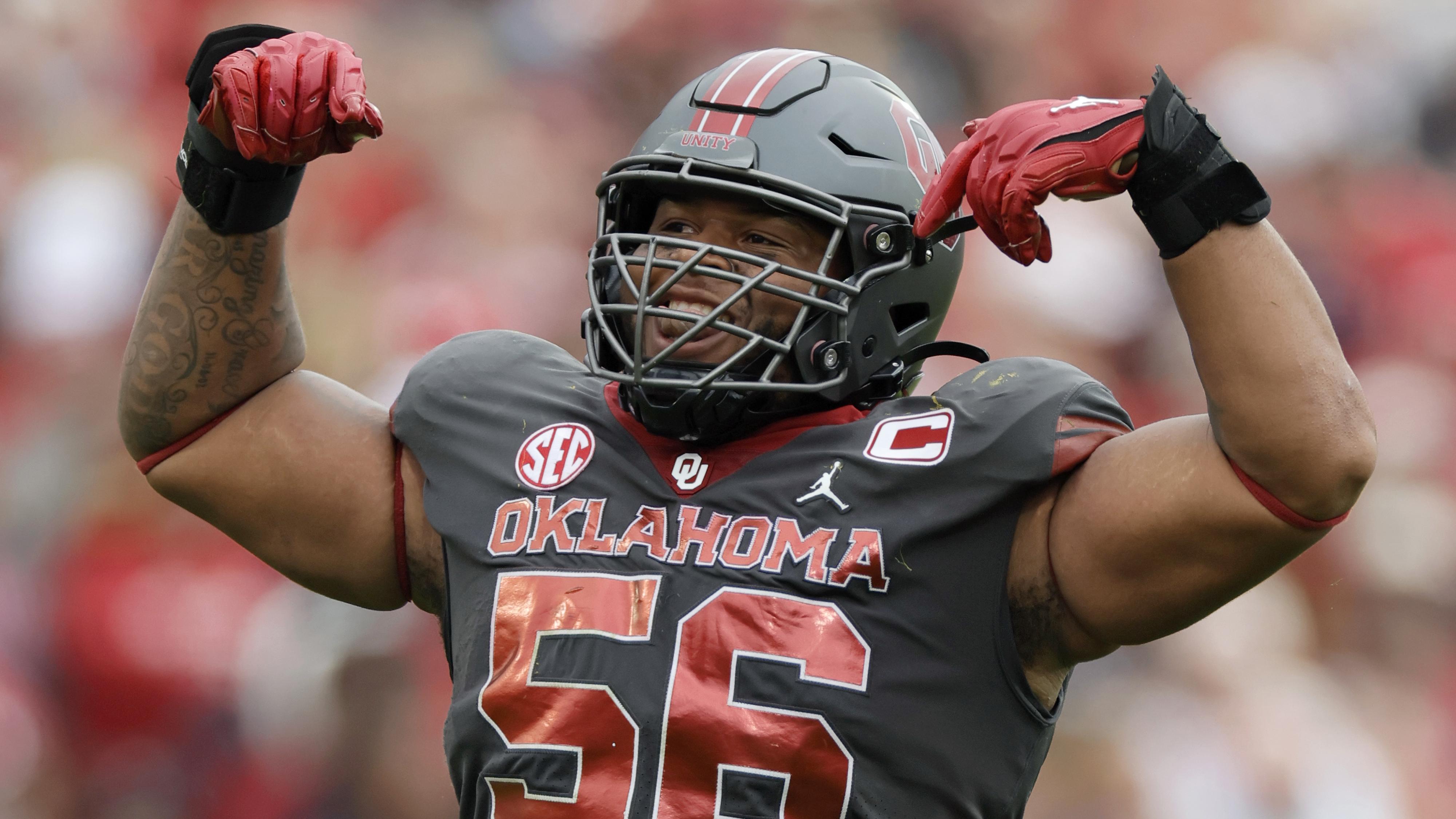
Gracen Halton (DT, Oklahoma)
Although defensive tackle is far from Seattle’s greatest need, there are a few things that stand out about Halton.
During the college football season he had multiple ‘jump off the screen’ games. The big question mark, however, was his size. You could clearly see there could be some issues there and he subsequently weighed and measured at the combine at 6-3, 293lbs with just over 31-inch arms.
However, he then put on an outstanding testing session. Halton jumped a 36.5 inch vertical and a 9-6 broad. He ran a 4.82 forty with a 1.70 10-yard split. At the Senior Bowl he reached a top speed of 16.6mph which was faster than EDGE rusher Romello Height (16.3mph).
Let’s compare this to Byron Murphy, another undersized defensive tackle who has played well enough in the NFL that nobody mentions he was 6-0, 297lbs and had 32 inch arms at his combine.
Murphy ran a 4.87 with a 1.69 split. Very similar times to Halton. He was also less explosive, jumping a 33-inch vertical and a 9-3 broad.
Admittedly they have very different body types. Murphy’s lower body mass is his calling card, enabling him to coil like a snake and propel into opponents to defeat blocks and double teams. Halton isn’t in the same boat there. However, his explosive testing and speed speak to a twitched up defensive tackle — and those are rare to find.
It speaks to his ability that his run defense grade was an 86.9 despite being sub-300lbs. Again, to compare, Murphy’s run defense grade in his final year at Texas was an 80.5. On top of this Halton managed five sacks in 2025 and 30 pressures. His 30 pressures were the most among any of the key draft eligible defensive tackles.
On tape he shows an explosive first step enabling him to shoot gaps with ease. His gap discipline flashes consistently and he makes plays within structure — playing a big part in making him such an effective run defender.
He has shown he can line up across the interior in different positions. His closing burst to the ball carrier is strong. When he gets his feet moving he’s difficult to slow down once engaged yet he’s slippery to escape blocks and burst through gaps too.
He doesn’t have the deepest repertoire of moves and relies on quickness but Murphy had quite a limited repertoire too.
Halton is a character fit. He plays with a fantastic motor, has a clear passion for the game and speaks with an authority. There’s a great level of maturity in the way he talks.
The Seahawks have the talented Rylie Mills to go along with Murphy and may not need another high upside interior lineman. Personally, I’m not sure you can have ever have too many. Interior pass rush is one of the most important factors in winning football. If you can win inside, you will cause chaos.
It’s also worth noting that Mills was 6-5 and 291lbs at his combine, with 32 5/8 inch arms. So the Seahawks are clearly open minded about defensive linemen in the 290’s with shorter arm length who can play both inside and defensive end, slanting in from different angles using quickness to penetrate.
Given his run-defense capabilities and the age of Leonard Williams and Jarran Reed, I’m in favour of considering Halton as a day two option. Murphy, Mills, Halton and then having one or two big-bodied veterans could be a reasonable idea for the future.
Cashius Howell (EDGE, Texas A&M)
I’ve written about Howell before but I wanted to add some extra notes to his blurb. After studying his interviews you can absolutely 100% tell he’s a character fit for this team. It’s very, very easy to imagine him in Seattle’s locker room — and his playing style matches that.
Running a 1.58 10-yard split at 253lbs shouldn’t be sniffed at. That’s not small in weight terms, even though the impression you get of Howell is he’s a smaller player because of his lack of length. He does have dynamic short-area quickness.
The problem is the lack of length is so extreme (30 1/4 inch arms) that it’s really hard to imagine he’ll be playing a high percentage of snaps. He is perfectly set for a specialist role rushing the passer. He could also be very good at creating pressure in obvious passing situations.
That’s the problem sometimes with a player like this though. He could play four years for you, play 40-50% of the snaps, collect a decent number of sacks and then what do you do? The sack production would dictate a certain level of salary that you might not be able to justify based on his snap percentage. You may be resigning yourself to a one-contract situation.
Equally, if you’re banking on a specialist role, it caps the range where you can take him. Unless you genuinely think with sub-31 inch arms he can be an every down player (I find that hard to believe), you can’t really take him in the top-40.
He could be a quicker Yannick Ngakoue. Ngakoue had 70.5 NFL sacks in his career but bounced around eight different teams because he was more of a situational rusher. Nobody really wanted to commit long term.
Howell is athletic enough to avoid college tackles and he’s a high effort player. He needs to win with quickness though. His hand-use is non-existent and he lacks power. He will try to avoid contact rather than engage and rip through. There are some reps where he doesn’t even consider trying to engage, with his arms almost locked by his side, as he tries to skip by tackles. It’s highly unorthodox.
There is very little chance he will win with speed-to-power at the next level.
He could also be a liability vs the run in the NFL. Is he really going to be able to set an edge? Although it’s worth noting his run-defense grade in 2025 was a 73.6 which was better than Gabe Jacas, LT Overton and Malachi Lawrence.
He can catch tackles on their heels with his quickness. He’s developed a euro-step move to beat tackles. He can sprint to the edge and dip around contact. Yet he doesn’t really have a counter when his initial plan stalls, he doesn’t drop into coverage with ease and can you live with one big shove ending a lot of his pass rush attempts?
Like Ngakoue he might be a player who collects sacks winning isolated reps but his overall impact is a net-negative as an every-down player.
As I said before, I think the draft media got carried away talking about this EDGE class and that was proven at the combine. There are a lot of names but it’s more a case of quantity over quality. It’s a class full of players with a fatal flaw in their play or physical profile. You can fit players into roles but there aren’t any you can confidently project will be every-down dominators.
With Howell, he can probably replace Boye Mafe if you keep everyone else. Perhaps if they can sweeten the pot for DeMarcus Lawrence to convince him to play on, this could be an option.
Hezekiah Masses (CB, California)
The cornerback drills at the combine are among the best for checking on translatable traits. The backpedal, transition, ability to change direction, whether a player has loose hips and solid footwork.
Masses really impressed in Indianapolis and the tape study backed that up.
He shows really good feel and understanding in coverage. He correctly comes off routes, reads the play and then breaks on the ball. His backpedal and transition are smooth and he’s able to keep his eyes on the passer when in motion.
He mirrors superbly and is just so sticky in coverage whether that’s over the middle or on the red-line. He traces receivers across the middle and outlasts them with his speed. His production in his final season ramped up with five interceptions and they weren’t flukey picks either. His angles to the ball and instinct was clearly on show when playing the ball. He appears to understand the knack of playing in zone better than, say, Brandon Cisse currently. You can see how well he masters his assignments, gets into position, reads plays and reacts how he needs to in order to be a playmaker.
On top of the five picks he had a NCAA leading 18 passes defended.
His grade in zone for 2025 was a 90.0. Only Chris Johnson and Devon Marshall scored higher. This is important to note given the Seahawks run zone about 77.5% of the time.
He’s very aggressive attacking WR screens, disengaging off the front block to disrupt/hit the receiver.
It’s not all perfect, which is why he’s not being projected as a day one pick. He had a lot of flags. I think most were technical contact issues that can be fixed but it still warrants mentioning. In total it’s 14 flags in the last two seasons.
He also had some whiffs, including four touchdowns tagged against him. His tackling technique also needs work.
Even so, I thought Masses gave off a bit of an X-factor vibe. I think this is a player who, with the right guidance, could turn into something really good.
He’s 6-1 and 179lbs with 31 1/8 inch arms and ran a 4.46. He’s not an amazing athlete (31.5 inch vertical) but his movements are so fluid and quick on tape.
I think he’s a really good day two option.
Bryce Lance (WR, North Dakota State)
He’s a very natural, fluid athlete. When he gets going he’s tough to catch.
Lance ran a 4.34 at 6-3 and 204lbs — adding a 41.5 inch vertical jump and an 11-1 broad. He shows easy movement skill and isn’t at all stiff for a longer bodied receiver.
His production is excellent with 25 touchdowns in the last two seasons. He dropped three passes in 2025 and his run blocking is nothing to write home about. However, there’s so much to like about his dynamism as a receiver.
Lance has massive YAC ability because of his speed and explosive traits when he gets a crease. He will accelerate quickly and leave defenders for dead. His height is a big winner in the red zone and he still manages to gain quick separation in tight quarters.
His speed and acceleration is staggering when he gets going. There are multiple examples where he just takes off like a sports car.
His body control is excellent and he dodges the jam and releases with suddenness. In terms of tracking the ball, he adjusts very well.
His competition level is what it is but you want to see players jump off the screen in this setting and he does that. He is going to be a pain in the arse to cover in the NFL if he can settle into the demands of the league and match the physicality at the next level.
One final note — he is not a big-time catcher away from his frame. There are a lot of body catches. That could be an issue. But overall there’s enough there to think a mid-round pick would be a worthwhile investment.
DeMonte Capehart (DT, Clemson)
On tape he stood out with some big flashes — but with no hype, it was hard to know what to make of him — especially as the tape was a bit inconsistent. Then at the combine he ran a 4.85 at 6-5 and 313lbs. He added a 33.5 inch vertical and ran a 1.71 10-yard split. He has 34-inch arms and 10 1/4 inch hands. This is a tremendous physical profile, so it’s time to increase the interest level.
He shows the power to throw off blocks acting as a nose tackle. When he makes contact it can get violent and there are snaps where interior offensive linemen end up on the floor courtesy of Capehart.
He plays with very heavy hands that often overwhelm opponents. He can be devastating at times when he gets the right pad level and drives blockers backwards. If you want someone to push the pocket he can do it.
Despite his testing speed there were too many snaps where he didn’t show enough burst or quickness and he didn’t consistently penetrate gaps to shoot into the backfield as a pass-rusher. Indeed, his movement and agility was laboured sometimes which is surprising, knowing now what a dynamic athlete he is.
If you want a bull-in-a-china-shop DT that’s what he looked like. Now, you wonder if you can coax more out of him because the traits are there. My notes pre-combine asked — ‘will he be able to win exclusively with power at the next level?’ Now, I’m not it has to be that way.
Sometimes he plays too high and loses leverage. That’s not uncommon for tackles with his body type though. He does have an injury history.
I think he’s very intriguing, even if it’s just to work within a rotation.
Mason Reiger (EDGE, Wisconsin)
He performed well at the combine so he was one of the my first studies following the week in Indianapolis. He ran a very solid 1.61 10-yard split at 6-5 and 251lbs and jumped a 40-inch vertical and a 10-5 broad. Those are intriguing physical tools. He does have shorter arms (32 5/8 inches) but massive shovels for hands (10 3/8 inches).
He’s very competitive and loves to launch head-first into tackles. His speed rush isn’t fantastic. He doesn’t ‘ole’ his way beyond the tackle for a lot of bend-and-straighten wins. He’s more of an attack dog who wins with twitchy anger. Reiger is more comfortable battling through contact. He finds a way through, rather than just blowing opponents away with speed or speed-to-power.
He plays with a great motor and it’s not unusual to see him pinball-ing past defenders to find a route to the QB. He has shown the ability to use his hands to disengage and swipe away contact. He generally does a good job getting off blocks one way or another.
When he goes for an inside counter he’s shown the ability to deliver a wonderful swim move paired with quickness. It’s a winner.
He had six sacks on a struggling Wisconsin team in 2025, plus 45 pressures. His win percentage was 15.9%. His run defense is solid enough but it’s effort, not anchor based.
After transferring from Louisville I think he’s shown on tape and at the combine that he’s worth adding as a rotational piece who could develop into something more significant in time.