
This is a guest article by Curtis Allen…
The link between a good Quarterback and a successful team is one of the most foundational principles in the NFL. While the team with the best Quarterback does not always win the Super Bowl, no one position can affect a team’s success more.
Therefore, teams are on a continual quest to make the position work for them. First, they must find a Quarterback who can take them deep in the playoffs. Once they have one, they turn their attention to managing his next contract within the scope of the salary cap, which at times can be no less challenging.
The Seahawks are obviously in the latter group. Sam Darnold has proven to be a good fit with the team, and their Super Bowl window is wide open. His superb performances down the stretch and in the playoffs have cemented that feeling. It is reasonable to conclude that both sides are thrilled with their partnership and desire that it to continue for the foreseeable future.
That means working out an extension. Darnold will be entering the last year of his contract in 2027. While the team has done excellent work extending Rashid Shaheed, Jaxon Smith-Njigba and Derick Hall this summer, a Quarterback contract is the fulcrum of a team’s salary cap. It is not far-fetched to think that the Seahawks negotiated those contracts with a Darnold extension in the back of their minds.
Having led the Seahawks to a Super Bowl win on one of the most reasonable veteran contracts in the league, we are all bracing for the impact of what will no doubt be the biggest contract in franchise history.
The biggest question on everyone’s mind is: Can the Seahawks pay Darnold commensurate with other top Quarterbacks and still field a championship-worthy roster?
Answer: With an extension that is properly structured, they absolutely can in 2026, 2027 and 2028. The 2029 season is the first real point they will have to assess where they are with Darnold and consider some decisions.
How?
A Contract Sketch
I picked a rate near the top of the market to give us an idea of what we can expect: $55 million annually. As we discussed recently there are several Quarterbacks in line for new contracts. That number will not be the top of the market by the time a new contract is signed. If Darnold has another strong season, we can expect a contract to be somewhere in that range.
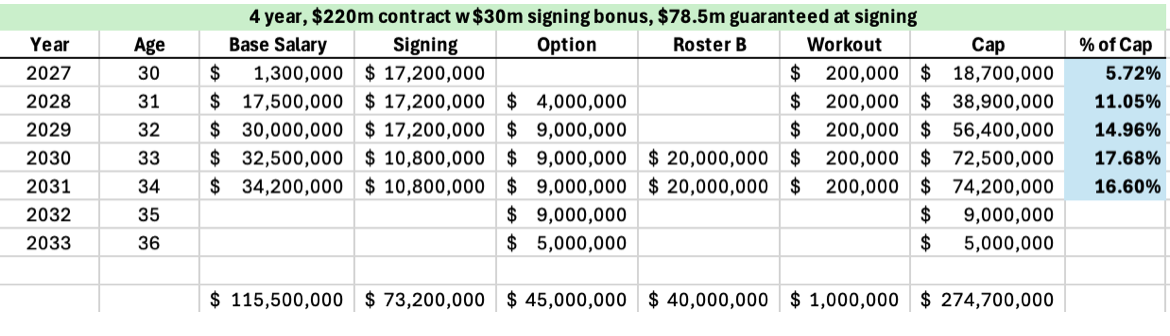
The contract details: Every penny of Darnold’s 2027 salary that can be converted to a signing bonus ($24 million) has been.
There are option bonuses in 2028 ($20m) and 2029 ($25m) and roster bonuses in 2030 and 2031 of $20 million each.
The first-year cash is an extremely healthy $55.5 million. With the option and roster bonuses, Darnold essentially gets a nice lump payment every year aside from his salary.
The Seahawks reduce Darnold’s 2027 cap number by $23.2 million. By substantially lowering his cap hit, they create room for extensions or acquisitions to strengthen the roster.
The Seahawks can escape the contract with a slight cap savings in 2029 before the option bonus triggers. It would mean a large dead cap hit but is doable. This gives them two seasons to draft or develop a Quarterback behind him, or simply an out in case they deem it necessary.
If they want to keep Darnold, they can gain as much as $26 million in cap room with a restructuring in 2029.
That year might also be a pivot point for the roster. Current team pillars DeMarcus Lawrence, Jarran Reed, Leonard Williams and Cooper Kupp will likely be gone. The Seahawks are set up nicely to fill their voids with players such as Derick Hall, Byron Murphy, possibly Rylie Mills, Tory Horton and Elijah Arroyo. Plus, they will have three more draft classes on the roster contributing at some level.
That is not to say with the contract I proposed, the Seahawks must do something with Darnold’s contract in 2029 in order to remain competitive for a championship.
Have a look at the “% of Cap” column on that table. The Seahawks would commit acceptable amounts of the cap on Darnold’s contract in 2027 and 2028. However, in 2029 the contract takes almost 15% of the cap, almost 18% in 2030 and 16.6% in 2031.
At first glance, it would appear to be a major obstacle to keeping their Super Bowl window open through those years. Why?
In the salary cap era, only two Quarterbacks have won Super Bowls while counting for 13% or more of the salary cap: Steve Young and Patrick Mahomes.
With all due respect, Sam Darnold is no Young or Mahomes.
That would seem to suggest that the Seahawks should not pay Darnold his value and should start searching for their next Quarterback right now.
That does not have to be the case. I would argue the Seahawks could very easily make an extension like this allow them to still pursue multiple shots at a championship with Darnold leading the way.
The 13% number is not an inviolable barrier that teams must respect at all costs. It is not as black and white as it seems.
Quarterback Contracts and the Pursuit of a Championship
A closer look at the Super Bowl winners and losers the last ten years reveals that the 13% of the cap threshold really needs some context.
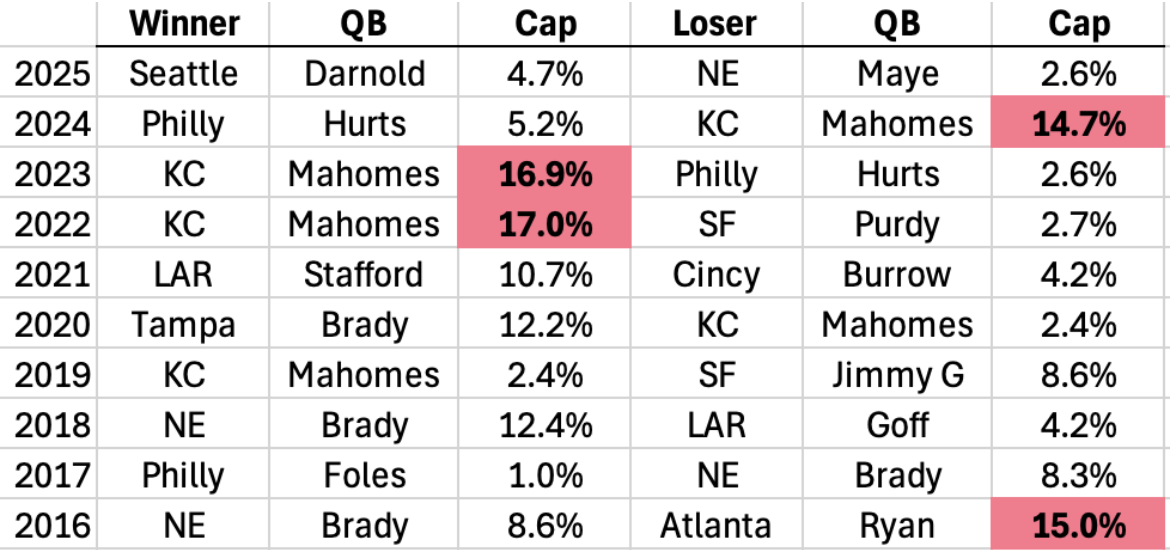
There are a few instances where the low numbers are honest: the Quarterbacks on rookie contracts. Drake Maye last year, Brock Purdy in 2022, Joe Burrow in 2021 and Mahomes in 2019 and 2020. I say they are honest because those cap percentages reflect what the players are actually paid by their teams to start.
Yet look at Jalen Hurts. 2.6% in 2023 and 5.2% in 2024. Those are not numbers from his rookie contract, but rather his 5-year $255 million extension. Why so low? The Eagles placed $97 million of void year money on the end to finance those crazy low numbers. If they paid Hurts on a ‘regular’ contract his numbers would have been between 12-15% and he would be right there.
Plus Matthew Stafford. The Rams paid him 10.7% of the cap in their Super Bowl year. However, to acquire Stafford in trade with Detroit, they had to commit to eating $24.7 million in dead cap money they had paid to Jared Goff. Figure that in, and the Rams are over 20% spent on their starting Quarterback in their Super Bowl winning season.
By the same logic the Seahawks committed more than Sam Darnold’s 4.7% last year. They took a near equal amount of dead cap on Geno Smith’s contract to make it happen, so their number is closer to 10%.
The point being, contract structure and cap manipulation have greatly affected those numbers. Teams still have to find a way to pay their star Quarterbacks top dollar, and those numbers are not fully reflected when the ‘under 13% standard’ is discussed.
Therefore, the Seahawks can sign Darnold to a very healthy extension, with a couple of years at the end that are above that 13% number, and then take steps like restructuring to take that number down and pick up some cap room.
The Cincinnati Bengals did just that a few weeks ago. Joe Burrow’s cap number for 2026 was at 15.2% but to finance the acquisition of Dexter Lawrence, Boye Mafe and Jonathan Allen, they restructured his deal and Burrow now sits at 11.9%.
There is another method of handling a Quarterback contract over 13% teams have employed successfully: ignore it and improve your team in other areas. There are several ways to do it.
Look at Matt Ryan in 2016 on that graphic. He sat at 15% and but for an all-time comeback by the Patriots, he has a ring. They did not lose the game because of some cap math.
Stafford last year was at 16.9% and got very, very close to winning it all. I think we can all agree that if they had found a way to beat Seattle, they very likely would have been able to beat New England for the title.
This method is gaining steam across the league: This year, Stafford is at 15.4%, Justin Herbert 15.2%, Josh Allen 14.7% and Dak Prescott 13.1%.
With John Schneider’s ability to draft and Mike Macdonald’s ability to mold talent, I can see the Seahawks sticking with a 14.96% cap number for Darnold in 2029.
Then in 2030, they do a little restructuring to get the number down and in 2031 get the number down again by extending Darnold or exploring other options.
The Seahawks have been successful with Quarterback contracts near the bottom of the market. This next challenge will be to win with a contract that is much more expensive.
It is true that having a big cap number for your Quarterback narrows the margin for error. Yet with creativity and a commitment to constantly develop the other parts of the roster, it absolutely can be accomplished.
The Seahawks can extend Sam Darnold and keep their Super Bowl window open.