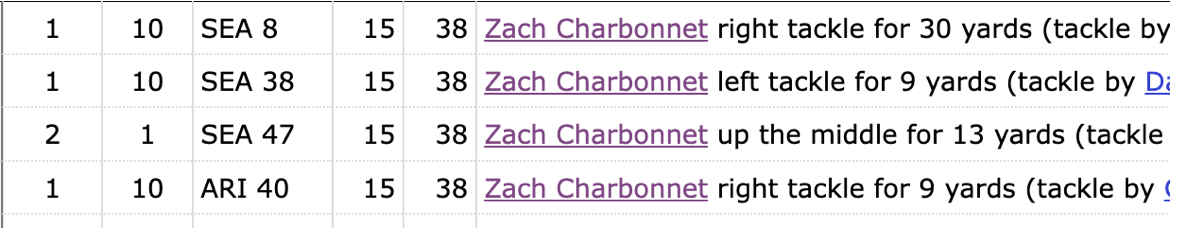
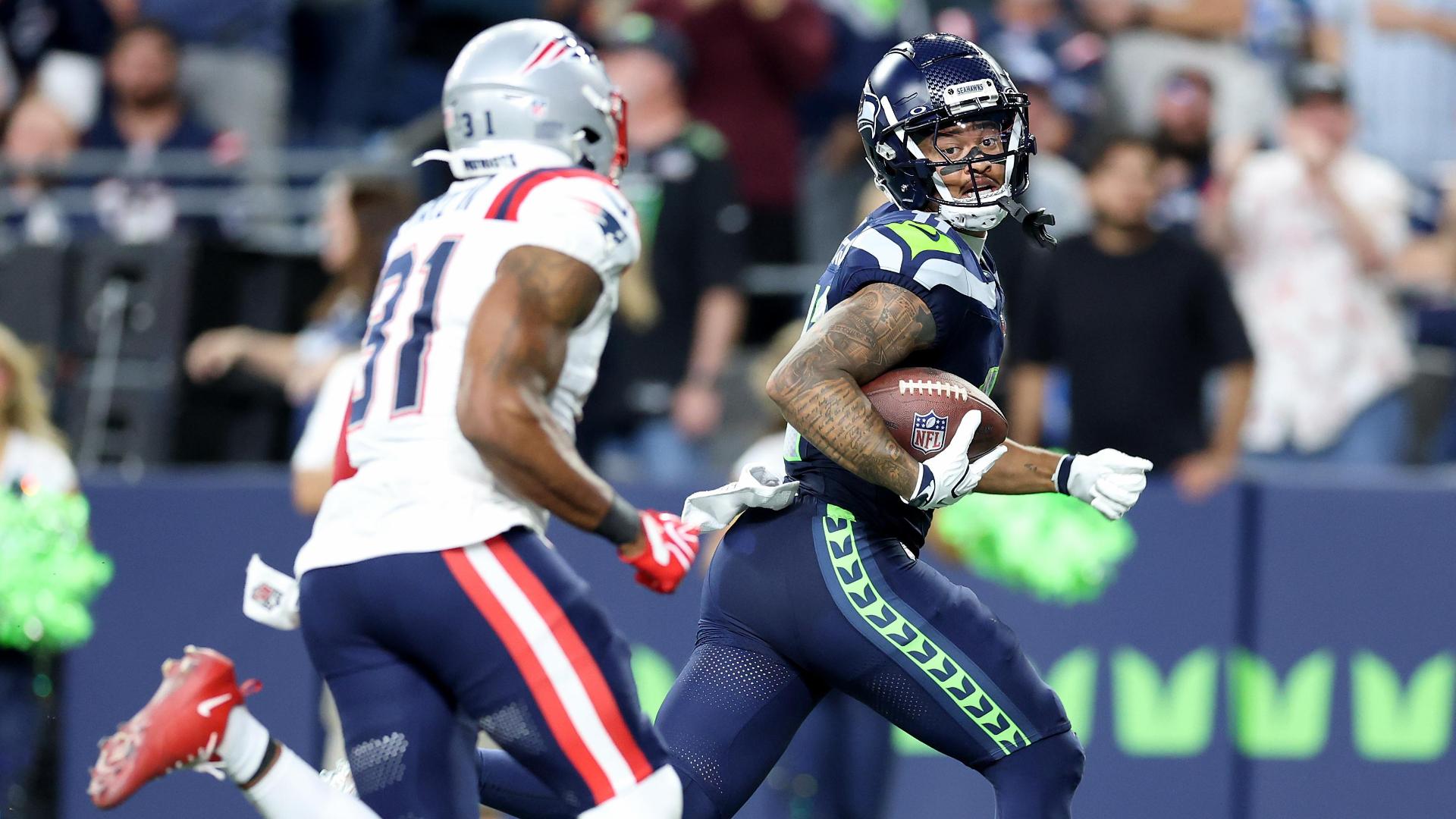
The Seahawks currently hold the NFL’s longest winning streak against another team, with nine wins against the Cardinals.Even more impressive – they play each other twice a year.Most winning streaks of this type are against teams that do not play each other often (for example, Seattle also has an eight-game streak going against Philadelphia).
The offense then slammed the door shut with this soul-crushing sequence:
It was a sign of things to come for this team on their way to the Super Bowl.The formula found a very high expression in this game:build up a lead, then play defense to keep the opponent out of the end zone, and run the ball to ice the game.
As much as everyone would like another win like that today, the truth of life in the NFL is a win is a win, even if it is rather unpleasant, like Week Four last year against the Cardinals team.The Seahawks dominated statistically but let the Cardinals stay in the game and ultimately needed a Jason Myers field goal at the buzzer to win it.
The Cardinals have a new coaching staff, picked Jeremiyah Love #3 overall and have installed Jacoby Brissett as their starting Quarterback.
They are 1-0 after a surprising win over the Chargers in Week One.
How did they win?They controlled the game script by putting several long drives together, trading minutes for field goals.It kept the game close.When the Chargers starting getting desperate, it led to mistakes and the Cardinals were able to capitalize.
With only one game in this new regime, trends and tendencies have yet to fully emerge.So, it falls on Mike Macdonald and the staff to prepare a game plan that works for them.Still, there are some familiar elements the Seahawks can employ to have success.
Week One Lessons Learned
The win last week was thrilling and exhilarating.
And much harder than it could have been.
Ten penalties do not begin to tell the story.It is when they were called during the game.
A 34-yard Pass Interference call in the end zone by Josh Jobe that led to a Patriot touchdown.A sloppy late hit by Derick Hall on Drake Maye that extended a drive and moved field position.Chazz Surratt with a roughing the kicker penalty that let the Patriots keep the ball and kick a field goal.An “offensive offsides” penalty by Anthony Bradford (after they had overcome back-to-back false starts) that killed a drive.An illegal motion flag that wiped a touchdown off the board.
That is not just a lot of penalties.It is a lot of key penalties.Plenty of teams end the game with ten total penalties and they can shrug them off because they did not hurt the outcome too terribly much.
The Seahawks are not one of those teams.They played sloppy, undisciplined football and it nearly cost them.It cannot happen again.
On the bright side, we all let out a sigh of relief that Jason Myers had a good performance after a shaky preseason.Myers was responsible for seven points, more than the difference in the game.He needs to keep that momentum going.A relapse to bad form could really cost the team.As we saw above, he saved the Seahawks from themselves in Week Four.
It would instil a ton of confidence in the team and fanbase for Myers to have another perfect game today.
And lastly, Drew Lock.After some shaky series, he calmed down and ran the offense well.He showed exactly what the team needs from him in a starting role:run the offense within its parameters and do not be a hero.Get the ball into the hands of his playmakers and let them work.The defense and special teams will do the rest.
Thankfully two of these three factors worked well last week.If the Seahawks can clean up the penalties while scoring high marks in the other two factors again, Arizona’s strengths and weaknesses will not be as big a factor in this game.
Get To Jacoby Brissett
Brissett is not unlike Geno Smith:He is 33 years old, he has bounced around the NFL looking for a full-time starting job, and he has found late-career success with a team that needed a breath of fresh air after parting ways with their franchise Quarterback.
Another similarity to Smith:When he is comfortable, he can be accurate and deadly.When he is not, his effectiveness plummets.
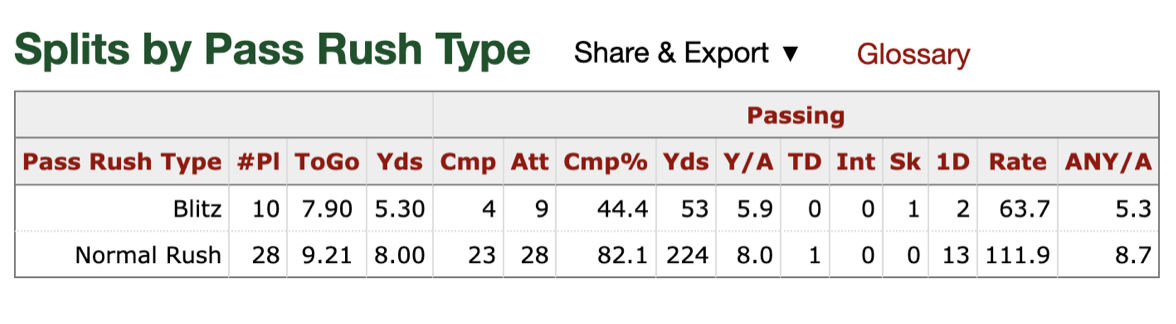
Have a look at his stats from Week One:
All-Pro when he’s comfortable, rookie scrub when he’s blitzed.
The key here is the Chargers cannot apply pressure in normal sets sending only four rushers.Blitzing for them is the better option and yet they decided to blitz a Seahawk-like ten times.
Brissett diced them up.He had fifteen completed passes of nine yards or more.The Cardinals finished the game with 15 more minutes of possession time than the Chargers.
It is critical that the Seahawks get Brissett uncomfortable.His greatest strength might be that he does not put the football in harm’s way in the passing game.Not a lot of unforced errors are coming.
In Week 11 last year, the Seahawks blitzed only one more time than the Chargers did on Sunday.Yet they got more pressures, and Tyrice Knight’s ability to strip the ball twice tilted the game.
Sam Darnold only had to throw 12 passes in a 44-point win.
They just need to live up to their reputation and keep the Quarterback out of synch.
Brian Fleury and the Offense Need to Support Drew Lock
It was encouraging to see a competent second half from Lock and the offense.The first half was a bit of a trainwreck.Yet Fleury and Lock put together an effective plan that was more than just a Band-Aid on the offense.
Now, they have had a full week to get Lock ready.There may be a temptation to run out more of the playbook than is necessary.If the defense is as effective as it had been against Arizona, a slightly less aggressive plan than they would have rolled out with Sam Darnold may hit the spot.
Fleury dialed up several plays that Lock could run without well within his capabilities.He was able to scheme receivers free for Lock, and when the team needed Lock to make an effective throw, he was up to the challenge.
It should be noted that the Chargers ran this kind of in-breaking pass route against the Cardinals several times with success.
Between the running game and options like the Tight Ends and quick passes to Jaxon Smith-Njigba and Tory Horton, the offense should be able to run somewhat close to capacity.And with Drew Lock’s arm strength, a deep shot is not out of the question.
The Cardinals do try to disguise blitzes and can occasionally dial up a big play on defense.I believe that play was on Justin Herbert for either not sliding protection to where he thought the rush was coming from pre-snap, and also not utilizing a hot read or just throwing the ball away.
It will be very interesting to see if Fleury furnishes the team with an effective offense with their star Quarterback out.
What a treat that would be for Lock to only need to throw 12 passes in a comfortable game.
Within this deep yet overrated quarterback class for 2027, there is a player who genuinely deserves more attention.
Ever since Trinidad Chambliss got an opportunity, thanks to an injury to now-Missouri quarterback Austin Simmons, he hasn’t looked back. There was clear growth and development on tape last season. By the end of the year he was absolutely dynamic for Ole Miss as they very nearly reached the college football playoff final.
He started the 2026 season delivering layered throws, taking big shots downfield to the speedy Deuce Alexander and throwing with timing and anticipation over the middle. He’s won a shoot-out against Louisville and then guided the Rebels past Charlotte.
One of the best throws Trinidad Chambliss has ever made
On Saturday he comes up against LSU and his former coach Lane Kiffin. This is a huge game for obvious reasons. If Chambliss can deliver — his stock will likely sky-rocket. Frankly it should already be higher than it is. He’s showing the necessary skills to believe he has a pro-future and he’s producing the kind of growth and standard that many of the bigger names simply are not.
Equally, if he struggles in this game, I’ll have to temper some of this talk. It’s the kind of showcase occasion that can help make a player.
Here’s what I see when I’ve watched his games from 2025 and his first two performances of 2026…
Chambliss throws with excellent touch, even when scrambling. He shows off easy arm strength and can zip throws into tight windows comfortably, putting passes in-between pockets of defenders. He can put the ball wherever he wants it to go without too much trouble or massive effort.
He legitimately throws with timing and anticipation unlike many of the quarterbacks eligible for 2027. There is a complexity to his game you simply don’t see with the rest. There’s also clear evidence of throwing receivers open.
Trinidad Chambliss throwing with anticipation and attacking the middle of the field
He knows when he needs to drop, set and get the ball out quickly. The best example of this was a 3rd and 5 vs Georgia in the playoffs. It’s a tied game at 34-34 with 30 seconds left. He sees the generous 1v1 to De’Zhaun Stribling outside so without any hesitation he drops, sets his feet and throws a perfect fade — giving Stribling an opportunity to run under the pass if he can create separation (which he does). It’s caught for a decent gain, setting up the game-winning field goal.
Admittedly it’s not great defense in the situation — but the quarterback understands the area to attack, he knows the matchup he wants and he doesn’t waste any time exploiting the situation.
He’s also an improv artist. In that same contest against Georgia he was scrambling away from pressure, extending plays whilst always keeping his eyes downfield. This enabled him to make some big-time throws on the run. He is clearly elusive and his scrambling ability is better than most.
If Ole Miss wins this game, these two plays from Trinidad Chambliss will live in Rebel Football lore forever.
When your quick-game is good and you can get the ball out quickly — but you also have a level of playmaking magic to your game — especially to extend plays when pressured — that’s a good mix.
He generates good velocity and loft to go with the touch on downfield throws. He delivers a very catchable ball. His ball placement at times is superb and for periods last season looked like his best quality.
Chambliss is very comfortable throwing over the middle and is not just operating a cookie-cutter system. He can layer passes into difficult spots. His accuracy does not suffer when on the move.
In the red zone his throws have good height and he will give receivers a great chance to win 1v1.
You want to see quarterbacks elevating their team. Chambliss took Ole Miss to a level Jaxson Dart could not. They were genuinely so close to beating Miami and playing Indiana in the final, having already knocked off Georgia.
His personality is very likeable. There’s no apparent ego or arrogance. He is well spoken and gives good answers during interviews. You are not going to have any worries about his character. On the field he shows a spark and a competitive spirit.
There will be talk of his size. He’s listed in the 6-0/6-1 range and that’s clearly not the ideal height. The bigger quarterbacks, who are also heavier than Chambliss’ estimated 205lbs, have stronger throwing bases and he’s likely already maxed out physically at this stage of his career. However, there’s enough on tape to believe he can overcome non-ideal measurables.
He threw 29 big-time throws last season — ranking behind only Dante Moore, Ty Simpson and Diego Pavia (all had 30). He threw only three interceptions — considerably fewer than Moore’s 10.
How can he still improve? There are times where he checks down too quickly and has telegraphed things a little too much, getting his close-range option hit in the process. You’d like to see him stick on his read a little bit longer when not pressured — or use his improv skill.
I’d also suggest that while he has a good arm it’s not a great arm. He is not going to cannon the ball 60-yards downfield. He produces plenty of zip to fit the ball into tighter windows and he varies his throwing speed — but he’s not Josh Allen with the deep-ball.
Other quarterbacks look like NFL prototypes. Chambliss, so far, has shown the superior skill-set to deliver at the next level. It’ll be fascinating to see how gets on against LSU.
Are the Seahawks digging around the college quarterbacks?
Apparently so — but I wouldn’t overreact to this.
According to Pete Thamel, who covers college football for ESPN, the Seahawks will be one of 10 teams frequenting the various press boxes (for those who don’t know, the scouts tend to share the space with the journalists bizarrely):
A crew of 10 obvious teams will have their scouts and executives filling college press boxes due to an immediate need at quarterback: the New York Jets, Miami, Pittsburgh, Cleveland, Indianapolis, Minnesota, New Orleans, Atlanta, Arizona and Seattle. (Seattle is because of Sam Darnold’s age/contract, the rest are for performance and need.) There are also some non-obvious candidates that could end up in the quarterback market, depending on performance, contract situations and management preferences. That group would include Baltimore, Tennessee, Carolina, Houston and Philadelphia. (This is a good year for a winning team with an aging starter or uncertain situation to wait to see what’s available late in first round or perhaps trade up, as there’s a bigger menu of options.)
It’s interesting that the Seahawks are described as an ‘obvious’ team to be scouting quarterbacks. I’m not sure if that’s a personal view from Thamel or something he’s heard doing the rounds within league circles. His piece includes various quotes from league personnel.
It still shouldn’t be surprising. As brilliant as Sam Darnold has been for the Seahawks, there’s a financial tactical game to be played in the very near future. We’ve just seen Baker Mayfield agree an extension in Tampa Bay that’ll put his cap hit in the $65-66m range for each of the next three seasons, starting in 2027.
If Darnold successfully returns from his glute injury and the Seahawks continue to thrive, he and his representatives could, and should, ask for more.
Even if this ends up being a mixed season for Darnold, he’s now a Super Bowl Champion and the unchallenged starter. Replacing him will be a major challenge. He will have a lot of leverage.
The Seahawks have to keep their options open. They have to know what the alternatives are. Or the potential pivots. That doesn’t mean preparing for life without Darnold — he’s contracted through 2027 anyway — it just means covering for all future eventualities.
We’re entering an era where quarterbacks of varying levels are being paid incredible amounts of money. It’s very possible teams will need to learn how to game the system — potentially switching to cheaper alternatives when necessary, unless they have a Josh Allen or Patrick Mahomes type, who you have to keep at all costs.
It is possible to move on and still succeed. The 2017 Eagles had a great roster. Carson Wentz got them to the playoffs. Nick Foles took over when Wentz injured his knee. The same roster, more or less, then returned to two more Super Bowls when the Eagles moved on from Wentz having drafted Jalen Hurts.
The Seahawks have a very strong roster and might have to weigh-up retaining that strength versus committing $60-70m a year to a quarterback. It’s a painful conversation to have and one I’m sure everyone would rather avoid. But this is the reality of football and a hard cap.
In an ideal world Darnold returns, the Seahawks continue to thrive, both parties come up with a very creative arrangement to reward the quarterback and limit the cap hit and all is well. In the meantime, you’re going to scout quarterbacks.
They did it during the peak years of Russell Wilson and they’ll do it now too.
So it’s not a big deal. It doesn’t mean anything at the moment. It might do in the future. But if you’re wondering why I’ll be including chunky quarterback analysis within the draft content this year — this is why.
And on that note, let’s discuss…
The deceptive way people are talking about the 2027 quarterbacks
Well done to Mel Kiper for finally presenting some sanity. In a piece published on ESPN today, he discussed the disappointing performances of the quarterbacks before adding this:
“So far, this quarterback class — one that was widely expected to be amazing — has underwhelmed. There’s still a lot of time. We’re only through Week 2. But I want to see the group level up and play with more consistency. This is the reason I don’t do rankings until October — we have to let these guys play a bit.”
Exactly this.
Years ago we’d have one or two high profile ‘way too early mocks’ published for a bit of fun (the clue is in the name). Now, in a world where clicks are king, everyone does one. And the same pundits feel obliged to publish ‘big boards’ and further mocks throughout the college football season.
Kiper is right. It’s too early. Todd McShay’s new top-50, published this week, is a great example. I take no pleasure in saying this but it’s not a good list. Demond Williams — the Washington quarterback who, frankly, probably won’t be drafted — is ranked 43rd. Oregon’s A’Mauri Washington — getting by on athletic upside when in reality he’s not a good football player — is at #22. There’s a long list of quarterbacks elevated well above their station. I don’t think the board is of any use to anyone.
Let the season play out. As Jeff Simmons rightly reminded everyone on our stream earlier this week — if you go back to week two of college football in 2019, most people would’ve had Joe Burrow down as a day three pick. A few weeks later he was in the middle of one of the all-time great college football seasons, he won the Heisman, LSU won the National Championship as they went unbeaten and Burrow ended up going first overall.
Big boards and mock drafts published now are designed only to titillate bored football fans. That’s all they are good for.
Meanwhile, the way this overrated quarterback class is being discussed is designed purely to generate excitement among the masses for — you guessed it — content and clicks. The idea of having a Manning family member as a headline act is too tantalising that it’s being ignored that he’s far too hesitant in the pocket, is not pulling the trigger when he has open receivers running across the field, is not throwing with timing or anticipation, or anywhere near enough accuracy, and does not look like a first round pick currently, nor ready for the NFL.
Dante Moore looks like Josh Freeman, the former Tampa Bay Buccaneers quarterback. Darian Mensah — a player nobody saw as a high first round pick when he was at Duke — is about to benefit from the Miami boost that jumped Cam Ward from non-Senior Bowl invite and expected day-three pick to first overall and now the latest quarterback struggling for the Tennessee Titans.
Oklahoma State’s Drew Mestermaker is one to monitor. He played well against Oregon in a big win but has also thrown four interceptions in two games and is a week removed from losing to Tulsa. He has very limited experience (one season at North Texas) and there’s increasing evidence suggesting players benefit from playing more games before turning pro.
LaNorris Sellers and Sam Leavitt are not remotely close to playing at a high first round level through two weeks. Trinidad Chambliss has easily been the most impressive so far and when combined with how he played at the end of last season, the Ole Miss quarterback is the one who deserves more attention.
Right now this is more a class based on depth than top-end talent — with players needing to show they’re developing and improving. We’ve consistently said that throughout the summer, when the messaging has often been simply that this is an amazing class of QB’s.
But the point is — all of this could change over the next six weeks. So let’s talk through the process, analyse as we go along and avoid the temptation to rank everyone or mock players well beyond their means. If for no other reason than the players themselves seeing these wild projections and can be influenced, often not in a good way.
Scouting notes
Here are some of the players I’ve studied this week…
Reed Harris (WR, Arizona State)
He has a big frame (6-5, 220lbs) but is still able to create relatively decent separation. He’s not sudden and dynamic, exploding into his routes, but he’s not a lumbering big-man as you often see at this level.
Harris has great body control and ball tracking skills. He can read the flight of the ball then contort to make difficult catches. He also catches away from his body and doesn’t let the ball come into his frame. He regularly makes acrobatic catches when throws are not ideally placed. He had zero drops in 2025 and you can see why.
When he’s running a deep route he can sprint away to create late separation downfield. He’s extremely difficult to cover 1v1 and if you throw it up to him — his size and superior ball-tracking usually means he comes down with it. He’s adept at coming back to the ball and will trigger PI penalties at the next level if he can retain the ability to get in behind.
He’s not bad running with the ball in his hands but he’s not a YAC threat really. You’re not doing much in the way of screens with him. Neither is he likely to take a crossing route the distance when he turns upfield.
It’s believed he’s capable of running a sub-4.5 at his size and that will likely be the acid test for his stock.
To his credit he has produced for a struggling Boston College team last season and now an Arizona State offense breaking in a new quarterback. Harris has natural ability and now it’s just a question of seeing what his upside level is with his frame.
One other thing to note is he’s working with Hines Ward at Arizona State. This is turning into another strong class of receivers and Harris is definitely one to watch.
Reed Harris has a blend of fluidity, long speed, and nuance that is RARE for a 6’5, 220lb WR 👀
9 REC, 189 YDS, 2 TD vs Texas A&M in the first of many big games—massive potential to rise up boards for the 2027 NFL Draft: pic.twitter.com/Et1XZLHCIb
Lauck plays like a bouncer at a club, in a good way.
Firstly, his frame and playing style appears tailor made to move inside. That was my first instinct. He doesn’t seem to have great length and we’ll get on to his kick-slide in a bit. I just think he’ll make a heck of a left guard, rather than a highly drafted left tackle.
For Iowa he consistently gets into the right position to seal off the edge but he does it in a way I’m not sure will definitely translate. He doesn’t possess dynamic, explosive steps to kick-out and set into his drop. He uses extremely measured, shorter steps.
This helps him, at the moment, stay in control. As he’s not really exploding to the outside, he can adjust to combat any attempted inside-counter with ease. Yet it does mean when a defender comes screaming off the edge, he has to resort to trying to shove them off the bend of the arc and disrupt their path to the quarterback that way. I don’t think that’ll work at the next level.
Ideally you have those explosive, highly athletic movements in your drop combined with the length to play inside-out. Whilst he’s very competent playing this way in college (he didn’t give up a sack in 2025) I’m not sure it’ll continue in the NFL.
One big positive is he always stays square to the defender. It enables him to take-on opponents from a strong position. He doesn’t always have the ideal engagement technique and he’ll need to be more consistent shooting his hands into the right areas — but he’s brutish and aggressive enough to battle anyone and win.
He will leave it on defenders, sometimes after the whistle. He has also shown the ability to hip-toss players to the turf. Like most Iowa linemen, he gets out into space and the second level with ease.
There is a tendency to drop his head and bend at the waist at times. Again, all of the weaker areas can be masked by moving inside. Then you just let him maul people and get after it. I think he can be very good in that role.
The improvement Thompkins has made since his USC days stands out. He was always athletic, disruptive and had talent. Now he looks like a far stronger, grown-man defender.
He’s also quite unique. He lined up off the edge for Alabama at 6-5 and 300lbs against Kentucky. He had one sack where he actually dipped under the attempted block and ripped through to finish. On that play he showed better ankle-flexion than most of the pure EDGE rushers in college.
Thompson then had a second sack in the game where he used brute force to drive back the left guard into the quarterback.
He’s shown he can hold the point off the edge, keep his frame clean by extending his arms and pressing the block, then release to play the run. At his size that’s impressive. He’s also always going to be a threat to help set an edge at this size.
At USC he would sometimes get pushed around. Occasionally even when he made plays he’d get pushed back then counter to release and then run to the quarterback. He looks more powerful, bigger and rugged now. His run defense has certainly improved.
There are things he can do better. His arm-over still needs a bit of work and that has to be a staple for him at his size. Even so — he flashed a good spin-move at USC and against Kentucky he showed he can certainly convert speed to power. He even had a play in the game where he effectively dropped into coverage. At 300lbs.
He’s a fascinating player who can be creatively used across the line. He’s a massive ball of clay waiting to be moulded. He had six sacks last year and he should be able to top that after a strong start. This is a heck of a prospect.
He’s tall (6-5 is his listed height although I’m thinking more 6-3/6-4) and well sized (210lbs). Despite this, he’s quick. He’s not stiff like a lot of bigger safety prospects. In fact he can be really shifty when he steps on the gas and it shows with the tight coverage situations he finds himself in when he’s in the slot.
Lopa plays everywhere — free safety, the box, the slot, special teams. He’s the modern day player for the league that most teams will be looking for.
He’s really instinctive and has a knack for making the right read and being in the right position. He’s clever with it too. So often in college, quarterbacks are merely tasked with holding the safety then throwing to one half-field read. Lopa will often shape his body to mask his intention — for example, shifting to face the left sideline, then rocking his body to a the middle and racing to break on a ball thrown centrally.
He had a three-interception game against Syracuse and all three picks were different, highlighting his skill. Simply put — it’s not often you see a player with this frame with his range.
He can stick in coverage when playing in the slot far better than you’d expect for his size. At times his coverage is absolutely water-tight, it’s like he’s wearing the receiver. Even so, you can also line him up as a deathbacker and have him drop with ease, and also run to the line and deliver a tackle.
Aside from the picks there was one excellent play against Syracuse where he covered his man to the right sideline, read that the ball was going somewhere else and as the pass was being thrown, he’d already set off to attack the intended target. He was the one who ended up breaking up the pass. He covered two separate players on one play.
There is evidence of him coming up and hitting running backs in the hole. He ran into the Syracuse left tackle at one point and dumped him on his back, Kam Chancellor style.
This is a very interesting player — an Oregon transfer who they could probably really do with at the moment.
Kingston Lopa had 3 interceptions, 1 pass breakups, 3 stops, and 6 total tackles vs Syracuse
I said in my big summer scouting piece that the 2027 draft looks like a deep class overall — but that the quarterbacks were once again being massively overrated. That feeling has only been reinforced after two weeks of the new college football season.
Let’s start with Arch Manning.
There’s a thirst within the media for Manning to be a top player. A draft class including a quarterback with his second name is box office. The league, equally, will be desperate for Arch to live up to the hype.
I’m convinced this is why we’re seeing a variety of ‘big boards’ with Manning listed at the top end. Dane Brugler had him ranked third in his top-50 list for the Athletic. I think that’s a preposterous ranking personally. The idea of Manning being an elite prospect is attractive. The reality is very different.
If he was called Arch Smith instead, we wouldn’t be putting him in this lofty position. The Ohio State game, fourth quarter comeback or not, highlighted exactly why.
On numerous occasions he was staring down wide open receivers, not pulling the trigger, holding on to the football, then taking off and scrambling. ESPN kept showing replays where they’d freeze the footage to show an open crossing route, with Manning looking right at it, yet choosing not to throw.
This is Manning’s greatest problem. He is just so hesitant in the pocket. But he’s not just hesitant for the tight window throws where you’d understand a young quarterback second-guessing things from time to time. He is looking at players who are wide open and for whatever reason, he doesn’t let it rip.
His interception the previous week was bad enough — a red zone situation where the receiver is open very quickly and it’s a basic set, drop and get it out to him. He hesitated instead, pumped, then threw far too late into coverage and was picked off. In the NFL — you are almost never going to get the open opportunities he had against Ohio State. If he’s over-thinking these passes and missing opportunities, how on earth is he going to live in a world where every throw is a tight window, every decision needs to be quick and you need to play with timing and rhythm?
Then there’s his accuracy, which also continues to be a problem. There are far too many high and wide throws, making life difficult for his receivers. You almost get the sense that any completion creates a situation where people are going ‘see, he can throw with accuracy’. Great. Nobody’s saying he can’t complete *any* passes, or that he lacks physical talent. He is simply not consistently accurate enough to warrant any first round talk at this stage in his career.
Manning’s best aspect is when he runs around, creates, and tries to make things happen. But he resorts to this too often. The fact is he’s rejecting the easy throw, the throw the offense has designed for him to make, in preference of scrambling, far too often.
Let me be clear — I’m not suggesting he can’t improve and work on these glaring issues to become a possible high pick in the future. But you can only judge what you’re seeing in the here and now. I’ve watched eight games from 2025 and his first two games from 2026. He is not a first round prospect at this point.
My prediction is he won’t declare for the next draft unless we see a major shift in performance over the next few weeks. I think he needs games. Two seasons as a starter won’t be enough. He’s not making enough progress.
Jeff Simmons messaged me to suggest Brock Osweiler as a comparison. I think that’s a fair comp for current-day Arch Manning.
He’s not even the best quarterback eligible for the draft (far from it) — let alone the third best player at any position in the class.
Then there’s Dante Moore at Oregon. The Ducks scraped by Boise State last week and lost to Oklahoma State this week. They stood out as a major overrated team coming into the year — with their best players being projected way above their means and a serious lack of depth in behind.
There’s no better example than defensive tackle A’Mauri Washington. Touted by many as a first round pick (#23 on Brugler’s board) — he simply isn’t a good football player. He’s a good athlete. That’s it. In this game he was consistently pushed around in the run game, he isn’t stout, he offered no pass-rush threat and then he limped off injured. This is who he is.
Bear Alexander and Matayo Uiagalelei are very average prospects too. They are a team very reliant on the offensive system, yet lost their top offensive coordinator to Kentucky in the off-season.
That means it’s up to the quarterback, who many project as the likely #1 overall pick next year, to elevate his team. He didn’t do it against Oklahoma State.
He missed a wide open 4th and 2 throw in the first half. He was under no pressure. You *have* to make the play. Throw it softly into the receivers body and it’s an easy completion. In no world should that receiver be having to extend his arms away from his body:
Dante Moore could have been the first overall pick last year.
Could he have caught it, regardless of the pass being slightly off? Yes. But that’s beyond the point. This should be a very easy completion and Moore makes his receiver work harder than necessary (the view from the endzone was even uglier on the placement of the throw).
There were several other similar misses — air-mailing a pass to talented receiver Evan Stewart and botching a swing-pass. He started the game 1/7 passing.
He is big and rigid and lacks creativity. Yes his mechanics are sound and he has the size plus a decent arm. But he just looks very average to me — not someone you’d expect to take the league by storm. What special qualities does he have?
On a 4th and 6 in the fourth quarter, he bootlegs out to the right and his read is covered. So he just burns the throw into the turf. It’s fourth down. You’re trailing by five points at this moment. There’s just under seven minutes to go. Improvise. The scheme told him the play — and he couldn’t shift on it, with the game on the line, so he just throws it away.
His processing in this game wasn’t great and he threw multiple dangerous fourth quarter throws. It said it all with about four minutes to go. Oregon were trailing by eight and yet kept trying to run the ball for the tying score. They didn’t just put the ball in Moore’s hands.
He did have a 36-yard touchdown to the deep left that was well thrown. He delivered a very catchable ball with a good arc. He dropped it in with touch.
Moore reminds me of Josh Freeman, taken 17th overall by Tampa Bay in 2009. Freeman was a 5.00 runner — and Moore similarly doesn’t have the mobility and quickness to move around and create. He has a decent arm, he’s well sized (although not as big as Freeman). I can imagine their careers following a similar path. I don’t think he has any kind of special quality to become a top NFL passer.
I’ve spoken to people recently in the scouting world who share these same concerns. Indeed, there seems to be far more league buzz around Darian Mensah. I have reservations there — he’s looking very polished so far but playing for Miami is becoming the cheat-code for boosting your stock. They aren’t really tested in the ACC. He gets to throw to Malachi Toney, who would be a top receiver in the NFL today even though he’s only a sophomore. Toney should be the Heisman favourite, not his quarterback. They run the ball effectively and protect at a reasonable level.
Mensah still has to put the ball in the right places and play on time — which he’s done very well so far against two bad opponents. He’ll also likely avoid the brain-farts Carson Beck had a year ago, meaning he’ll likely play at a consistent enough level to keep enhancing his stock. Nobody was calling him a future top-five pick at Duke or Tulane, though. We should remember that. And he doesn’t quite have the physical tools of Cam Ward — who equally used a spell at Miami to propel himself to a level that was probably beyond his capabilities.
For me, Trinidad Chambliss continues to be the standout quarterback prospect. His processing is just on another level — as is his ability to throw with anticipation and timing. He’s hugely creative and can make magic happen on the run. He elevated his team last season and appears destined to do it again this year. He’s not as trendy as some of the other ‘bigger name’ prospects but he’s the best quarterback prospect as of today.
Through two weeks, there are no signs LaNorris Sellers has taken a step as a passer despite the switch to the ‘Art Briles’-type offense in South Carolina. He was off all night against Towson, completing just 10/23 for 96 yards and zero passing touchdowns. His interception was unfortunate and on the receiver flubbing an easy catch — but this was another game where his running (119 yards and a touchdown on seven carries) was his main key skill. He has a big arm too — but he simply isn’t developing as a passer.
Neither Julian Sayin (Ohio State) nor John Mateer (Oklahoma) played like draftable players on Saturday. Sam Leavitt threw three honking interceptions for LSU against Louisiana Tech. UCLA’s Nico Iamaleava didn’t play well against San Diego State and threw an abysmal interception in the red zone — throwing woefully back across his body into a crowded central area with a lofted, loopy pass that any of us could’ve picked off.
Drew Mestermaker played well for Oklahoma State against Oregon — but only after a miserable display the prior week in a loss to Tulsa. He has four interceptions in two games.
The truth is — this is a wildly overrated quarterback class again. I understand why draft media is invested in suggesting otherwise — but just as we saw last year, the truth will out. Overall it’s a deep looking draft with many attractive options at the other positions. Just don’t be fooled by the people arguing this is a great crop of QB’s. It isn’t.
Other notes from week two
— In many ways Oregon linebacker Devon Jackson looks massively appealing. He’s 6-2 and 242lbs and has been timed at a remarkable 24 mph on the GPS. He chased down Mestermaker on a 75-yard run in a DK Metcalf vs the Cardinals style ‘lost cause’ — forcing the quarterback out of bounds at the three-yard line and ultimately saving his team four points. He then ran back a tipped-pass 96-yards for a pick-six. He’s a great athlete and can also reportedly jump a 40-inch vertical. However, his long speed’s better than his burst. He can be a bit slow to react and run to the ball. He needs to do a better job shedding blocks and playing with more violence once engaged. He’s not a short-area quickness player who can change direction freely and he doesn’t come downhill to set a tone.
— Kenyatta Jackson looks like he could play in the NFL now. He’s big, carries an alpha aura on the field for Ohio State and he’s had a productive start to the season. He has eight pressures in two games plus a sack. His run defense was strong against Texas. He consistently set an edge and on one occasion smashed into a pulling center to hit the running back for no gain. He drove the tackle back into Manning for his sack. However, he also stuck on too many blocks in the first half and doesn’t play with great quickness, burst or ankle flexion. He did effectively drop into coverage on one snap. He could be an eventual DeMarcus Lawrence replacement for the Seahawks but it’s tricky to judge his upside without testing numbers. I’m not sure he’ll be a sack-artist in the NFL.
— Yhonzae Pierre at Alabama is in a similar boat. He looks like a NFL player with a great frame. He’s good in space, plays read/react like a linebacker and seems to consistently be around the action. However, he’s better playing standing up and doesn’t seem to have the ankle-flexion required to be a great edge threat, nor the blistering speed. He looks like he’d fit Seattle’s system too, but again — what’s his upside? I feel like we’ve seen a few Alabama EDGE/OLB types like this.
— Ohio State’s transfer safety Earl Little Jr is a blog favourite and he led the Buckeyes in tackles against Texas (11). He was consistently reading things correctly, playing to the ball and coming up to make tackles in the running game. He’s someone I liked a lot for the last draft and this should be a great opportunity to showcase his talent. He deserves more attention.
— Ole Miss receiver Deuce Alexander just has so much burst, quickness and spark to his game. He also plays with a competitive edge. He’s caught my eye in both games this season.
— I really hope Alabama receiver Ryan Coleman-Williams can ease some of the concerns over his drops because he’s such a dynamic player. He has limitless potential. However, he just looks so awkward and uncomfortable catching a football. If it ever clicks for him you could end up with a top, top NFL playmaker. At the moment though, even when he’s making catches, his technique looks poor.
— Two players I want to watch more of based on Saturday — Wyatt Young the Oklahoma State receiver and Mi’Quise Humphrey-Grace the defensive lineman of Kentucky.
— The Seahawks look like they need more speed/quickness off the EDGE and could easily find themselves in the market for a pass rusher in the off-season. Princewill Umanmielen is off to an electric start this season. He has five sacks in two games and 10 pressures. He’s not just winning with speed off the edge — you’re seeing counters, you’re seeing hand-technique. It’s said he can run a 1.51 10-yard split. He’s a very intriguing player and one to keep an eye on.
— Indiana receiver Charlie Becker and Oregon’s Evan Stewart are both legit players. Becker is a quarterback’s best friend — he can go up and make contested catches, he separates early in the route to present open opportunities, he has enough size to be a red zone threat and he catches cleanly and away from his body. A terrific player. Stewart’s injury history will need checking out but he’s just so dynamic and quick.
There are many great characteristics that make the Seahawks who they are.
For a sport that is often focused on how you play in the trenches, the quality of your quarterback or the play-calling — the Seahawks feel like a different beast.
Their elite-level professionalism has been showcased on Hard Knocks and throughout an off-season where the franchise once again had to combat having the words ‘defending champions’ associated with the franchise. They’ve been able to draw a line, move on and return for another go.
The maturity of the roster is highly impressive. The veteran leadership, mixed with a blossoming younger core, seem to be driven in a way that is not usual. Take Devon Witherspoon for example. No hold-out. No hold-in. No big contract drama, even as talks over an extension lingered. He was at work every day, including the voluntary parts of the off-season. The mentality of the group is highly impressive.
Last night we also saw how well crafted the team is. Players who you typically wouldn’t have highlighted as necessarily being key to the game, stepping up to deliver big moments. Josh Jobe, Nehemiah Pritchett and of course, Drew Lock.
It speaks to the development work of the staff and the front office for consistently producing players who are capable of being developed in the first place. The environment helps — as does the approach of the individual players.
It was an improbable victory. Trailing 10-0 in the second half with your backup quarterback on the field, a first-time play-caller who lost his starting QB after the first drive and the defense, whilst keeping a lid on things, hadn’t produced much in the way of pressure and hadn’t had a sniff of a turnover.
It felt like they might go scoreless at one point, let alone win the game. And everyone had to come together to turn it around.
Suddenly the defense burst into life — the juggling Pritchett interception seemed to light a spark and make everyone believe. The defense ended the game with nine TFL’s, three sacks and three picks.
The offense began to flow — with Drew Lock moving on from a nervous looking first few series to suddenly appearing to be in complete control.
Let’s also not forget special teams. Jason Myers, after a challenging three pre-season games, made every kick with every point being hugely important. Michael Dickson also produced a typically excellent performance.
It was a ‘team’ win from the best team in the NFL. A shining example of what truly makes the Seahawks special. It’s not the glitz of a Hollywood quarterback or the diva superstar. It’s not a front-loaded roster, acquired at extreme cost, in an attempt to buy a title.
It’s a carefully crafted, expertly coached, driven bunch of individuals who have each other’s backs. It’s the grit of the group to stare down the most bleak situation — losing your quarterback after one drive, whilst also playing without other key starters — and still finding a way to win.
For a Head Coach like Mike Macdonald, he must constantly marvel at the character shown by his team. The Colts win. The Rams game in week 16. The NFC Championship rematch. Now this. Perfect examples of not knowing when you’re beaten, fighting through the tough moments and delivering under the biggest spotlight.
Granted, a truly awful second half from Drake Maye contributed greatly. The interceptions were, by all accounts, gifts. And for such an experienced staff it was bizarre how the Patriots handled being 10-0 and 10-3 up against a team facing such adversity with injuries.
Yet you’ve still got to capitalise and the Seahawks did. In a weird way, the Patriots come out of this game with greater quarterback questions than Seattle. Maye had a great season last year but he’s now on a stretch of games, including the playoffs last season, where he’s been a little bit exposed. The Boston media are starting to turn and he’ll be under pressure now.
Meanwhile in Seattle — clearly losing Darnold for any length of time would be massively suboptimal. Yet there’ll be renewed faith in Lock in relief after this performance. And the rest of the team has shown it can rally, galvanise and battle through in support. They can win games within this situation — let’s just hope Darnold’s MRI produces good news and this will merely be a short-term issue (although the way he left the field yesterday and then immediately went for further medical checks suggests it won’t be a quick return to football).
I am leaving Seattle later today and returning to the UK but wanted to say a few things on the trip. Firstly, the hospitality of the people of the PNW has once again been astonishing. There were several moments during the week where I’ve been blown away by the generosity shown to what is essentially a random journalist from Rotherham who happens to write a blog about the team we all share an interest in.
To Brian Nemhauser, who again has gone above and beyond, thank you. To Jason Puckett for an excellent evening, to Curtis Allen and Robbie Williams for their company, to my buddy at UW, to Curtis Rogers and Stacy Rost, to the fellas at Simply Seattle and anyone who came and said ‘hi’ during this week. Thank you. This is a wonderful part of the world, with even better people.
Finally to the community here. I doubt any of this happens without people engaging, contributing and making this, in my admittedly biased view, a great place to talk Seahawks.
A national spotlight on Hard Knocks that further underlined what this team is all about.
An historic sale of the franchise.
It has been quite the 2026 for the Seattle Seahawks so far.
Determination to shut all of that out and focus on the task at hand has been the next challenge for Mike Macdonald and John Schneider.They have said all the right things this summer and the players have bought into the concept.
They can talk the talk.Now it is time to see if they can walk the walk.
The Seahawks start the season the way they ended it:with a matchup against the New England Patriots.
What is mainly different about these teams?
For the Seahawks, Riq Woolen, Coby Bryant and Kenneth Walker are gone.They have brought in a collection of Cornerbacks, Safeties and Running Backs to fill their spots, most notably Jadarian Price and Julian Neal.Offensive Coordinator Klint Kubiak is in Las Vegas now, replaced by Bryan Fleury.
For the Patriots, Wide Receivers Stefon Diggs and Kayshoun Boutte have been replaced by A.J. Brown and Romeo Doubs.Center Garrett Bradbury has been replaced by Left Guard Jared Wilson, with Alijah Vera-Tucker taking the Left Guard spot.K’Lavon Chaisson has been replaced by old friend Dre’Mont Jones on the edge and Jaylinn Hawkins has been replaced by Kevin Byard at Free Safety.
It is fair to say that while some of the players on the field have changed, the fundamental truths that made the difference in the Super Bowl will still be very prominent for this game.
Here are my Super Bowl Watch Points posts from February:
We saw that the defense providing interior rush on Maye proved to be very effective.In fact, the Seahawks only blitzed ten times on their way to a 34% pressure rate that included six sacks, ten bad throws and two interceptions.Attacking the interior carried a lot of the weight on defense.
The Patriots are still vulnerable there.
Vera-Tucker’s last game was January 2025 and Jared Wilson (yes, this Jared Wilson) was a shaky rookie last year and is now changing spots to play center.Lining up across from one of the NFL’s best interiors is a very tough ask for Week One.The Seahawks must take advantage and move Maye off his spot.
Helping unbalance the game a bit is that Treyvon Henderson is out for this game with a nagging ankle injury.Rhamondre Stevenson will carry most of the load.
Offensive Coordinator Josh McDaniels will also try his patented blend of misdirection and changing defenders’ eye focus, then taking shots to burn defenses deep.This time around, he has A.J. Brown to work with, an upgrade over Diggs and Boutte.No doubt players like Nehemiah Pritchett, Anthony Thomas and D’Anthony Bell will have critical roles behind the linebackers.It will be a very interesting test of the defensive staff’s acumen to see if they can make the game plan work with depth players at one or two key spots.Last year, a depleted backfield was the biggest difference in Week Five’s loss against the Buccaneers.
Okay that third one may not have been from the actual game.But just look at Kenneth Walker’s run chart to see how much success he had in their wide zone scheme:
The first offensive play of the game for the Seahawks was a Walker wide zone to the left for ten yards.
Have the Patriots vastly improved at the edges of their defense?No they have not.
Do the Seahawks have a player who can take advantage of poor edge setting?
In the passing game, the Patriots will likely still rely on the “blitz a lot and pray” model, given their lack of effective pass rush.In the Super Bowl, they blitzed 23 times (to Seattle’s 10), getting a very nice 35% pressure rate.They recorded one sack and forced Sam Darnold into eight bad throws, but none were interceptions.
This is a key area to keep an eye on.Darnold knows he did not have a good Super Bowl.Having a better game will require that he torch the Patriot blitzes mercilessly.
One key way to beat the blitz was something we saw time and again in training camp this year:having Jadarian Price leak into the flat and be a safety valve for the Quarterback.If the Seahawks are able to time up some blitzes with a play like this, Price can really open things up.All the more so if the defense gets their signals crossed.
New Factors to Consider
— Week One is always a mix of the unknown.Teams keep their training camps under wraps more than ever and many do not even give their starters snaps in preseason games anymore.Mike Macdonald and the staff need to be sharp on their adjustments to what the Patriots are rolling out on both sides of the ball.
— The sword cuts both ways though.Brian Fleury is making his debut as a play-caller and putting in more pre-snap movement will be very interesting to watch.Perhaps he can catch the defense off guard.He also has envious depth to work with.A deep group of Tight Ends might provide opportunities for mismatches, particularly if they are not aware and put a slower Linebacker on Elijah Arroyo.
— Mike Macdonald has praised Tyrice Knight for his camp, noting that Knight is ‘making his job hard’ in finding ways to get him on the field.It should be noted that Nick Emmanwori was used often in a Linebacker role on the field.It would follow that Knight can take some of his snaps if Emmanwori cannot make it, which seems increasingly likely.Do not forget – he can be a very effective blitzer.
-Sam Darnold and Rashid Shaheed have demonstrated far better chemistry in training camp this year than they did in games down the stretch.Shaheed had a lot of great moments but often was just slightly out of synch with Darnold on deeper passes.All credit to Christian Gonzalez for a gorgeous breakup, but look at Shaheed slow down just enough when tracking the ball to allow Gonzalez into the play.It also happened in the first Rams matchup Week 11.It can be hard to time up passes with a track-speed level runner.If Darnold can hit Shaheed deep on one or two plays, that could flip the game for the Seahawks.
— The A.J. Barner touchdown in the Super Bowl was such a blown coverage, I would be tempted to run it again and see if both Linebackers – having watched the tape several times this offseason – overzealously bite to cover him and leave the Running Back all alone in the flat.