This was a real treat — to visit ‘Seattle Sports’ in person and join Bump & Stacy. Please do check the video out below! And like/leave a comment on the YouTube page as it all helps.
Category: Main (Page 4 of 99)
A mixed bag from the quarterbacks
There’s a definite thirst among draft media’s big players to talk up the quarterback class. I still think we’re seeing familiar issues on tape.
Take Arch Manning. In my season preview we noted he hesitates too long in the pocket and needs to learn to throw with better anticipation. Yet he’s started this year in exactly the same fashion.
Look at his red-zone pick against Texas State. He pumps then throws way too late over the middle into traffic:
Arch Manning throws an interception into triple coverage to close out the half😬 pic.twitter.com/YlcQyCcZNQ
— College Football Report (@CFBReport) September 5, 2026
The commentator says the defender reads the eyes but in reality, the receiver is wide open. There’s no reason not to get that out — Manning’s delay and late throw made it an interception. That has to be a see it, get it out of your hands and execute play. You cannot ever throw late into that area, in that much of a shortened field. That’s a basic fundamental flaw that he still hasn’t fixed, clearly.
You can clearly see his mobility on tape and he has a good arm. I would say he threw with far better touch in this game than we saw in 2025. To me though, it’s way too early to be talking about him as a high first round pick. Name recognition is doing a lot of heavy lifting at the moment — but let’s see how his season progresses.
Oregon, who give off a distinct ‘good not great’ feel again, toiled a bit against Boise State. That at least created a good test for Dante Moore, who barring something unforeseen will be the first quarterback drafted next year.
He’s well sized, he has an ideal combination of height and bulk (he’s 6-5 and can easily play at +215lbs). In this game he showed off the most natural mechanics — a drop, set and throw that is extremely polished. His release is smooth and he has easy arm strength. Generally he makes it look easy throwing to all areas of the field.
The offense at Oregon is still restrictive though for evaluation and you’d like to see more challenging reads. It’s a lot of half-field stuff, or over-matched defensive backs struggling to cover Evan Stewart.
There’s also not much in terms of ‘wow’ moments — little crazy improv or downfield magic off platform. In the NFL things will break down and you need to make things happen in that instance. Can he do this? Or is he going to need to need to be a very effective ‘execute the system QB’ supported within a top offense?
He’s also not fast — he is not going to be a big running threat. This does mean he often sticks and climbs in the pocket rather than taking off, so it’s not always a negative (see: Sam Leavitt in a moment).
In the pre-season preview I discussed Nico Iamaleava as being arguably the most naturally gifted of the draft eligible quarterbacks. However, he needed to play with greater consistency, take a step in his overall play and stay on the field. I don’t think we saw a great deal of evidence of that against California.
Iamaleava played with far too much hesitation — he kept patting the football, unnecessarily hitching and that led to his interception in the game. You’ve got to be able to play on time, with anticipation and accuracy. He has the tools to be a very good player — but that pick, along with several other plays where he just wasn’t processing quickly enough, stuck in the memory.
Someone who had no problems playing with timing and anticipation, delivering several ‘wow’ throws, was Trinidad Chambliss. He ended last year brilliantly for Ole Miss and in a weirdly open, back-and-forth second half against Louisville, he stood out.
There are very few of the quarterbacks we’re talking about for 2027 with the ability to anticipate this route, throw on time and execute. This is the kind of thing you have to do, albeit remarkably sped up, in the NFL:
ELITE anticipation from Trinidad Chambliss 🎯 pic.twitter.com/e7e6934y8L
— Coach Dan Casey (@CoachDanCasey) September 7, 2026
In a world of wide open receivers running free and reads where you only have to hold the safety in position then peal off to your only target on the play-call, this is a wonderful example of what makes Chambliss so impressive. He is currently playing at a far greater, more NFL prepared level than anyone else.
Against Louisville he threw over the middle into tight areas. He layered throws. He attacked downfield, using the extreme speed of Deuce Alexander in 1v1 situations to gain junk plays and/or score points. He can scramble to extend, throw on the run, make gains with his legs. The only downside is purely his lack of ideal size. Other than that, there’s a ton to like here.
I was not similarly impressed with LSU’s Sam Leavitt, despite the lopsided win against Clemson. His first two throws were off target and behind, leading to one interception. He seemed to throw into dangerous areas with bad ball placement too often and largely got away with it.
He drops his eyes far too quickly when he feels pressure and immediately sets off to escape. Where was the poise in this game? Stand tall, execute the system. He’s not a dynamic enough athlete to get away with this approach in the NFL.
There’s not enough arm strength. He under-threw badly a second quarter fade to the right sideline and then had a similar very average throw deep right. There’s hardly any loft or touch to his longer range throws, the arc is too flat and there isn’t enough punch.
Look at this screen grab below. It’s an attempt to Trey’Dez Green wearing #7. He is open and there is a lot of space in front of him:

This throw goes incomplete. Why? Because Leavitt doesn’t have the juice to just rocket that into Green. Instead the pass is too floaty and the defender can recover and he has more than enough time to come across and break it up. That was a big play waiting to happen and should’ve happened. It didn’t because Leavitt doesn’t have the arm.
The Lane Kiffin system has always featured a lot of high percentage throws and this game was no different. I didn’t see one complex, highly impressive completion against Clemson. He ran around and contributed, yes, but from a pro-evaluation stand point there’s very little to get the juices flowing here.
I thought it was very difficult to glean anything from Darian Mensah’s performance against Stanford. The Cardinal were no match defensively. Mensah really spent most of the game looking off to one side, then coming back to Malachi Toney and then just throwing him the ball. He ended up with 12 catches for 234 yards and three touchdowns. Toney is a cheat code — a clear very high first round pick who could already play in the NFL even as a second year player. His presence will clearly aid Mensah this year but it also might create a red herring situation where mass production through Toney is being viewed as Mensah driving forward his own stock.
For what it’s worth, I think it’s mildly insulting that Mensah is the current Heisman favourite. Toney, the man doing the Heisman pose after his touchdowns against Stanford, really is the one deserving of that attention.
Other quick non-QB notes
— Deuce Alexander had an electrifying performance for Ole Miss against Louisville and was virtually uncoverable in a foot race. Alexander consistently burnt-off defenders to run deep and he collected five catches for 159 yards and two touchdowns. He also used his speed well to drive downfield, fake the deep route and comeback to the QB. I think he’ll need to show a bit more polish and variety with his routes, plus he needs to clean up his catching technique, but there’s a dynamic player here. Per Bruce Feldman he’s been timed at 23mph on the GPS and can deadlift three times his weight. He is clearly a freakish athlete.
— I continue to fail to understand why Oregon’s A’Mauri Washington gets so much attention in draft media. Sure, he’s a good athlete for a defensive tackle. But there’s still little sign on tape that he’s actually good at football. Against Boise State I thought he was typically poor vs the run despite his size and he offered very little as a pass rusher. He missed a tackle too. He needs to reach a whole new level of performance to justify the hype and I don’t think we saw it in week one.
— Kenyatta Jackson at Ohio State is the opposite of Washington and perhaps deserves more love in the media. He had a fantastic eight pressures against Ball State — plus six hurries and two QB hits. Admittedly it’s weaker competition but that’s when you need these players to shine. Jackson isn’t ever going to fly around the EDGE and win with pure speed but he does everything else well — he’s tough, can work speed-to-power, he can set an edge, he’s well sized. He’s a good football player.
The new College Football season is underway but the first big slate of games comes this weekend. I’ll be attending the Apple Cup on Sunday during my week in Seattle.
For the last few weeks I’ve been watching 2025 tape on draft eligible players to get a feel for the 2027 class. Here are my notes…
Is this draft class as good as people are saying?
I think some of the stuff people have been saying, such as this could be the best class ever, is premature. Some position groups appear thin at the moment, although this could change during the season as players develop and emerge.
What I would say though is there’s definitely the potential for this to be a deep, thick class of prospects with some exciting, legit blue-chip players at the top end.
There are a lot of good draft eligible players. There are potential stars at the top end. It’s going to be one of the more interesting drafts to cover in some time.
Who are the potential stars?
At the very top you have Jeremiah Smith the receiver at Ohio State. You don’t need a big report from me on Smith. There is definite Julio Jones-esque potential here. He is a truly rare prospect who ticks every physical box you want at his position. He’s already produced strong numbers in his first two years for the Buckeyes — it would be great to see him go and reach the next level in 2026. He’s playing for a contender with a settled quarterback situation. There’s no reason why he can’t win a Biletnikoff and put himself into Heisman contention. It would be a surprise, even at this early stage, if he isn’t the first non-quarterback drafted.
The second clear star in the making is Notre Dame cornerback Leonard Moore. I can’t recall watching someone with his exceptional combination of size, natural cover skills, production and physical talent. He is tall — said to be in the 6-1/6-2 range — and yet his mirror and transition, his back-pedal, his ability to play well in both man and zone, his quickness, his length, his instinct — he looks like a complete package at the position.
Both players would likely be considered top-five players in any given draft class.
I think there’s a bit of separation to the next group but there’s still a lot of potential with the following players:
Dylan Stewart (EDGE, South Carolina) — he’s listed at 6-6 and 250lbs and plays with classic lean quickness. He’s very difficult to contain and can dip around attempted blocks and just explode to the quarterback. His length and closing burst are major weapons. There’s very clear evidence of him extending his arms to use his length to stack blockers. He will constantly concern tackles with his EDGE speed. When he fills out a bit and gains more strength he could be a speed-to-power dynamo. His burst has to be seen to be believed at times and that initial quickness will be a major X-factor at the next level. His run defense is surprisingly good for his frame — he’s very willing to take on blocks vs the run, get free and attack downfield. He looks like an outstanding athlete with amazing upside but will need to develop more of a repertoire in 2026. It would also be good to see better counter plans when his initial rush stalls.
Colin Simmons (EDGE, Texas) — His body looks well filled out for a player listed in the 6-3 and 250lbs range. He’s very quick and moves with ease. He’s patient when reading the play and doesn’t just go with his head down in attack mode. You see a clear football IQ — he seems to understand what’s going on and what his role needs to be during a given play, rather than just rushing the backfield. For example, he will take the outside shoulder to force runs back inside and do the dirty work willingly. He doesn’t go chasing the ball-carrier and wreck contain. His closing burst is excellent. He can man-handle linemen at the point of attack, shaking them off with disdain vs the run. He has very powerful hands and is capable of delivering a big jolt to the chest to disrupt blocks. He can turn the corner as a pass rusher but doesn’t have the unreal burst to attack the shoulder then bend and straighten. His EDGE rush tends to be tighter around contact. He doesn’t have the unreal ankle-flexion to change direction on a dime — he’s a little bit tight. However, he’s just so forceful that he often plows through contact to turn the corner.
Will Echoles (DT, Ole Miss) — he can really move for a 6-3, 310lbs defensive tackle. He’s capable of barging his way into the backfield. He had five sacks as a sophomore which is a good return and something to build on. His 33 pressures were sixth most among interior defenders in college football last season. His run defense is very good — he is athletic and disruptive but also stout and difficult to move. He doesn’t have the twitch of a lighter DT but once he attacks the outside shoulder he’s tough to stop. He can set-up a blocker to the outside, then use an effective arm/over to shift inside. If you line him up in the gap — O-liners struggle to get across and cut off the angle. If linemen overextend he will throw them down with disdain. He plays with a toughness and an edge. His initial contact is forceful with a powerful strike to disrupt and knock blockers off-balance. He already looked in 2025 like he could play in the NFL. He’s probably not going to be a game-wrecking pass-rush force but he still looks really good. He’s going to competently do everything you need at a good level. He possesses grown-man strength for such a young player. He has a big frame with thickness throughout. Just a really good football player.
Justin Scott (DT, Miami) — His quickness off the snap leaps off the screen for a 300lbs lineman. He can man-handle interior linemen and shove them backwards into the quarterback. He will bench-press blockers to keep his frame clean and keep his eyes in the backfield. He has an effective fake to the outside shoulder before dipping inside on the counter. He can absorb initial contact on the block and still jolt a lineman backwards to gain advantage. The thing you notice is how often opponents go backwards when facing him. He can work around contact when he sees a gap opens up and sprint to the QB. There’s evidence of him running to the sideline to make tackles despite his size. He has the instinct to get his hand up and try to tip a pass when he can’t get home. He’s just an absolute menace who will give O-linemen nightmares every week. He carries a well proportioned frame and looks like he can play multiple positions. He played a lot of snaps last season (505) which speaks to his conditioning. He can do a better job finishing (only two sacks last season) and technique refinement will be key here. He should develop a plan pre-snap — at the moment it feels like a lot of instinct and feel. He can learn to set up blockers more. He could use his explosive speed to attack the outside shoulder and rip through contact. It feels like he has a limitless ceiling to emerge as a top NFL Draft prospect if he can put together a strong 2026 season.
Kyngstonn Viliamu-Asa (LB, Notre Dame) — to me he looks like one of the most natural linebacker prospects in years. He constantly plays with his hips sinking into the turf, keeping low, then exploding to the ball. He’s very quick and can move across the line with great agility. He fires out like a cannon when he reads the play and reacts with violence. There’s clear evidence of him blowing up pass-protecting RB’s and TE’s. He’s extremely fluid working around blocks. So much show, he’s even shown an ability to dip his shoulder and round the arc off the EDGE as a pass rusher. He actually turns the corner brilliantly. His natural knee-bend for his size is impressive and enables him to keep low. He just moves so easily around the field. He’s extremely competent in second-level coverage and not just a forward-attacking player. He has tape where he drives the right tackle back into the pocket playing off the EDGE to show how much power he has. Stalks stretch plays to the sideline with quickness and discipline. Fills gaps in the line versus the run with ease and seems to enjoy it. He has good size for the modern-day linebacker at 6-3 and 234lbs.
Cam Coleman (WR, Texas) — There’s not actually a ton of separation on his Auburn tape from last year. However, he made several improbable completions in tight coverage. His concentration when making catches is at a high level. He can make spectacular one-handed grabs and contort his body to complete catches. Basically if you throw it in his general direction, he can make plays. This particularly works a treat in tight areas of the red zone and he still gives you a chance to score even when he’s well covered. He can round off routes nicely to comeback and present a target to the QB. He has shown he can make catches in tight windows across the middle of the field. There are examples of him extending his hands to catch away from his body. He has a nice, lean frame with good height. You see quickness off his release to challenge cornerbacks and he can get deep. You get the sense he’s only scratching the surface of his potential. I’m not sure Texas and catching passes from Arch Manning was absolutely the best move — but Manning will have a very consistent target to throw to and Coleman should make his life easier. A very natural receiver.
There are two other names I’ll mention quickly.
Ryan Coleman-Williams (WR, Alabama) burst onto the scene as a freshman and appeared destined to be a very high draft pick. Last season it felt like he disappeared — receiving fewer and fewer targets as the season progressed to the point it started to feel a bit like he was in the doghouse. I will say this though — he has clear twitch and change of direction skill and he uncovers superbly. He has the ability to cut back and break ankles to create with the ball in his hands. He can be used in a multitude of ways — conventional, deep, intermediate, YAC. He catches the ball away from his body. He has had several special moments in big games for Alabama and provides an X-factor element at his best. He runs the redline to maintain space to the sideline, then creates late separation squeezing the DB. He can adjust back to the football better than most receivers and his ball-tracking skills are great. It’s said he can jump a crazy 44 inch vertical and an 11-2 broad. He has shown a suddenness on tape that matches that level of freaky athleticism. He did have 10 drops in 2025 which is nuts and perhaps explains his loss of favour. But he has all of the talent in the world if he can have a get-right year in 2026.
I also think Kewan Lacy (RB, Ole Miss) is just such a fantastic talent. Every time I watched Ole Miss last season he jumped off the screen. He scored 24 touchdowns and was a workhorse — playing every game. He can hit home runs, he can get the tough yards. It’s difficult to project where running backs will go in pre-season but Lacy has the potential to be a high pick if he can build on last year. He is a little bit high-cut which teams typically don’t like. But he’s just so buttery smooth when running with the ball. He can run through or around contact. When he finds a crease he can turn a good run into a great run. His long strides gobble up yards when he hits top speed. He hits the hole quickly with a purpose to capitalise on openings and then when he reaches the second level the fun starts. He had 1,010 yards after contact last year — fourth most in college football.
Do any offensive linemen warrant a mention?
I think we need to see more from Trevor Goosby at Texas, who most are suggesting is a high first round prospect (I’m not convinced at the moment). Keep an eye on Ryan Baer at Pittsburgh. But the name to mention here is, unsurprisingly, another Iowa Hawkeye.
Kade Pieper will switch from right guard to center this year. He had the seventh best zone-blocking grade in 2025 (89.0) and only gave up one sack (vs Michigan State). He has the ideal center frame at 6-3 and 300lbs and reportedly runs a 4.13 short shuttle, a 1.52 10-yard split and jumps a 37-inch vertical. When linemen from Iowa put up these numbers, they typically go in the first two rounds.
He’s very quick moving upfield to the second level and he’s a block-finisher. He can extend his arms to control blocks and he’s capable of turning defenders to create lanes. He constantly resets his hands to control with good pad level. Pieper stays square and keeps defenders in front of him, rarely losing leverage. His feet keep moving forward during blocks when he’s latched on and he’s not a static blocker. He can be a tone-setting finisher.
He’s brilliant on the pull — quick, decisive and accurate with his hands, plus always in control. He’s one of the best pullers I’ve scouted. He’s shown an ability to competently combo-block and there are loads of examples where he drives defenders off the ball and dumps them to the turf.
Pieper excels in the red-zone to help finish drives in the running game. He consistently panics defenders and has them moving backwards, clinging on for dear life. He never plays with too much aggression and is always seemingly in control of his emotions. I’d call him a silent assassin as a blocker.
In pass-pro he drops and sets with ease and shows a strong back to anchor down. He’s shown he can move, turn his body against the grain and steer defenders from an angle. He’ll be able to play anywhere in the interior and looks like he could be a first or second round pick. My only quibble is he can over-extend sometimes and can play a little high.
Are some players being overrated in the media?
I’m not going to linger too much on negatives — I want this to be a positive piece — but I do think there are some players who need to show the hype is justified. A’mauri Washington (DT, Oregon) is more of an ‘athlete for his size’ than good football player based on 2025 tape. I’ve mentioned Texas’ Goosby but there’s absolutely no way anyone should be projecting new LSU tackle Jordan Seaton in the first round based on what he showed at Colorado. When I watched Ahman Moten Jr (DT, Miami) I didn’t see a first round player like many are suggesting and find him a weird player to analyse — given he’s 6-3 and 325lbs but his best skill is rushing the passer and I wish he did the basics better — anchor, control, take on blocks, tackle.
I think there’s a group of EDGE rushers who are being inflated in the media — Will Heldt, John Henry Daley, Quincy Rhodes, Clev Lubin, Anthony Smith and Matayo Uiagalelei. It’s not that they’re bad players — it’s just I think they are what they are and are being pumped up a little too much.
Players who might be a bit underrated
I have enjoyed watching safety Earl Little Jr and now he’s going to Ohio State he’ll have a great opportunity to showcase his potential. Kelley Jones, the cornerback at Mississippi State, looks like he should be really stiff given his frame is so long and big but he’s surprisingly capable in coverage. I think Ohio State pass-rusher Kenyatta Jackson has another level to reach and if not — he’ll give you everything as a physical force off the EDGE. Miami running back Mark Fletcher is a really fun watch and has plenty of talent. I mentioned Ryan Baer at Pitt earlier and I think it’ll be interesting to see how Justice Haynes the running back gets on after transferring to Georgia Tech.
Let me also highlight a kicker to watch who stood out to me in 2025 — Lucas Carneiro from Ole Miss.
So… quarterbacks
This is the one area I do think some people have got carried away. It’s not a surprise — the draft is big business now and the best way to engage an audience or readership is to sell the dream that quarterbacks are here to save your team.
A year ago Todd McShay (not to pick on Todd, but it helps illustrate the point) had Garrett Nussmeier as the #1 pick in his ‘way too early’ 2026 mock with Cade Klubnik at #5 and Drew Allar at #7. They went in the seventh, fourth and third rounds respectively.
Remember, although it turned into a universally viewed underwhelming quarterback class — a year ago, there was plenty of hope and expectation for the group.
For 2027 — I think it’s full of players with an absolute ton to prove. There are issues galore throughout the class — but also plenty of upside. It’s a deep group. Many won’t turn pro, weakening the numbers. The sheer depth of players available, though, will make for many a great debate over the coming weeks.
Let’s start with Arch Manning at Texas.
If he didn’t have ‘Manning’ on the back of his jersey, we wouldn’t be talking about him as a first round prospect. Let’s just get that out of the way. There is very little on tape to suggest he warrants that kind of talk. I also think he needs to take such a stride in terms of development that the chances are he may well return to college football in 2027 rather than turn pro. Based on his 2025 tape he isn’t close.
Now, he has the arm to throw from the left hash to the right sideline with good velocity. He’s not static in the pocket and keep’s his feet moving and eyes downfield. When the pocket opens up to scramble, he has the legs to make gains. There are tools to work with.
However, he hesitates in the pocket and needs to learn to throw with better anticipation. He waits far too long for players to uncover. He will throw dangerous passes into tight areas. He only had 17 big time throws and 15 turnover worthy plays last season. He doesn’t help his receivers by telegraphing passes, leaving them open to big hits.
He needs to throw with better touch downfield. There’s nowhere near enough plus accuracy on tape currently. He moves around too much sometimes — just drop, set and trust your read. He really only has one level of velocity and doesn’t vary his throwing pace enough. His best skill at the moment is his mobility but you want to see so much more as a passer.
The player who most of the mocks have at the top of the class is Oregon’s Dante Moore. I understand why. He’s big with an arm, he’s a former hot-shot recruit and there are definitely moments on tape to catch your eye. I’ve got to be honest though — I’m just left wanting so much more from him. A lot of his tape is quite boring. I can see the physical potential. I can see the flashes. At no point during the 2025 tape study did I think I was watching a future NFL star though. He did the right thing returning to Oregon to develop his game. He wasn’t ready. Let’s see if that changes in the coming weeks.
LaNorris Sellers at South Carolina clearly has extreme physical tools — a big arm, great running ability. Yet there are moments on tape where he simply doesn’t look like a player with a NFL future. South Carolina’s offensive line was absolutely dreadful last year so we’ll see if that situation improves. Plus with Art Briles’ son coming in as offensive coordinator, the system may now be tailored to make the most of Sellers’ talent. But he needs to become a productive quarterback, not just a player with physical upside.
The quarterback who I think might be the most naturally gifted is Nico Iamaleava at UCLA. He can drop, set and throw over the middle with accuracy and velocity. He flicks the ball out of his hand with ease. He showed last year that he can fit the ball into tight areas and can layer throws. He’s very capable of playing the short/intermediate game but can also challenge opponents downfield.
He can fire pinpoint accurate throws down the sideline, hitting his receivers in stride. I really like the way he fits throws in-between second-level defenders. He varies his velocity nicely — he has a fastball but also throws with touch. He can throw difficult deep-balls to covered receivers, throwing them open down the seam. He can complete difficult middle-of-the-field throws in the crowded red zone. He can attack the middle of the field with accuracy and has delivered big throws on third down — for example a big 3rd and 21 vs USC conversion in the fourth quarter. There’s clear evidence of throwing with timing and anticipation.
There is so much talent here — he just needs to be more consistent, stay on the field and produce. Iamaleava is a big season away from launching his stock into the stratosphere. He has all the talent you need to succeed.
He has a tall, lean frame. Can he add some mass to help protect himself against NFL hits? He can be absolutely dynamic as an open-field runner. You have to account for his legs at all times. When he sees an opening he can take off and glide for running gains. He shows great escapability and can dodge sacks and extend plays with his legs. He possesses a good sense of danger and will throw low/high when sensing turnover potential.
He does needs to avoid throwing late across his body. He also has too many ‘trusting the read’ throws and can throw blind into dangerous areas.
Can the new staff at UCLA tighten up his game and get him to deliver a complete season? It might not help that this is year one of a new regime. Is the supporting cast ready to help him realise his potential? If progress is made, could he be tempted to return next year to really finish with a bang and max out his stock?
The other thing to wonder about is his personality fit as an eventual leader of the locker room. The way he departed Tennessee will be studied by NFL teams closely. I’m not convinced he will be for everybody. One thing I’ve learnt in recent years is teams really do value an alpha energy, calmness in the huddle, doing things the right way day-to-day, leading by example. Iamaleava may well be capable of that. He was also still very young when he left Tennessee and clearly had maturing to do. I’m just not sure. It won’t matter if he can’t elevate his game to a more consistent level in 2026. If he does, the person will be scrutinised as much as the player. He has a ton of talent though — and that can’t necessarily be said for some of the other quarterbacks in this class.
In terms of the others — Trinidad Chambliss (Ole Miss) is also very naturally gifted and just got better and better as last season went on. His lack of ideal size is an issue but he is just so creative and capable of making magic happen. If he plays in 2026 the way he ended 2025 — he will rise, regardless of his size. He throws with unique touch, even when scrambling. He shows off easy arm strength. He’s a classic improv artist who can create and extend even when the play looks over. His scrambling ability is better than most. He has a good arm and is capable of throwing downfield with velocity. There are examples of superb ball placement — in fact it’s arguably his best quality. He’s comfortable throwing over the middle and can layer passes. His accuracy doesn’t suffer when he’s on the run. He’s good but small and would be a 25-year-old rookie next year. It’s also worth noting he lost two really good receivers from last year, including De’Zhaun Stribling.
I would be surprised if CJ Carr left Notre Dame after just two years as a starter. The only way I could see it is if he plays lights out, the team go on a great run and they perhaps win the playoffs. Then he might choose to leave on a high. I just think quarterbacks are going to be more conscious than ever of being ‘ready’ for the NFL — and game experience matters. Now that you get paid handsomely to play college football, there’s no rush any more.
I’ll be very interested to see how the Sam Leavitt/Lane Kiffing double act goes at LSU. Leavitt has sneaky creative ability that people don’t talk about and can definitely execute Kiffin’s offense. However, Kiffin’s quarterbacks are not often highly drafted players. Leavitt is unlikely to possess the physical tools to be a high pick but he could end up being an attractive late day two or early day three option for some teams with a big year. He’s very capable of making plays on the move and he’s a playmaker. He just lacks the real punch to his throws and he’s been banged up.
John Mateer at Oklahoma was threatening to build a compelling draft profile a year ago before his thumb injury derailed his season. Mateer at his best is a playmaker with his arm and legs. He’s also worked to fix some technical issues this off-season. He’s disappeared off the radar a bit given the way 2025 unfolded but I wouldn’t count him out just yet.
When Darien Mensah was at Duke last year, I thought he really grew into the season. He’s another slightly undersized player who lacks the elite level tools. However, he can function as a very capable starting college quarterback — who can do things NFL teams will like. Going to Miami, somewhat controversially, will give him a huge platform to elevate his stock just as players like Cam Ward managed. I remember watching Ward at Washington State and he didn’t look like a first round pick in the slightest. Miami made him the #1 overall pick.
I still think Mensah’s stock should be projected, for now, in the middle rounds at best. Is the physical upside truly there? I’m not sure.
Byrum Brown will be an interesting player to keep an eye on, having transferred from USF to Auburn. He’s a strong, athletic runner who can still make plays with his arm. Julian Sayin will likely have a good year for Ohio State but physically he just doesn’t have the tools to think he’ll be a high draft pick. NC State’s CJ Bailey had some standout performances last year but his supporting cast has been decimated by transfers, despite his decision to stay put, and the end result was a horror show against Virginia last weekend. He might need to go somewhere else next year to rejuvenate his stock.
I have to say I’ve seen very little from new Oklahoma State quarterback Drew Mestemaker to justify all the hype he’s getting online. I’m also not sold on USC’s Jayden Maiava being much more than a mid-to-late round prospect.
I wrote a piece about Brendan Sorsby, who’s sitting out the season, here.
Overall, there’s a lot of names to talk about. But I think at the moment people are just throwing first and second round grades at these players. There are too many question marks to feel that way about many of the 2027 eligible quarterbacks. Development is needed.
If you missed my latest conversation with Puck Sports discussing the Seahawks, click here.
And if you want to watch this week’s Seahawks Collective, click here.
— I’m intrigued to see what the plan at safety is. By cutting D’Anthony Bell, AJ Finley and Rodney Thomas, there is no depth behind Julian Love and Ty Okada. Presumably at least one of these players will be on the practise squad and then elevated for the Patriots game. It’s an interesting approach, though.
— It shouldn’t be a surprise that Trevon Diggs was cut. He was on a pitch-count to play about a quarter for the Chiefs game. He’s clearly building up after a long time without any consistent football in his life. He hasn’t had a full camp either. It always felt likely he would go to the practise squad, see how he comes along and eventually he might get called up to the roster, or elevated. This was a longer term play I think. (Note — Tom Pelissero is reporting Diggs will indeed be back on the practise squad).
— Having stashed Jared Ivey throughout last season, I wondered if a very active performance against the Chiefs might save him. Evidently not — it was too little too late. It’s a shame, we’ve needed to see a young D-liner emerge and that’s not really happened this off-season.
— I am surprised Cody White was cut and Montorie Foster Jr was retained. I think White is a better player. Foster Jr has shown flashes and it sounds like he had a good camp. There’s a reason he’s been featured on Hard Knocks and I’m sure the call to find out he’s made it will be a big emotional moment in Tuesday’s final episode. However, he’s tended to be pretty up-and-down in his performance. I think this is a position where they are probably one light.
— It’s a shame that Zach Charbonnet will have to start the season on the PUP — but it’s a good opportunity for Jadarian Price to hit the ground running. I can’t wait to see what he can do over the first month of the season. They will need him to produce though. I do wonder if they’ll lean on their passing game in the first couple of weeks. Who are you going to turn to in this situation? A rookie runner, or putting the ball in the hands of Sam Darnold and Jaxon Smith-Njigba? At least until things settle down with a new playcaller.
— Seattle’s last four picks in the 2026 draft were all cut (Emmanuel Henderson, Andre Fuller, Deven Eastern and Michael Dansby). I wouldn’t spend one second over-thinking that. This was one of the thinner drafts in recent memory. This was very much a priority UDFA range for players. It’s a shame none of them stood out enough to make the roster but it shouldn’t be unexpected. And they could all land on the practise squad and get another look down the line.
— Looking at the roster overall, I do think there’s scope for some business down the line. We talked about potential trades and they added cornerback Avery Smith today. I think as the season progresses, there might be some areas where they want to make some moves.
The #Seahawks and star Leonard Williams have agreed to terms on a 3-year, $90M extension to keep him in Seattle for the foreseeable future.
The three-time Pro Bowler made one last year and is still in his prime at 32. Now, locked in. pic.twitter.com/chVFvvRQ8R
— Ian Rapoport (@RapSheet) August 27, 2026
During the 2014 season, there were a whole bunch of reports suggesting the Seahawks had grown tired of Marshawn Lynch. The expectation was they were ready to move on.
Then, after a challenging 4-3 start to the season, they played the Raiders and Giants in back-to-back weeks.
Neither game was pretty. The Seahawks needed someone to get them out of a hole in both contests.
Lynch was the answer. They handed the ball to him. He was unstoppable. He won them both games.
Here’s what I wrote after the win against the Giants:
Replacing Lynch, a heavily touted move that suddenly appears annoyingly inevitable, will be the greatest threat to Seattle’s longevity as a contender. You’re losing a great player and you’re also losing a piece of your identity. It might force an early pick on a running back. It’ll probably lead to a drop in talent at the position. It could mean having to add multiple pieces — new running back, receiver, tight end — to compensate for the talent shortfall after losing one single player.
This is a debate we’ll need to have in greater detail down the line. But this kind of major surgery is deeply unattractive. And yet unless several high profile and storied reports are wrong — it’s going to happen.
A few days later I doubled down on the take:
Replacing Lynch will be the toughest thing this franchise has to do in the post-Super Bowl era. You could argue running backs are easy to plug into an offense. How else can you describe 29-year-old Justin Forsett posting 5.4 yards-per-carry in Baltimore as the fourth most productive runner in the NFL? I think for most teams it’s a valid point. But not for Seattle. Not with Lynch.
He is so integral to this teams identity. He is a phenom, a truly unique runner that deserves to be remembered as fondly as any other running back since the turn of the century. His physical style, ability to break tackles, his attitude on the field. These are not easily replaced by just plugging in another player. The moment Seattle loses ‘Beast Mode’ the team will also lose a part of its identity. There’s no getting away from that.
Why am I bringing this all up, you might ask? It’s because I’m getting serious deja vu thinking about what life will be like for the Seahawks when they don’t, one day, have Leonard Williams.
It’s not a perfect comparison. Lynch was basically the beating heart of the team, along with Kam Chancellor on defense. Williams is unquestionably of that ilk — but I’d argue the current-day Seahawks have about 10-15 players who similarly carry that emotional value. Look at the ‘leadership council’ on Hard Knocks for example. There were 11-or-so players in the room with Mike Macdonald.
Also, Williams doesn’t have the ‘can’t live with him, can’t live without him’ conundrum that Lynch provided. As much as we all love Marshawn, he was clearly a massive pain in the arse to coach.
Williams, like so many of his team-mates, is a consummate pro. There are no headaches here.
The reason I make the comparison is purely down to the physical and talent combination that Williams provides. He’s a rare player and person. He’s listed at 310lbs but carries it perfectly. He’s a genuine elite-level athlete for his size. Yet he also complements that by being tremendously physical and doing the hard parts of the game well too.
He’s someone who can wreck games and stymy opponents in equal measure. He’s quick, dynamic, explosive, violent and sturdy. There just aren’t many players like this in the NFL.
That’s why he was recently rated the #1 defensive tackle in ESPN’s poll of scouts, execs and coaches.
As with Lynch, there’ll be almost no way to replace Williams when he moves on. Not unless you’re picking in the top-10 and get really lucky with the players available.
He’s the kind of player Seahawks fans spent years pining for — while having to watch Aaron Donald, the DeForest Buckner and Arik Armstead combo or Calais Campbell. He’s the type of unbelievable interior rusher who can do it all. He’s someone the other team has nightmares about. Someone who can sack a quarterback, stuff a run, lead by example and turn up every week and play with elite consistency.
A true game-wrecking interior defender is one of the most valuable assets to possess. It’s also one of the most fun things to watch on a football field — provided the player in question is on your team. Otherwise, it’s a miserable experience.
I know a few of us wondered if he might choose to go out on a high after winning the Super Bowl this year. To know he’s not only continuing this year — but also signing a three-year extension — should be music to fans’ ears.
Enjoy every minute of Leonard Williams while you can. When he’s gone, you’ll notice.
Credit to the Seahawks too that he wants to continue playing for a few more years. It’s pretty clear the environment that has been cultivated makes players want to play for this team.
If they can keep that atmosphere going, I wouldn’t be surprised if Williams plays on beyond even this contract. He’s the kind of natural athlete who, frankly, could play as long as he wants to.
Watching Williams play is a privilege. He is one of the great Seahawks already — and he has an opportunity now to become an all-time legend.
Give John Schneider and his staff their flowers too. What a last few months since the Super Bowl — Jaxon Smith-Njigba, Devon Witherspoon, Derick Hall and now Leonard Williams all with new contracts. That’s a titanic sized effort.
I’ll be discussing today’s news in a live stream today at 1pm PT:
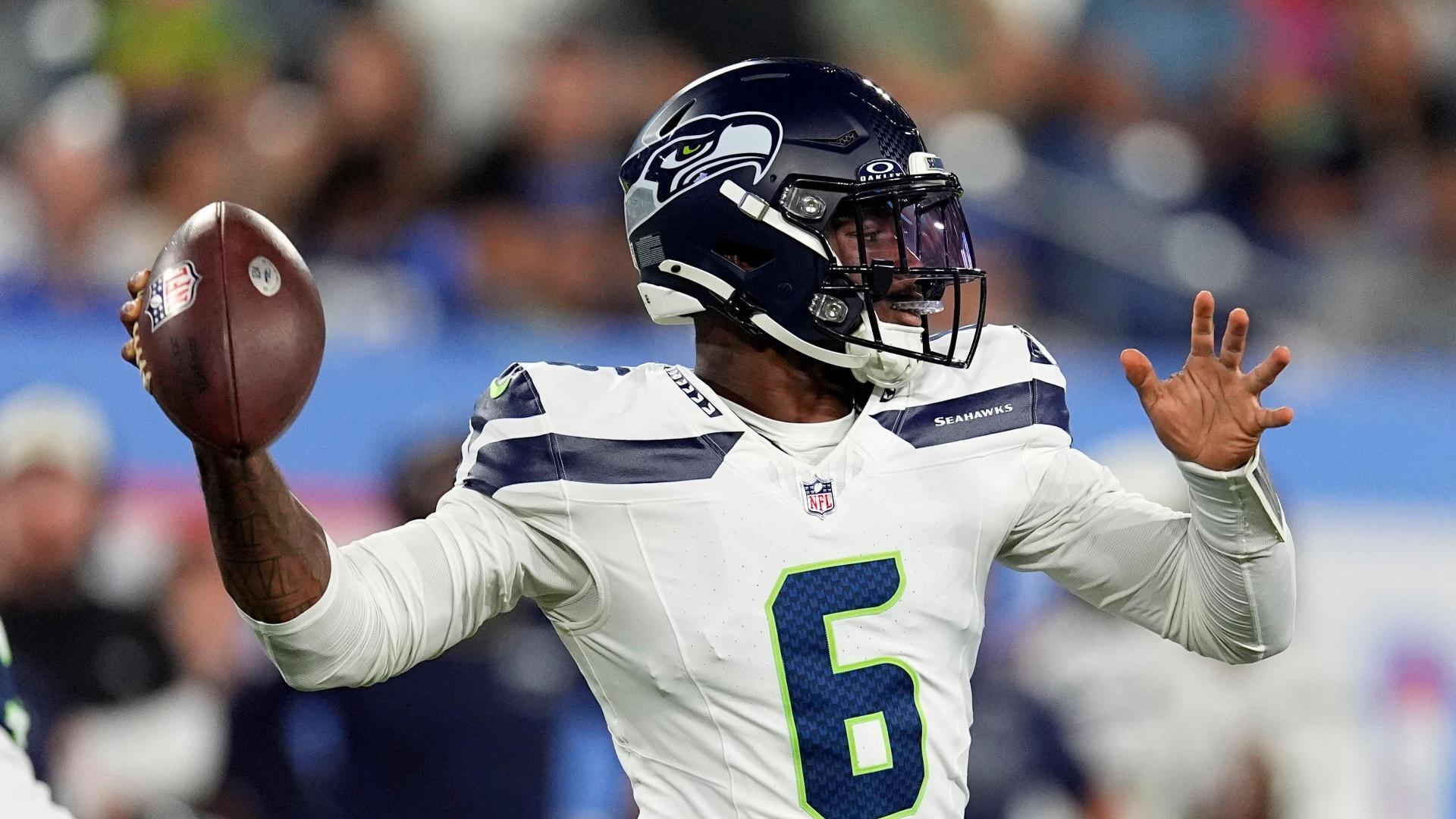
I don’t believe Jalen Milroe is a starting caliber NFL quarterback. I appreciate we’re only two years into his pro-career — but you don’t always need a lot of time to pass judgement.
He is too hesitant in the pocket. He is not processing quickly enough. He hasn’t shown an ability to throw with timing and anticipation. He appears determined to prove himself as a passer, rather than leaning on his ‘super power’ which is his ability to run.
Mike Macdonald was even featured on Hard Knocks encouraging Milroe to use his legs more often. The quarterback didn’t appear entirely receptive to the advice.
In truth, it’s probably his only way to stick in the league.
We don’t have to judge Milroe simply on his time in Seattle either. In his final year at Alabama, he was not a good passer.
He finished the year with 16 touchdowns and 11 interceptions. 10 of those 16 touchdowns came against Western Kentucky, Mercer, USF and a 5-7 Wisconsin team. In games against LSU, Oklahoma, Auburn and Missouri he failed to register a passing score.
His completion percentage for the year was 63.3% and he finished with just 2834 yards. He had 18 ‘big time throws’ (33rd most in the NCAA, level with freshman DJ Lagway) compared to 10 ‘turnover worthy plays’.
He made up for this with his running production. Milroe scored 20 rushing touchdowns in his final season at Alabama with 879 yards at 5.9 YPC. He had 30 runs of 10 or more yards.
This is who he is as a player. There’s nothing wrong with drafting him with the idea of developing his passing skills. There’s nothing wrong with Milroe wanting to prove he can be more of a complete player either.
Yet we’re two years into the project and we’re still getting plays like this:
It looks worse on the All-22… pic.twitter.com/yriAkKp6jk
— Mookie Alexander (@mookiealexander) August 24, 2026
Mistakes happen. Interceptions happen. But you can’t combine them with the hesitation he shows in the pocket and his propensity to get sacked as a consequence — particularly on key fourth downs, as he has in the last two games.
At the moment — whether it’s for the Seahawks or anyone else — you couldn’t play Milroe, even in relief, and expect to win a game of football.
I started the piece by noting I don’t think he’s a NFL starter. That might be difficult to come to terms with as a player — but there are only 32 starting jobs and if we’re being honest, there aren’t 32 starter-level signal-callers. It was always going to be a long-shot that Milroe would join the ranks of legit starter.
What he needs to do now is show to the Seahawks, and anyone else watching, that he might not be the most accurate timing-and-rhythm passer but he can still help if you need him to play a game or three. He does that by maxing out what he does well — running — whilst letting the passing game play off that.
We saw it against Tennessee when he ripped off a 16-yard scamper. Yet it was his only rushing attempt in the whole second half. Keep doing it. Use your legs.
Is it a sustainable way for a quarterback to play for a 17-game campaign? Of course not. But the truth is, that’s never likely to be Milroe’s destiny. He needs to show that he can be a worthy backup who can come in if the starter is injured and have a skill that enables you to win a football game. For him, that’s his legs.
You adjust your game-plan and tailor it towards getting him on the move. It doesn’t mean abandoning the pass. It just means scheming him to run, then finding ways to attack opponents if/when they have to adjust to stop him.
It might not work. Teams might defend his running ability well, take away his key trait and then you’re not left with much. At the moment though, that’s what we’re getting anyway. The offense he led on Sunday scored zero points in a whole half. He has to listen to his Head Coach and run more often. It’s his only shot to stick.
Chase Daniel made $42m in his career as a backup quarterback. It can be a great life if you find a way to make yourself useful. Milroe has to have that mentality, at least for now. He can try so hard to prove he can be a pocket passer and end up without a gig — or he can show to the Seahawks or any other suitor that there’s something worth sticking with here.
At least by doing that he’ll buy himself more time to develop as a passer, if it’s even possible. Right now, he just isn’t showing enough to warrant stashing.
The thing that might save him is there doesn’t appear to be a heated battle for the last few spots on Seattle’s 53-man roster. If there was, he might be in trouble. This isn’t a team over the years that has typically carried three quarterbacks in the John Schneider era.
I’m also not convinced if he was cut that someone else would claim him. He isn’t showing anything to believe that would be the case.
When he was drafted there was talk of him being a X-factor weapon with a ‘Milroe package’. They had to shelve that idea almost immediately because any time he was on the field bad things seemed to happen. He didn’t impress against Green Bay last season when given the opportunity to show what he can do. Through two pre-season games this year, it’s more of the same.
It’s possible he just doesn’t have what it takes. The Seahawks aren’t going to stick by him and give him another year just because they spent a late third round pick on him. In this final game against the Chiefs he needs to make some plays. His best opportunity to do that is get on the move. Don’t hesitate. Don’t linger too long trying to find a wide open throw over the middle. Don’t stand patting the football. Get on the move and create.
He will have a role as a backup quarterback in the league if teams believe he can at least make some plays and score some points — even if it’s not necessarily with his arm. It’s time for Milroe to lean on what he does better than most and not try to be something he isn’t.
You’re not a pocket passer. You probably never will be. Be the best running quarterback you can be.
Why I’m not worried about Jason Myers
In week 18 last season, Jason Myers missed two field goals against the 49ers. It helped make what could’ve been a one-sided pasting on the scoreboard a little too close for comfort.
Given the Super Bowl was due to be played in the same Santa Clara stadium a few weeks later, it was concerning.
So what happened when the Seahawks ended up qualifying for the showpiece finale? Myers kicked all five of his field goals and two extra points. He was a strong candidate to be Super Bowl MVP.
In total in the playoffs, Myers was 8/8 on field goals and 11/11 on extra points. Nobody remembers the bad game in week 18.
In pre-season so far, he’s missed a couple of kicks against the Titans and one against the Cowboys. Some people are fretting.
Don’t.
Myers, like all kickers, is only human. He has had bad games in his career. He has had spells where Seahawks fans have doubted him.
Yet the truth is, he’s always bounced back from these moments. He has genuinely been fantastic for the Seahawks. It wasn’t just the Super Bowl last season either. He won them the game against the Colts too — a critical win in the race for the NFC West title.
He’s going to miss kicks. He’s not going to be perfect. I was really surprised to see some fans thinking out loud, saying they were ‘concerned’ about his pre-season display.
If, one month into the season, he’s consistently missing kicks — let’s have a conversation about it then. Not now.
Being a trustworthy kicker isn’t about nailing every attempt. It’s whether you can reliably trust your man more often than not in key moments.
The Seahawks can do that with Myers. Over a number of years he warrants more faith than to overreact to an iffy pre-season.
Will the Seahawks explore the trade market?
I think it’s possible — at both safety and receiver.
I’m not convinced they will feel comfortable with just D’Anthony Bell and AJ Finley backing up Julian Love and Ty Okada. Especially given the injury situation with Nick Emmanwori.
If Tory Horton is due to miss time — Mike Macdonald is being extremely vague about his status — and with Jake Bobo now out for the year, this could be another area they look at.
It’s highly unlikely to be a big-name, blockbuster move. But they might be seeking to add.
Cut-down days are often talked about as a solution but the reality is players cut by weaker teams rarely appeal. The Seahawks, in the middle of a Championship window, are likely to be more pro-active.
I wouldn’t be surprised if we see a move or two. Receiver and safety are the two positions I think that are most likely to be targeted.
If you missed yesterday’s live stream discussing these topics, check it out below:
I’ve opened this thread to comment on the game. I’m watching the first half live, will catch up on the rest tomorrow and likely do a stream on Monday with reaction. I’ve posted some quick first half notes below.
First half thoughts
This was an outstanding performance in the first two quarters by the Seahawks. A genuine palate cleanser for last week’s game.
The juice that was missing against the Cowboys was clearly back. Players flew around the field. They were far more competitive in the trenches. Team-mates sprinted on to the field to celebrate the big plays and the sideline was bouncing.
The Titans played their starters in the first quarter against Seattle’s backups. The score? 16-3 to the Seahawks. Everyone raised their game and made the Titans’ starters look ordinary.
It was good to see Elijah Arroyo involved as a big factor in the passing attack. He has a big opportunity to take a step forward in year two and become a key weapon, especially given Jake Bobo’s injury.
The team blocking on the Jacardia Wright drive was perfect. He also read it really well and you’ve still got to execute and finish the run. He did. Wright flashed in pre-season last year and showed he has some ability here. It’s just a shame on a big third down catch across the middle he didn’t get upfield to convert.
The defense had three drives vs Cam Ward and the Titans #1’s and they gave up just three points. They played how you’d expect a Seahawks defense to look. They were creative, physical and fast.
Chris Paul Jr and Chaz Surratt played well, following on from Tyreece Knight’s lights-out performance last week (Knight didn’t play, speaking to how he’s now very much part of the #1’s). Nehemiah Pritchett, Andre Fuller and D’Anthony Bell made plays.
There were a couple of negatives. Bud Clark’s injury looked bad — presumably a broken leg. That might be his rookie season over before it even gets started. The Seahawks may need to dig around the safety market.
Cody White muffed a kick. Jason Myers also missed an extra point and a field goal. He occasionally has a game like this. It’ll be fine. He had a game like this right before the end of the season against the 49ers then kicked the Seahawks to victory in the Super Bowl in the same stadium a few weeks later.
I stayed up until 1am for the kick-off and was rewarded this week. This was a far better example of Seahawks football.