Category: Main (Page 2 of 99)
This was an uncharacteristically poor performance from the Seahawks. Three turnovers, all converted into touchdowns by Washington, essentially decided the game.
Seattle’s defense — which was put under pressure by the offense turning the ball over — couldn’t muster a big play to flip the momentum — whether that was a turnover of their own, or a key stop at the end when two third down conversions iced the contest.
It created an odd situation where it always felt like the Commanders were in control and deserved to win — yet clearly the Seahawks contributed massively to their own downfall.
It was surprising they couldn’t have more success against a banged-up Washington team missing key players, while also losing Leo Chenal during the game. Yes, the Seahawks badly missed Julian Love. Yet it never felt like the Seahawks truly maxed out the losses on the Commanders’ roster.
Even so — they should be able to rally after this and come fighting back. They did a year ago after each of their defeats. There’s no reason to think that won’t be the same again this time.
After all, they still possess arguably the best current player in football in Jaxon Smith-Njigba and they have enough proven, big-game players to make this a one-off disappointment.
However, there are some concerning issues emerging that could derail any hopes of the 2026 Seahawks going on a similar run to last year.
The first one is the situation at running back and the running game in general. It has stuttered to start the season, aside from at the end of the Cardinals game when the white flags were being waved.
Jadarian Price has fumbled twice. His latest mistake put him in the doghouse today — but it became quickly apparent that Emmanuel Wilson, try as he might, simply isn’t going to be able to carry this running attack or produce much of anything short of a few power runs up the gut. The way he was easily chased down by Chenal on a promising outside run in the red-zone was a great example of his limitations.
When Zach Charbonnet returns — and the Seahawks must be hoping that’s sooner rather than later — it might be a moot point and they can get back on track. In the meantime however, the Seahawks have a problem.
They used their biggest off-season asset on Price. When you spend a high pick on a runner, it typically comes with the expectation they will produce quickly. They didn’t draft him for three years down the line. He had to be a direct replacement for the departed Ken Walker.
While Walker continues to thrive in Kansas City (two more touchdowns today), Price was in a raincoat watching Wilson plod for 1.6 yards per carry.
Simply put — he has to fix his fumbling problem pronto. And the Seahawks then need to commit more to him, to try and get some production out of their top pick. He has to provide the kind of juice that Wilson isn’t capable of, to provide a dynamic spark to get things going with the running game.
In many ways, they’ve kind of made their bed and have to sleep in it now. He fumbled three times last year for Notre Dame in limited reps. We knew this was a thing. We also knew Walker and Charbonnet hardly ever fumbled. Now that you’ve drafted Price as high as you have — don’t you have to run him, for better or worse? Don’t you have to use the dynamic back you made a big commitment to?
You’re not benching the defensive backs for a badly timed pass-interference or Sam Darnold for a bad pick-six. This is the path they have chosen, shouldn’t they stick to the plan — rather than put Price on the sideline, while a lesser talent basically takes away any running threat?
Having taken no reps during pre-season — does he have to take his lumps now in the regular season? Is that not the decision you’ve taken?
A year ago it felt somewhat inevitable that they’d fix the running game. Walker and Charbonnet were too talented, the Shanahan system too productive for things not to click. And they did. Right now, it’s harder to be confident a turnaround is coming — and the Seahawks, short of that final quarter against Arizona, have been pretty one-dimensional so far.
Some of that is on the blocking too. It has to be better.
There are two other curious talking points.
Rashid Shaheed had two catches for 14 yards today. In three games he now has six catches for 53 yards. He has no meaningful returns on special teams.
This is a problem.
They appear further away than ever to finding a consistent, productive role for him on offense. Now — every target could and should initially be aimed towards the brilliant Smith-Njigba. But other players — Cooper Kupp, and today AJ Barner — are finding ways to be involved. Shaheed’s most impactful play was a roughing flag for a hit to the helmet he earned on an incomplete pass.
It’s especially challenging when Shaheed is now earning $17m a year. People are eventually going to point to the fact Ken Walker’s contract in Kansas City is worth $14.4m a year and wonder if they got this decision right.
John Schneider has rightly been lauded for his team building and whatever happened this year doesn’t change anything. But it’s also OK to approve and trust any move he makes — then in time, wonder if he got it right. It’s at least fair to wonder right now whether the Seahawks would be better fielding Walker as a focal point in the backfield, while having their top pick in the draft to use elsewhere (pass-rusher? receiver? cornerback?) working around replacing Shaheed (who would’ve brought back a comp-pick).
Finally, the pass-rush. There’s no doubting the Seahawks have major talents in the interior and they are still producing. Do they have enough juice off the egde?
The likes of Derick Hall, DeMarcus Lawrence and Uchenna Nwosu all do an admirable job. None are flying off the edge, however, and producing quick wins or it feels like consistent pressure. Dante Fowler has been fairly anonymous through three games.
This felt like an area they had to add to in the off-season and I’m not sure they’ve done enough. Next season it’s plausible only Hall will remain under contract from the four. What then? Would it have been wise to add some youth and quickness to the group via the draft, to have that now and also for the future? Maybe.
Perhaps it wouldn’t have mattered with Love starting today? Or if the offense didn’t turn the ball over three times? It might not feel like it but the defense contained Washington to four yards per play today. They more or less did their job, apart from producing a key turnover or third-down stop at the end.
It does still feel like they’re missing some speed off the edge though.
I don’t want to second-guess too much after one loss, following a 12-game winning streak. But staying at the top of the tree is incredibly difficult and watching that today shows why.
The Seahawks won a Super Bowl playing excellent football in all three phases. Today, they had issues in all three phases and are faced with finding answers ahead of some big upcoming games.
This is a guest post by Curtis Allen…
This game is quite similar to last year’s Week Nine matchup.
The Commanders came into the game 3-5, struggling to keep their heads above water in the NFC playoff race. They had key players hurt and their defense was an absolute mess.
The Seahawks on the other hand were 5-2 and coming off a strange bye week. Some players had been hurt during the week off. They utilized their depth and were ready to start a dominant run.
The game was over by halftime. Sam Darnold sliced up the Commanders’ defense, going 21-of-24 with four touchdown passes. It helped that Washington’s pass rush only recorded one – one! – pressure for a barely-registering 4.2% pressure rate. Team depth players shined, as Ty Okada, Tory Horton, Elijah Arroyo, Cody White and Brandon Pili all made key contributions.
Jayden Daniels hyperextended his left elbow and left the game.
This year, the Commanders are 0-2 and have one of the NFL’s worst defenses again. They are badly banged up. Daniels injured his elbow in the same way last week, so Marcus Mariota will be starting in his place. Also ruled out are several starters and key contributors: RG Sam Cosmi, TE Chig Okwonko, OLB Frankie Luvu and Safety Nick Cross.
The Seahawks are 2-0 coming off a dominant win against the Cardinals. Their depth will be deployed, as Anthony Bradford, Julian Love and Ty Okada will be out.
Defending Mariota
With Daniels out, Marcus Mariota steps in. Mariota is one of the NFL’s better backup Quarterbacks. A performance similar to Drew Lock’s in the last two games is not out of the question. Particularly if he is allowed to get into a rhythm.
The biggest change to the offense when Daniels goes out and Mariota comes in is the focus.
Daniels makes throws to be sure — but he also tends to let his talented Wide Receivers clear some room so he can run and dance his way through the defense on the ground. He is by far the most effective rusher on the Commanders and he sort of pulls everyone else into his orbit.
By contrast, Mariota knows his role. It is much more of a traditional Quarterback. His job is to get the ball to the talent. He uses his legs mostly to buy time in the pocket while keeping his head up to find a target.
The Commanders have one of the league’s deeper Wide Receiver corps — Stefon Diggs, Terry McLaurin and Dyami Brown lead the way. Treylon Burks and Antonio Williams round out the group and there is not much of a drop-off when they are targeted.
Mariota will act as a distributor of the ball — and not just with checkdowns. He is able to make good, accurate throws down the field.
After Daniels got hurt last week, Mariota came out firing in the second half. He found McLaurin for an explosive play and dropped a beautiful 29-yard pass into Dyami Brown but just barely was out of bounds.
On the next drive, down by two touchdowns, the Commanders resorted to trick plays, asking their Wide Receivers to complete passes. Neither worked and they settled for a field goal try, which was missed. They may try them again, but their best bet is to get Mariota comfortable.
The Seahawks cannot allow that.
The play is to use their talented advantage in the trenches to keep him out of rhythm. The Commanders are down their two best Offensive Lineman in Laremy Tunsil and Sam Cosmi. Their depth is poor, particularly when you consider the depth of the Defensive Line the Seahawks will roll out.
Their trademark blend of getting pressure with four and mixing in a timely blitz should provide them a decided advantage.
Control the Game with the Pass
I wrote this exact game plan for Week Nine last year and that worked very effectively. Sam Darnold was crisp, decisive and punished the Commanders’ defensive backfield ruthlessly.
Look at this throw to Elijah Arroyo. Darnold could not have delivered that any better and the defenders are helplessly flailing at the ball.
Oddly enough, the Commanders have not addressed the situation. Corner Mike Sainristil and Safety Quan Martin are currently two of the worst pass defenders in the NFL. They will be facing Jaxon Smith-Njigba, Tory Horton, Cooper Kupp, AJ Barner and Arroyo. That is just unfair.
Frankie Luvu will not be playing to provide second-level pass coverage nor rush the passer effectively. Daron Payne has not been the same player, come to think of it, since he said “Who is that?” when asked about Jaxon Smith-Njigba.
There may be a fan temptation to baby Sam Darnold a bit. But the numbers and the talent advantage clearly say the Seahawks should take this game to the air.
They are conceding 6.1 yards per play and have allowed seven passing touchdowns. They are blitzing 36% of the time as an effort to disguise their horrendous backfield.
It is “working” in the sense that they are achieving better results than when they do not blitz. When they do not blitz the results are ghastly:
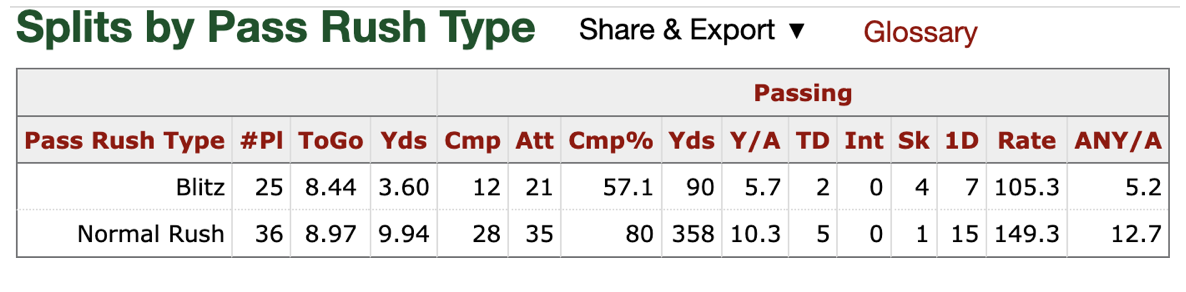
It is a small sample size to be sure but the Commanders have one sack, concede an 80% completion rate and are giving up a near-perfect passer rating when they do not blitz.
If Darnold can find his hot reads when blitzed – perhaps making use of the mismatches he has at the Tight End position – this defense will not have answers.
Attacking this defense on the ground will not be an afterthought but the play is to take to the air, get a lead that the Commanders will struggle to keep up with and then pound the ball to run out the clock.
I’m opening this post so people can follow along today’s college football schedule — but I also wanted to share some notes.
The Northwestern vs Indiana game was particularly competitive and interesting and a couple of draft eligible players really stood out.
I’m eager to watch more of Indiana running back Lee Beebe Jr. He has ideal size (5-10, 215lbs) with a thick, sturdy frame. He showed an ability to get skinny through the smallest of holes in the O-line to sneak through and explode to the second level. He uses a wide gait to scamper away from tackles and stretch out runs. He was quick into the hole with no hesitation to capitalise on opportunities. He showed good contact balance, enough speed to make big runs and a shiftiness 1v1 to produce some elusiveness and make people miss. There’s a lot to like here and I want to watch more.
I was also impressed with Northwestern receiver Griffin Wilde. I’ve gone back and tracked a few of his games this morning. He’s not going to be a high pick but he’s the type of mid/late round receiver who could stick in the league.
Wilde tracks the ball ever so well. His build is unusual for the position — he’s thick with a dense frame at 6-2 and 200lbs. He’s not a vertical threat with his speed and there’s a lack of suddenness. However, he possesses good body control and combines it with solid hands to complete difficult catches.
He concentrates perfectly when the ball is in the air to track and make challenging grabs. When covered he still makes catches under pressure — which is key because he’s not a big separation-creator. He’s willing to run across the middle and fight for catches.
Against Indiana he showed excellent control and leaping ability to go up and make a red zone catch. He got up in the air so high, caught the football and then got both feet down. It was an improbable touchdown catch — given the small amount of space he had to work in.
There’s nothing wrong with his route-running and he’ll use a head-fake to deceive cornerbacks. He just doesn’t have the quickness and speed to truly threaten with suddenness.
He mixes between the slot and outside corner with almost an even split. He seemed to thrive playing with Aidan Chiles who played as well as I’ve ever seen him play — to the extent I’d like to see more of him later this season.
Overall I’ve done more scouting in the three weeks than I’ve ever completed before the end of September and already have thousands of words of notes. I’ll begin to start publishing some positional breakdowns in the coming days.
I’ll probably start at wide receiver because it’s a particularly strong position group again. I’ll probably also do a stream/video soon talking through some of the players I like in this class.
Meet 6-7, 300lbs English-born DL Emmanuel Oyebadejo. Now starring for @GatorsFB, he has a chance to be the highest drafted British player ever. He starred against Auburn and takes on Ole Miss & Trinidad Chambliss this weekend. One to watch.
Here's some of our conversation… pic.twitter.com/QkeNTNSuG3
— Rob Staton (@robstaton) September 24, 2026
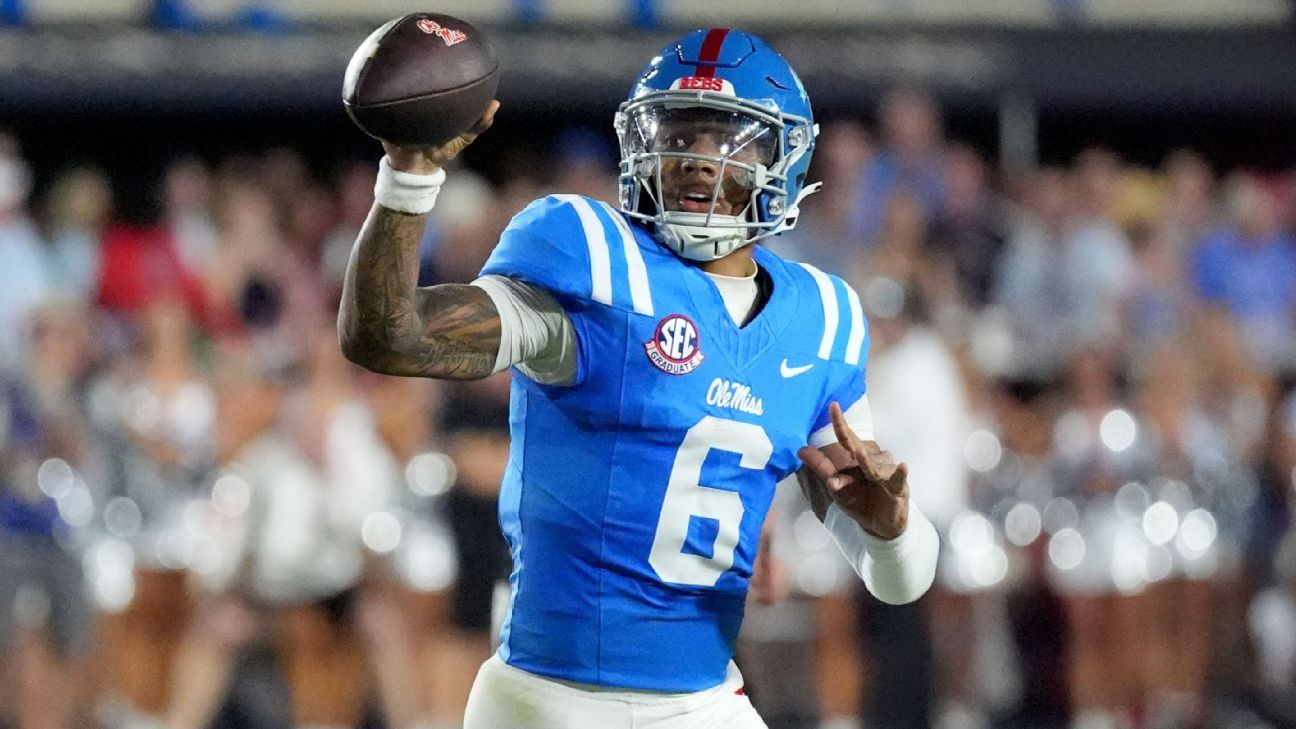
Trinidad Chambliss shows why he is currently QB1
The point I’ve kept repeating during the early stages of the college football season is draft media are hopelessly building up and overrating the quarterback class.
For example, Todd McShay had LaNorris Sellers as the ninth best player on his big board last week, with Sam Leavitt at #20. Neither player is remotely close to being a first round prospect at this stage. A fifth of the players in the top-50 were quarterbacks — yet the chance of players like Demond Williams and Jayden Maiava going in that range are remote.
You can easily say the same about Arch Manning — universally projected in the top-five by most draft pundits and regularly talked about as a possible first overall pick — the reality is quite different (we’ll come back to Arch later).
The one player who is playing well enough to warrant some hype is Ole Miss’ Trinidad Chambliss. His rapid rise over the last 12 months has been highly impressive. He’s gone from small school prospect to backing up Austin Simmons, getting an opportunity to start when Simmons was injured, excelling to the point he won the starter’s gig full time and he hasn’t looked back.
With every game he gets a little bit better. He excelled during the playoffs last year, almost dragging Ole Miss to the College Football Playoff final.
This year the progress has continued. He is making passes all of the other ‘big name’ draft eligible quarterbacks can only dream of. You’re seeing throws with anticipation, timing and zero hesitation. He’s creative, he’s making plays over the middle of the field and he’s delivering complex, layered throws. He has a good arm. He’s a playmaking machine — and it culminated in Ole Miss beating Lane Kiffin’s LSU on Saturday in what is probably an all-time win for the school.
This was a masterclass performance.
I’m going to post some clips in a moment but a few key drives and plays stood out. For example, with one minute to go in the first half — LSU has just scored to fight their way back into the game. Chambliss responded with a quick-fire drive of his own, ending with a touchdown pass with just five seconds to go.
He was consistently strong on third downs. It’s been put to me by people far more experienced than I am that this is one of the key things to look out for when scouting quarterbacks. One veteran evaluator told me he won’t even scout a quarterback fully until he’s watched every third down throw they’ve ever made, to determine whether it’s worth watching anything else. He would’ve enjoyed Chambliss’ tape on Saturday.
There was one play where he had a panicked scramble and looked for sure like he was going to be sacked for a big loss. Half the LSU defense was chasing him down. Instead he managed to extend just enough, then threw a crazy little flip-pass to a team-mate, who was able to scamper for a first down. It was classic peak-Russell Wilson escapism and playmaking:
I keep watching this clip and keep wondering “How?”
You simply can’t teach this, you either have it or you don’t. Trinidad Chambliss has it, and I can’t imagine ever leaving a qb with that talent. pic.twitter.com/aZhdrEjCM0
— Random SEC (@therandomsec) September 22, 2026
He scored a brilliant scrambling touchdown to give Ole Miss the lead late in the game. He had a lot to do to get around the edge and out-run the defense. But he did it. It capped an excellent, high pressure drive after LSU had come roaring back in the game and threatened to steal it.
Let’s look at some clips.
On this first throw — you have to deliver this on time and with the right velocity. If you pause the video you see his arm is going back to throw as the receiver makes his break in the route. You have a second defensive back peeling off his man, noticing what the play-call is, so if this is in any way inaccurate or late, it’s dangerous. This is a NFL throw:
Trinidad Chambliss RIPS it from the far hash in 3rd and 9
NFL throw. pic.twitter.com/gGRU7kyjcz
— NFL Draft Files (@NFL_DF) September 20, 2026
The next clip shows off top-level composure. He is scrambling around with a defensive lineman stalking him in close proximity. He has to retreat to buy time, yet keeps his eyes downfield. Most quarterbacks, even at the NFL level, panic in this situation and either take a big sack, drop their eyes to try and scramble, or they make a horrible mistake throwing without base. Chambliss can see his tight end uncover and is wide open — so now he just needs the angle to throw. He runs to the right and throws back across his body, safely, with the necessary torque to deliver a first down. There are not many players who can do this:
Trinidad Chambliss is a cheat code. pic.twitter.com/vDuz9M5CRk
— Underdog CFB (@UnderdogCFB) September 20, 2026
The final clip I want to highlight is the first one in the reel below. He steps up into the pocket because extending doesn’t always mean bouncing to the outside. He buys himself some time by stepping up, sees the receiver uncovering in the end zone and on the run, fires it into him for a touchdown:
Trinidad Chambliss is so good when you don’t have someone in your ear telling you how short he is pic.twitter.com/QdpZdsjHJY
— James Foster (@NoFlagsFilm) September 20, 2026
It wasn’t a flawless performance. The interception at the start of the second half was really bad. He was far too aggressive as he’s being hit during a heavy blitz. Just take the sack. Don’t turn it over. There was no good outcome here and it was clear very early off the snap that LSU had won the down. He threw blind into coverage and it was costly.
Even so — we’re talking about a quarterback who is consistently improving with every start. He is elevating his team not unlike Cam Newton did at Auburn — making them a legitimate contender. Without him, Ole Miss are not a serious threat. He is playing with timing and precision yet also delivering with magical creativity and making the unlikely possible.
Nobody else is at this level. It shouldn’t even be a discussion who QB1 is for 2027 as we sit here today on the 23rd September. It doesn’t matter if Dante Moore is a bit taller, or Arch Manning has a better second name. Neither is playing very well and Chambliss is putting electrifying tape on record.
I’m not going to rush to say he’s a legit first round prospect at this stage. There’s no point jumping to that conclusion. There are still weeks to go in this college season. Let’s see what happens over the next six weeks and reassess.
This need to place and rank players prematurely is how we get people suggesting Cade Klubnik could be QB1 a year ago. Let’s take a breath.
However, it shouldn’t be remotely debatable at this point who is playing the best among the draft eligible quarterbacks, showing off the greatest range of NFL skills. It’s Trinidad Chambliss — and he’s lapping the field at this point.
Other notes from LSU vs Ole Miss
— Ole Miss defensive tackle Will Echoles showed why he could easily be a top-10 pick next year. He had one sack and three TFL’s. He flashed a highly disruptive bull-rush, driving blockers back into the pocket. He has a dynamic arm/over move and a burst of quickness unusual for a man his size. He was swatting away blockers with a thunderous swipe but then combined it with agility and foot-speed to get around linemen to pressure the quarterback. When he beat the initial block and LSU had a running back in as a last line of defense, he’d just blast them out of the way. He can play one, three or five technique. He finished with seven total pressures and six hurries. A top prospect for 2027. This is what a very high pick at defensive tackle looks like:
Will Echoles was DOMINANT vs. LSU (7 pressures, 3 TFL, 1 sack)
He was my clear DT1 over the summer (No. 13 overall) and hasn’t disappointed so far in 2026. Equally disruptive vs. pass/run. pic.twitter.com/vLRmXF2u4r
— Dane Brugler (@dpbrugler) September 20, 2026
— Echoles’ team-mate Kam Franklin had a big game against Louisville and he flashed again against LSU. He had the final significant play of the game by tipping the ball at the LOS leading to a game-clinching interception. He also had a TFL, six pressures and six hurries. He definitely looks like a NFL player I just wonder about his quickness and upside for the next level. Testing could be key for him.
— Trey’Dez Green, the LSU tight end/big receiver, left the game with what looked like a serious knee injury. The latest news is he will miss some times but it’s not season-ending. He’s a very exciting receiving prospect with great size and mobility. He can be an X-factor weapon at the next level as a pass-catcher. However, he has to get stronger and bigger to block the perimeter, otherwise he’s going to be limited to being a big target. The idea of players like this can sometimes seem better than the reality. How many 6-7, 240lbs receivers are there? He’s really quick and dynamic for his size but he isn’t likely to act as a conventional receiver. He has to show at least some semblance of ability to block to max-out his potential as one of the more interesting tight ends to enter the league in recent history. For every Jimmy Graham (mostly a receiver) there’s an Eric Ebron or Kyle Pitts — who never really live up to expectations.
— LSU quarterback Sam Leavitt can at times be really fun to watch. He’ll scramble around, extend plays, he’s a better runner than you’d expect. Yet he’s far too quick to bail on the pocket and he doesn’t have NFL physical tools. His play is fairly up-and-down. In this game he had an excellent third down throw with perfect placement to the right corner of the end-zone. It followed a play just before where he missed two wide open receivers. He’s thrown five interceptions in just three games.
— Ole Miss running back Kewan Lacy left the game with an injury and he’s considered a game-time decision for Florida on Saturday. He is a legit player. Meanwhile, receiver Deuce Alexander continues to show promise. He’s incredibly quick and catches away from his body. He can challenge receivers on the outside downfield but can still run over the middle and make catches in traffic. He’s reasonably well sized and showed in this game he’s a willing blocker. He looks like someone with a NFL future — especially with his sprinters speed.
We shouldn’t even be talking about the NFL Draft for LaNorris Sellers
There’s absolutely no doubt the South Carolina quarterback has physical talent. However, he endured a miserable season last year — in part due to a shambolic offensive line. This season was supposed to be different. There were changes up front and a new offensive coordinator, with Kendal Briles brought in to produce an offense like the one his father made popular at Baylor during the Robert Griffin III era.
Unfortunately, he simply isn’t progressing. If Trinidad Chambliss has shown remarkable and sustained growth as a quarterback at Ole Miss — Sellers is stuck with his wheels spinning in the mud.
Firstly, I don’t much like the new offense. It’s a ton of read-option and he’s more or less asked to run around and see what happens. Take off if it’s there, throw if you see an option. It’s not remotely close to a pro-system, meaning he isn’t developing the kind of skills required to judge him for the next level. They’re just setting up a system where his legs and arm *might* be able to make a difference.
He was bailed out of an ugly interception early in the game against Mississippi State. He was in the red zone and threw straight to a spy stood in the way of the intended target over the middle. A very fortunate hands-to-the-face-penalty took the pick off the board. How did he not see the defender stood right in the way? In fact, there were three defenders blocking the intended target:
This is a reminder for draft season to not talk yourself into LaNorris Sellers pic.twitter.com/LdMkq9d1Ro
— SleeperCFB (@SleeperCFB) September 20, 2026
He nearly threw another interception forcing a third down pass on a slant. It was an awful late throw, delivered behind the receiver and was dropped by the defensive back.
Eventually his luck ran out. With around six minutes left in the third quarter he benefited from good protection. He sat in the pocket — with two wide open receivers on a post and a deep cross. Instead he threw it straight to a sitting defender. You’ve got to loft that pass over him. It’s an awful throw — the kind you simply cannot make if you expect to be given a draftable grade.
His second interception was even worse. It’s 3rd and 10 and he looks to the right sideline then just throws it straight to a defender. It’s never on. What on earth is he looking at? How do you not see the defender breaking right in front of the target? He didn’t even zip it in there to make sure — he floated the pass right to the defender:
LaNorris Sellers is coming apart man
Inexcusable interception pic.twitter.com/nLNNlr3QZm
— NFL Draft Files (@NFL_DF) September 20, 2026
Overall he had five turnover worthy plays in the game and only one big-time throw.
He is a classic example of a player emerging early in their college career, people talk them up as a ‘down the line’ draft prospect — yet when they show no development or even regress, people don’t adjust their takes. Sellers should not have been highlighted by the media as anything but an interesting player to see if he can rebuild his stock after a challenging 2025. Instead, we had people naming him as a star within this “loaded” quarterback class.
He isn’t a draftable player currently. That can change in the future — this season or next, whether that’s at South Carolina or somewhere else. But he is not a high draft pick like many have suggested based on his play in 2025 and 2026 so far.
Other notes from Mississippi State vs South Carolina
— Mississippi State’s Junior OLB Amaree Williams — a transfer from Florida State — was the top performing defensive player on the field. At his weight (approximately 240lbs) he did a great job blowing up run plays, setting an edge and playing with consistent physicality. Had a sack and two TFL’s — plus led his team in tackles with 10 (all solo, per ESPN). He’s a former tight end who caught three touchdowns for FSU. He also dropped into coverage well. This is a player to keep an eye on.
— Cornerback Kelly Jones wasn’t even tested until the fourth quarter, which speaks to how opponents are treating him. South Carolina threw at him twice, with no completions. Teams are 37% throwing at him so far this year. He’s big but mobile for his size. He’s not cumbersome and can change direction. He played with his arm in a cast. He’s a player I really enjoy watching and he’s a fascinating draft prospect for 2027.
— When I’ve spoken to people I respect within football, they wax lyrical about Dylan Stewart’s potential and believe he will be a high first round pick. The South Carolina pass rusher returned to play in this game and had some splash plays. He created a pressure on his first snap. He slammed into a pulling guard, stopped him, then made the TFL on the running back in a highlight-reel moment. He drew a holding call at the start of the second half on a run to the outside. He was grabbed by the left tackle and basically hugged to prevent him setting the edge. He did have his snaps managed in the game. The expectation is he will be a very high pick next year due to his length, quickness and power.
Arch Manning continues to struggle — can we just be honest about him?
Draft media needs to give up the ghost. Manning either isn’t as good as they’re telling you — or he isn’t ready. Either way, he’s not playing like anything close to a first round pick. My prediction continues to be that he won’t declare unless things change between now and the new year.
He completed only 50% of his passes against UTSA on Saturday. There was the usual mix of off-target throws, hesitation, being too keen to set off and run and limited throws of a pro-standard. He had zero big-time throws against a non-elite opponent and one turnover worthy play.
Look at these two throws — the first is his first pass of the day, the second was not long after:
I understand why the media want a Manning in the draft next year. I understand why fans, having been sold a bag of magic beans by the media, are investing their hopes and dreams in Manning saving their franchise. It’s fake news for now — as is the case with this quarterback class overall.
Notes from Florida State vs Alabama
This was my first opportunity this season to get a good look at FSU receiver Duce Robinson. He has a good frame with decent size. His body control for his size stands out. This was evident on his touchdown — you see his ability to stay in control and keep his feet in bounds:
DUCE ROBINSON WHAT A CATCH
One of the best catch radiuses in the 2027 NFL Draft 👀 pic.twitter.com/UddRbylOxF
— NFL Draft Files (@NFL_DF) September 19, 2026
He can cross the face of the defender well and used his strength vs Alabama to win 1v1. He catches the ball well away from his body.
If you don’t disrupt his route early with a jam he can release and create separation nicely on quick-hitting slants. When he was jammed in the fourth quarter he couldn’t get into his flow and the pass was broken up and nearly intercepted on a deflection. He didn’t box-out and never gave the QB a target. Finding a way to use his size consistently and make life easier for his quarterback is key.
His long-speed is a question mark. However, he had a nice long reception where he did create some separation then tracked the ball brilliantly. He had to slow down to adjust and make the catch. The throw brought the cornerback back into play but despite the contested nature of the grab, he came down with it. Good concentration.
He’s a player I will continue to watch.
For Alabama, Ryan Coleman-Williams had his first catch with six minutes left in the first half. It was a dump off on fourth and 2 when they were trailing 21-6. At the time I kept thinking — why is he not a bigger part of the gameplan? You’ve got to at least try and get him the ball.
His second catch was a swing pass after he ran across the formation. As soon as the ball was in his hands he ran 50 yards for a TD — dodging and weaving through defenders and accelerating away from others. He showed he is a truly dynamic, sudden, explosive athlete. He has special qualities and electric speed:
RYAN COLEMAN-WILLIAMS 46 YARDS TO THE HOUSE 🐘 pic.twitter.com/h3llYyw23C
— Hayes Fawcett (@Hayesfawcett3) September 19, 2026
Look at the acceleration as he burns off the last few defenders. You can work with that in the NFL.
It’s the hands that are the problem. If he had good catching technique he could be a top-10 pick. Yet he’s a mile away from having passable hands for that kind of range. If he can fix that issue, he will become one of the top players in this class. In order to do that though, Alabama will have to find more ways to get him the football than they showed here.
Defensively, I don’t understand why Alabama rotated Yhonzae Pierre and Devan Thompkins as much as they did.
Pierre looks the part and has stalking speed. I’m just not sure he’s much of an actual playmaker. He can play within structure as a big OLB. He’s far from a sack artist and he lacks great ankle flexion to create quick pressure. Even so, he had six pressures and six hurries in the game but also missed two tackles.
Thompkins played mostly inside this week after playing end last weekend. He was very active but didn’t have any quick wins with speed. He still needs to refine his arm/over and develop some better interior moves. He does play to the sideline and keeps going to the whistle.
In the fourth quarter Thompkins started to line up off the EDGE. He had a clean-up/hussle sack with 14:23 to go. Again, he was just playing until the end of the play. He led Alabama in tackles, had five pressures and had four hurries.
Pierre and Thompkins feel like the heart of Alabama’s defensive front seven. They will be in some big games moving forward — so keep an eye on them.
Big defensive tackle Terrance Green completely destroyed the interior O-line with one forceful bull-rush. The guard lost his footing and stumbled backwards, enabling Green to win. I want to watch more of him.
Safety Keon Sabb had an excellent play to tip a pass enabling a cornerback to pick it off on the rebound. I find it challenging to place a grade on Sabb having watched a lot of him since the start of last season. I’m not sure I’ll come to a conclusion until I see testing numbers.
Can we have some perspective on Darian Mensah?
I couldn’t believe he was made the Heisman favourite, or that people were suddenly talking about him as a top-five pick. Nobody was saying that during his time at Duke.
I understand why he’s getting attention. Miami has become the school to go and boost your stock as a quarterback. They protect well, they have skill players for days and they run the ball. Cam Ward and Carson Beck have elevated their stock beyond what is probably reasonable courtesy of playing for Miami in a poor ACC.
Mensah is technically sound and has some mobility. His arm is good enough. He’s not too big. As he was a year ago — he’d be a solid mid-round flyer.
Let’s stop with the Heisman and early round one talk though. Firstly, Malachi Toney is the real star. Mensah basically just has to look for him, wait for him to get open and throw him the ball. Toney is a superstar. He might have more talent than Jeremiah Smith. He can play in the NFL tomorrow. Mensah often just has to hold a safety to allow Toney to release, then come back to his #1 target.
If anyone is winning the Heisman from Miami, it should be Toney.
Once he got hurt at half-time against Wake Forest and was only used on third downs, Miami’s offense completely stalled. Mensah suddenly looked very average. Situations matter — and there’s a reason Mensah fought so hard to be transferred to the Hurricanes.
A nice player with a future in the league (even if it’s as a backup) but let’s keep some perspective here.
Meanwhile, Miami running back Mark Fletcher was a blog favourite from the end of last season. He had a good showing against Wake Forest — in particular this beast of a run:
Grown man physical run by Mark Fletcher. This is what he does pic.twitter.com/hGyyXpdB73
— Billy M (@BillyM_91) September 19, 2026
Other quick notes
— Earlier today I interviewed Emmanuel Oyebadejo — a 6-7, 300lbs defensive lineman for the Florida Gators. He is originally from Manchester in England. I’m hoping the BBC will put the interview out this week. There is a lot of excitement that he could be Britain’s first ever first round draft pick. There are simply not many people on Earth who can move as well as he can at his size. It’s also said that he has around 36-inch arms and will test through the roof. He was brilliant against Auburn (see the clips below). The temptation is to say players like this are ‘raw’ because they’re relatively new to the game but here’s what the video below shows — the power to demolish an SEC left tackle off the edge, a brilliant swim move to win inside, bending round the edge to get a sack (not the tightest bend but he is 300lbs), the quickness to attack the outside shoulder of a guard and just flat out win and bench-pressing the tackle to set the edge and keep his frame clean. What a fascinating chess-piece he is and he’ll be an exciting player to have on your radar. Florida faces Ole Miss and Trinidad Chambliss at the weekend.
Florida DL Emmanuel Oyebadejo (6’6 299) was a basketball player in England before giving football a try first at University of Exeter, then Jacksonville state and now Florida
He’s still very raw but he also shows the traits of a starting NFL DL. Size/Power/Athleticism #NFLDraft pic.twitter.com/rtJt1NIDgj
— Draft Capital Podcast (@TheDraftCapital) September 20, 2026
— There was another interception for California safety Kingston Lopa, taking him to five for the season already. He also led Cal in tackles against Wagner. We noted last week his range, versatility, quickness and playmaking instinct. He is certainly capable of being a very interesting draft prospect for 2027, having transferred from Oregon.
Apparently Cal S Kingston Lopa (6-5, 210) is going to get at least 1 INT a game
5 on the year now. Biggest NFL Draft riser of any position so far this season pic.twitter.com/qi33uOFpva
— Clint Goss (@NFLDraftDome) September 19, 2026
— Kentucky defensive lineman Mi’Quise Humphrey-Grace also followed up a good performance last week by helping the Wildcats defeat Texas A&M. He had five pressures and five hurries in the game and while he isn’t likely to trouble the early rounds of the draft, he has an intriguing skill-set that will give him a chance to be on the radar of NFL teams.
— UCLA had a shoot-out against Purdue and while we’re still really waiting for Nico Iamaleava to reach a consistent level of performance delivering on his immense upside — one other player stood out. Tight end Brayden Loftin was a blocking machine — hammering opponents in space, sealing edges in the running game and putting his body on the line numerous times. It was an impressive performance.
As always please leave a like and a comment on the YouTube page if you can!
That was a Championship performance.
This is how the Seahawks rose to dominance last season. Not every game was a blowout by half-time. Many contests were close after two quarters. They were well contested.
Working things out, exerting your physicality, breaking things open, dominating. That’s the mark of a winner. That’s what the Seahawks are.
And that second half performance today was as dominating as you could hope for.
Don’t underestimate how it was achieved either. This looks like a more measured, organised Cardinals team than a year ago.
You just gave them a good thrashing after half-time. You did it with your backup quarterback dealing in a way many starting quarterbacks can only dream of. You did it minus your most experienced running back, your starting right guard, a starting safety, and with Nick Emmanwori on a significant pitch-count.
To be able to do this today is a serious flex. We just watched the best team in the NFL. We just saw the best coached team in the NFL.
There are so many positives to dig into that I’ll probably miss some out. Apologies if so — but here are some highlights:
— Obviously Drew Lock was absolutely fantastic. He didn’t just manage the game like you hope from most backups. He threw complex, difficult passes. He flashed big-time throws into tight windows. He made things happen. This was a performance that could well get him a starting gig somewhere next season.
— Jaxon Smith-Njigba is a superstar and it’s offensive that he isn’t one of the true faces of the league. You should be bored of seeing him in commercials by now. Fix that, NFL world. He is an inevitable, dynamic, game-changing force.
— The defense just smothered the Cardinals and gave up a measly 150 yards. While the rest of the league seems to be working out their defense, the Seahawks are showing they are still #1.
— Julian Love’s interception was remarkable. He is one of the most under-appreciated players in the league.
— Brian Fleury is two games into his play-calling career and I couldn’t be more impressed. I’m going to come back to the sequence before half-time in a bit. What he has done in these two challenging games in difficult circumstances is about as encouraging as anything in the early stages of this season.
— Emmanuel Wilson running all over the Cardinals in the second half. Souls were taken as the Seahawks exerted their total dominance to run out the clock. This is why I watch this f***ing sport. For that fourth quarter, where you show who the real top dogs are and kick some f***ing arse up front. This is what I want my teams to look like. Exactly this. We are living the f***ing dream right now. Sorry for my language.
It’s also a timely reminder not to lose yourself in the first half which I saw a few doing in the comments. Especially on the sequence before half-time where the Seahawks were stopped on the goal-line. I had no issue with anything there.
Firstly, if you kick the field goal you then have to kick-off, with a minute left, giving the Cardinals decent field position. You could go in at half-time down by four points. There was loads of time left — and they had timeouts.
The worst case scenario of being stopped as you run the football means the Cardinals get it back on their goal-line, have to march 99-yards to score a touchdown and +50 to get a field goal. They are naturally going to be conservative because of the field position.
That was exactly the right thing to do. They didn’t execute because the Cardinals did a great job. Kudos to them. They are allowed to make plays too.
You then stopped them, knowing you’d get the ball back, and then would receive the kick-off in the second half.
This was true game management. The Seahawks figured things out to dominate in the second half. This will have to happen again in future games, so let’s just embrace that now.