Category: Main (Page 5 of 99)
The pass rush against the Cowboys wasn’t good. This isn’t disappointing for the here and now — but it was slightly frustrating in the context of the future.
The Seahawks don’t have a youth movement off the edge. DeMarcus Lawrence, now 34, has confirmed 2026 will be his final season. Dante Fowler recently turned 32. Uchenna Nwosu turns 30 in December.
Both Fowler and Nwosu are out of contract at the end of the season.
Derick Hall is the only long-term piece at the position currently on the roster.
We’ve seen in the past how weak depth and a lack of talent in your EDGE rotation can hurt a team. The Seahawks spent a period of time from the end of the Cliff Avril and Michael Bennett era until the start of Mike Macdonald’s tenure scrambling to find options.
They won’t want to end up in the same place.
If one of the younger players competing on Saturday had looked sharp — it would’ve been a great benefit. They didn’t need to look like the next big thing at outside linebacker — a pass-rush version of Ty Okada or Drake Thomas would suffice. Just someone who you could imagine rotating into a starting group.
None of those participating flashed that ability. I know some might claim Jalen Gaines did — but his one pressure came late in the game against questionable competition and he lacked the sudden quickness to turn a 1v1 win into an end product.
Jeremy Fowler’s recent report from Seahawks training camp noted that drafting a pass-rusher was on Seattle’s to-do list this year — but with limited early-round picks they couldn’t make it happen. They were connected at various times to R Mason Thomas — a second round pick for the Chiefs.
Had the Seahawks taken him at #32, they would’ve only created a hole somewhere else. They had four key need areas pre-draft — running back, cornerback, safety and pass-rush — based on the players they lost in free agency.
At least one position was going to miss out when you only had your native picks in the first three rounds. Therefore, there’s no criticism to jab the Seahawks with here.
Nevertheless, if this is the final year of Lawrence and Nwosu, and Fowler ends up being a one-year arrangement, they can’t really afford to simply rely on the draft next year to prop up their pass-rush arsenal. Especially when Hall is only coming off a two-sack season in 2025 and is yet to show he can be a lead dog off the edge.
The free agent options for next year are not great. The Seahawks are also not in a strong position to go wading into the market — with new money needing to be saved for the growing number of re-signings they’re having to make.
That could be an issue because both Lawrence and Nwosu were significant veteran signings — the kind of which might not be possible moving forward.
It’ll be interesting to see how they approach this situation. They have good interior options that do as much to help an EDGE rush as anything. For that reason, they might feel like a draft pick and a couple of choice veteran additions will be OK.
I do remember the Benson Mayowa and Bruce Irvin days though, mixed in with an aggressive move to get Darrell Taylor. It didn’t work — and I’m not sure banking on Leonard Williams, Byron Murphy and Rylie Mills to bail a similar rotation out is a safe bet.
It’s why I think there could be a veteran move to be made at some point over the next seven months — either before the deadline or when the new league year begins. Someone on a deal that isn’t necessarily expiring, that can be acquired without needing to immediately pump new money into the deal.
It’s why, without wanting to go over old ground too much, a Maxx Crosby trade remains appealing even though it’s a complete mystery if or when he’d be available again. He’s signed for the long-term already, so you could find a way to slot his salary into the structure — even if things needed re-jigging.
They could also do what they’ve done in the past with Leonard Williams, Ernest Jones and Rashid Shaheed — sign a player on an expiring deal, get a feel for them and then extend them. That will be harder to do from now on though, given multiple players have been given bigger second contracts and cap and cash space is running thin.
The other factor will be that the Seahawks are now coached by Macdonald — who seems firmly on top of his brief and feels unlikely to ever allow a situation to happen where his roster is weak off the EDGE.
Or, he might be able to get a lot out of whatever options he has — just as he did with Kyle Van Noy and Jadeveon Clowney in Baltimore.
It is going to be an area to monitor though. I think the Seahawks will have their ear to the ground at this position as we edge towards the trade deadline. If they can get someone who is more than a mere rental — it’ll certainly help for 2027 if key players move on. And we’ll need to keep an eye on the top pass rushers in college football this year.
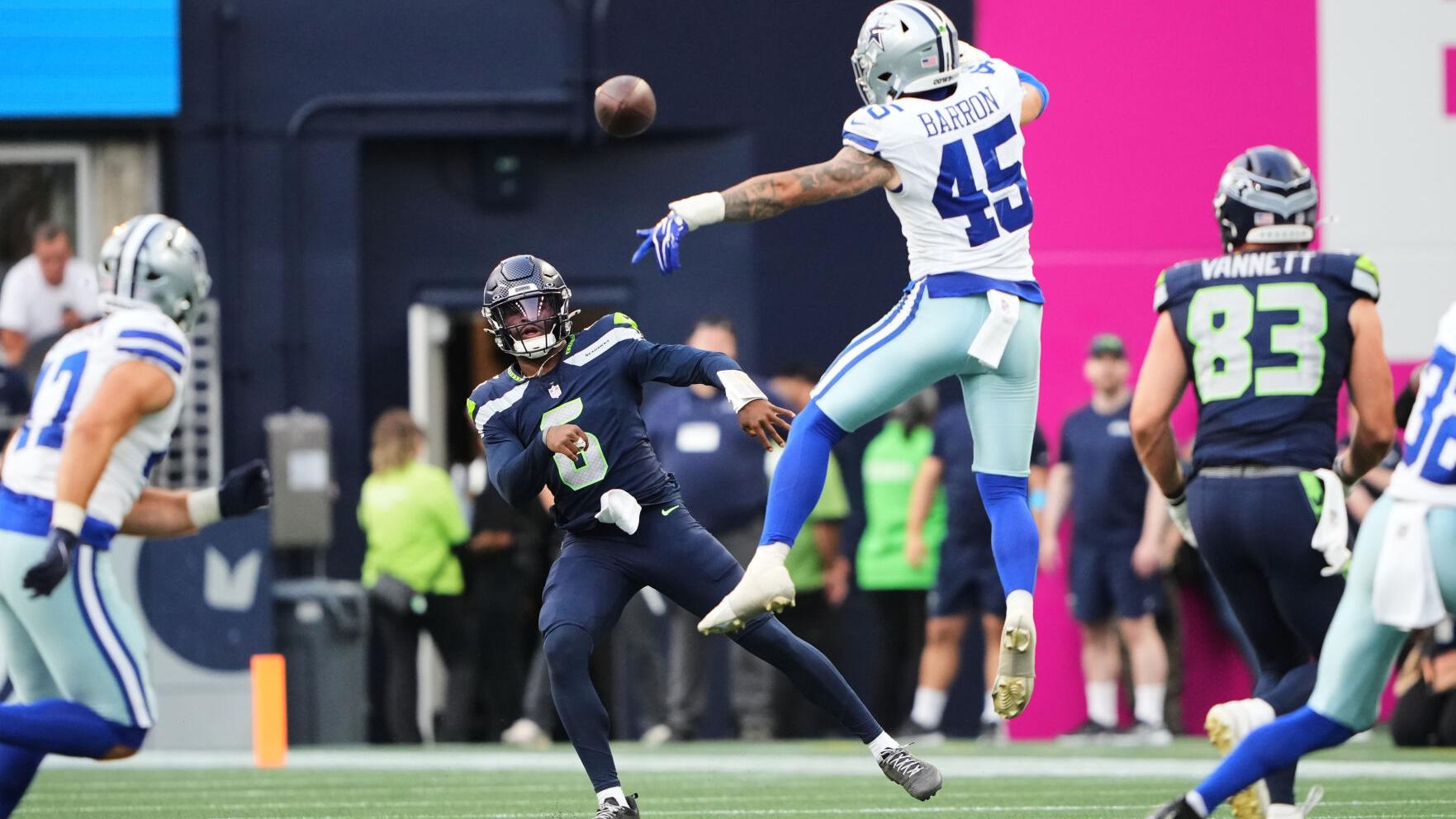
There are a lot of good things going on with the Seahawks this summer. The performance against the Cowboys in week one of the pre-season most certainly isn’t one of them.
It was surprising to see just how badly they played. It felt like nothing functioned, on either side of the ball. Every play on offense felt laboured. The defense had no answers apart from the performance of one outstanding player in Tyrice Knight (more on him in a moment).
The perspective is that none of the true starters featured in this game. Even so, it was disappointing to see the difference in levels compared to the Cowboys.
There was no pass-rush to speak off. Underneath Seattle’s excellent leading D-line, it appears they haven’t been able to develop a young up-and-comer. To put it bluntly, it felt like they were playing without a rush. Only Mike Morris showed in flashes. On my first viewing, nobody else put their hand up to show they mean business. It was a nothing burger of a display.
On the second level, Noah Igbinoghene had a couple of good moments and there was a stark difference in the way he stood out compared to some other Seattle’s other defensive backs. It felt like Dallas was targeting Shemar Jean-Charles and he simply had no answer in those situations. He got himself into bad positions and couldn’t play the ball. The touchdown he gave up was awful. I also have no idea what Michael Dansby was doing on the touchdown he gave up.
The positive on defense was Knight, who was clearly the best player on the field. He seemed to be constantly around the football in coverage or attacking downfield vs the run. He led the Seahawks with 10 tackles despite not playing the entire game. You couldn’t take your eyes off him pre-snap because you knew he was the one guy who was going to do something. Sadly, too often he was the only one. He looked like a quality starter playing against backups.
On offense it was painful to watch. There was no real connected flow to the play-calling — which could be put down to the chopping and changing at quarterback. Even so, Drew Lock seemed to operate on taking occasional wayward shots mixed in with risky throws into tight coverage. He completed 9/13 for just 40 yards and continues to look like an odd mix of supreme arm talent without the ability to make the most of it.
Even so, watching Lock was a veritable treat compared to what Jalen Milroe offered up. I’m sure this will be judged to be overreactive — but I’m just not seeing it with Milroe. Last pre-season I already began to have my doubts that he had sticking power in the league — but you could put it down to his rookie status. This is year two and I just don’t think he has what it takes.
His processing is so slow. He holds on to the ball, pats the ball, and then by the time he tries to scramble it’s often too late. Either make a call and show you can throw with anticipation and timing, or just be an athlete dude. At the moment his hesitation is crippling every play when he’s on the field. Worst of all — it’s taking away the one asset he has which is his athleticism and ability to run, because he’s setting off when the rush has the time to attack him from multiple angles.
It speaks volumes really when Joe Milton comes on to the field and is noticeably better with his processing. He also showed easy arm strength and the ability to attack the second and third level. I don’t think Milroe can.
I’d argue both Milton and Sam Howell looked significantly better than Milroe, which is not a promising sign. He finished 5/8 for 36 yards and took three avoidable sacks.
At Alabama he was a dynamic athlete who can make crazy plays with his legs, putting in the occasional great moment with his arm. Even at this pre-season level, he just doesn’t look up to it.
I don’t think the Seahawks are going to end this experiment imminently but I think the writing’s already on the wall. They don’t have one in the chamber at quarterback. If there ends up being some tricky roster conversations to have down the line — I wouldn’t assume Milroe is safe unless he plays a lot better than this. I just don’t see a NFL player so far — and I’m not sure anyone would claim him.
My other quick reflective notes are that Jake Bobo is such a useful player to have on the roster. He’s naturally instinctive, reliable and shows good hands. Beau Stephens showed some good blocking on the run during a George Holani attempt, then came back and dumped his opponent on the floor on the next snap to clean out a gap on his side. He also had some rookie moments though — and while the potential is clear, I doubt he competes to start right away. On special teams they had some good returns, although Jason Myers missed an easy kick.
I made the right call not to stay up until 1am to watch this game, after a long 24 hours working in London. This was a poor effort by the parts of Seattle’s roster who are fighting for a job.
It doesn’t mean anything overall because Seattle’s starting core is deep and talented. But every one of these games is an opportunity for someone to put their hand up and standout. Only Tyrice Knight did that really — and he’s already established as someone who is very capable of playing meaningful snaps.
I’ll be doing a live stream at 2pm PT today discussing all of the latest news from the Seahawks. You can watch below or on YouTube (please subscribe!):
For the last few days, it’s felt more like a competition to sign Terrion Arnold rather than a series of visits and tryouts.
Despite the accusation of orchestrating the kidnapping and beating of three men, he’d become a cornerback in demand.
He was featured on Hard Knocks, who even showed clips of his workout in Seattle. Both Mike Macdonald and John Harbaugh of the Giants spoke about him at the podium in a way that felt almost like a pitch.
He had other visits with the Texans and Saints.
As discussed on the stream yesterday, given the serious nature of the allegations, the teams surely have intel on what the outcome is going to be. How has Arnold — a valuable former first round pick just two years ago — gone from being cut by the Lions in a flash to doing a tour of the country and now signing with a new team?
His attorney and agency have claimed there’s not sufficient evidence to proceed with the charges. If that is true, he will not face prison. Then it’ll be up to the NFL to determine how much they want to get involved.
The whole thing has been baffling. Pre-2024 draft you would’ve been hard pressed to find a more celebrated player in terms of character. When this story emerged, it was shocking. But determining how involved he was, and proving it, is the key to what happens next for any prosecutor.
Regardless, it appears he’s getting another chance in the NFL based on the news he’s signing with the Seahawks. I don’t think they would’ve made this move if they thought he was going to end up in jail. They have multiple people in their building — staff and players — who know Arnold and may be willing to vouch for him. They’ll have done extensive work before the draft and it’s believed he was a potential Seahawks pick in round one, had Byron Murphy not made it to #16.
I think it’s safe to assume they’re fully across the individual and the legal situation.
It speaks well that he’s made the right decision, in my opinion, to join the Seahawks. Having read through the story in the Athletic — I think moving to the other side of America to join an incredibly professional, veteran-led organisation is just what he needs now.
Some fans might not like the move but personally, I have no problem with it. I trust the Seahawks have done their homework. I trust they have information that we don’t possess that will be guiding their decision.
From a strictly football point of view it’s a heck of an opportunity for Arnold to come in, be coached by a proven staff and try to resurrect his career. For the Seahawks — if they can make this work, they just acquired a first round prospect still in the early development stages of his career at a position of need.
Hard Knocks ended on a Terrion Arnold cliffhanger last week. I’m already looking forward to seeing what the third episode has in store.
.jpg?w=2560)
Just before the 2024 draft, a few rumours emerged that the Seahawks could take a cornerback with their top pick. The two names mentioned were Quinyon Mitchell and Terrion Arnold.
In the end Byron Murphy dropped to the 16th pick — the player they graded as the top defender in the draft. Had he not been available, it’s very possible Mitchell or Arnold would’ve been their man instead.
According to Jordan Schultz, Arnold visited the Seahawks on Sunday. This is despite being charged with kidnapping and robbery.
Authorities accuse him of orchestrating the abduction and beating of three men whom prosecutors believe he wrongly suspected of having stolen luxury goods and $100,000 in cash from him.
According to prosecutors, the victims were abducted three days after cash and luxury items, including Rolex watches and Louis Vuitton bags, were reported stolen from Arnold at an Airbnb rental in the Tampa area. Prosecutors say that six of Arnold’s associates carried out the crimes by holding, beating and pistol-whipping the victims and that Arnold wasn’t there at the time.
None of Arnold’s co-defendants had bond set for them. Two female co-defendants have pleaded guilty and are cooperating with authorities. Their statements tie Arnold to the crimes even though he was not at the apartment, according to prosecutors.
Prosecutors argue that Arnold is as responsible for the crimes as his co-defendants because he told his associates that he thought he knew who had stolen from him and said that he wanted to confront them, setting events in motion.
If he’s convicted he could face a life sentence.
So what’s going on here?
I have no idea on the legal situation obviously but you’d imagine for him to be able to actually play for the Seahawks, they would need some information to suggest he will be available. At the very least it’s hard to imagine the NFL just allowing business as usual given the severity of the charge.
The fact the Lions cut him almost immediately didn’t suggest at the time this would be something that either just goes away or will drag out long enough for Arnold to continue to play football in the short term. Him taking visits, though, suggests otherwise.
His attorney has argued in court that prosecutors are “not even close” to showing that the player knew or directed what his associates would do. His agency has said the judge’s ruling “confirms that there is very little evidence to even suggest any criminal involvement by Mr. Arnold.”
If the attorney and the agency are correct and there’s not enough evidence to prove that he was involved, it’s not beyond the realms of possibility we’re heading towards a foregone conclusion that charges are dropped. What evidence would emerge now to change that? Either there are clearly evidenced instructions or there aren’t. If not, it’s hard to know how anything can be proven in court.
The Athletic published a lengthy report on the situation on July 6th. Included is the following exert:
A man in the neighborhood would later tell Largo police he smelled “a constant cloud” of marijuana smoke emanating from Arnold’s rental. He guessed 20 people were coming in and out of the home, loud enough at 3:30 or 4 a.m. to wake him and his family.
Neighbors discussed seeing a stripper standing on a counter visible from the kitchen window. The Airbnb host estimated it took three cleaners seven hours and 20 trash bags to clean the townhome after Arnold checked out.
The owner of the cleaning company told police that her cleaners saw multiple firearms inside the residence, including an AR-style long gun, and a notebook they believed was used to log the sale of narcotics.
“What a weekend,” the president of the community’s homeowners association later told police, according to body cam footage. “We’re changing the rules because of that.”
By Feb. 1, a Sunday morning, Arnold and others staying at the house began noticing things were missing. Arnold asked a neighbor across the street if he could review security footage.
“He was respectful, he was kind,” the neighbor later told police. “But his group that he was with were just loud and obnoxious … They definitely came across lower-rent than him. He seemed somewhat professional. I wanted to run into him to just say, ‘This is your image, this is your brand. You got to lose these clowns.’”
Then, later in the piece:
Police say while those reports were being taken, the plan to lure Lopez and Tenesaca to the apartment was coming together.
“Yall communicate in here,” wrote Hilton, in creating an iPhone group chat at 11:29 p.m.
Randazzo and Del Valle were part of the chat. So were Christion Williams and Lyndell Hudson, two former Division I football players and longtime friends of Arnold. Arnold, however, was not.
“… text in this chat when yall are 5 away from the house,” Hilton texted to Williams and Hudson in the group chat.
A few minutes later, Williams and Hudson arrived at Eagles Point at Tampa Palms, a large apartment complex a mile from the University of South Florida.
Police say Williams carried a semiautomatic handgun while Hudson — a former Florida offensive lineman who weighed 325 pounds and stood 6-5 in college — had an AR-15-style rifle. They walked up two flights of stairs to the apartment, where Del Valle let them in.
And then, police said, the men hid in a bedroom closet, guns in hand, waiting for Tenesaca and Lopez to get there.
“Let us know when he is inside,” came a text from Hilton’s phone.
I would recommend reading the full piece by the Athletic.
As for Seattle’s interest — I think two things.
One, perhaps they have information to suggest the above is likely, that charges will soon be dropped.
Two, I also suspect they really took to Arnold during their scouting and drafting process.
Despite the significance of the alleged crime he’s been charged with, he received rave reviews for his character pre-draft. He was seen as one of the most engaging, personable and high character individuals.
Media types gushed over his interviews. There were no flags from his time at Alabama. You couldn’t help but like him when you listened to him speak. Nick Saban wrote a letter of support for Arnold’s release on bond, citing ‘exceptional character’.
For a team so focused on character, it’s very easy to see why the Seahawks would’ve given him high marks. I suspect that’s one of the reasons why they’ve got him in — to dig around themselves and get his side of the story. To find out exactly what’s gone off here.
If he’s in a position to continue his career, their background knowledge of the player might lead them to give him the benefit of the doubt.
Some cynical people might view this as purely being motivated due to a lack of depth at cornerback. I don’t think the Seahawks are desperate enough to pull a stunt like that. After all, they were connected with a potential future visit with Arnold a month ago.
I’d imagine it’s down to the confidence in their own work pre-draft, the belief that he was an A+ character prospect and that there might not be enough evidence to force a conviction, meaning he will be a free man. Thus, the Seahawks could be willing to give him an opportunity to restart his career and life.
I don’t think they’d do that for absolutely anyone who just so happened to be a former first round pick. I think the reason they might do it for Arnold is due to the character traits he previously showed.
If you missed my earlier piece on why Sam Darnold is being ranked too low in the media, check it out here.
According to Mike Sando’s annual tiers list, Sam Darnold is only the 14th best quarterback in the NFL. In Jeremy Fowler’s poll of scouts, execs and coaches, he’s only worthy of an honourable mention.
Darnold deserves more credit than this.
He is being unfairly judged because he spent his formative years in New York before having to completely rebuild his career. He’s been robbed of an opportunity to compile stats and provide a portfolio of results to bolster his standing over multiple seasons.
The rankings should better represent the player Darnold has now become — because this isn’t a career success ranking or a projection based on potential. It’s about who’s better than who in 2026.
It seems he’ll never shake off the early struggles he had with a wretched Jets franchise. He is given no benefit of the doubt today, whilst others are judged with a far more complimentary eye.
Take Lamar Jackson. He is unquestionably one of the NFL’s most physically impressive players. He is capable, on top form, of being the league’s MVP — an award he has won twice.
However — Jackson turns 30 in January and there are now signs that perhaps his great ability as a runner is waning. His 349 rushing yards last season are easily the lowest of his career.
Mixed in with the MVP seasons in Baltimore are years where he threw nearly as many picks as touchdowns (2021 — 16/13) and he’s missed 15 games in the last five seasons.
He’s also 3-5 in the playoffs with 10 touchdowns and seven interceptions. His post-season passer rating is 84.6 and his completion percentage is 60.6%.
None of this is to say Jackson should be ranked below Darnold or that he’s wildly overrated. I’m simply noting that there’s nuance with all of these players. We focus on Darnold’s issues to an extreme level, while ignoring the positives. I’d say we do the reverse with Jackson — who is still considered one of the NFL’s very best even after an underwhelming 2025 and with signs of decline starting to emerge.
Let’s reflect on why Darnold should be ranked higher and start with the obvious. He’s now a Super Bowl winner with the Seahawks and he’s won 28 regular season games in the last two seasons.
This is the kind of record that some of the players listed higher than Darnold can only dream of.
Some will argue that circumstances and environment have positively impacted him. He’s been well coached by Kevin O’Connell and Klint Kubiak. He’s been able to throw to Justin Jefferson and Jaxon Smith-Njigba. Both teams had a strong complementary defense.
Isn’t that the case for other quarterbacks too?
Brock Purdy, a former seventh round pick, has clearly benefited from playing for Kyle Shanahan. He has played on a loaded 49ers team. Jared Goff’s career has been salvaged by playing for Ben Johnson — after Sean McVay decided he wasn’t good enough. Now with the Bears, Johnson is equally having a very positive impact on Caleb Williams. Goff and Williams have a collection of good weapons to work with.
Patrick Mahomes might be the most talented quarterback to ever play the game. Last time I checked though he did still play for Andy Reid, has had excellent options to throw to and had elite defensive team-mates.
If we’re going to knock Darnold for his support system, let’s be consistent.
Not to mention — without Darnold the Vikings, with the same supporting cast, regressed from 14-3 to 9-8. After signing him the Seahawks improved from 10-7 to 14-3.
One of the biggest complaints about Darnold are his number of turnovers. The reality from last season, however, is quite interesting.
Darnold threw 19 turnover worthy plays. Let’s look at how that compares to some of the other quarterbacks:
Baker Mayfield — 28
Trevor Lawrence — 22
Patrick Mahomes — 20
Bo Nix — 20
Sam Darnold — 19
Caleb Williams — 19
Matthew Stafford — 19
Dak Prescott — 19
Drake Maye — 17
Justin Herbert — 15
Jordan Love — 14
Jared Goff — 13
Lamar Jackson — 12
Brock Purdy — 11
Darnold’s number of turnover worthy plays is the exact same as Stafford, Prescott and Williams. He threw fewer TWP’s than Mahomes and Mayfield.
Let’s also consider that Darnold played all 17 of Seattle’s regular season games. Mahomes started 14 games before his injury, Love started 15 for the Packers, Herbert started 16 games, Jackson 13 and Purdy just nine. There are several players below Darnold who, had they played 17 games, would’ve likely been above him on the list.
The concept of him having a big problem with turnovers seems to stem from a handful of standout moments in his career. The ‘seeing ghosts’ quote with the Jets, the meltdown at the end of the 2024 season against the Lions and Rams, plus the four-interception game in LA in 2025.
People linger too much on these and not enough on the good things he’s done in the last couple of seasons.
For example, his performance in the NFC Championship game this year was outstanding. He outgunned Matthew Stafford on a night where Seattle’s defense struggled and the offense only managed 75 rushing yards. Darnold finished with 346 passing yards, three touchdowns and zero turnovers.
All three scores were well executed by the quarterback — especially his first of the night to Jaxon Smith-Njigba under severe pressure:
2025 Seahawks Season Grid, Day 6
Best Play Call: JSN Touchdown vs the Rams
What was the Best Defensive Turnover of the 2025 season? https://t.co/wzqYczNdlv pic.twitter.com/VKL0PWxqzK
— ᴅᴏxx ⚡️ (@new_era72) February 25, 2026
He also kicked things off with a brilliant downfield bomb to Rashid Shaheed.
That was a winning performance when it mattered most. Without Darnold and the passing attack, the Rams play the Patriots in the Super Bowl.
How many big-game moments has Dak Prescott had like that, for all his gaudy numbers over the years? Or Jared Goff? Or Justin Herbert? Or Jordan Love? Or even Lamar Jackson for that matter?
Everyone focuses on the weird two-point conversion in the week 16 win against the Rams. How about Darnold’s epic drive to win the game, where he had to throw two redzone touchdowns to clinch an overtime victory? High pressure moments against a top opponent. Darnold delivers again.
What about his nearly flawless first half performance on the road against the Commanders on Sunday Night Football? Or 3rd and 10 against the 49ers with 4:02 remaining, leading 13-3 with the NFC West up for grabs? Darnold extends the play, then throws across his body to Cooper Kupp for a huge 3rd and 10 conversion to clinch the game.
Now let’s look at his time in Minnesota. He threw 347 passing yards, scored five passing touchdowns and had a perfect 157.9 passer rating against the Falcons — breaking a Vikings record. He delivered a clutch game-winning drive to win in Chicago 30-27 in overtime.
When the Vikings beat the Packers 27-25 in week 17, the entire Vikings roster and staff waited for him in the locker room and lifted him into the air after a three-touchdown, 377 yard passing performance on a day where Minnesota ran for 69 yards at 2.65 YPC.
Had these moments occurred 3-4 years into his career, having been drafted by a normal franchise, we’d all be raving about his trajectory. Instead, he’s had to take the long road to get to this point. Yet he still only recently turned 29-years-old.
We never really hear as much about the horror-moments other quarterbacks have faced in their career.
Matthew Stafford has 15 games where he threw three or more interceptions. On four occasions he threw four picks and he even had a five-interception game against a bad Seahawks team for the Lions.
Lamar Jackson had a four interception game against the Browns in 2021. Jared Goff has a four and a five interception game on his rap sheet. Joe Burrow threw four picks against the Steelers in 2022.
The point is — good quarterbacks have bad games. Darnold has had bad games. He will have more bad games in the future. Yet he’s also had the kind of career-defining moments that should wash away any lingering priors people had about him to the extent he’s somehow still viewed as a lesser quarterback.
Darnold is also more than a mere facilitator. Last year he threw 29 big time throws in the regular season — the fourth most. In 2024 he threw 33 BTT’s — the third most.
Here are the BTT leaders for the last two seasons:
Matthew Stafford — 70
Sam Darnold — 62
Josh Allen — 60
Joe Burrow — 56
Justin Herbert — 55
Caleb Williams — 52
Bo Nix — 52
Baker Mayfield — 50
Dak Prescott — 45
Lamar Jackson — 39
On top of this:
— His ‘average yards per completion’ is 8.2 yards — good for joint second in the league alongside Jared Goff
— He’s seventh for yards per game, sandwiched between Patrick Mahomes and Baker Mayfield
— His 60 touchdown passes are sixth most — level with Joe Burrow and two behind Lamar Jackson
— His quarterback rating (100.9) is seventh best, just below Josh Allen
— His touchdown percentage (5.9%) is tied for fifth with Matthew Stafford
— His completion percentage (66.9%) ranks 8th — ahead of Dak Prescott, Justin Herbert, Allen, Jackson, Stafford and Mahomes
— He has the third most passing yards (8367) behind Goff and Stafford
Darnold is winning at a Championship level, is making as many big plays as anyone else and is only throwing risky passes at the same level as the players at the top of the tier list. He’s in the top-10 for all meaningful stats and often ahead of many of the top ranked players.
So why isn’t he higher?
Let’s go back to Sando’s poll for his tiers list:
2026 QB Tiers is live!!@TheAthletic keeps raising the bar in terms of production quality
This year you can produce your own tiers with your own votes
Link in replies pic.twitter.com/MAy63JiKz5
— Mike Sando (@SandoNFL) August 4, 2026
I think it’s pretty clear that if you were doing a ranking today — Patrick Mahomes, Josh Allen and Matthew Stafford should be comfortably the top three.
Joe Burrow could’ve been in that conversation had he been able to stay healthy. Instead, he’s just outside that top tier.
After that, there’s a group of quarterbacks who could all jockey for position in the second and third tier.
I’d have no problem with people putting Lamar Jackson next based on his résumé, overlooking the possibility of him declining physically.
Darnold should be in the conversation to be next, along with the likes of Dak Prescott, Jared Goff and Justin Herbert. They should be the top-nine in my opinion.
It’s insulting that anyone would put Jayden Daniels ahead of Darnold. He’s had one successful rookie season and one injury-ravaged season. His frame and durability was a massive concern coming into the league and now it already looks like an issue. He should be viewed as a player with a ton to prove in 2026, not someone who ranks above a player of Darnold’s proven ability.
Drake Maye and Caleb Williams both took big steps forward last year. Yet Maye also looked exposed in the Super Bowl and didn’t play well in the playoffs generally. We’ll learn a lot about him this year but to be ranked 8th as he was in Sando’s tier list feels a bit reactive to last season which could end up being a bit of mirage for the Patriots in general.
For example — I think I’ve heard more about Darnold not playing well in the Super Bowl than Maye. How’s that right?
I am at a loss to understand why Jordan Love is ranked 10th in Sando’s poll, four spots ahead of Darnold. It makes no sense on a performance or consistency basis. He is a major question mark for the Packers.
Brock Purdy is not better than Sam Darnold and neither is Baker Mayfield, despite an electric start to 2025 before falling off dramatically (one of the reasons why the Buccs might be hesitant to pay him now).
For me Darnold is clearly one of the nine best quarterbacks in the NFL currently. Others, such as Williams or Maye, might have more potential. In the here and now, Darnold deserves to be ranked above them.
I can’t help but think the reason for his low ranking might be stats like QBR (19th) and EPA (15th), which had him middle of the pack. In that case, shouldn’t CJ Stroud be higher? He was 11th for QBR and 14th for EPA. Does anyone truly think that he played to those levels in 2025?
Lamar Jackson was 20th for EPA. Brock Purdy was 2nd for QBR, with Mac Jones 10th. Jared Goff and Caleb Williams ranked in the same range as Darnold for QBR.
Therfore, I find it hard to believe these two data points had a big impact alone.
It might be the way the world views Darnold is reflective of the way they view the Seahawks too. There seems to be an air of — ‘sure, they won the Super Bowl — but how good are they really?’
They’ve forgotten they went unbeaten from November 16th. They’ve forgotten they actually beat the Rams twice — and that the two-point conversion didn’t determine an entire season (so much happened in that game after the crazy play). They battered a 49ers team 41-6 that had just beaten the defending Champion Eagles in Philadelphia and outgunned the Bears in week 17. The Seahawks swatted aside the AFC Champions in the Super Bowl.
They are being undersold going into 2026 and people are dropping the ball with the quarterback too.
Darnold shouldn’t have anything left to prove other than how far he can take his career rejuvenation. He should be viewed as a player who has already proven the critics wrong — and claimed a place among the nine or ten best players at his position.
On the 13th August last year, I wrote a piece titled: ‘Why I’m very positive about the Seahawks in 2025‘.
The majority of people were bullish about the Seahawks — although there was certainly an element of the fan base and media who were unconvinced by the decision to move on from Geno Smith and DK Metcalf. I still remember walking out of the opening game defeat to the 49ers with one noisy fan announcing that he’d ‘told everyone’ it was a mistake to trade Geno.
A post-season run to the Super Bowl was not on anyone’s mind really, even if there was a feeling of intrigue surrounding Mike Macdonald’s second year.
Here’s what I wrote:
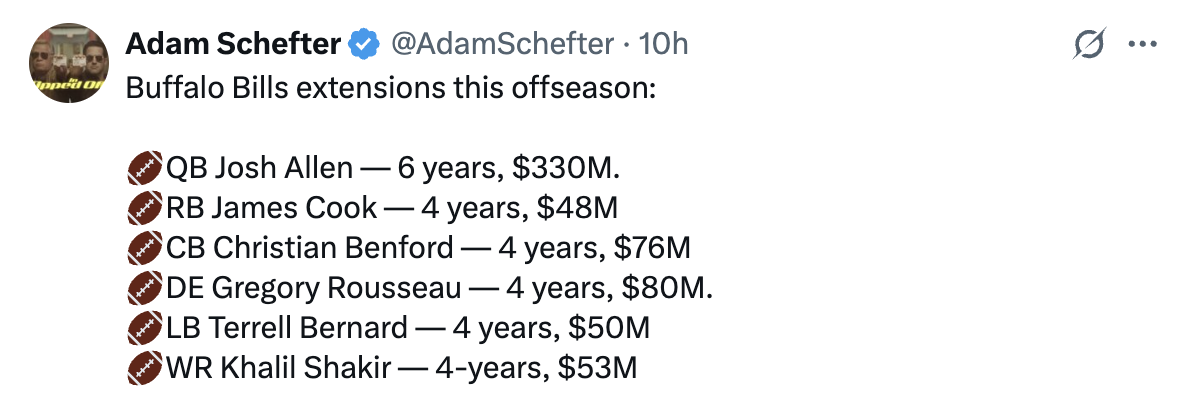
As news broke that running back James Cook had signed a new contract with the Buffalo Bills, Adam Schefter tweeted a list of extensions completed by the team this off-season:
My initial reaction was to think there’s only one player on the list I’m jealous about — the name at the top. Otherwise, the Bills have signed a group of players to second contracts who are no better than the bulk of Seattle’s core.
The Bills are third favourites to win the Super Bowl, behind the Eagles and Ravens, according to ESPN Bet. Baltimore, like Buffalo, have a decent roster. Yet they’re led by their MVP candidate under center, not a loaded talent pool.
There aren’t any true super-powered blue-chip heavy teams at the moment. There’s nobody like the 49ers at their best a few years ago, for example. The Eagles are the closest and yet they’ll have to contend with being the defending Champs. Last time they were in that position they went 9-7 twice before collapsing to 4-12.
The point I’m making is this feels like quite an open NFL. There’s every chance a great quarterback like Josh Allen, Lamar Jackson or Joe Burrow will break through this year as a consequence. Or Patrick Mahomes bounces back from a disappointing Super Bowl loss.
All of those players are in the AFC though. As we saw in the most recent Eagles Championship victory, it’s possible to get to the final game of the season then dominate on defense and win handsomely.
The Seahawks have a good young roster. They have key players and some, such as Leonard Williams, feel underrated nationally. Certain players have to reach a new level in 2025 but they’re capable. The defense has a chance to do special things this year in Mike Macdonald’s second season through a combination of available talent and scheme. We’ll need to see Klint Kubiak’s offense in a real game to properly judge but there’s definitely a positive vibe at the moment.
If the Seahawks can play better up front (they can hardly play worse), run the ball and get efficient play from their quarterback — they can complement a great defense nicely — much like the Shanahan-led 49ers when they were reaching Super Bowls with Jimmy Garoppolo and Brock Purdy under center.
This isn’t me making a Super Bowl prediction. A team needs to earn that kind of backing. They need to be better at home in 2025 to justify any level of post-season faith. They need to show they can be far more competent and consistent on offense. They need to stay healthy, too.
Yet I can’t shake the thought that this team is being slept on in a wide-open NFC. Unless you truly expect the Eagles to just carry on where they left off, who is the great team in the conference? The Lions have lost coaches and key players since last season and carry a ‘missed their best shot’ feel about them. Are the Commanders really that good aside from an excellent young signal caller? Are the Vikings a bit of a paper tiger, breaking in a new quarterback? How good are the Packers, actually?
The Rams and 49ers get plenty of attention but both are dealing with key injuries. Los Angeles, in particular, are riding a playoff hype train from last season that masks a matching 2024 record as the Seahawks — even when Seattle effectively played the whole season with an inept offensive structure. Matthew Stafford’s injury situation surely dents their prospects.
Much like the Lions’ emergence not that long ago, or the Commanders last year, I think the Seahawks can make some noise in 2025. I do think the O-line will be better thanks to proper guidance and scheming. I believe the running game will be more effective and complement a great defense. I sense Sam Darnold will do what he needs to do to make this team interesting.
I think the Seahawks are heading in the right direction. There’s no drama or ego either. Everyone seems to be getting on with business which is a refreshing change.
They also get to play the AFC South and NFC South this year — a bonus.
Everything feels positive and for once, maybe we can afford to wonder what is possible in 2025? It might not be a run to the Super Bowl. Playoffs? Very possible. Winning a post-season game? Ditto. Making a bit of a run? That would be an exciting shift in gears for a franchise that has had to wait a long time to get back to that kind of position.
Contrary to what some people suggest, I always own when I’m wrong. Heck, even in this piece I went on to voice scepticism about Matthew Stafford health (he went on to win league MVP).
Therefore, I’m not going to hide from the fact that was a pretty good projection for what was to come. The faith in the Seahawks in particular — which again, was not shared by everyone — was justified.
So what do I think now?
I don’t really think anything has changed.
There is an existing window for the Seahawks and the Rams that remains firmly open for this season. If I had to make a call for the upcoming season it would be that one of these two teams will once again represent the NFC in the Super Bowl.
That’s not a very daring take — but it does feel firmly rooted in reality should both teams avoid terrible injury misfortune.
I wouldn’t say the conference is ‘wide open’ any more as I did a year ago, because the Seahawks and Rams have filled the void at the top. Anyone looking to make a run will have to go through them. Last summer, it felt like it was very much ‘TBD’ who would get to the end, with a handful of possible contenders.
I don’t think the other teams have done enough to catch up.
The NFC East could be an interesting division to watch but I’m not convinced any team within it has what it takes to become a Super Bowl outfit.
The Eagles were flawed a year ago — with question marks about the play-calling, the quarterback and other aspects of the team. The old guard who helped drive them towards Championships are either hanging on to the back end of their careers or they’ve retired. So much was built around the offensive line yet now there are question marks — including the loss of O-line coach Jeff Stoutland.
They were eliminated from the playoffs in their own stadium by a banged-up 49ers team who lost 41-6 to the Seahawks the following week. I’m not convinced they’ve done enough to come flying back to form in 2026.
The Giants have a collection of interesting younger players and now have a very experienced Head Coach in John Harbaugh. Does it feel like they’re at least a year away, though, from being a team you can truly buy into? We need to see how everything comes together. Plus, their key players need to stay healthy.
The Cowboys are the Cowboys — they’ll probably be very similar to last season. I’m not convinced by the Commanders at all and increasingly their 2024 run to the NFC Championship feels like a bit of a one-off.
These four teams will be fun to watch when they play each other — and it could be a competitive race for the division — but I don’t think any will be in the Super Bowl.
In the NFC North I can’t help but feel like the Lions missed the boat. They had a window of about three years that might be comparable to the current window the Seahawks and Rams have. They failed to get to the big game — and now they might be coming down the other side of the mountain.
The Packers flatter to deceive too much. On their day they can probably beat anyone but they have consistently failed when it comes to key playoff games and showing they can go on a great post-season run. They’re always in the mix but often feel like a bridesmaid, never the bride.
The Vikings could be a sneaky difficult team to play given Brian Flores will undoubtedly field an excellent defense again. Kyler Murray is who he is at this stage but if they can find a way to play complementary football, with that defense, they could be in business. It’s still hard to imagine a Murray-led offense going deep in the playoffs though.
The Bears are the ones who could emerge. They gave the Rams a game in the divisional round and possibly should’ve won that game in the freezing conditions. Ben Johnson clearly is capable of putting a productive offense on the field. However, last season they relied on highly dramatic late comebacks to win a series of games. Can they keep doing that? Could their luck reverse in 2026? Is their defense good enough?
It’s hard to have any faith in the NFC South teams. Todd Bowles feels like he’s clinging on to his job and another middling season in 2026 could be the end. They’ve lost key veterans like Mike Evans, Vita Vea wants a trade and Baker Mayfield isn’t happy about his contract. It feels like a mess is brewing.
The Saints got on a bit of a roll towards the end of last season and the Falcons have upgraded their Head Coach. It’s still a division that was won by a very average Panthers team last year though. It would be a stunning set of events if any of these teams turned into genuine contenders.
So that leaves us, really, with the Seahawks and Rams. The clear top-two, just as they were a year ago. It could be that they go toe-to-toe for the next 1-3 years creating something of an epic rivalry.
I underestimated the Rams a year ago but nothing about Matthew Stafford’s stats from 2022 to 2024 suggested he’d do what he did. His play had declined. He’d had injuries. He didn’t reach 4000 yards in three consecutive years, have a QB rating close to 100 or top 24 touchdown passes. Then bang — 4707 yards, 48 touchdowns and a rating of 109.2.
I do wonder if he can do that again. He turns 39 in February. As we’ve seen with many quarterbacks, eventually you do just hit a wall. I’m going to give him the benefit of the doubt until we see him play though, after last season.
The moves to improve their secondary and then make the mega-trade for Myles Garrett shows they sense the opportunity on offer. So we see two teams really attacking things from different positions.
The Rams — highly aggressive, flashy-move dependant — relying on star power.
The Seahawks — keep their group mostly intact, modestly replaced those who departed, possess a deep roster that does not rely on big names.
Both teams obviously are well led and brilliantly coached.
Originally I didn’t like the fact that the first meeting between the teams wasn’t until Christmas Day. Now, it’s growing on me. I think both teams will be sizing each other up. They’ll be able to react at the trade deadline to prepare for the second half of the season and the inevitable collision course.
If both teams avoid the injury bug — they could be destined to meet three times again this season.
I haven’t forgotten about the 49ers but you have to wonder whether their injury issues, not to mention the recent accident for the Head Coach, combined with the age of certain key players, could mean that this is finally the year where they regress ahead of what might be a fairly significant refresh/rebuild.
The AFC feels more open to opportunity. It’ll be interesting to see what the Bills do under a different Head Coach. The Ravens also have a new coach and it’ll be fascinating to see how different they are in 2026.
Can the Bengals stay healthy enough to be competitive? They have the talent.
The Jaguars came on strong last season, whilst the Texans are clearly good quarterback play away from being a genuine threat. The Broncos have proven to be strong under Sean Payton, whilst the Chiefs will be expected to bounce back. Can Jim Harbaugh’s Chargers take a step forward?
And then there’s the Patriots — a team who feel primed (to me at least) to regress in 2026 after a fairytale run last year that has since been long forgotten amid the biggest tabloid scandal of the year.
A final point on the Seahawks and Rams.
I think there’s little reason to believe the Seahawks won’t handle being defending champions very well. As we saw on Hard Knocks, this is a very unassuming staff and roster. There’s exceptional veteran leadership, a deep talent pool and plenty of young players who are very capable of taking the next step in 2026.
There’s a ‘business as usual’ feel to training camp, which doesn’t seem typical for defending champs. This is a team that went undefeated from November 17th and played completely balanced football across all three phases. They can win in so many different ways.
There are questions about losing the offensive coordinator and needing to see how Brian Fleury does in his first year as a play-caller — but even if there are growing pains, it’s fair to be optimistic about Seattle’s chances of being a team that can make another run.
It’s very rare that teams who ‘win’ the off-season go on to win the Super Bowl. I think the Rams have the best chance to break that conventional wisdom. They were a very good team a year ago and have now acquired the most physically gifted human in the NFL.
The weight of expectation can also be an issue sometimes. They start against the 49ers in Australia, return to play Harbaugh’s Giants, then go to Denver and Philadelphia. Their fifth game of the season is at home to the Bills.
It’s a challenging start. It’ll be interesting to see how they respond if they begin slowly because it’s entirely possible they lose at least a couple of those games.