Category: Main (Page 6 of 99)

This is a guest article by Curtis Allen…
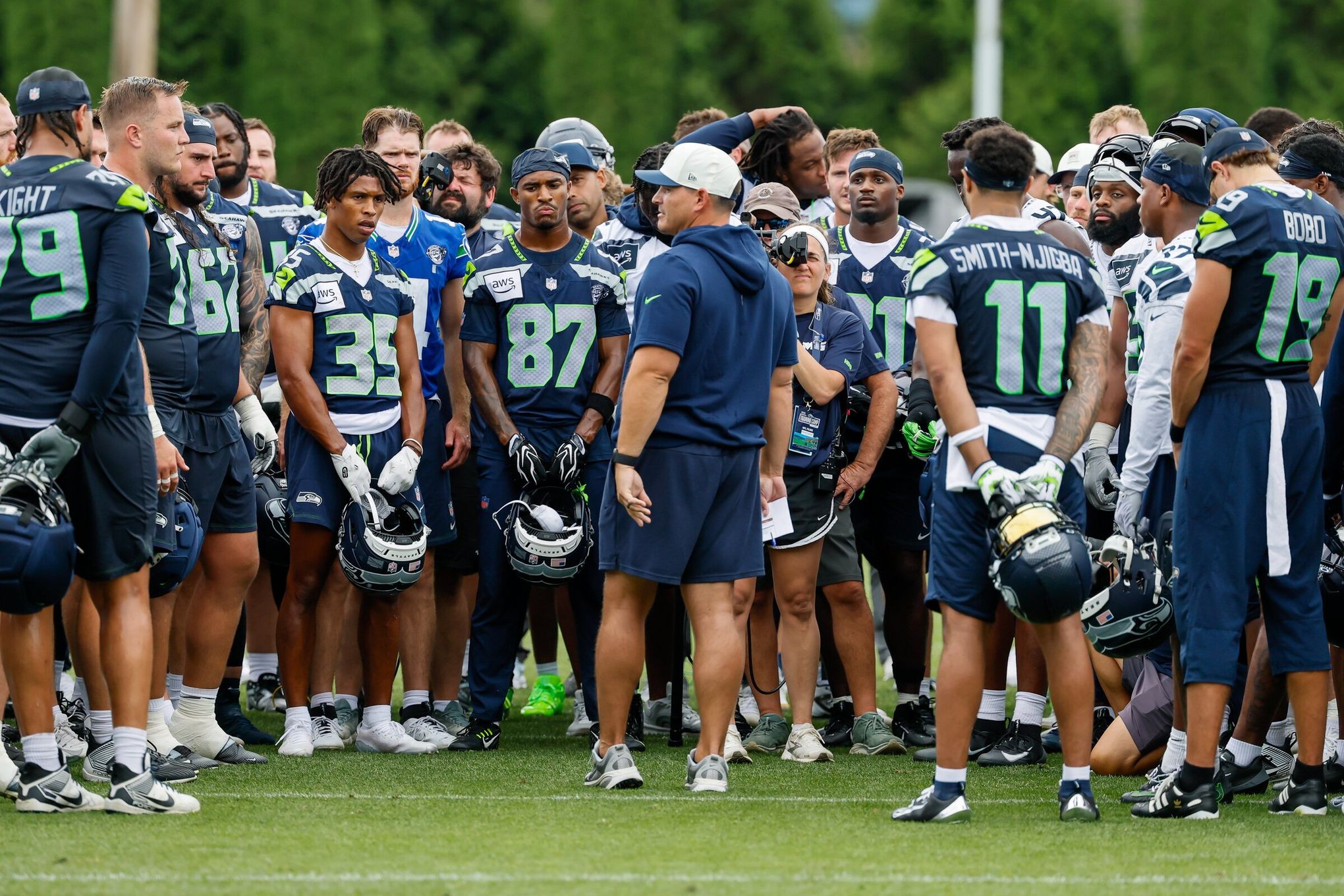
The first open camp day with the players wearing pads did not disappoint.
The competitiveness and pride – particularly on defense – were evident. Just imagine this defense finally being able to hit someone after a week of witnessing Jaxon Smith-Njigba, Rashid Shaheed and Jadarian Price bust off big play after big play.
As we talked about on Day Four, the restrictive nature of the early camp days heavily favors the offense. Add in the continuity of nearly the entire offensive roster and new Offensive Coordinator Brian Fleury wisely deciding to retain the essence of Klint Kubiak’s concepts, and that made for some potent fireworks early on.
That is likely the match that lit the stick of dynamite of today’s rowdy moments between the two squads. Leonard Williams kicked it off by tracking down A.J. Barner downfield on a pass play that was an explosive one and taking him down hard (side note – Williams running down a Tight End in practice is another example of the team intensity this year). The offense was not amused. But calm was quickly restored. On the next play, Williams and Bryce Cabledue went at it after the whistle. Derick Hall came in from behind and took Cabledue down to the ground. It flared for about 5-7 seconds and then order was eventually restored.
Usually, these things happen a little bit later in camp. It is hot, players are sick of practicing and want to be get into real games — and so fuses are short.
It is my assertion that this came earlier because this top NFL defense had been embarrassed thus far in camp and was fed up.
I will say it again: there is no Super Bowl hangover. Some had said camp so far had been ‘low energy’ or ‘boring.’ Personally, I think we have been seeing the straight-line focus and efficiency of Mike Macdonald and staff being implemented very effectively. The intensity and hunger were always there; it was just more harnessed. It was easy to see today.
Some Noteworthy ‘Promotions’ on Display
Bud Clark got a handful of snaps with the starters on defense. A nice reward for his hard work and sound play with the twos and threes so far in camp. It was especially nice to see him used in several different roles with the ones.
When he first came in, he was the deep safety while Julian Love and D’Anthony Bell roamed near the line of scrimmage. I think that can only be beneficial, as he can get a sense of a fantastic passing offense and its timing.
Later, he moved down into the box and was in the Nick Emmanwori/Bell role. Then he covered Tight Ends like Barner and Elijah Arroyo, quite effectively I might add.
Nehemiah Pritchett got his first sustained bit of reps with the ones also, lining up at the Right Cornerback spot while Devon Witherspoon stayed on the field in a nickel/slot role.
And perhaps most notable: Beau Stephens was moved up to the twos after spending most of the summer and all of camp with the threes. He slotted in at Right Guard while Christian Haynes moved over to Left Guard.
I doubt these moves represent a major sea change for the team. However, it is fair to expect all three of those players to log some important snaps for the team at some point this year. Bumping them up a level above what they had been practicing with helps them prepare to do that.
Elijah Arroyo’s Best Day So Far
On Tuesday I mused about Arroyo, wondering if he was a good fit on this team. Whenever A.J. Barner was not with the ones, they had Eric Saubert taking his spot, not Arroyo.
The team just brought in Nick Vannett, an ability match with Saubert, Barner and Kallerup. Brady Russell had also worked in the mix in drills. He feels like a misfit toy.
Today, Arroyo showed why they spent a second-round pick on him. He played with all three offenses and had great catches for healthy chunks of yards with each of them.
Sam Darnold found him on a crosser, running the route like a Wide Receiver in traffic.
Drew Lock found him after buying some time by drifting to his left and Arroyo caught it and accelerated up the field.
Jalen Milroe found him deep downfield and used Arroyo’s height and jumping ability to deliver about a 35–40-yard pass.
A couple of times after a nice catch, Arroyo let loose with a burst of emotion. Guessing there had been some pent-up frustration with his use and performance in camp so far.
Brian Fleury had him inline at times but mostly as a split out Tight End, creating mismatches with Linebackers (not fast enough) and Safeties (not big enough).
I love it when I am wrong in this way. Arroyo could be a very nice chess piece for Fleury to play with. I think the biggest challenge is working him in. Barner, Saubert, etc you can bring in and the offense is not sure of your intentions. Arroyo comes in and your hand is tipped a bit that you are essentially in a three Wide Receiver set.
We will see how he is used.
Notes & Observations
— Jalen Milroe was once again impressive today. I do not think I have seen one ‘very poor’ decision yet from him in camp this year. Last year it was daily occurrence. He is still being used with the threes, with occasionally an Arroyo or a Price thrown into the mix. More and more, what I am liking is he is not panicking. He displays patience and does not rush things. It works for him because he has a quick release and his footwork is pretty quiet when he is scanning so he is not out of position when he decides to execute.
— In the warmup period Milroe was doing a drill where he took the snap and literally froze like a statue. Feet planted like trees in the ground. When the receiver established his route, then Milroe unfroze and his mechanics were clean. It feels like one of those drills that helps root the mind in the idea that you need to stay connected to the ground to have good mechanics.
— Milroe also had a presnap sequence that was interesting. Price set up in the slot, Milroe waved him to get set next to him, then moved him to the other side before taking the snap. That is commanding your offense. I continue to believe he will in time get some reps in camp with the twos. We will also need to see if the pressure of a preseason game will crack this calm precision he is currently displaying.
— If you follow my twitter account while I post the blow-by-blow of camp, you will see a ton of ‘Price’ and very little ‘Holani.’ That was true today as well, as Price got a much larger share of snaps with the ones and then worked with the threes a bit. Even Emanuel Wilson got more snaps than Holani today. What is going on? I think the Seahawks know what they have in Holani and are using camp reps to evaluate & train the position aside from him. They ran some pass block drills again today and Holani was far and away the best of the group. It was a mixed bag with Price and Wilson. Jacardia Wright was overmatched.
— Bobby Hart has not taken any reps with the twos that I have seen. Josh Jones, Amari Kight and even Logan Brown have regularly gotten snaps there. He may just have been depth insurance and/or a message to Jones. He practices fine but the team is moving Kight and Brown from the left side to the right when they want to change up the Tackle spot with the twos.
— Julian Neal and Jake Bobo were on the field but not participating today. Irv Charles was a full participant, working on Special Teams as well as with the threes. Milroe hit him with a beautiful deep pass late in practice that made for a big play. I found this interesting – Charles is so big, they lined him up right in the middle on the kickoff coverage reps. In between Mike Morris and Brady Russell. It is very possible a guy of his size and speed can create mismatches on coverage.
— The team did a drill where a Running Back takes a pass out of the backfield and has to make the catch, turn and juke the defender. Price drew Patrick O’Connell three times and all three, left O’Connell in the dust.
Amid the very mixed projections for the Seahawks in 2026, I thought I’d take a bit of time to reflect on just how good things are right now.
This is a roster with a lot of young players who are barely scratching the surface of their upside and potential. I’d argue Byron Murphy, Zach Charbonnet, Tory Horton, Elijah Arroyo, Grey Zabel, Rylie Mills, Drake Thomas, Devon Witherspoon and Nick Emmanwori are only scratching the surface of their potential. You could name others too, including established veterans like Charles Cross.
Complementing this group are a selection of season veterans leading the way. DeMarcus Lawrence, Leonard Williams, Jarran Reed, Cooper Kupp, Julian Love, Ernest Jones and Uchenna Nwosu help set the tone, the standards and provide the kind of alpha energy any successful team requires.
You have players on the roster playing at an elite level — such as reigning offensive player of the year Jaxon Smith-Njigba.
There’s also a quarterback who is both a proven winner and very easy to root for. While sections of the media seem intent on focusing on things like turnovers, the fact is Sam Darnold has led two different teams to back-to-back 14-3 seasons and he’s now a Super Bowl Champion.
The Seahawks are in an enviable position financially. They have new owners who are likely to want to back the team on and off the field to create a positive first impression. They have a healthy cap outlook for the future — with a clear path to keeping the core players they need to retain while paying their proven up-and-comers seeking a big second contract.
Difficult decisions will need to be made in the future yet there’s sufficient depth across the board — enabling them to use the draft to replenish lost players in free agency — as we saw with their three top picks this year.
There’s talent throughout the roster being primed and readied to step up to the plate whether that’s in relief or as a future potential starter. Just look at the way Drake Thomas, Ty Okada and others have emerged.
They own 12 draft picks in what is widely perceived as possibly the deepest draft in some time for 2027.
Their talent extends beyond the roster. The Seahawks have an ideal blend of youth and experience on their staff. They have a Head Coach who is wise beyond his years and a Champion already at 39-years-old. Mike Macdonald is a star — with a clear philosophy, vision and approach for his team. He has a team of coaches around him that are mightily impressive too.
The Seahawks are professionally elite. There’s absolutely no drama for the second consecutive off-season. This is despite the emergence of contract negotiations and the obvious and understandable desire to gain financial reward for the massive success the team has achieved.
They also seem to be handling being ‘Champions’ better than most. The level of normality surrounding their title-winner status seems comparable to the Chiefs during their great run under Patrick Mahomes and Andy Reid. It’s business as usual, even after reaching the summit.
The General Manager has reached a Hall of Fame level after building his second Championship roster. Do not underestimate how comforting it is to have a GM who knows what he’s doing. In that instance, you don’t know what you’ve got until it’s gone. John Schneider deserves a ton of credit for leading a front office that fans can trust implicitly.
The entire franchise feels connected — staff, players, fans. The ownership news has been smooth, not at all controversial or distracting and things are ticking along nicely.
I’m struggling to think of a better example of a competently run sports team in any sport in the world currently.
Nothing highlighted the calm waters more than the last few days. Vita Vea — former standout at the University of Washington — requested a trade. Typically there’d be a lot of shouting about bringing him in. Instead, most of the chatter from fans was simply hoping he didn’t end up in LA or San Francisco.
The Seahawks can afford to be opportunistic now. They have such a strongly bonded roster, rich in talent, that they can let opportunities come to them — at the price point they feel comfortable with.
They don’t need to chase anything. They are strong, physical, tactically excellent and capable of beating opponents in every possible way. They have everything they need already.
If the right trade emerges before the season, or in a few weeks before the deadline, they will attack it. But there’s no need for any more aggression than letting an opportunity come to them.
It is very rare that any team reaches this level of competency — let alone it be the team you actually follow.
We should bask in this. Enjoy this. Celebrate this.
Whatever happens in 2026 — this franchise is 100% on the right track.

You could spend everyday annoying yourself with other people’s takes on your football team.
In writing this, I know I’m falling into the trap. This is the whole point. This particular clip, lasting 3 minutes and 15 seconds, was selected solely because the content is so spicey, it will generate a reaction:
"I think this is a fringe team on that playoff discussion… Don't forget Sam Darnold led the NFL in turnovers last year."@jasonrmcintyre and @SharpFootball discuss if the Seahawks are in for a major regression pic.twitter.com/mfi9tYkRyl
— Herd w/Colin Cowherd (@TheHerd) July 28, 2026
It’s been viewed 325,000 times at the time of writing. It’s the most viewed video for this account this week. The next most popular video has 100,000 views.
You can well imagine the social media manager wearing a wry smile as ‘Warren Sharp’ (real name Tyler Brickner) declared the defending Super Bowl Champions were a ‘fringe playoff team’.
I’m going to bite though. Sharp (Brickner) is one of these people who seems to have been around forever — always willing to offer an opinion — and it’s not entirely clear why.
I’ll admit that some of his data work is fascinating, helpful and can assist in explaining why certain things occur within the NFL. Yet if the data analysis leads you to delivering the kind of appalling take we see above, is he even capable of discerning what the data tells him?
Let’s be clear. There’s nothing wrong with casting doubt on the Seahawks’ ability to repeat as Champions. Only two teams have done it since the turn of the century. The chances are Seattle won’t repeat, as nice as that would be.
They’ve lost Ken Walker, Coby Bryant and their offensive coordinator. They are in the same division and conference as the consensus title favourites.
Yet to suggest they are a fringe playoff team is bordering on a level of preposterousness saved for people stuck on a desert island, Tom Hanks style, without a TV, for the last 12 months. And I couldn’t see a volleyball hiding behind Sharp/Brickner in the video.
Did he even watch this team?
The Seahawks finished the season with a 17-3 record. Two of their losses came in the first five weeks of the season — including week one — when a new team was still figuring things out. Their second loss, to a red-hot Tampa Bay, also came when numerous key defenders were missing through injury.
Their third and final loss came against the very capable Rams in week 11. Despite the quarterback throwing four interceptions, they were a missed-kick away from winning.
From November 17th until the conclusion of the season, they won every game. They did it in a variety of ways too. This wasn’t just a great defense carrying everyone else. Sam Darnold and the offense won the NFC Championship game and, to a slightly lesser extent, the week 16 contest against the Rams. Special teams play was constantly elite.
Every position group had at least one very talented player, and often multiple players — particularly in the defensive front seven.
The Seahawks led the league in point differential (+191). That was 19 points better off than the second-placed Rams. Only three teams had more than +140 points.
The offensive player of the year came from the Seahawks. They have the #1 ranked defensive tackle per ESPN’s recent polling of executives, scouts and coaches. They have numerous young players yet to reach their peak — complemented by seasoned, ultra-professional veterans providing leadership and standards.
The total depth of talent across the roster and the balance across all three units is top-notch. The performance of the coaches was exceptional — and it’s clear the Seahawks have a depth of talent across their staff. Losing Klint Kubiak is a blow but the staff won’t collapse collectively because one man departed. In fairness, they have appointed a replacement who is very familiar with Kubiak’s offense and the quarterback.
They used their first two draft picks to replace their two main losses in free agency. Their third replaced the wildly erratic Riq Woolen. They kept virtually everyone else apart from Boye Mafe — who had two sacks last season.
They’ve had another off-season with zero drama and it very much appears business as usual despite carrying the weight of a defending champion status.
Nothing about this suggests they are, without major misfortune with injuries, on the road to regression. Being a nine-win fringe playoff team would mean losing five more games in 2026. It would be one of the biggest and most epic declines in recent memory if this team was to regress from the deepest, most rounded roster in the NFL a year ago to virtual also-rans.
By all means reflect on the quarterback’s need to limit turnovers, changes to the offensive staff or anything else that casts doubt on Seattle’s ability to repeat.
But let’s not be silly. This is not a fringe playoff team. They are Champions. They remain strong. They will be in the mix if, like anyone else, they avoid lots of injuries.
Be balanced, not ridiculous.

This is a guest article by Curtis Allen…
Less than a week into camp, things are starting to take shape with this team.
Sam Darnold has the same starting Offensive Line that he had last year. He has weapons galore to work with, including the reigning Offensive Player of the Year. The chemistry he has developed with Rashid Shaheed is undeniable. Cooper Kupp is going to once again be that dagger at just the right time, when defenses have been scrambled by covering the other two receivers.
And Jadarian Price is going to have an impact with this team.
Today, the Seahawks did not force feed him as much as they did on Sunday. George Holani got just as many reps with the ones, and even Emanuel Wilson got some. But Price still had a big impact on the day.
First off, he had another fantastic catch from a ball perfectly thrown by Jalen Milroe. He ran a wheel route and his acceleration made the play easy.
Some run plays also highlighted his special ability. On one, it was a basic wide zone left. Charles Cross was working on Donte Fowler and Fowler was not being moved. Price did not have his edge to turn but the lateral adjustment he made around Cross was done so quickly it appeared that was the play all along. Fowler set the edge. He did his assignment and won the rep. Did not matter. Price was so quick and smooth he made the run work and got yards anyway.
Ditto a run to the other side. Derick Hall had busted through and Price just calmly sidestepped him and accelerated.
Later he had a short gainer that demonstrated his tremendous footwork. It was a standard run behind Grey Zabel and Cross. As he got to the line, there was nothing there. Price hit the brakes on a dime, considered reversing course to the right side, saw Rylie Mills closing on him from the right and that split second of working things out opened a way back on the left for 3-4 yards. Mills had three full steps to build momentum and Price still was able to accelerate away from a near standstill and gain yards.
It is the kind of play we will have forgotten by the end of the game. But ask Brian Fleury how much value there is in turning a potential 3rd and 11 into a 3rd and 6. With the playbook opened up, a conversion of that Third Down could turn the tide of the game.
Price is going to affect some games this year. He may not have the primary role in the Running Back room. But everything the Seahawks have given him he has done and done well and he clearly has the talent to make an impact.
Jalen Milroe’s Great Day
Milroe had several fantastic throws today in camp that featured his strong arm, touch on deep balls and his ability to make throws on the move.
He had a 30-yard throw to the end zone front pylon that Montorie Foster caught for a touchdown. It was in tight coverage and Milroe placed the ball in a way that allowed Foster to go up and get it.
Another throw had Milroe play-actioning to the Running Back to the right side and reversing course and moving left and hitting the receiver while making a throw across his body. It takes technique and control to not allow your momentum to affect your accuracy.
Milroe twice made the throw very effectively. On one, he hit Eric Saubert on a crossing pattern right in stride so he could turn up field without losing any speed. It was a thing of beauty. They ran it again later and he hit Ricky White, this time with a throw a little behind him but on target enough to make the play.
On another play, Milroe was doing a red zone drill. He took the snap and found no immediate options. The end zone was really crowded. He slowly drifted to his right to buy a little time, then fired a bullet to Chris White in the back of the end zone for a score.
He did have an interception to Bud Clark that Michael Dansby tipped. I feel this is more a ‘great defensive play’ than a poor play by Milroe, not unlike Patrick O’Connell’s leaping grab of a Darnold pass on Sunday.
It has been an impressive few days for Milroe. A few weeks back I wrote that his mechanics need to improve for the finer points of being a Quarterback to come to the fore.
It is happening. The mechanics have improved noticeably and now he can focus on making plays and letting the game slow down a bit for him.
Now, the caveats: His plays were against the threes on defense. And the playbook is very limited for him. He needs to keep pushing hard to get where he wants to go.
Look for him to get some reps with the twos in the coming days. The Seahawks know what they have in Drew Lock. They need to challenge Milroe by giving him better talent to work with and against.
But it is safe to say a corner has been turned.
Camp Notes & Observations
— Julian Neal did not practice today after leaving early Monday. Mike Macdonald seemed to indicate it was not that serious.
— Eric Saubert is getting stronger with each practice. He only had four catches last season. He may not explode on the stat sheet this year but the dropoff in capability when Saubert subs in for A.J. Barner is not as big as we might think.
— Leonard Williams was asked by Brady Henderson about a contract extension and he confirmed there have been discussions. Great news, as it seems to indicate he is open to playing beyond this year.
— Bud Clark is fun. After the interception, the play was whistled dead but he blew past the coaches standing on the field and ran it all the way to the end zone with an entourage of defenders. He finished it off with a Marshawn-style reverse dive into the end zone, then punted the ball into the crowd on the berm.
— Rylie Mills is making good progress. Seeing him take Kickoff Coverage reps today was fun. Imagine that big man rumbling toward you with malice in his heart. He also frequently played Defensive End on both sides in scrimmages.
— Derick Hall was impressive today. He had several reps where he just was quicker off the snap and got into the backfield to disrupt.
— Tory Horton appeared to just have gotten a rest day Monday. He looked really good in drills and scrimmages. On a red zone drill, he was running a post pattern and the defender had established the inside position so Darnold threw to Horton’s outside shoulder. Horton leaped and twisted his body to adjust and made the catch look much easier than it was.
— For all the talk of the rising young talent the Seahawks have, I have yet to see anything that is making me think Elijah Arroyo is about to take a big step forward. I do not see him going through drills with quite the vigor his Tight End brethren do. The vast majority of his reps are with the twos and threes and he does not seem to be having an impact on the offense that his skill warrants. At this moment in time, he does not appear to be pushing the coaches to find consistent snaps with the starters for him. Is he just not a good fit for the offense? All the other Tight Ends fit a similar profile: Excellent blockers, good route runners, standout Special Teamers and happy to be put in a Fullback type role on the occasional play.
One Final Thought
I wanted to address something that seems to be quickly spreading across the fandom in reaction to some of the things happening in camp. An opinion that can harden like concrete and if unchecked, can distort our view a bit on the state of the team.
We are in a portion of Training Camp where things need context. What is happening on the practice field will not be what is happening in games. Right now, the players are not wearing pads. Defensive Backs cannot press or get physical with receivers. The Quarterback has a no-touch rule. Defenders cannot hit or really even tackle.
It is in that context we are seeing receivers run free and make spectacular catches regularly. Josh Jobe has often been the defender when these catches are made. Fans are starting to form an opinion that Jobe is the ‘weak link’ on the defense, and that is unfair.
The sessions vastly favor the offense. Jobe is not playing zone. Receivers do not have to think twice about running over the middle of the field or if they will run the perfect route just to have their Quarterback sacked.
Let me give you an example from Sunday. Jadarian Price had a wide zone run to the right side behind Abe Lucas. He was accelerating at an angle toward the sideline and just was about to clear Lucas who was engaged to the defender. Devon Witherspoon was closing like a cruise missile. Had this been a game, Witherspoon would have clocked Price into next week with one of his classic hits. But that is not allowed at this stage. So, he let up, put two hands on Price and let him go. Price kept running and the crowd cheered a 15-yard run that was in real life a three-yard run that Price would be feeling in the morning.
The same thing happened in 2023. Geno Smith was in this early portion of camp spinning passes all over the field and fans were drooling at the thought that he would take a huge step forward into the top echelon of Quarterbacks. Those of us that pointed out that this Offensive Line (particularly the interior) was weak and Smith was only making many of his fabulous practice throws after he would have been sacked in real life were criticized as ‘haters.’ The regular season bore out that Smith would be under constant pressure, a state in which he finds difficult to make good decisions.
The opposite effect is happening with Jalen Milroe. He is a tremendous athlete, a dazzling physical talent. But as I said above, at this stage he has thrown some great passes from a limited route tree, against third string players and with a no-touch order on pass rushers.
Yet I see people overreacting that he is a future starter and star in the making, when he needs to make a tremendous amount of improvement to get there.
Rylie Mills is looking really good at this stage. But do not forget: he is essentially a rookie, having only played 28 regular season snaps last year. He will have moments but very likely 2026 will see him in a support role on defense, used to spell veterans and play when the game is mostly settled.
Both hopes and disappointments need to be tempered at this stage. There will be plenty of time to discuss where players are and what they and the team need to do to get the best results.
For now, enjoy camp and keep these things in mind. We talkin’ bout practice. Not actual game situations at this point.

This is a guest article by Curtis Allen…
Today was Jadarian Price Day at Seahawks’ camp.
The rookie was all over the place. Yesterday, he mostly split starter reps with George Holani and had a sprinkling of reps with the twos and threes. Today? He took reps with all three units and got plenty of touches, whether in drills or scrimmages.
It feels like yesterday was a warmup, a precursor to opening things up even more. It was as if seeing how he handled a few key reps yesterday allowed Brian Fluery to expand Price’s use. Sometimes teams go from drips and drabs to turning the tap on full blast to see how a rookie handles it. In regular season games, things move quickly. On a play where you get a run for five yards, you get ten seconds to get up and celebrate, then it is back to the huddle and you need to focus on your assignment for the next play.
He handled them fantastically. He displayed good hands and an ability to quickly secure the ball and focus on juking the incoming defender. I can see a play like this regularly threatening a defense that is stretched too thin by trying to keep a lid on the receivers and tight ends while still defending the run.
Now, I am not saying Price is going to be the next Jahmyr Gibbs. However, he has that same ability to hit the brakes and stop on a dime and let defenders fly past and then accelerate back up to top speed in two or three steps.
On one play, Jalen Milroe threw to the ball to his feet and Price showed great hands to go down and keep the ball from hitting the turf. It was not a novice-level catch.
Today reminded me of AJ Barner and before him Will Dissly in this sense: Just because he did not catch the ball much in college, that does not mean he cannot do it and is starting from scratch with the skill.
Kenneth Walker often split out and ran routes in order to offer that skillset but also to discern what the defense was doing before the snap. Price is showing us in real time that he too has that club in his bag.
This Roster Is Very Deep
Today was a very interesting day in regards to how Mike Macdonald and the team deployed their players in drills and scrimmages. It was very “mix and match” between the ones, twos and threes rather than the more traditional units all working together. He also shook up the matchups. The ones on offense played the twos on defense, and vice versa. It was fascinating to watch and highlighted to me how deep this team is.
There were some basic constructs that featured the same crews (the starting OL, Darnold and Kupp and JSN) at times. But frequently the units got some players from other units to play alongside them. Jaxon Smith-Njigba playing with the twos and taking passes from Drew Lock with Julian Neal covering him. Rylie Mills playing with the ones as a big, physical edge-setter on the right side of the line. Eric Saubert lined up at times with the ones. That sort of thing.
You could see the depth the team has unfolding in real time. It is not hard to look at a roster on paper and see a team that is deep. Seeing it on the field is a real experience that embeds the point even deeper.
Julian Neal worked on Jaxon Smith-Njigba and timed up a pass breakup perfectly. JSN had turned his body and presented a target to the Quarterback and Neal was closing from behind, being shielded by JSN’s body. He arrived with terrific timing, got his arms around the receiver and batted the pass away.
Mills came in and set the edge on a run play, not allowing Charles Cross to win the engagement. The run was forced back inside and had very little gain.
If this keeps developing, it is not out of line to visualize a team so deep, they can spread snaps around to keep everyone fresh. Particularly on the Defensive Line.
For instance, if Mills can pick up that role as a big Defensive End who can set the edge, it is not hard to imagine a series with Derick Hall, Brandon Pili and Mills on the line, supplemented by Uchenna Nwosu in a free-standing role. Maybe Mike Morris coming in to line up inside too. Try running the ball on that lineup.
Just imagine that. While those guys are in, standing on the sideline getting game rest are DeMarcus Lawrence, Jarran Reed, Leonard Williams, Byron Murphy and Donte Fowler.
And then imagine the mad scientist Mike Macdonald having all of those guys as reliable pieces he can mix and match with game by game, even series by series.
The possibilities are tantalizing.
However, it also means something else: cutdown day is going to be rough. There are players we know could make the roster and contribute that will be caught in a numbers game. There will be ones who we hold our breath to see if another team claims them, or if the Seahawks can put them on the Practice Squad and can keep grooming them.
Camp Notes & Observations
— Nick Vannett did not waste any time getting into the groove of things. He looked good in drills and caught a bullet slant pass with ease.
— Play of the day, offense: Cooper Kupp with a beauty of a catch. He does not need to be the focal point of the offense. If he can keep making catches like this, it keeps the offense on the field and gives all the other weapons reps and chances to have impact.
— Play of the day, defense: Patrick O’Connell had a beauty of an interception of Sam Darnold. He had dropped in coverage and Darnold tried looping the ball over him and dropping it in to the receiver crossing behind him. O’Connell high-pointed the ball and snared it with his fingertips.
— The twos had Julian Neal and Noah Igbinoghene as the outside corners. Shemar Jean-Charles occasionally stepped in and lined up in a nickel-box safety look.
— I said yesterday that the chemistry between Darnold and Shaheed was apparent. Here is today’s example. Darnold lofted the ball perfectly over Josh Jobe right into Shaheed’s hand for the score. A moment of comedy after: the crowd cheered heartily and Julian Love, right nearby, tried to shush the crowd… sort of jokingly signing ‘it wasn’t that good’
— Jalen Milroe had an interesting day. He had several good throws, nicely on point. A couple quick slants that needed his arm and touch were delivered just right. He had a play or two where time was running out and he needed to get rid of the ball. He found an open receiver in the middle of the field and with a mere flick of his wrist delivered a bullet. He also had a ‘fake pitch left and circle back to the right’ option run where he turned on the jets and just glided through the defense for a big gain. And again, he had no catastrophically bad plays. He had a couple of plays where he waited too long to make a decision. Not great, but I do think he has broken the tendency to run if his first read is not there. Progress. I very much hope he builds on today’s work, because he might have started to turn a corner.
— Speaking of bad throws… you might remember my description of an infamous Drew Lock throw across the side of the field in 2022 camp, a throw I described as ‘the worst throw off the worst decision I’d ever seen a pro QB make.’ Brock Huard and Pete Carroll used similar language when they talked about it. Lock did it again today. He was drifting to his left and saw a receiver open near the right sideline. He lofted a pass all the way across the field. It was caught but for not much gain. I had a bit of a visceral, guttural reaction that was pure instinct. I shouted “no, no, no, no! You can’t make that throw!” Everyone around me reacted to the brute force of my tone. I was not embarrassed. I promise you Mike Macdonald and Brian Fleury talked to Lock after practice.
— Yesterday I observed that I thought Tory Horton was easing in a bit in practice. He seemed to take a baby step forward today. He has a full range of motion but is not quite cutting himself lose with this explosiveness and change of direction. He still was taking punts and running routes, a good sign.

This is a guest article by Curtis Allen…
The Seahawks are back. And they look as determined as they always have.
That is my initial impression from Day One of camp. After years of ‘fun’ training camps, with Pete Carroll throwing the ball around while music blasts at full volume, the vision Mike Macdonald has outlined for his team has come to full fruition. Gone are the carefree vibes-based camps (often followed by appalling defensive starts to the season).
In its place is a team that is tightly together, determined in their outlook to continue to chase edges.
Jaxon Smith-Nijgba was not just spouting standard-issue team-speak when he said this:
“It feels like a revamp, a new energy in the building, honestly. It feels good to put the past behind us and really focus on the future. On right now in front of us, that’s attacking training camp, and I can just tell by the vibe of the guys, talking to them in the locker room, we’re ready for that. We’re ready for the next thing. It’s awesome to be here now.”
More than ever, you can see it in the way players warm up, go through drills, and scrimmage. The team mirrors its coach — no nonsense and intently purposeful in all their motions.
Players moving crisply through drills. Punt coverage units streaking downfield on every punt to simulate a real game situation for the returner. Defenders with no-contact orders trying to break up scrimmage plays through positioning and determination.
The biggest takeaway from Day One of Training Camp: There is no Super Bowl hangover.
Macdonald and the team have talked about it all offseason, with their ‘running it forward’ mantra.
They are putting their money where their mouth is.
Day One Saw a Lot of Good News
The first day of camp is a revealing of sorts. Who is hurt, who is ready to go, and who is unhappy with their contract situation. All of these things tend to work themselves out in time. But knowing what the issues are is always of high interest to the fanbase.
With that in mind, there were a lot of very good things to report today.
Devon Witherspoon was present and a full participant in camp today. In hindsight, it was always going to be this way, given his attitude and participation in all of the offseason activities with vigor and intensity. But confirmation that his contract situation is not going to hold him back from being fully ready to be his best in 2026 is good news.
Witherspoon was his usual self today, going at full speed. He mainly manned the Left Cornerback spot outside (with Josh Jobe on the Right side) and made his counterparts work for every catch they got. He also worked in some of his trademark versatility, at one point sneaking up to the line and timing up a blitz to get into the backfield quickly.
I think Witherspoon and his agent have negotiated like he plays: competitive, aggressive and with full confidence. A deal should be forthcoming in the near future.
Other open questions were answered as well: AJ Barner, Tory Horton and Josh Jones all had different questions. None of them were put on the PUP list and practiced fully today, a clear indication of the precious depth this team has cultivated in recent years.
Horton took some punts in early drills and ran a full set of reps in passing drills and in scrimmages. He looked good but did not appear to be going at full thrust just yet. He likely will work up to it through camp. I would not be surprised if he is seen on the field sparingly in the preseason, just to give him a full camp and preseason to get up to speed. It is a situation worth monitoring.
Another to monitor: Dante Fowler was on the field but did not participate. He did not wear his helmet but had a baseball cap on. Mike Macdonald said it was merely precautionary and did not sound overly concerned by it.
The Rookies
Jadarian Price split reps with George Holani in drills and the scrimmage, a clear sign of what Mike Macdonald has alluded to multiple times this offseason.
He has the qualities we all saw when reviewing his Notre Dame highlights: a repeatable ability to shake loose and make things happen. He possesses a handsome package of twichiness, vision and physicality at the point of attack.
He had a couple of plays that had the crowd cheering heartily: On one play, he lined up next to Sam Darnold and leaked out to the flat as a safety valve. Darnold after viewing the field threw to Price. This was a designed drill to take the checkdown after looking at the options.
Darnold threw a bullet that was a little off target. Still, Price brought it in and turned and streaked up the sideline, outrunning the coverage closing in.
On another rep, Price got the ball and the play clearly called for him to run behind Cross and Zabel. But finding no room, he reversed course and found daylight on the right-side edge behind Abe Lucas and turned a loss of two into a gain of eight or nine. I think runs like that will be daily occurrences in camp.
Price and Darnold did have one miscommunication on a pass play. Darnold threw a back shoulder fade and Price did not turn to make the play and the ball fell to the ground incomplete. It is a work in progress.
Bud Clark and Julian Neal were being fed reps in bunches in scrimmage. Neal at the Right Corner spot and Clark at the safety spot Coby Bryant vacated this spring in Free Agency.
I liked what I saw but it is really hard to judge with the no-contact order in place.
Beau Stephens is still working with the third unit, with Anthony Bradford and Christian Haynes ahead of him at Right Guard. It is just one day, but given he has not had much – if any – time this summer with the top two units, it may be the plan is to groom him for a year to take Bradford’s spot if and when he leaves in Free Agency in 2027.
Camp Notes & Observations
— D’Anthony Bell worked with the first unit in the third Safety spot occupied by Nick Emmanwori, ahead of Rodney Thomas, Bud Clark and Maxen Hook.
— Bradford and Haynes’ physiques stand in contrast to the rest of the Offensive Line. They both have thick midsections. It is nothing out of the ordinary, just something I noticed when everyone was doing drills and lining up.
— You can see the benefits of Darnold working with Rashid Shaheed this offseason. I would say they have an easier, more fluid connection now. They were a bit out of synch at times on offense last year.
— Jacardia Wright and Emmanuel Wilson shared third-team reps. Wilson did not get much time that I saw with the top two units, with Holani and Price rotating for both. That said, Wilson had a sweet cutback on a wide zone run that left a defender grabbing air and letting him pick up a few more yards on run.
— Jalen Milroe had neither a ‘wow’ play nor a “oh that was ugly” play today. Progress I suppose. From my untrained eye he seems improved but still not fully settled with the idea of being an NFL quarterback. He seems to be fighting his mechanics a little in the early going. As if his brain is telling him the right things to do but his body wants to rely on what is comfortable, to lean on his talent.
— Josh Jones looked fine to me, and he got all the second team reps. Bobby Hart was mostly used on the third team.
A Salary Cap Prediction
Like I said above, I believe a Witherspoon contract is inevitable. Aside from that, I wanted to talk about something I believe is in the works.
The Seahawks currently have $25 million worth of cap room. They will mentally earmark about $10 million of that for the Practice Squad and to pay any players they need to use to fill roster spots for injured players.
They may have a deal in the works for Leonard Williams and that would very likely open up some more cap room for the team. They can pick up as much as $11.6 million with a Williams extension.
I think the Seahawks will have one more move in the works: to restructure Sam Darnold’s contract to gain some more cap room at some point before Week One. They can pick up $8.25 million by simply converting the maximum amount of salary available to a signing bonus.
Why? They have enough cap room to pay the bills with some money left over for another trade deadline acquisition.
I believe the Seahawks will want to keep all of their options as open as possible and doing a simple restructure of Darnold’s deal accomplishes that. They would then enter the season with approximately $33 million of cap room and be working with twelve 2027 draft picks. They would be loaded for bear and not inhibited in any way by cap room or draft capital if they see a move or moves they want to make.
Why do it before Week One? Several reasons.
First, the maximum amount to restructure is available. Every week that goes by, that drops by 1/18th. This keeps the maximum amount of powder dry for a trade.
Second, it is a procedural move to ensure cap compliance in the event of a trade. When a player is traded, the acquiring team needs to immediately have the full amount of his salary available in cap space. Yes, you can restructure a player’s contract to create enough room to fit him into your cap structure. But that has to happen after you have acquired him. At the outset you need enough cap room to cover his salary as is.
So, if the Seahawks were intent on acquiring a player with a healthy salary – cough – they will need more cap room than they currently have.
If no trade options materialize, they can just roll that cap into 2027 and the effect of pushing money onto future Darnold years is effectively neutralized.
I wrote a different version of this article. I’ve torn it up and started again.
If you watch the video I’ve posted above, you’ll see me discussing the sale of the Seahawks with Brian Nemhauser and Jeff Simmons. At the start of the conversation, I suggested the best approach for Seattle’s new owners would be to change as little as possible and invest faith in the people already working for the franchise.
I still firmly believe that would be beneficial. The Seahawks are a roaring success — on and off the field. It’s a unique situation where the existing Super Bowl Champions are for sale.
There are so many positives within the organisation that this should be a fairly smooth transition to a new era.
However, Brian played some clips of Vinod Khosla discussing some of his philosophical approaches to business. It changed my opinion — and ultimately the article I wanted to promote today.
I would urge you to check out the stream to view the clips. Clearly Khosla, described by ESPN as the leader of the group, has far more to offer the Seahawks than mere delegation and support.
He talked about constantly seeking ways to improve, the correct way to challenge people in order to enable them to reach their maximum potential and other such topics. He did it in far more detailed and technical language that I’m offering here — but ultimately he sounded like a man with a lot to offer.
Khosla also comes across as an ideal fit to work alongside Mike Macdonald and John Schneider. I challenge anyone to listen to his words and not see what he’s saying as simply another form of ‘chasing edges’ — the mantra so successfully adopted by Macdonald over the last two-and-a-bit years.
There’s no sense of an ego. In one other clip I’ve seen, not featured by Brian, Khosla noted how he still feels he’s learning even at the age of 71. He speaks with great clarity and assurance.
The fear with any prospective buyer would be that they’d want to come in and reinvent things completely. That isn’t necessary in Seattle. Yet there’s always a new edge to chase. Always a way to find marginal gains. I was wrong to initially suggest they should simply offer unconditional support and trust. They should back the people so ably running this franchise but also keep them on their toes. It sounds like that will be the plan.
The hour spent with Brian and Jeff opened my eyes, even with just a few short clips, that this can be a positive move for the Seahawks. Added to this is their prior knowledge of the inner-workings of the NFL, given their minority owner status with the 49ers.
It would’ve been reassuring to some (most?) fans if the new owners were rooted in the Pacific North West with a long-standing fandom of the Seahawks. It should be remembered, however, that local-legend Paul Allen-type owners are rare. With a price-tag pushing eleven figures this was always going to be a very niche pool of potential buyers.
The speculation of a ‘local whale’ was unhelpful and seemingly based on no substance. No big-name local was ever connected and the speculation only served to raise hopes that a Seattleite champion would emerge. It didn’t materialise and feels like fans were led down a garden path. There may now be some harrumphing. I hope we avoid that.
The buyers deserve to be embraced and given an opportunity to reveal what type of ownership group they will be.
Watch the video above. I think you’ll find the clips insightful.