
This is a guest article by Curtis Allen…
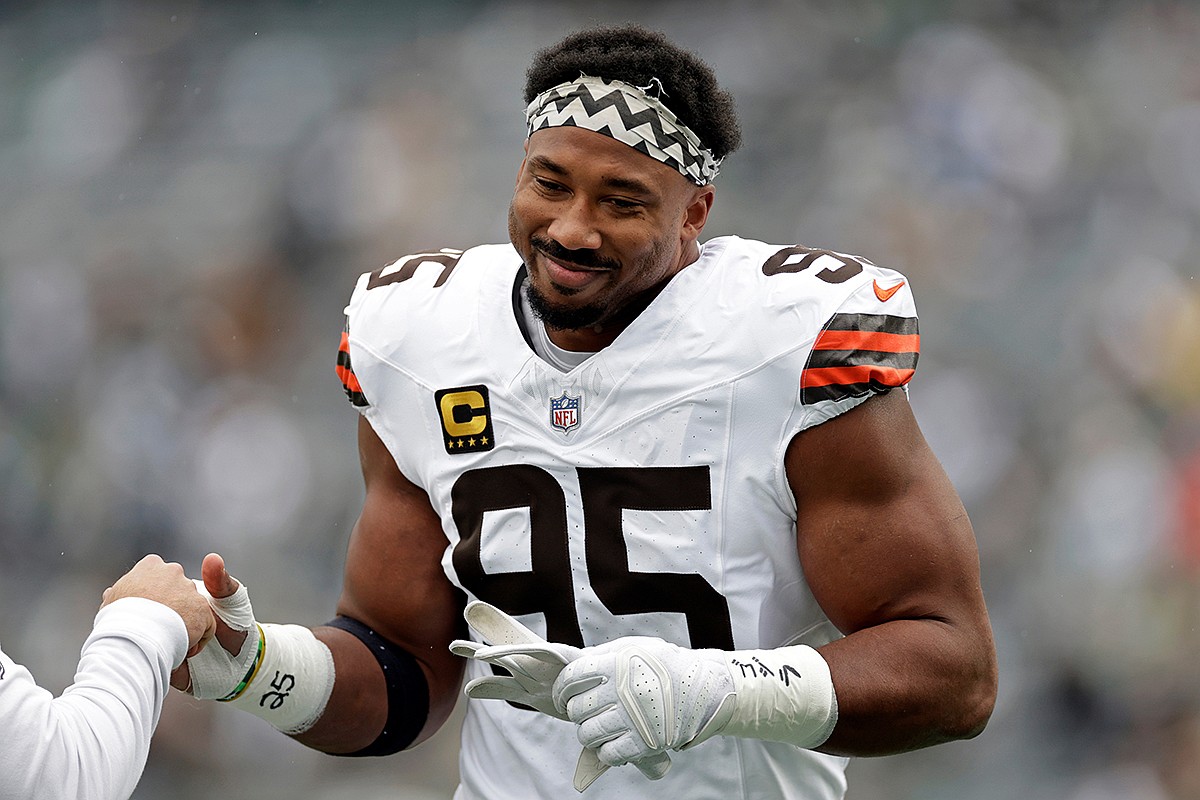
One of the most intriguing storylines this offseason has been the relationship between Myles Garrett and the Browns. Far too many of the clues leading to the idea that a trade is a possibility are being brushed aside by the media in general.
If he truly is available, the Seahawks – and the thirty other NFL teams – will be very interested.
Decoding some of the clues and looking at his fit will help us discern if pursuing Garrett makes sense for the Seahawks.
Why He Might Be Available
After publicly demanding a trade in 2025, the Browns convinced Garrett to stay by signing him to a massive contract extension. He promptly turned in a monster season, breaking the all-time record for sacks and winning the Defensive Player of the Year award, while the team around him limped to a 5-12 record.
The Browns fired Head Coach Kevin Stefanski and hired Todd Monken, prompting Defensive Coordinator Jim Schwartz – whom Garrett had endorsed as his choice for the head job – to quit.
Monken recently said that he has not had any contact with Garrett this offseason. At all.
By avoiding the voluntary portion of offseason workouts, he is putting a $1 million workout bonus in jeopardy. While that is not a major financial hit to Garrett, it should be noted that it is one of the highest workout bonuses in the NFL. The Browns clearly want Garrett onsite in the offseason.
However, the biggest clue that a trade may happen came earlier this year in March, when Garrett and the Browns agreed to a very intriguing contract adjustment.
The initial contract had included a March trigger date for a $29.2 million option bonus and both parties agreed to move that date almost six months out to September 1.
This makes Garrett tradable this summer. Let me explain.
Garrett already has $41 million in signing bonus money on his contract that would become dead cap should he be traded. If the $29.2 million option bonus had triggered in March, that number would have ballooned to $70.2 million, making him untradable.
It is not the dead cap number preventing the trade, it would be the cap hit. The Browns’ 2026 available cap space would have dropped by an astounding $46 million, putting them so far over the cap they would have no mechanism to create enough room to be cap compliant (the Browns have leveraged a bunch of contracts already and still have almost half of Deshaun Watson’s disastrous $230 million contract to account for on the cap).
By moving the trigger date to September 1, the Browns now have the option to trade Garrett, absorb only $41 million in dead cap (as the new team would be responsible for the $29.2 million option), as well as splitting the dead money over 2026 and 2027 due to being a post-June 1 trade.
The Browns would pick up around $8 million in cap space by trading Garrett after June 1.
However, if Garrett is a Brown on September 1, the trigger hits and he once again becomes untradable. Even a deal at the trade deadline is off the table.
Therefore, there is a three-month window to trade Garrett this offseason, from June 2 to September 1.
Browns’ General Manager Andrew Berry refuses to explain the reasoning behind the adjustment and would prefer not to talk about trading Garrett. It does give the team a little more cash flow flexibility but it also kicks the door wide open for a potential Garrett trade.
Here is the kicker though: to adjust the contract, Garrett and his agents had to agree to it. What possible reason would there be for Garrett to agree to moving a trigger date for $29.1 million from March to September? No one has been able to explain why and this angle seems to have gone largely unexplored. Players do not agree to contract concessions that large without something big in return. They just do not. And much less immediately after recording one of the all-time great seasons of play in NFL history.
Garrett does get some money from this adjustment in 2029 and 2030 a bit earlier due to converting some salary to $8 million in roster bonuses — but that is peanuts in the grand scheme of things and three years away.
There can only be one obvious conclusion: Garrett agreed to this adjustment to facilitate a trade.
This is all reminiscent of the saga between the Seahawks and Russell Wilson in 2021 and 2022 that led to him being traded to Denver: a public leak by the player discussing a potential trade, followed by a smoothing over by the team.
In the following year, stringent denials by the team that the player is on the trade block, with the bulk of the local media and fans parroting the team’s public position on the player while denying there are columns of smoke billowing out of team headquarters.
Regardless of what the Browns are saying publicly, the 31 other teams can discern from the signs: Garrett is available for the right price.
Trade Compensation
So, what is the right price?
Three first-round picks are the general cost bandied about among pundits and commentators.
I would argue that Garrett can be had for less than that. Why?
Micah Parsons was traded for two firsts and Kenny Clark last year. He was 26 years old.
Khalil Mack was traded to the Bears in 2018 for two firsts. He was 27 years old.
I think we all can agree that Garrett is superior to those two players. But he is 30 years old. Those three or four prime years that have already passed can cap his trade value to a package similar to what Dallas and Oakland received for their superstar rushers.
There is also another factor that can keep the trade compensation in an earthly realm: Garrett’s last extension included a full no-trade clause. He can pick his next team. At the very least, he can keep a moderate lid on an all-out bidding war by limiting the number of teams he will accept a trade to.
Granted, we do not know what teams and cities appeal to Garrett. But it is not hard to imagine that a team like the New York Jets – armed with three first-round picks next year and hungry to make a splash – would likely not be a preferred destination for Garrett. In pure football terms, going from the Browns to the Jets would simply not appeal.
For the Seahawks, would first-round picks in 2027 and 2028 along with say a third-round pick in 2027 get the deal done? They might have to stretch that far to get a deal over the finish line.
Softening the blow is the Seahawks are set to have eleven picks in 2027. Trading a first and third would reduce that to nine picks (there is still an opportunity to add 2027 & 2028 picks should Nolan Teasley and Aden Durde get top jobs with other teams).
There is an easy argument to be made that adding the best defensive player in the NFL and still having nine picks in a strong 2027 draft is right in John Schneider’s wheelhouse.
It also would serve as an effective hedge against a potential talent drain in 2027 at Defensive Line, with Leonard Williams and Uchenna Nwosu as Free Agents and DeMarcus Lawrence potentially retiring.
Another argument in favor for pursuing a trade is to keep Garrett from going to a rival team. Very likely the Browns would want to trade him out of the AFC and teams like the Eagles, Niners and Rams would surely line up to get a shot at him.
It is very believable that the Seahawks could pursue a trade of this nature.
Even more so when you consider the salary cap and cash implications.
The Financial Impact is Very Appealing
The team acquiring Garrett inherits this contract:

Just look at those cap hits for the first three years. $46 million for three years of the best pass rusher in the game. And if you want to consider the cap space “saved” by trading two firsts and a third in, that number drops to about $34 million.
None of those cap hits will inhibit the Seahawks in any way. They can look to extend other players without having to make any very tough decisions until 2028 or 2029.
However, one of the ‘team rules’ they will have to break to make this happen is to acquire a contract with five years left on it. The benefits secured would make it a very palatable exception but it must be weighed as a factor.
When you consider the excellent salary cap shape John Schneider has the team in, this structure and cost is almost too good to be true.
Of course, this is assuming the Seahawks have assurances that Garrett is happy with his contract. Last year he signed a deal worth $40 million AAV and now has five players making more annually than him, led by Will Anderson Jr’s recent extension valued at $50 million.
It would be an open question if Garrett would accept his current contract at face value – now and well into the future – in order to facilitate a trade. A deal could easily be scuttled if Garrett will want annual raises that keep him at the top of the pay scale. There is a reason the Seahawks’ cap situation is so good – they don’t wreck their cap structure for one player.
The other financial consideration is the cash money spent. The Seahawks currently sit at #15 in the NFL and that ranking will rise if/when extensions for Devon Witherspoon and Derick Hall are reached. With those two extensions, they may have reached their budget ceiling for cash spent in 2026.
What would picking up this Garrett contract as-is mean for cash outlay in 2026? About $19-20 million. Joel Corry has the details of the payment plan on the $29.2 million option that triggers on September 1:
— $12 million due Nov 1
— About $5 million paid in the 2026 season in weekly payments
The balance of the option is paid in 2027 – a new budget year.
That is on top of the $2.3 million in salary and Per Game Bonuses paid in 18 game-check installments.
It is very flexible. Still, when you have already committed a whopping $336 million in cash – and probably another $40-60 million for the Witherspoon and Hall extensions – another $19-20 million may just be a bridge too far.
John Schneider would have to be convinced that this move is for the team’s best interest and would need to propose some extra cash be allocated for this acquisition (possibly foregoing his annual trade deadline deal to make this happen).
One consideration that could make this cash spend a little more palatable: at this moment in time, we still do not have a definitive answer on DeMarcus Lawrence’s status. If he decides to retire a champion, that opens up $9.5 million in cash and cap space, effectively cutting in half the requirement to fund a Garrett acquisition and nicely filling Lawrence’s role on the defense.
So overall, the acquisition is a slam dunk on the salary cap side but some work would need to be done on the cash side.
One more piece of the puzzle needs to be explored.
How Would Garrett Fit in Seattle?
This might be both the biggest factor and the biggest unknown.
For years, Garrett has been a lone wolf in Cleveland. The undisputed leader and best player on the team. He has faced constant double-teaming and fought through them with great success.
Has that mindset ingrained itself so deeply in Garrett’s play psyche that he may not be adequately able to adapt to Mike Macdonald’s constant ‘all-for-one and one-for-all’ play style?
In 2026, Garrett personally out-sacked the three best Seahawk pass-rushers (Murphy, Williams and Nwosu each had 7 sacks) 23 to 21. Yet the Seahawks fielded a fantastic defense, predicated on unselfish line play to keep the uncertainty of ‘where is the rush coming from’ alive.
To be fair, Garrett is regularly praised by his teammates and coaches for his relentless work ethic and example on the field. His fellow defensive players regularly express gratitude that he makes their lives easier by his dominant play and he obviously did not let his public trade request last year effect his play – quite the opposite in fact, raising his game to another level.
But can Garrett go from being the unquestioned Alpha in the Browns’ locker room to fully adopting the “M.O.B.” mentality in Seattle? Does he grasp the concept of ‘earning’ his pass-rush opportunities by consistently setting the edge in the run game and regularly stunting to set his teammates up with opportunities? Will he agree with occasionally dropping in coverage to allow a schemed-up Ernest Jones Jr or Nick Emmanwori to blitz effectively? Would Garrett’s affection for Jim Schwartz – a tough, demanding and aggressive coach – translate easily with Mike Macdonald’s style?
And as discussed above, could he do all of that while regularly being out-earned by other pass rushers over the next 3-4 seasons?
Put another way, is he ready for a different phase of his career? One where money, personal stats and singular attention mean less and winning regularly, playing meaningful football in December and competing for championships mean more?
These questions are hard to answer.
I would dare say that John Schneider and the Pro Personnel arm of the franchise would spend just as much time getting confident answers to those questions as they would negotiating the trade with the Browns.
That said, one big factor in favor of a trade is this: Garrett’s no-trade clause means he would have to choose to come to Seattle. As long as he understood up front the team-first pay and play implications, the pathway for a trade could be clearer than we realize.
On the whole, exploring a Myles Garrett trade definitely has merit. The trade and salary cap cost are well within an acceptable range. The cash budgeting aspect is an obstacle that can possibly be overcome. And if the team and player can gel on their philosophies, this could be a blockbuster of epic proportions that could propel the team to dynasty-levels of success.