This is a guest article by Curtis Allen…
With the trade deadline passing, the balance of the Seahawks’ salary cap spending is limited to Practice Squad movement and short-term replacements for players put on Injured Reserve. It is a good spot to check on the status of their salary cap for next season.
By virtue of their two-year roster makeover that removed some of the team’s more expensive contracts, some excellent drafting and effective Free Agent spending, the team’s salary cap stands in excellent overall health.
Have a look at what is on the table for 2026:
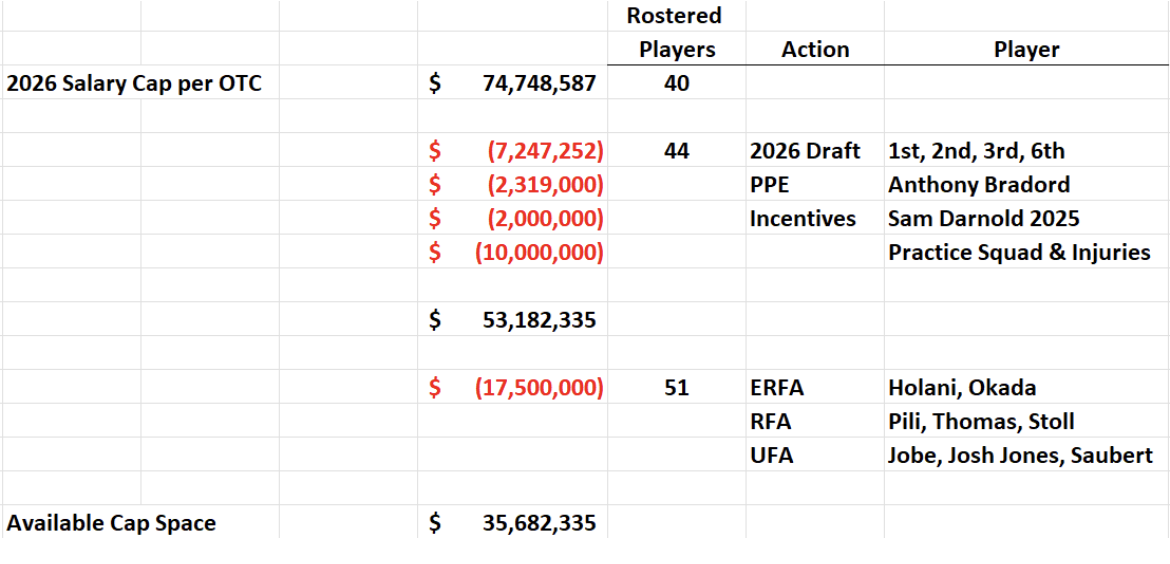
Whereas last year the Seahawks started out the season under the cap, this year they are comfortably over and have plenty of room to take care of their needs.
Anthony Bradford has earned an extra $2.3 million on his salary for 2026 by earning a Proven Performance Escalator, for total compensation of about $3.6 million. It should be noted that this salary is not guaranteed. If the Seahawks want to trade him, cut him, or negotiate his contract down, they can do so, saving nearly all that cap money.
There is a potential for the Seahawks to take as much as $3.5 million more in cap charges on in 2026, as Sam Darnold’s contract has incentives in his contract. I would say some of it is reachable. I put in $2 million as a guestimate that Darnold will earn more than half of what is available. Some of that includes money for NFC Championship game and Super Bowl wins. I trust that no one would be upset with taking on those kinds of cap charges in 2026.
I allocated $17.5 million to complete the roster out and listed some of the popular choices among the upcoming different Free Agents the Seahawks will have and will likely consider retaining. While they may not keep all those players, an equivalent can be found at a similar cost among the draft or in Free Agency (I think Eric Saubert is already signed for 2026, we just do not have his contract available yet).
The meat of the off season will be what they do with that $35 million they can spend.
Pending Free Agents and Extension Candidates
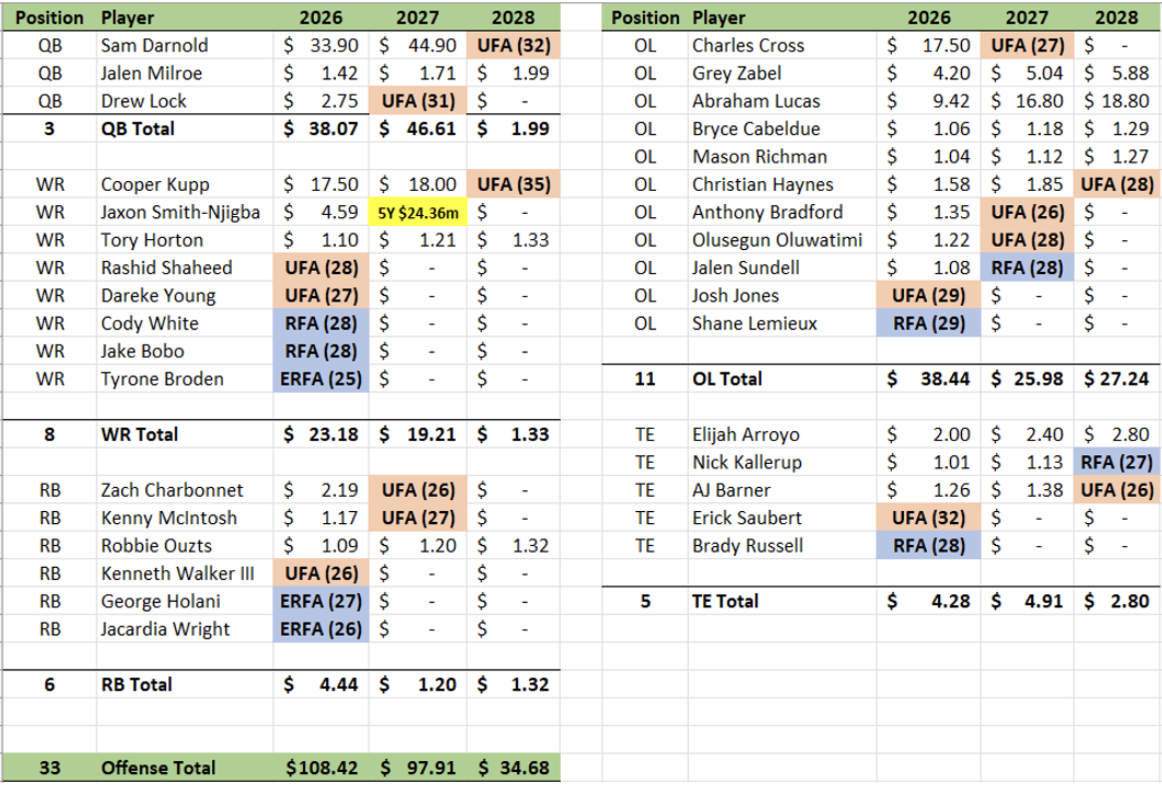
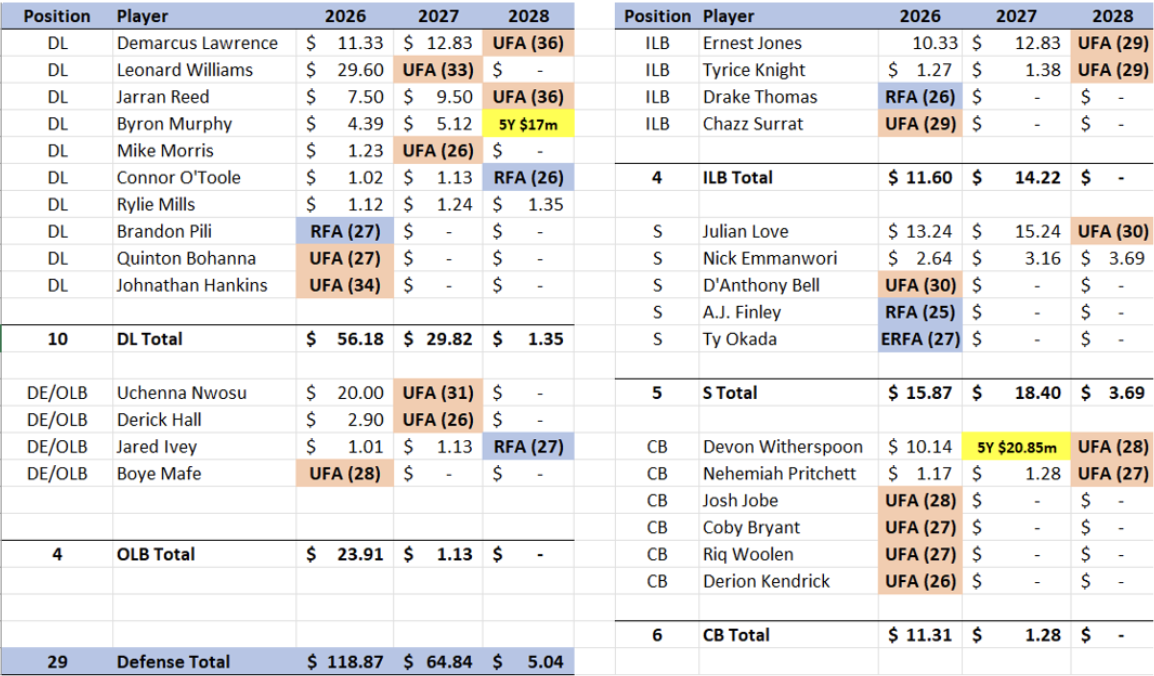
Have a look at the roster below from a three-year outlook. Included are players yearly cap hits and Free Agent status with age included.
Prominent Unrestricted Free Agents include unsigned members of the 2022 draft class: Boye Mafe, Kenneth Walker, Tariq Woolen and Coby Bryant.
Of that group, we know that the Seahawks have talked about an extension with Bryant per Brady Henderson but are not eye to eye on his value.
What about the other three? They all seemed like easy choices to extend after their rookie seasons but now the picture is clouded.
Boye Mafe has not been effective rushing the passer this year, and his run defense – a core tenet of Mike Macdonald’s defense, particular for edges – has been average at best. The Seahawks made him available around the trade deadline and he only seems to be a Seahawk because some trade terms could not be worked out.
Kenneth Walker has struggled with injuries and explosive runs are very hit and miss with him.
Tariq Woolen has been benched at times and is currently sharing a job with Josh Jobe.
I doubt the Seahawks would absolutely rule out bringing any of those players back. Very likely, they will prioritize other players ahead of them. If any of them want to come back it would be on a team-friendly contract.
Who would they prioritize? It seems in-pattern to talk with Rashid Shaheed on an extension first. Given the price they paid to acquire him (fourth and fifth-round picks next season) and assuming he shines as a player who can fill all kinds of roles in Klint Kubiak’s offense, it is obvious to conclude they would talk to him. This follows consecutive offseasons of extending in-season acquisitions Ernest Jones and Leonard Williams.
What kind of contract could Shaheed expect? A couple of weeks ago, I speculated that a 3-year $40 million contract would be a range it would take to extend him.
That would mean about an $8 million cap hit in 2026. That takes their available cap down to about $29 million.
Which is fine — but if they want to go big-game hunting this offseason, they will need more.
Fortunately, they have the means to free up a bunch of cap space and keep their core together through some extensions:
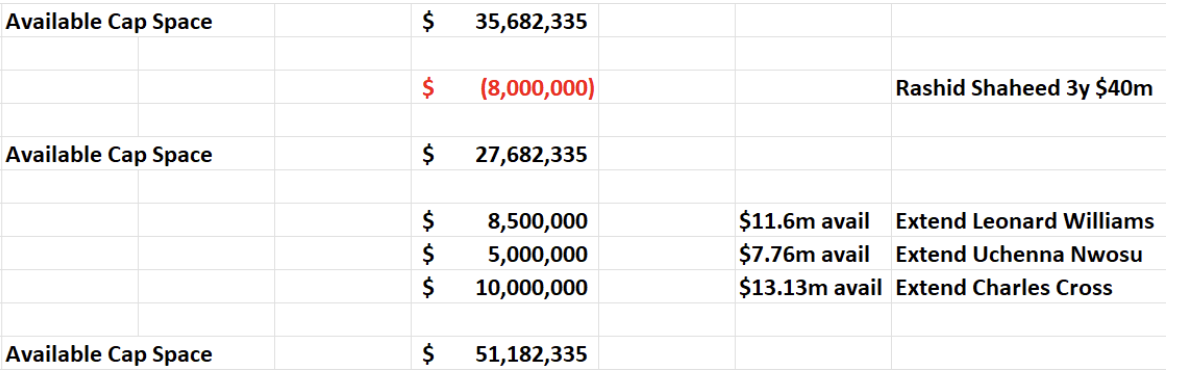
Per Over the Cap, the Seahawks can pick up a maximum of $31 million through extending Williams, Nwosu and Cross. I trimmed that a little to $23.5 million, as the Seahawks do not typically take the max room on an extension. It makes sense to have some guaranteed money up front to allow for flexibility later.
All three of these could be in line for extensions.
Leonard Williams is the defense’s heart and soul and a player who is playing his best football now. He will be 33 years old in 2027 when his contract is up. What kind of contract could he demand at that age?
A couple of comps: Javon Hargrave at age 32 got a two-year $30 million contract on the Free Agent market this year. Hargrave had missed most of 2024 with a torn tricep. Cam Heyward last year signed a two-year, $29 million extension with the Steelers at age 35.
I could see the Seahawks extending him with something like a two-year $40 million contract that pays his 2026 salary up front in terms of a signing bonus and has some roster bonuses worked in to give the Seahawks decision points for some protection against declining skills as he ages.
Uchenna Nwosu is still only 29 years old and has rewarded the Seahawks’ faith by putting together a fine season of rock-solid run defense as well as being a reliably good pass rusher. He is on track to match his career-best 2022 season while only playing about 50% of the snaps on average (he played an astounding 78% of the snaps in 2022). A three-year $50 million contract with some injury protection would lock up his remaining best years and give the Seahawks another piece to secure on defense. There might be additional motivation to get an extension done if and when Mafe walks.
Charles Cross may never be a top-10 Left Tackle in the NFL but it does seem that the team is happy with his production and would like to lock him into an extension. It will be very interesting to see how the Seahawks value him. His $17.5 million fifth-year tender in 2026 is a bargain – that would put him at #16 for AAV for Left Tackles. Also to know: 10 Right Tackles and 11 Interior Linemen make more on AAV than Cross. That makes Cross the 37th highest-paid Offensive Lineman.
There is a lot of talk that Cross will demand a contract in the $30 million per year range, which would elevate him to the highest-paid Left Tackle in the NFL. Rashawn Slater is the current king of the mountain, having signed a $28.5 million AAV extension this year at age 26.
I just cannot see the Seahawks crossing the $30 million threshold to sign Cross.
It will greatly depend on what he and his advisors think he is worth. If he is firmly set on that top number, I can see the Seahawks standing on principle and exploring their options.
What about the Franchise Tag in 2027? It would be very hard at this point to see it as an option for the Seahawks. Why? The current 2026 number is projected to be about $27 million and a standard increase would put it in the $29 million range. Therefore, if the Seahawks do not value Cross at $30 million per season, the tag is not a great tool to advance negotiations, as it sets the floor for an extension.
As for tagging him and then letting him play out the season while they draft and develop a tackle behind him, that may be a potential option. The cash and cap hit involved might be a hindrance to that strategy though. If the team wants to be aggressive this offseason, that will include committing a very healthy chunk of their 2027 cap space to fit everyone in on the cap this season. Tagging Cross might not be a viable option.
What kind of extension would work for both sides? This summer I proposed a three-year $60 million extension for Cross, the primary value of which was to A) put a bunch more money into Cross’ pocket this year, have some financial protection against injury and get him primed for another extension at age 28 and B) give the Seahawks a chance to lock down a four-year starter at Left Tackle for three more seasons at a below-market rate.
That opportunity has passed. And truth be told, it might be beneficial for both sides that it did. For Cross, the obvious: he can make a whole lot more money by waiting. For the Seahawks, it is not so obvious: they get another full season to evaluate Cross and see if he elevates his play.
What kind of compromise could the two sides make to get a contract done next fall? I would guess a three-year contract between $75-85 million could be worked out. Cross gets $25-28.3 million per season and the Seahawks get their Left Tackle locked up.
Making all those moves gives the Seahawks a war chest of about $51 million free and clear to work with. They will be in the enviable spot of having plenty of young, developing talent and cap space to make strategic moves to greatly improve their roster.
What About Cooper Kupp and Sam Darnold?
Right now, OTC has Kupp with a $17.5 million 2026 cap number, with savings of $9.5 million if cut.
Given Kupp is far behind Jaxon Smith-Njigba as a target for Sam Darnold and his age is starting to become a question, some have wondered if Kupp would be cut in the spring.
That is highly unlikely. His contract has $9 million salary that is guaranteed in February. In essence, it is not guaranteed currently but it is as good as guaranteed (we discussed this in May here).
The closest the team has ever come to not letting that vesting date trigger was this year with Uchenna Nwosu. The Seahawks needed cap room and Nwosu was coming off two very difficult seasons and was open to overtures from the Seahawks about reworking his contract to give the team relief yet allowing him to earn some of that money back. It made sense for both sides to work something out.
So, unless Kupp and the Seahawks both have their backs up against a wall – unlikely – he will be on the team in 2026.
With Sam Darnold, it is similar but with a major caveat: Darnold and the team moved the roster bonus up from the typical mid-March to early February. This is a way to force a decision on Darnold’s future sooner than normal and so Darnold and the Seahawks could both get their processes in motion about finding their next opportunity should the Seahawks decide to part ways.
It is safe to say that Darnold is staying in Seattle for 2026 at this point.
However, if the Seahawks want to get a jump on bulking up their cap space for 2026, they could convert Darnold’s $15 million roster bonus due in February to a pro-rated signing bonus, picking up another $11.25 million in cap room.
They also can pick up around $8 million more if they convert Darnold’s 2026 salary to bonus. They could do this at any time leading up to Week One.
Jaxon Smith-Njigba and Devon Witherspoon
The Seahawks have until May 2026 to exercise the fifth year First Round option for 2027 on those two.
Just a reminder: It is a fully guaranteed year and the number is based on a formula that includes snaps and Pro Bowl selections.
Witherspoon’s number is $20.85 million for 2027.
Smith-Njigba’s is a little more fluid: He has met the snaps criteria to make his number $17.51 million. However, an original ballot Pro Bowl selection this year will bump that number to $24.36 million.
That is the number I used for him on my chart below. It is fair to project in ink that he will be a Pro Bowler with the season he is having.
Would the Seahawks tag both these players and push the negotiations for an extension to the fall of 2027 or even as far as March 2028? It is possible. That would follow what they did with Charles Cross.
My guess would be that in the current roster hierarchy of Cross, Smith-Njigba and Witherspoon, Smith-Njigba is the clear priority, Witherspoon is next and Cross third.
If Smith-Njigba were open to a contract extension, the Seahawks would happily sign him right now to a contract in the Justin Jefferson-CeeDee Lamb range and watch his contract get leapfrogged the next four years by other players (like they did with Tyler Lockett twice). It just depends on what the player and his team want to do. He might be very happy to let George Pickens, Drake London and Puka Nacua get their deals first to further establish his market value.
Devon Witherspoon is at a crossroads of sorts. He has two Pro Bowls on his resume and is a very solid player. But does he tilt the field or lock down a side like a top corner regularly does? Will he take a bit of a backseat on the defense once Nick Emmanwori can be fully deployed?
Is he also willing to discuss an extension in 2026 and trade some market value for security? Is the Cornerback market going to level off a little after a crazy one-year jump (Patrick Surtain got $24 million AAV in fall 2024, Derek Stingley and Sauce Gardner both topped $30 million less than a year later)?
Those are the questions both sides must answer next year.
Concluding Thoughts
I want to emphasize that this piece is an exploration of the possibilities, not necessarily a recommendation of what I think the Seahawks can or should do.
Each lever the team can pull and get some 2026 cap space might not be pulled. But we need to know where the levers are and the benefits of pulling them.
Many fans are concerned about using and abusing the company credit card in the name of immediate gains to get some fantasy-roster style wish-fulfillment that rarely works out as desired.
The truth is teams that are not using their credit card (even moderately) are falling behind. The salary cap is rising so quickly that intelligent teams must take advantage.
In the next two days, when you focus on NFL football, keep an eye out for two things: the ratings the league will pull for the four games played Thursday and Friday and the number of gambling commercials and other endorsements you will experience as you watch them.
The league is a monster, the current North American champion of pro sports. The revenues it generates are just going to get greater.
The Seahawks drafting well and escaping mind-numbing contracts like Jamal Adams, Quandre Diggs and Geno Smith and reshaping their roster with flexible contracts that provide value opens tremendous opportunities for them to be competitive in the trade and Free Agency markets. The current core of key players that are peaking and the amount of cap space resources they have available to them put them in one of the more enviable positions in the NFL.