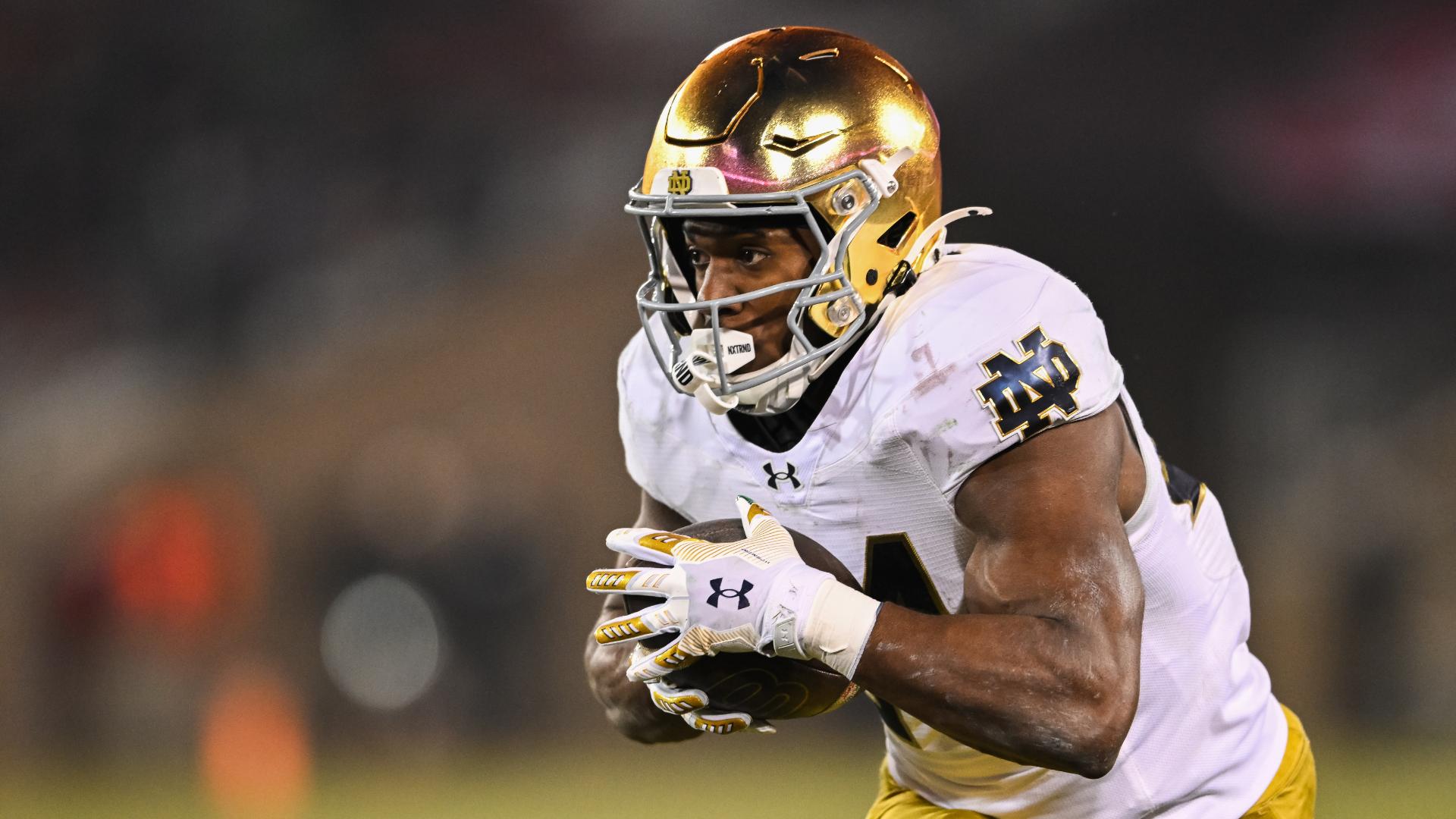
Why did the Seahawks use the 32nd pick on Jadarian Price?
It’s a question a lot of people in the media are asking.
There isn’t going to be an ‘aha’ moment where we see one specific set of statistics or a testing score that suddenly explains everything.
However, we can use data to help explain why the Seahawks felt this particular running back was worth taking at the end of round one.
One of the data points we know the Seahawks look at is yards after contact per carry. John Schneider revealed as much during one of his recent interviews on Seattle Sports.
I looked at college career statistics for yards after contact per carry for every prominent running back over the last 10 years.
Here’s how the top-20 rank:
Ashton Jeanty — 4.76
Rhamondre Stevenson — 4.65
Travis Etienne — 4.51
Bijan Robinson — 4.40
Jeremiyah Love — 4.35
Rashaad Penny — 4.31
Jadarian Price — 4.28
Ken Walker — 4.27
Javonte Williams — 4.26
Jonathan Taylor — 4.24
Jonathon Brooks — 4.13
Josh Jacobs — 4.10
Omarion Hampton — 4.01
Cam Skattebo — 3.95
De’Von Achane — 3.93
Dalvin Cook — 3.93
TreVeyon Henderson — 3.89
Aaron Jones — 3.82
Bucky Irving — 3.81
Alvin Kamara — 3.77
There are a few things to note here. I gathered data for 36 running backs in total over 10 years. Jadarian Price ranked 7th. You can see the company he keeps near the top. You can also see the names he’s ranked above.
You can choose how much weight you personally want to place in this data point. If it’s something the Seahawks have worked out is significant for NFL success — and this list suggests it might be — it’s easy to see why they might think Price is well worth taking a chance on.
Half of the players ranked above Price were top-10 picks. 14 of the top-20 were first or second round picks. The other six are De’Von Achane, Aaron Jones, Alvin Kamara, Rhamondre Stevenson, Cam Skattebo and Bucky Irving. Achane, Jones and Kamara have gone on to become NFL stars. Stevenson is the 13th highest paid back in the league. Skattebo and Irving have shown early promise in their careers.
The list, if nothing else, is a collection of successful pro’s or players drafted early. If you place a lot of faith in yards after contact per carry, you can build a case for Price based on his data in this category.
It’s also worth noting the two players directly next to Price in the list. He’s just below Rashaad Penny and just above Ken Walker. Coincidentally their positions in the ranking mirror the order in which the Seahawks selected them — Penny 27th overall, Price 32nd and Walker 41st.
If you’re wondering why the Seahawks were prepared to draft all three players early — their placing in the list above might be a hint.
Obviously yards after contact per carry isn’t the be-all and end-all. Here’s how the next 16 players ranked:
Joe Mixon — 3.75
Nick Chubb — 3.71
Najee Harris — 3.69
JK Dobbins — 3.65
James Cook — 3.59
Ezekiel Elliott — 3.57
Zach Charbonnet — 3.54
Saquon Barkley — 3.51
David Montgomery — 3.50
Jahmyr Gibbs — 3.53
Derrick Henry — 3.27
Chase Brown — 3.26
Quinshon Judkins — 3.23
Breece Hall — 3.22
Leonard Fournette — 3.04
Christian McCaffrey — 2.89
Clearly Christian McCaffrey’s career hasn’t suffered due to a lack of yards after contact at Stanford. It’s quite striking to see Derrick Henry so far down the list too, plus Saquon Barkley.
The point isn’t to argue that every good player will score well here. It’s simply a single interesting piece of data that reflects well on Price.
Let’s look at a second piece of data — explosive run rate. This measures the rate in which players run for +10 yards among their college carries.
These numbers reflect rates for each player’s entire college career:
Javonte Williams — 23.3
Rhamondre Stevenson — 23.0
Najee Harris — 21.1
Rashaad Penny — 20.6
Joe Mixon — 20.3
De’Von Achane — 20.1
Dalvin Cook — 20.1
Jonathan Taylor — 19.8
Josh Jacobs — 19.8
Travis Etienne — 19.6
Jadarian Price – 19.2
James Cook — 18.7
Alvin Kamara — 18.7
Bucky Irving — 18.5
Nick Chubb — 18.3
Cam Skattebo — 18.0
TreVeyon Henderson — 17.5
Ezekiel Elliott — 17.3
Zach Charbonnet — 17.3
Jeremiyah Love – 17.1
Ken Walker — 16.7
Leonard Fournette — 16.7
Christian McCaffrey — 16.6
Ashton Jeanty — 16.6
Aaron Jones — 16.5
Saquon Barkley — 16.2
Bijan Robinson — 16.0
Chase Brown — 16.0
JK Dobbins — 15.6
Jahmyr Gibbs — 15.1
Omarion Hampton — 14.9
Quinshon Judkins — 14.7
David Montgomery — 14.4
Jonathon Brooks — 14.3
Breece Hall — 14.2
Price ranks 11th out of 36 and is within one percentage point of De’Von Achane, Dalvin Cook, Jonathan Taylor and Josh Jacobs. All but two players above him were drafted in the first or second round.
If nothing else, it highlights just how explosive he was in his college career. He produced big plays at a higher rate than most players entering the league. This also doesn’t take into account his three kick-return touchdowns and his average of 36.1 yards per attempt from 22 returns.
He’s a big play specialist who also produces strong results after contact. Coming into the league, he compares well to some of the best running backs in the NFL in both categories.
That’s something to consider when assessing whether he was worth the #32 pick — especially for a team who needed to add big plays to their running game.
It was a need because they opted not to pay Ken Walker $14.4m a year, with cap-hits in 2027 and 2028 of $18.7m.
Price’s projected average salary is $4.2m per year on his rookie contract. That’s a significant saving for a team that has already paid big money to Charles Cross and Jaxon Smith-Njigba and will need to pay big money again in the future to Devon Witherspoon and, next year, potentially Byron Murphy and Sam Darnold (not to mention possible new deals for players like Derick Hall and AJ Barner).
Finally, an argument could be made that the Seahawks could’ve waited until pick #96 to select a running back. Both Mike Washington Jr and Jonah Coleman, for example, were available.
Here’s how the three backs compare for career yards after contact per carry:
Jadarian Price — 4.28
Jonah Coleman — 4.12
Mike Washington Jr — 3.09
And here’s how they compare for career explosive run rate:
Jadarian Price — 19.2
Jonah Coleman — 16.7
Mike Washington Jr — 13.4
Price is ahead in both categories — significantly so when it comes to explosive plays (the key area of need for the Seahawks). The yards after contact per play data is reasonably similar between Price and Coleman but you need to consider this — if you pass on Price with the intention of selecting Coleman at #96, how can you be sure he’ll still be on the board? He was the #108 pick to Denver. That’s uncomfortably close and it wouldn’t have been a foregone conclusion he’d be there for you to select.
The risk of missing out completely had to play into the equation. The Seahawks could get the player who best fit what they needed with the #32 pick — eliminating any middle-round anxiety.
I’m not sure anyone can seriously argue selecting Colton Hood at #32 instead (for example), then hoping Coleman was there at #96, is clearly a better use of resources. The trio of Price, Bud Clark and Julian Neal sufficiently addressed three key need areas.