On the 27th March I wrote an article titled:
‘Do you want big plays in your running game?‘
The Seahawks gave their answer today. They do.
I’m going to try and explain in this piece why the Jadarian Price pick makes sense. I think, if you read it to the end, you might end up agreeing.
Firstly, let’s go to the data on ‘big plays’. They selected Price to fill the void left by Ken Walker in terms of explosive running ability for their offense. There was nobody more equipped to do this than Price, once his Notre Dame team-mate Jeremiyah Love was selected third overall by the Cardinals.
Let’s start by looking at explosive run rates for the 2025 college football season. This measures the percentage of +10 yard runs a player has within their total running attempts:
Jadarian Price – 21.2%
Jeremiyah Love – 19.6%
Mike Washington – 18%
Emmett Johnson – 14.3%
Kaytron Allen – 14.3%
Kaelon Black – 14%
Jonah Coleman – 12.7%
Roman Hemby – 11.3%
Nick Singleton – 9.7%
J’Mari Taylor – 9.5%
The average rate over the last decade for running backs entering the league is 16%. As you can see, only three players are ‘above average’ and many of the big name backs in this class are significantly below that mark.
Price is #1 ahead of Love. So right off the bat, that helps explain why he was attractive to the Seahawks.
How does Price’s rate compared to previous highly-drafted Seahawks running backs? See for yourself:
Zach Charbonnet – 22.7%
Rashaad Penny — 20%
Ken Walker – 17.6%
His 21.2% mark is right in their wheelhouse. So it shouldn’t be a surprise that he appealed to them as an attractive option to replace what they lost with Ken Walker.
Now let’s look at missed tackles forced rate. This is also important. How do you turn a +10 yard run into a long scoring run? By making people miss.
Jadarian Price — 28.3%
Jeremiyah Love — 28.1%
Emmett Johnson — 27.1%
Kaytron Allen — 27.1%
J’Mari Taylor — 24.8%
Rashul Faison — 24%
Jonah Coleman — 23.6%
Seth McGowan — 21.1%
Noah Whittington — 20.9%
Demond Claiborne — 20.7%
Mike Washington Jr — 20.4%
Adam Randall — 19%
Jam Miller — 16.9%
Roman Hemby — 16.1%
Kaelon Black — 16.1%
Le’Veon Moss — 15.6%
Nicholas Singleton — 15.3%
Chip Trayanum — 12.6%
Once again, Price is at the very top of the class — ahead of his team-mate Love. Also, for the second time, his rate of 28.3% compares favourably to former high draft picks at the position:
Ken Walker – 33.6%
Rashaad Penny — 29.7%
Zach Charbonnet – 25.8%
I wrote a piece two weeks ago specifically noting the importance of making people miss. Here’s what I wrote about Price:
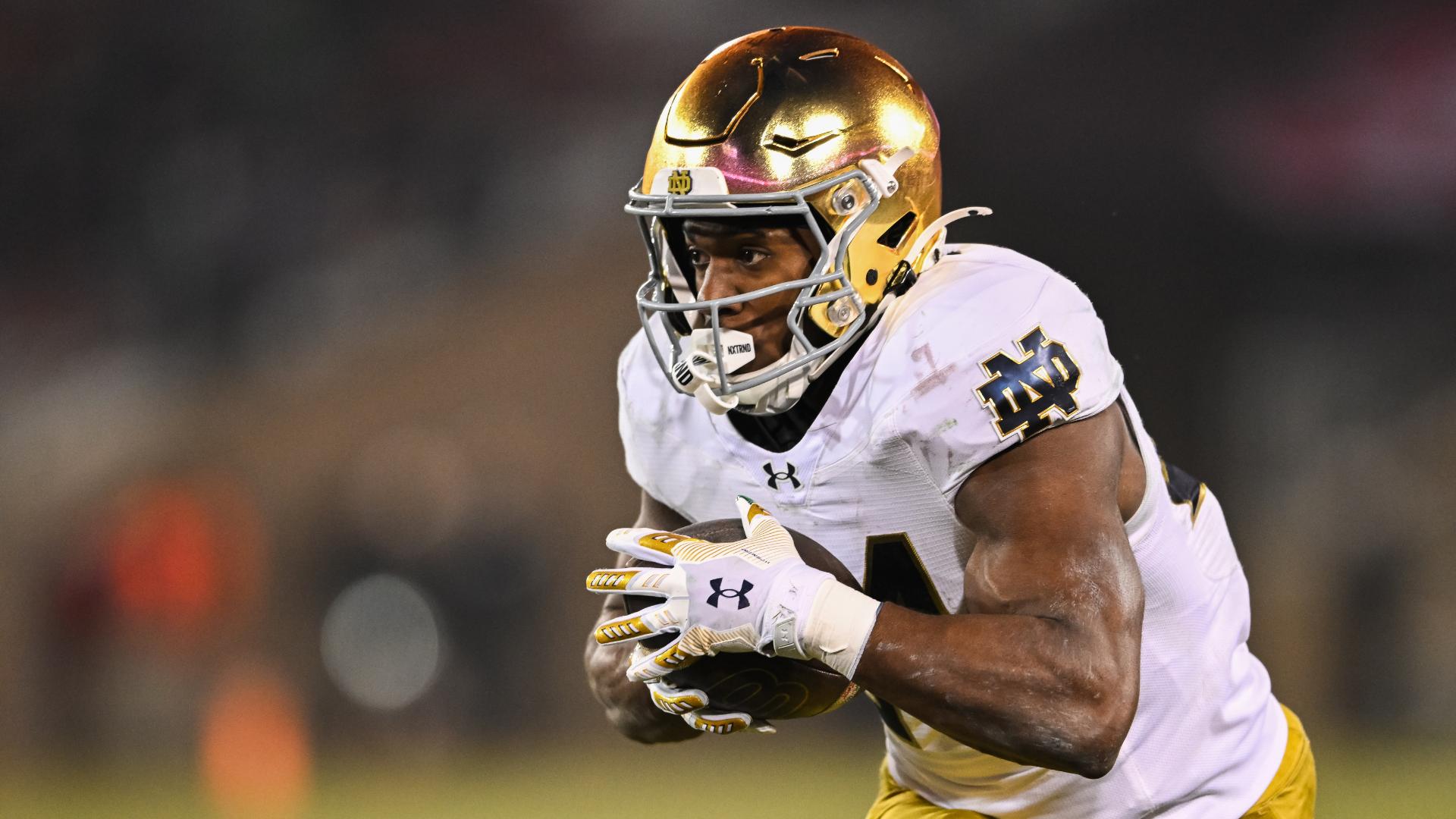
Watch this collection of clips from Jadarian Price. Notice how consistently he slips through contact and then when in space, is able to make people miss. This is particularly the case when he gets outside and is faced with one tackle to beat to reach either the corner of the end zone or to break contain to get a first down:
Price will drop a shoulder, fake-out the defender and then pivot to quickly change direction to juke away from attempted tackles. This is how you make good runs great runs. This is the difference between finding a way to score and getting tackled just short. He clearly has a knack for making people miss, eluding tackles and extending runs. The data and the tape show this.
It’s pretty clear that Price is well equipped to provide the spark they lost when Walker departed. Why is that important? I don’t think they are able to come back against the Rams in week 16 without Walker at least keeping them in it with a 55-yard touchdown run to start the second half. In the post-season, Walker had the most +10 yard runs (9), the most yards after contact (211), the longest run (30 yards) and the most first downs (17).
You might ask, why not just keep Walker then? It’s quite simple. His cap-hit for 2026 is $5.7m but it elevates to $18.7m for 2027 and 2028. Price’s cap-hit will be approximately $2.6m as a rookie and by year four, he will only cost $4.6m.
That is a hugely significant thing to consider given the status of the Seahawks. They have just set records with a new contract for Jaxon Smith-Njigba and will inevitably pay Devon Witherspoon a massive extension soon. They paid Charles Cross a few months ago. In 12 months they might pay big money to Byron Murphy and Sam Darnold. Derick Hall is also entering the final year of his deal.
You have to find savings somewhere. Yes, they have invested a first round pick at running back and people will obsess about the use of that asset. What this does, however, is give them an opportunity to replace Walker adequately at a majorly reduced price. This is critical when you have so many players set to be paid big money. Cash and cap-space is not limitless in the NFL.
Running backs drafted in this range typically offer two things — early impact and cheap contracts. That’s also what they needed, along with the big plays.
Meanwhile, on the field, if your running game can remain super-charged, you will continue to complement your defense and be highly competitive.
People might point to the lack of positional value. I think you need to consider how weak this draft is overall. For example, when I spoke to Drew Fabianich the Senior Bowl Executive a few weeks ago, he admitted that the cornerback group was full of #2 types. Included were Chris Johnson and Colton Hood. If a cornerback doesn’t have the potential to be a #1 corner, is that really any more worthy of a first round pick than a good running back?
I liked Emmanuel Pregnon a lot. Is swapping him to right guard again, for a shot to replace Anthony Bradford, really any more worthy of the investment? And they brought Kayden McDonald in for a visit. They did their homework — and several other teams with far bigger needs at defensive tackle passed on him too.
Most teams stack their board with number gradings. When you have players bunched together, you typically use ‘need’ as a tie-breaker. That isn’t reaching per se, it’s simply how you make decisions. It’s why most teams typically address perceived needs throughout round one.
I want to finish with this. I don’t cite a ton of sources. I have been able to cultivate a few contacts over the years though. After all, my full-time job is a Senior Journalist for the BBC.
One of my sources is an extremely well respected, successful executive and talent evaluator. When I spoke to that individual a few weeks ago, unprompted, he brought up Jadarian Price. He told me Price, “can be special” and that he had size, toughness and vision — adding that his hip flexibility was a big positive.
The source said he was built to be a good pro and could even be better than Jeremiyah Love, potentially. He felt he was explosive and a more ‘typical’ NFL styler runner than Love.
When I asked for ranges, the answer I got was that Love would go early in round one (he did) and that Price would be an early second round pick (he pretty much was). After that, the feeling was no other running back would go until the late third round at the earliest.
The Seahawks could ill-afford to hope for the best at the position later on, miss out and be left ringing Najee Harris next week. If they’d been able to trade down and acquire more stock, perhaps they could feel more confident that someone like Jonah Coleman or Mike Washington Jr would be easier to acquire?
With so many trade-ups happening late in the first, it’s possible the offers ran out. At least the reasonable offers.
If they believed Price was the real deal, they had to consider him once they knew they were staying at #32. The data proves he was the explosive, big-play runner they needed — and the cost saving at the position fits where they are financially.
There is ample depth at defensive back and pass rush for day two.
Even if Price wasn’t your ideal scenario at the start of round one, the pick the Seahawks made at #32 made sense.
If you missed my instant reaction stream discussing the pick, check it out below. I’ll be doing another stream immediately at the conclusion of day two: