Category: Scouting Report (Page 32 of 38)

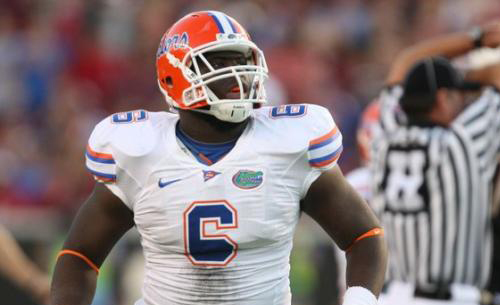
Draft Spotlight: Jaye Howard, DT, Florida

Dan Quinn built a strong reputation as a defensive line coach, joining the Seahawks in 2009 and helped the line retain respectability in 2009 and 2010 even when there wasn’t a ton of talent there.  He left the Seahawks last year after being offered a promotion to coach as a defensive coordinator for the Florida Gators.  It’s only fitting then that the first gator to be drafted in 2012 was a defensive lineman, going to the Seattle Seahawks no less.

Quinn has a reputation for developing and improving defensive linemen, so Howard’s big step forward in 2011 should hardly be surprising.  Howard is likely going to be a situational contributor at the next level, but the fact that he comes with the Dan Quinn seal of approval is no minor detail.

Howard tallied 5.5 sacks last season and was one tackle for loss short of the team lead.

Productive pass rushing defensive tackles are one of the NFL’s rarest commodities.  There are three qualities that most successful interior pass rushers share:

  1. Stellar snap recognition with a lightning quick first step
  2. Outstanding hand use, upper body strength, and overall technique
  3. The quickness to step around a blocker once they’ve won the hand battle

There are some exceptions, as rarely you will see a defensive tackle so physically dominant that he can win with power alone (guys like Ndamukong Suh and Cortez Kennedy), but for the most part your top NFL pass rushers at tackle will excel in the skillset above.

So what does Howard do well? Continue reading

Bruce Irvin tape review vs Clemson

Bruce Irvin took 43 snaps against Pittsburgh, a game we reviewed earlier in the week. In the Orange Bowl he didn’t need such a workload as the Mountaineers blew Clemson away in a record breaking 70-33 victory. The nature of the snaps was interesting though.

Against Pittsburgh, 58% of Irvin’s snaps were on first and second down in basic down/distance situations (eg, 1st/2nd down between 0-10 yards). Against Clemson, Irvin didn’t take a first down snap until the second quarter and by half time, he’d only played three first downs. Overall he had 27 snaps, the difference of 16 in part due to the nature of the game (Pittsburgh was a one-point nail-biter). But it’s interesting that this time 81% of his snaps came on second or third down.

First down snaps: 4

Second down snaps: 14

Third down snaps: 8

Fourth down snaps: 1

Irvin had one short-yardage snap on 3rd and 3 in the second quarter, but didn’t take another snap with the distance between 0-5 yards.

0-5 yards: 1

5-10 yards: 20

10-20 yards: 5

20+ yards: 1

It’s no real surprise that he didn’t feature too heavily in a 37-point victory, but the snaps he took do give some insight into how he was used. The Mountaineers were determined to persevere with the 3-3-5, a system which is the very antithesis of a good scheme fit for #11. Maybe it’s not such a surprise they were managing what amounted to a 5-technique who, by his own admission, was playing between 220-230lbs. They made no attempt to max out the most prolific pass rusher on their roster by switching schemes. Thus, we see 27-snap games.

So how much of an impact he have in those 27 snaps? The tape above offers an insight into what Irvin will probably be as a pro. He’ll make two or three big plays in a game, he’ll provide consistent threat with edge speed and a good counter – but he’ll also be blocked out of series too. Irvin may never be an every down work horse, although the LEO by design offers potential to be a starter. Even f he does feature in just 50% of the snaps, he’s good enough to make enough key plays per game to warrant the #15 pick.

Against Clemson he made back-to-back splash plays at the end of the first half and start of the second. Go to 2:03 in the video above and you’ll see Irvin run out of the play originally as Tahj Boyd attempts to scramble up the middle of the field. Irvin loops back around the line of scrimmage and spots the quarterback, before making up 20-yards to strip the ball and force a fumble. It wasn’t just great hustle to rush back and make the play, it was also pretty instinctive to get the turnover. It’s also worth noting he made that effort with a minute to go in the half and with his team leading 42-20. He wasn’t in the locker room. He could’ve been – and who would’ve blamed him – but he wanted more points.

The next big play is a sack, where Irvin leads the tackle to the edge before quickly cutting inside and taking down the quarterback. It’s a move he’s pretty much mastered and he’s very fluid when changing direction during a sprint. A tackle is always going to need to cover the inside counter. Yet by protecting inside, he’ll be susceptible to the speed around the edge. Irvin might not have superb upper body strength (although it’s underrated for his size) but having a counter move like this will cause pro-lineman problems, not just college left tackles.

He likes this move. Check 1:00 where he tries it again and probably should’ve drawn a holding call for the tackle basically grabbing him round the neck to avoid the sack.

There are also examples in the tape where the counter doesn’t work. See 0:13 where Irvin just lacks a little bit of extra juice in the cut and the tackle reads it. I keep reading that when a lineman gets his hands on Irvin it’s over, but I think we see in this play that he can fight, he’ll prod and jab. He almost tips the pass in the end because he has another fight to drive the tackle backwards. Don’t write off this guy’s ability to brawl.

Irvin shows decent instinct at 0:46 to read the play, work through traffic and do enough to put off Boyd and force him to throw the ball away. He’s stoned on four consecutive plays from 1:31-2:01, with the #63 dominating him with a good punch to the body and following through the block. This is really what Seahawks fans should expect at the next level – a lot of key defensive plays, but also a series or two where Irvin is just blocked out pretty comfortably.

Back to this 3-3-5 scheme, because he’s again playing in a three-man front. It’s going to be much harder to block the guy when he’s rushing opposite Chris Clemons with some beef in the middle, or even in an aggressive five-man front. He may be unblockable in those situations. It stands to reason that the Seahawks will utilise Irvin’s foot speed in the same way that San Francisco did last year with their first round pick. The 49ers would regularly send Justin Smith to the edge and have Aldon Smith loop around and attack through the middle, with all the attention going to Justin. The Seahawks will try and get Irvin into positions where he’s not accounted for and if he finds a gap, it’s over. They could even have Clemons and Irvin rush the same side. It’s impossible to see how WVU were getting anything like the best out of him in this 3-3-5 scheme… and he still made 20+ sacks in two years.

I’m still a little annoyed for second guessing myself and not spending the necessary time to understand the role he was being asked to play in West Virginia. The position never suited him and I didn’t pay enough attention to that when watching WVU games last season. Now that I have a reason to sit down and pick through this, I get it. And I also get why the Seahawks spent the #15 pick on Irvin, and why one GM called him the hottest prospect in the draft in the week leading up to April 26th. The raw speed, the surprising upper body strength, the ability to counter. “Bruce Irvin is ready to crash the 2012 NFL DraftI wrote a year ago. Why did I ignore that?

There will be frustrating plays, but there’s also going to be an impact. People will watch this game and second guess themselves just like I did. The guy had a key sack and a forced fumble. He could’ve had another sack but for a blatant hold. If he’s recording that most weeks in Seattle, nobody will be giving the pick a D grade in twelve months time.

Irvin is going to be a headache to scheme against next season, particularly if there’s interior pressure from Mebane/Branch/Jones and continued effectiveness from Chris Clemons. It’s also going to be pretty difficult to send the tight end on a route when Irvin’s in the game and not playing with his hand in the dirt. He’s just not going to be truly effective on every series – but who really is? Rest assured that every offensive coordinator the team faces next year is going to be working overtime to find a way to block this guy. Specialist or not, he’ll have an impact.

Grading the 2012 Draft: Rounds 4 and beyond

...which is also how they reacted to the Seahawks' draft.

Written by Kip Earlywine

(Grading the draft rounds 1-3)

If grading the draft is stupid, then grading the late rounds is absurdity.  If the first round feels like an auction, then the final rounds feels more like a yard sale.   Hidden amongst a mountain of barely used workout machines, old socks, cheap jewelry, and toys from thirty years ago, you may (on extremely rare occasions) stumble across a signed Mickey Mantle rookie card or a first edition Superman comic book.  It’s possible, but you might have to search through millions of yard sales before you find anything with that kind of hidden value.  If you just visited one yard sale, the odds of finding anything amazing would be essentially zero.  But the more yard sales you search, and the better trained your eye for value is, the more those odds increase.

There is a luck factor to consider, but I don’t think the team’s success with Kam Chancellor, Walter Thurmond, KJ Wright, and Richard Sherman was a result of dumb luck.  They were the result of tirelessly churning through hundreds, maybe even a thousand or so college prospects without discounting anyone.  As Bill Walsh said, “the harder you work, the luckier you get.”  Based on how active this front office is in all phases of roster construction, and based on how inclusive their draft selection process has been, it gives the impression of a very hard working front office that never cuts corners to save time or effort.  It also helps that the Seahawks had thirteen picks in rounds 4-7 the previous two years.  Having a high work ethic, having a good synergy with the coaching staff, having a lot of picks, and having skilled talent evaluators in both the coaching staff and scouting department, it’s the perfect storm for mid to late round success.

Continue reading

Bruce Irvin tape review vs Pittsburgh

The first thing people want to know about Bruce Irvin is how many snaps he’ll take in Seattle. Pete Carroll claims he can play 600-700 snaps initially in the Raheem Brock role, but others have argued that Brock featured in around 550 snaps. Either way, Irvin can still have an impact at 500 snaps.

Before San Francisco’s week-16 meeting with Seattle in 2011, Aldon Smith had featured in 446 snaps. That was 377 less snaps than defensive rookie of the year Von Miller and 267 less than JJ Watt. Smith still managed to accumulate 13 sacks, 12 quarterback hits, 30 quarterback pressures and two forced fumbles. In comparison, Miller had 11.5 sacks, 19 quarterback hits, 28 pressures and three forced fumbles, despite playing nearly twice as many snaps. Watt had 4.5 sacks, eight hits, 24 pressures and two fumble recoveries. Stats aren’t everything, but it goes to show how Irvin won’t necessarily be required to play even 2/3’s of the team’s snaps to have an impact.

And that’s just as a rookie. If the plan is for Irvin to eventually replace Chris Clemons as the full time LEO, he’ll one day play the majority of the defensive snaps. A lot of people have criticised the nature of the pick, questioning how often Irvin will feature and what impact he’ll have. The Seahawks want their version of Aldon Smith, even if their version isn’t quite so orthodox. As John Schneider told Adam Schein today, “We thought there was a good chance the Jets were going to take him at 16. If we walked out without him, it would’ve hurt. If you like a guy, get him. 12, 15, 28.”
Continue reading

Grading the 2012 Draft: Rounds 1-3

Draft grades are silly

Written by Kip Earlywine

Grading a draft right after it happens is… well… it’s kind of stupid.  As much fun as it is to read good (or blistering) reviews, we all know this to be the case.  But as much as ignorant people allow those draft grades to make up their minds for them, and for as much as smart people love making fun of grades before any of the players have taken a professional snap, the truth is actually somewhere in the middle.  Let me give you an example to illustrate what I mean.

Richard Sherman wasn’t a pro-bowler last year, but he should have been, and he’ll probably have many pro-bowls in his future.  By just about every metric, he was among the best corners in the league last season.  Richard Sherman was a 5th round pick just last year.  If we were to do a re-draft right now, Sherman might be a top 10 pick.

But here’s the thing, Seattle didn’t have to trade up into the top 10 to get Richard Sherman.  He was under the radar.  Way under the radar.  Sherman was so far under the radar that even his college coach didn’t draft him.  Even the Seahawks didn’t think Sherman would be this good this quickly.  That said, while it’s best to grade a draft after seeing how that player pans out in real games, we also can’t forget how these players were graded at the time.  If you know you can get a good player later, you take him later and you take another good player sooner.  Especially if that player is a guy that might be a product of the system.

Seattle did exactly that with Kam Chancellor, a player they had rated much higher than the 5th round.  They could have taken Chancellor in the late second or with either of their 4th rounders, but they put it off because they (correctly) deciphered that Chancellor’s lack of top speed would allow him to be available later.  John Schneider is a hell of a poker player, and his ability to read the hands of other front offices has proven valuable time after time.

Seattle could have taken those players earlier, but because they didn’t, they pocketed players like Walter Thurmond, Golden Tate, or KJ Wright.  Knowing when to take a player is just as important as the player himself.  And in that respect, we can at least partially grade the 2012 draft right now.

So rather than grade this draft based on my own ratings for the players, I’m going to grade this draft based on decision making.  Did they accomplish the team’s draft goals?  Did they draft players earlier than they needed to?  Did they get good value from their trades?  In other words, when John Schneider went to bed Saturday night, did he sleep soundly knowing that he just had the draft of his dreams, or did he lie awake all night second guessing the decisions he made?

Before I start with the grades, let’s first state the goals of this front office had before the draft.  This is what our inside source told us the front office wanted to do before the draft:

  1. Use the first round pick to upgrade the pass rush as much as possible, assuming that Richardson doesn’t make it
  2. Add a running back in rounds 1-3.
  3. Add a quarterback in rounds 4-6 (possibly earlier) .

Pete and John’s plan was to spend the #12 pick on a pass rusher, although they would have at least considered Trent Richardson had he fallen to that pick.  They also really liked this year’s group of running backs and thought it would be a great opportunity to draft Lynch’s future successor out of this group.  Finally, they were impressed by a lot of quarterbacks outside of the first round and felt this would be a good year to finally draft a quarterback.

In addition to those goals, the front office had also stated on numerous occasions that they wanted to get faster at linebacker.

While it wasn’t a stated goal or something we were told by an inside source, an assumed fifth goal of this front office was to add picks in the draft.  Seattle’s draft philosophy is built around drafting by volume, and the Seahawks entered this draft with only six picks after selecting nine in each of their previous two drafts.

(As an aside:  This is why Rob and I had Upshaw as a lock at #12 for so long, and never even bothered talking about players like DeCastro or Floyd even though everyone else was.  We got the name wrong (we were never told Upshaw was the guy, but had heard Carroll liked Upshaw a lot from three different sources), but we did at least get the position right.  In our SBN mock draft, we had Seattle taking a pass rusher at #12 and a fast linebacker at #43.  We got the names wrong, but we got the areas exactly right.)

So with that in mind, here’s how I’d grade the judgment exercised by the Seahawks at each pick:

With the 15th overall pick, the Seahawks select Bruce Irvin (grade: A+)

This was one of the most shocking picks in recent NFL Draft history, being rivaled only by Tyson Alualu by Jacksonville at #10 a couple years ago.  Giving this pick an “A+” grade might seem contrarian at best or LSD-laced at worst.  However, the more I learn, the more this pick is looking like a master stroke.

By now you probably know that seven teams had Bruce Irvin graded as a top 15 talent.  We’ve heard plenty of rumors about teams like the 49ers and Chargers planning to take Irvin when their pick came up.  Now we’re hearing that the Jets had planned on taking Irvin at the very next pick (Chicago at 19 and Green Bay at 28 were known to be considering Irvin too).  The Seahawks wanted to add the best pass rusher in the draft, and with the possible exception of Fletcher Cox, it appears numerous other NFL teams (including a few known for their defenses) shared the Seahawks assessment of Irvin.  In a recent press conference, Carroll told reporters that he was certain the Jets would take Irvin if the Seahawks had moved down again.  It turns out Carroll was right.

A lot of people graded this pick poorly because Irvin didn’t grade in the 1st round on draft analyst’s draft boards- including mine (group think strikes even me sometimes).  What those people fail to realize is that amateur draft rankings are only estimates and are not binding.  Bruce Irvin would not have slipped into the second or third round just because draftniks thought he would.  What actually matters is how NFL scouting departments and front offices rate prospects, and multiple front offices had a top 15 grade on Irvin.  If Seattle had gone a different direction, it would be the New York Jets getting heckled for taking Irvin right now instead.

Irvin comes with a lot of risk, but if he didn’t he wouldn’t have reached the 12th pick in the first place, much less the 15th. He hasn’t been coached up as a pass rusher at all.  He’s clueless with his hands.  Despite looking very muscular and putting up a respectable bench press total, Irvin struggles with upper body strength against linemen.  Irvin has decently long arms too, so his upper body struggles very likely point to a lack of technique.  Irvin is one of the rawest players in the entire draft; he’s an athlete playing pass rusher.

That said, athletically he’s a top five pick.  When used in a 4-3 defensive end role and played wide of the tackle, he was a terror at West Virginia.  He didn’t just have good production, he had good looking production, with incredible displays of speed and pass rush ability that were at times jaw dropping.

Even when I had Irvin going in the 3rd round a few weeks ago, I said on this blog that he was the best pure pass rusher in the whole draft despite that grade.  Irvin has rare speed to go along with fantastic change of direction skills and killer motor.  I don’t know if I’ve ever seen a more impressive “hustle sacks” player than Irvin.  John Schneider compared Irvin’s speed to Dwight Freeney, Von Miller, and Jevon Kearse.

If Irvin were drafted by a lot of other teams, I might question the pick.  Not so in Seattle.  The Mountaineers used Irvin in a variety of looks and from that sampling it was clear that Irvin was at his best in a 4-3 end role- the wider off the tackle the better.  Seattle’s 9-tech LEO position provides the perfect “training wheels” position for Irvin that allows him to produce early in his career and build confidence while still learning and improving his craft.  Pete Carroll knows a thing or two about coaching up defensive players.  I can’t guarantee this pick won’t flop, but I like Irvin’s chances of working out in Seattle better than just about anywhere else.

I’m not expecting Bruce Irvin to have an Aldon Smith sized rookie year, but I do think there is a basis for the comparison.  Smith was a widely ridiculed top 10 pick this time last year.  Irvin was a widely ridiculed top 15 pick.  As a rookie Smith nearly broke the rookie sacks record while only being used as a 3rd down pass rusher.  Irvin will be very similar, inheriting the “Raheem Brock role” of a situational pass rusher that will occasionally spell Clemons at the LEO.  By Carroll’s estimate, Brock saw nearly two thirds of Seattle’s snaps last year (although a source that tracks snaps put it closer to 50%).  Irvin is a different player than Smith, but it’s not inconceivable that he could have an eight to ten sack rookie season as he is a perfect fit for Seattle’s system.

If Irvin develops, he has scary upside.  If he doesn’t there is a chance Seattle could still wring some production out of him anyway based purely on how his athleticism matches the wide nine pass rush role on Seattle’s defense.  Seattle had a top 10 defense last season in both yardage and points allowed while also having a below average pass rush.  If Irvin reaches his full potential, just imagine where Seattle’s defense could be headed.

Seattle didn’t just take Irvin at #12 either, they traded down as far as they possibly could have while still getting their guy.  The Eagles generously rewarded the Seahawks with a 4th and 6th rounder for the privilege, which also helped the team achieve its assumed fifth goal- expand their number of draft picks.  Those picks turned into pass rushing defensive tackle Jaye Howard and another highly intriguing big corner with tools in Jeremy Lane.  Given that Howard comes with the Dan Quinn seal of approval and that Pete Carroll has been money with late round corners, Seattle added not one but three interesting defensive prospects with their first pick.  The combined upside of Seattle’s first round haul is in the stratosphere, and for a front office that has won on so many of their long shot gambles through good coaching and proper scheming, it’s hard not be excited about that.

With the 47th overall pick, the Seahawks select Bobby Wagner (grade: B-)

Seattle gets the speedy coverage linebacker they needed, and gained valuable extra picks in the process, but I’m not completely convinced that Seattle would have repeated their actions here if given a redo.  John and Pete’s press conference enthusiasm for Wagner was noticeably less enthusiastic than for their Irvin or Wilson picks.  Mychal Kendricks graded higher than Bobby Wagner on most, though not all, draft boards.  Kendricks also had the Pac-12 connection and had the higher upside of the two, which would have appealed to Pete Carroll on both counts.

Despite what Mel Kiper thinks, Bobby Wagner was not a reach, and if not for the Morris Claiborne trade, Wagner wouldn’t have even made it to the 47th pick.  Depending on how Seattle graded the other linebackers, they may have really dodged a bullet.  Losing both Wagner and Kendricks after moving down four spots would have been a minor fiasco.

I’ve made it no secret I was highly impressed by Lavonte David.  I was hardly alone in that assessment, as a lot of mock drafts had David going well before the 43rd pick.  Seattle passed on David twice.  That may prove to be a poor decision in hindsight.  I can’t say I’m completely surprised though, as David is a classic Tim Ruskell second round pick, and Pete Carroll has tended to take a different route in the second round.  David is a prospect that might already be playing his best football, and Pete seems to gravitate towards players who’s best football is still ahead of them.

And what about Zach Brown?  The team rated him very highly at one point early in the draft process.  It might have possibly broken their hearts to see the Eagles nab Kendricks right in front of them, but there were still three or four quality linebackers left who had speed.  Why not trade down again?

Overall, the way they handled the 2nd round picked looks “botched” to me.  That said, the Seahawks did satisfy their goal here- they did get a fast linebacker, maybe the best man coverage linebacker in the whole draft.  I’ve been saying for a while that Wagner seemed like a Pete Carroll kind of linebacker to me, even if I had him graded lower than most.  Seattle also added two more picks with their trade down, putting their draft total up to a whopping ten picks.  Those picks turned into Korey Toomer, a toolsy linebacker I had mentioned before the draft that had drawn strong interest from NFL teams, and Greg Scruggs, a guy who John Schneider called his favorite value pick in the draft.

Wagner probably won’t emerge as much of a play making middle linebacker, but he has a good chance to be the kind of “glue that keeps the defense together” middle linebacker that has a ton of hidden value.  His speed will also help reduce the liability Red Bryant presents against speedy running backs, and Wagner’s ability to cover ground should dramatically improve Seattle’s ability to defend passes to running backs and tight ends- a major weakness on the defense.

With the 75th overall pick, the Seahawks select Russell Wilson (grade: A+)

I wasn’t expecting Seattle to draft Russell Wilson this early, but I do not think they reached in doing so.  Pete Carroll told reporters that he was contacted by two teams who let him know that they would have drafted Wilson later in the same round had the Seahawks not done so. I graded Russell Wilson very highly and I haven’t been ashamed to admit it.  Though as I alluded to in the opening of this article, you don’t always have to take a top talent early if you know you don’t have to.  Wilson has the talent to be one of those guys who goes in the first round of a future draft re-do article, but there was no need to take Wilson earlier than this.  John Schneider and Pete Carroll badly wanted Wilson, and got him at essentially the latest possible moment they could have.

Wilson has his share of fans in NFL circles, but even they knew that taking Wilson in the first round wasn’t necessary.  Taking him in the second round probably wouldn’t be necessary either.  Drafting well isn’t just about staying true to your board, it’s also about getting guys at the right spots, which can be a tricky thing.  I hate comparing Wilson to Drew Brees, because Brees is one of the greatest quarterbacks of all time, but Wilson isn’t wrong when he compares his situation to the one Brees faced in 2001.  Like Wilson, Brees was not an under the radar talent in college.  Everyone in the country knew about Drew Brees and the immense amount of talent he possessed.  Like Wilson, Brees led his Big Ten team to a Rose Bowl berth where he lost in a hard fought match to the Pac-10 champion.

And yet, despite his obvious talent, Drew Brees was not a first round pick, sliding to the first pick in the second round.  Every quarterback hungry team in the league passed on Brees in the first.  Why?  Either because they discriminated based on height, or because they thought they could get Brees later based on his perceived market value.  Teams were afraid of drafting Brees early, because if Brees flopped from his lack of height, it would make the pick look so much worse in retrospect.  It’s the kind of first round pick that could very easily cost a GM his job if it goes wrong.

This made the selection of Brees a curious game of chicken.  Teams knew about his talent and what he could do, but who would be the first team to bite and where would it happen?  It’s a process that might best compare to the Japanese “posting” system to determine where Japan’s best end up playing in the Majors.  Players such as Ichiro, Daisuke Matsuzaka, and Yu Darvish are famous examples of this.  Teams submit secret bids to the Japanese owner with no knowledge of how much other competing teams bid for.  The team who submits the highest bid wins the rights for the player.

Replace high dollar amounts with a higher draft pick and it’s a very similar idea.  The Seahawks had to play a delicate game of not pulling the trigger too early but also not waiting until it was too late either.  And as we now know, they timed it just right.  If Seattle hadn’t picked Wilson with their 3rd, he wouldn’t be a Seahawk right now.  However Wilson’s career turns out, the Seahawks should be commended for guessing Wilson’s draft stock just right.

So why do I like this pick so much?  Because I could hardly give a damn if Russell Wilson is an inch and a half shorter than Drew Brees.  Any quarterback under 6’2″ is probably going to be a throwing windows quarterback in the NFL.  It’s not like you can be too short to be a throwing windows quarterback either.  It’s simply a question of can you do it or can’t you? Plenty of short quarterbacks have shown they can’t.  Max Hall is two full inches taller than Wilson, but failed miserably in the NFL because he couldn’t see downfield.  He didn’t have the mobility and the skills necessary to overcome his 6’1″ height.  Max Hall was a solid college quarterback at BYU, but concerns about his height proved to be completely justified.

Wilson is a different case.  He’s proven that he can play behind tall NFL lines.  His line at Wisconsin was one of the tallest in the country, NFL included.  Wilson was able to overcome his height because his line pass protected well enough for Wilson to complete his deep drops, and at the back of those five and seven step drops height becomes far less of a factor.  Like Brees, Wilson makes a lot of quick movements in the pocket to look through passing lanes.  Wilson also has a very high release point- you could count his season total of tipped passes on one hand.  After researching Wilson thoroughly, I am convinced he will not fail for height related reasons, assuming that he is schemed correctly.

So why are there so few short quarterbacks in the NFL?  The answer is because their aren’t many short quarterbacks in the college ranks to begin with, much less ones with talent rivaling Wilson’s. Even among the shorter quarterbacks with talent, very few get opportunities in the NFL.  Chandler Harnish has serious talent, but he went one pick away from being undrafted.  Austin Davis is the best quarterback for his school since Brett Favre, and he went undrafted (signed by the Rams).  Bo Levi Mitchell has a lot of talent, but he went undrafted and unsigned, and might end up heading north of the border for his next career move.  And then you have players who don’t know how to overcome their height issues or play for teams that don’t understand how to properly scheme around it.

And while I respect the heck out of NFL scouting departments and front offices for their ability to evaluate talent, I think there are times when group think and mental laziness lead teams to make unfortunate assumptions.  The Seahawks were not one of those teams on Friday.  Pete Carroll knows exactly what he’s getting with Russell Wilson, and in case you didn’t notice, he’s pretty freaking excited about it.  Seattle runs a similar style of offense that Wisconsin used and Pete Carroll is famous for adapting his team to make room for unconventional talents.  The Seahawks and Russell Wilson are a perfect match.

There is a lot more to discuss with Wilson, regarding why he could be great or why he might fall apart.  I’ll save that for a future article.  But for now, I’ll say this:  I truly believe that Russell Wilson will be a starter at some point in his NFL career and given the investment Seattle paid and the unrestrained enthusiasm for Wilson exuded by both Carroll and Schneider, I do not think they drafted Wilson just to compete as a backup- I really believe they drafted Russell Wilson in the hopes that he can be a franchise quarterback.  Pete didn’t compare Wilson to some backup, he compared him to Fran Tarkenton.  And for those comparing Wilson to Seneca Wallace, let’s not forget that it was Pete Carroll himself who once traded away Seneca Wallace for peanuts.

The more I have studied Russell Wilson the more convinced I’ve become that he was going to be a gem in this draft.  Not quite a Drew Brees or Tom Brady level steal, but something that could at least compare to it.  That’s why it was so painful to think about the Seahawks potentially not drafting him, and why I was so excited to hear Wilson’s name called at the 75th pick.  To the outside media, perhaps even to many Seahawks fans, Matt Flynn is the presumptive QB of the future here in Seattle.  I’m not so sure Pete and John see things that way.  The preseason quarterback battle will tell, but I’d bet you the powers that be are secretly pulling for Russell Wilson to emerge from that group.

It can be argued that Seattle should have taken Lamar Miller here, but the blow is softened by the fact that Seattle still landed a very good running back with their next pick anyway.  I had Miller rated higher, but that rating was based off tape alone and didn’t factor whatever that injury concern was that caused Miller to plummet down draft boards.  It’s very possible that Robert Turbin topped Seattle’s draft board for running backs at #75 anyway.

Overall impressions (rounds 1-3):

I wasn’t sure how to feel about the first three rounds of Seattle’s draft at first.  Wagner was fairly low on my list of favored linebackers, and while I was stoked that Seattle wound up drafting my two favorite prospects in the entire draft, I didn’t like the “reach” factor of those first and third round picks.  However, after reading further into the situation, it appears that Irvin was a terrific value at #15 and wouldn’t have lasted another pick.  Russell Wilson similarly would not have lasted much longer.  With that knowledge in hand, I’m able to enjoy the picks for what they are: two high upside selections at positions of supreme importance and massive need.

I also liked that Seattle added four picks with two very small trades down the board.  The only notable options it cost Seattle were Fletcher Cox and Mychal Kendricks, and neither one would have been my preferred option at #15 or #47 anyway, had the call been mine to make.

My first day writing for Seahawks Draft Blog came only a week or so after Pete Carroll was hired here.  I’ve now followed three Pete Carroll / John Schneider drafts with an uncommon degree of attention.  Out of all those drafts I’ve seen Pete Carroll exhibit plenty of excitement, but I’m not sure I’ve ever seen him as happy to draft a guy as he was for Bruce Irvin or Russell Wilson.  The only other player that even comes close was Earl Thomas in 2010.  Irvin and Wilson have their flaws, but both have the potential to be franchise players.  Pete drafted them knowing those flaws fully well, and he’s got a plan in place to work around them.   If Carroll can get the most out of both of them, watch out.
Still trying to work out Whitney Mercilus

Every year there seems to be at least one player you struggle to work out. Increasingly I’ve found that player to be a pass rusher. In 2010, I occasionally mocked Jason Pierre-Paul to Seattle at #14. At the same time, it seemed impossible to judge what kind of player he would become. He had the elite measurables and a ceiling higher than virtually any other player in the draft. Yet the tape was inconsistent, he was an inexperienced JUCO transfer and the question marks were almost as substantial as the potential. He turned out pretty well in the end.

Last year, Robert Quinn was another athletic defensive end who flashed an effective speed rush, consistently troubling college offensive lineman. Many ranked him as a top-ten talent, yet he missed his final year at UNC through suspension and looked like a bit of a one-trick pony. He had five sacks as a rookie and grew into a role at St. Louis, but can he develop into a productive pass rusher? The jury’s still out.

This year’s unknown quantity comes in the form of Whitney Mercilus, who came from nowhere in 2011 to lead the NCAA with 16 sacks. You put on the tape, sit down and try to work out how good this guy is going to be. But you can’t. At least I can’t. This is the third time since he declared for the draft that I’ve sat down and considered what kind of pro he’ll become. Is he a one-year wonder? Or is his emphatic junior year a sign of things to come?

Perhaps the bigger question is whether teams will have the same view. Can they work him out any better? Continue reading

BJ Coleman (QB, Chattanooga) tape review

BJ Coleman could be a late round option for Seattle

On January 11th I wrote an article for Field Gulls discussing quarterbacks available in this class, and touched on a little known prospect from Chattanooga: “If we’re talking darkhorses, B.J. Coleman is a former Tennessee transfer who has put up impressive numbers for the Mocs and has a lot of the physical tools Seattle likes. Big arm, mobile, makes difficult plays downfield. He’s very raw and more of an UDFA project, but he’s worth bringing to a camp.”

Ten days later he performed well enough at the East-West Shrine game to move beyond UDFA consideration and he could easily be drafted in April. He performed well for scouts during workouts in St. Petersburg and during the game completed 10/15 passing for 170 yards and a touchdown. He measured at 6-3 and 234lbs in Florida and has been invited to the scouting combine which starts this week. Coleman looks the part as a prototypical modern day quarterback – he’s big yet mobile, has an arm strong enough to make downfield throws and reports say he commanded the huddle and impressed onlookers at the Shrine game with his leadership.

So what do we know about the guy? He was a top-20 recruit coming out of high school but struggled for playing time at Tennessee with Jonathan Crompton acting as the starter. Coleman decided to transfer as a red-shirt sophomore when Crompton received all-first time reps in the Spring 2009 ‘Orange and White’ game. “It’s the best move for me. What changed my mind is, after this spring, I don’t see myself getting a fair shake. Based on conversations with coaches and things that happened this spring, I feel the staff has goals that do not include me. I didn’t just quit. I didn’t just walk out. But I’m going to be taking a huge risk of losing another year of eligibility if I stay. I just want to play ball.”

Coleman was criticised in some quarters for the decision, with the Tennessean’s David Cliner suggesting he’d put ego before the team – that Coleman had an inflated view of himself, his abilities and his importance. Lane Kiffin – who has coached a few quarterbacks in his career – clearly didn’t believe Coleman was good enough to start in the SEC at a time when the player believed he was ready. We also have to factor in that his father played football at UTC for four years alongside the current Head Coach and there are obvious links between the family and the school. Rather than waste time backing up Crompton, there’s something to be said for moving on and just playing some football. Let’s look at his time at Chattanooga and move on to the tape.

His senior year at Chattanooga wasn’t his best. He missed time with a shoulder injury – only featuring seven times – and managed a 9/9 touchdown/interception ratio passing for 1527 yards. Compared to his previous two years at UTC, this was a disappointment. In 2010 he went 26/13 for 2996 yards in 11 games and he had similar numbers in 2009. He did manage to improve his completion percentage to 60.9% as a senior, up from an average of 56% in his first two years – but this may have been impacted by less playing time. For a run down of his statistics from 2011, click here.

Mel Kiper says he could be a 5th or 6th round pick, and I think that’s a fair range for Coleman. Kiper: “He’s got the arm, and he’s got the size. You look at him at 6-3 and change and at 235 pounds, and you look at what he was able to do during his career at Chattanooga. I thought he ran a little hot and cold and had an accuracy issue here and there, but the long-range possibilities are evident.”

An obvious comparison can be made to John Skelton – a former 5th round pick out of Fordham who also boosted his stock during the Shrine Game in 2010. He had the size (6-5, 243bs) and the arm and has since started (and won) games for the Arizona Cardinals. Coleman hasn’t quite got the same downfield tools or accuracy, but he’s a little more mobile.

I’ve added two videos below. The first is every pass he attempted at the Shrine game, the second a performance against Nebraska.

Here’s what I like. At the 0:31 mark of the Shrine video, he shows a nice crisp drop back, good anticipation and delivery. He rejects the first read, there’s a good fake. That’s a quarterback responding to a week of coaching and showing he can learn quickly because there was no previous evidence of progression in college. I liked his three-step drop and throw in Florida, it was an improvement on the Chattanooga tape. At 1:38 he shows good awareness to put air on the ball and fit the pass into a really tight window. That’s a dangerous throw that usually you wouldn’t want to see your quarterback make, but he puts it in exactly the right area for the tight end to make a play. The throw at 3:52 is very difficult to execute and should’ve been caught, but it shows he can fit passes into tight window’s and isn’t scared to try and make plays in coverage.

In the Nebraska tape he makes a good throw to a soft spot at 0:49 but that’s a pass that should be defended. He stares down his target all the way and still has enough of a gap in between two defenders to make the play. He consistently stood tall against heavy pressure, stepping into passes and delivery with the necessary velocity to the target. His deep ball flutters sometimes and needs to be crisper. When he sees separation he can’t be conservative and try to place it too much (he is guilty of this sometimes). Coleman will consistently face difficult throwing positions at the next level, so when he gets a shot he needs to let fly with a little more punch. He’s shown on other throws his willingness to fit passes in there, so when offered an easier target I’d like to see him attack those plays a little more. On the touchdown vs Nebraska at 5:29 he takes advantage of a slip by a defensive back and executes better.

He’s good on timing passes especially on crossing patterns over the middle. These are high percentage plays, but even against a tough defense like Nebraska that outclasses his offense at the LOS and in the secondary, he didn’t panic. His accuracy is inconsistent, often just missing the target and he could do with becoming a little sharper across the board even on short range slants and touch passes into the second level. Yet the biggest problem Coleman has – unsurprisingly – is the inability to make great progressions. It’s a common issue for non-elite college quarterbacks, but it’s something Coleman particularly has to work on. Too many times he throws the play call even if it’s not on. He almost never rejects an option to move to a secondary read, he’ll linger on the primary receiver and try to throw him open rather than move on. He stares down targets, he gives away his intention too early. It’s the biggest step so many quarterbacks have to make in the NFL and Coleman is no different. It was good to see some degree of improvement in the Shrine game after some pro-level coaching.

One thing that stands out in the second video is just how good Jared Crick (DT, Nebraska) can be on his day. He’s almost the forgotten man of the 2012 draft due to a torn pectoral injury that ended his senior season prematurely. Crick should still be a second round pick this April. As for Coleman – I think if he performs well at the combine he has a shot to go in the 5th or 6th round. The Seahawks are likely to acquire a quarterback in the round 4-6 range and I wouldn’t be surprised if Coleman is on their radar.

Whitney Mercilus tape review vs UCLA

A lot of people ask why Whitney Mercilus (DE, Illinois) isn’t universally ranked higher than the late first round. He was the NCAA leader for sacks in 2011 with 16 in total and this isn’t a great year for pure pass rushers. So what gives? He’s not listed among Todd McShay’s top-32 for the draft or his latest mock draft. There’s always room for productive pass rushers, which is why I’ve consistently ranked him in the 16-32 range. Yet I’m still finding Mercilus one of the toughest players to work out. What defines him? What is going to make him a force at the next level, or what will hold him back? I keep coming back to these questions and I’m still searching for the answers.

On the one hand you see a player very capable of beating a blocker around the edge. I like his competitive spirit and you’re going to get a player who will keep thinking of ways to beat an opponent. In the video above you’ll see an instance towards the end of the UCLA game where he’s taken out of five consecutive plays by the left tackle, but on the sixth he beats him with a side-step counter. He’s worked the guy out, found a weakness and forced the error. He looks like an athlete, but you expect that from a pass rusher listed at around 6-3/6-4 and 265lbs. Mercilus was clearly the most productive pass rusher in the NCAA in 2011, registering three more sacks than his nearest rival.

At the same time, far too often in this tape he’s being beaten by tight ends. If you’re going to draft a pass rusher in round one, surely he should be dominating college tight ends? It was frustrating to see examples of speed and tenacity mixed in with mediocrity as he struggled to shed a tight end protecting the blind side against Illinois’ supposed best rusher. That’s when the concern kicks in – if he can’t beat a tight end in the PAC-12, how’s he going to get on against pro-left tackle’s? Illinois mixed him around into different positions, had him standing up and with his hand in the dirt. He never looked truly comfortable apart from when he was rushing an edge 1-on-1 and he might be a bit limited in that sense.

I’ve seen better pure pass rushers not just in this class, but in other drafts too – yet none of them came close to getting 16 sacks in a single season. So what gives? Am I missing something here? Does he just have an intangible knack of getting to the quarterback – and if so will it translate to the next level? Or has he just had one tremendous season, perhaps with a bit of fortune, and now he’s going to make some money off the back of it? I’m pretty suspicious of Mercilus as a round one pick and would avoid him in that 16-32 range. Yet part of me is also thoroughly intrigued if he lasts until Seattle’s pick in round two. You’d almost have to roll the dice and take him in that range.

I don’t expect Mercilus to be an option for the Seahawks in round one with Courtney Upshaw, Quinton Coples and Melvin Ingram all more realistic (and predictable) alternatives. I’ll still be watching him closely at the combine and hope to see further tape in the future. It may take until April to work out just how good (or bad) he really is. See below for the tape review – the video was once again provided by JMPasq:

0:01 – 0:34 – In the first three plays highlighted in this video, Mercilus is pretty easily dealt with by a single block. At 0:34 he has to deal with a double team and again is kept quiet. He doesn’t flash violent hands or a lot of upper body power, he doesn’t tend to bull rush and he can’t punch a blocker in the chest to buy an advantage. In the first three plays he also lined up in different positions – at both left and right end, while also standing in a central position attacking the A gap.

0:46– This should’ve been a flag. He’s clearly offside and is still well blocked by the right guard.

0:52 – Takes on a tight end around the edge and although he forces the blocker backwards, he really needs to dominate that guy and make a play. The full back was behind the TE also in protection, but ended up just getting in the way and backs into the quarterback.

0:57 – Beats the left tackle for speed around the edge with absolute ease to make the sack. Initial burst off the snap is key, but quickly leans round the corner and the tackle cannot match his athleticism to recover. Good hand use on show to bat away the blocker, but would prefer to see a jolt into the pads rather than a swipe of the arms.

1:24 – Lines up in front of the right guard, but gets zero push. Stoned at the LOS.

1:34 – Standing up in a three man front but stoned by the right tackle immediately. Ineffective.

1:49 – Excellent play against the run. Knife’s through the right tackle who take a poor angle on the block and is quickly turned square to the right. Recognises the ball carrier quickly and explodes to make the play for a big loss.

2:15 – 2:28 – Well blocked on the next two plays by each tackle.

2:29 – Another impressive play against the run. Reacts quickest to the snap. Shed’s the initial block from the tight end before taking on the right tackle. His ability to beat the tight end and eliminate the edge forces the runner to check and he’s surrounded by tacklers.

2:36 – Good pursuit on the quarterback after initial block from the tight end. Perhaps could’ve disengaged from the block quicker.

3:20– This isn’t good enough for a first round defensive end. The tight end seals the edge and blocks Mercilus out of the play. The left tackle joins in for kicks, but in reality he’s taken out by a tight end. He needs be dominating guys like that.

3:29 – Again, caught up too easily with the tight end.

3:35 – Double teamed by the tight end and left tackle this time, but where’s the edge speed to punish UCLA for putting a TE on Illinois’ best pass rusher?

3:42– A third big play against the run. Illinois shift the line to favor the left, with Mercilus playing right end but lined up in front of the guard. He dodges a pretty basic block from the tight end who puts his head down and just runs past Mercilus, but he again explodes to the ball carrier for a big loss. The left tackle jumps to the second level too soon allowing Mecilus a free shot at the ball carrier. Not great blocking, not a good assignment, but sometimes you can only make the plays on offer.

4:03 – 4:16 – Well blocked on two plays by the left tackle/guard.

4:17 – Would like to give him credit for forcing the bad throw, but this pick-six is all on the quarterback. Terrible.

4:29 – Ineffective working inside.

5:01 – The most impressive play on the tape in terms of a pass rush. Mercilus drives back the left tackle with ease, dominating him at the point of attack and taking the quarterback down with a free arm. The tackle’s technique is awful and he’s all over the place, failing to get any hands on Mercilus who virtually carries him to the quarterback. But it’s the first sign of any real power to drive back a lineman and make the play.

5:48-6:25 – Better job from the tackle getting hands to the pads and keeping Mercilus out of the next five plays.

6:26– Mercilus counters with a side-step inside and a great double move shimmy to dodge the block, but he’s picked up by the guard and driven to the turf. Good evidence of Mercilus trying something after five unsuccessful rushes, thinking about a way to draw the tackle into a mistake. Equally good block from the interior lineman to protect his QB.

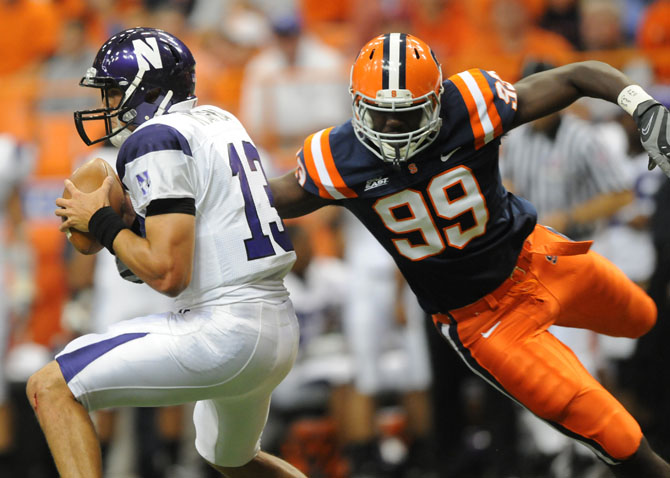
Chandler Jones (DE, Syracuse) tape review

Chandler Jones - a possible LEO pass rusher for the Seahawks?

In three years at Syracuse Chandler Jones only recorded 10.5 sacks, 4.5 of which came in an injury-hit 2011 campaign where he missed five games. The sign of an underachiever? Or maybe someone who’s best days will come in the NFL? There’s something raw and edgy about his play and as an athletic pass rusher in a class lacking a lot of top-end talent, he could be one of the players who’s set for a big rise after the combine.

At the moment he’s more of an athlete than a complete, rounded defensive end. He has a good frame – almost ideal for the LEO – listed at 6-5, 265lbs with a lean frame with minimal body fat. Jones doesn’t flash a lot of technical ability and certainly he doesn’t have a great repertoire of moves, but he doesn’t take many plays off and he’s shown enough speed off the edge to warrant consideration in the second or third round range. He’s also quite inconsistent as you’ll see in the tape, but there’s enough here to intrigue teams like Seattle who are looking to give their pass rush a shot in the arm and maybe fill the roll currently occupied by pending free agent Raheem Brock.

As with most defensive ends playing at this size, Jones isn’t an orthodox fit for 4-3 teams unless he’ll be working mainly as a specialist. At Syracuse he switched between taking snaps in space (LEO) and working in a three-man front and it’s good to see he wasn’t overwhelmed when Syracuse dropped extra players into coverage. He’s still a bit small to act as a pure end in the 4-3 and I’m torn as to whether he’ll fit at OLB in the 3-4. He’s not going to be a consistent run-stopper as you’d probably expect at 265lbs, but he needs to get stronger in the upper body and try to add an effective bull rush to his game. Too many times he engages a tackle and gets very minimal push. There’s also times – especially in the WVU tape – where he flashes well against the run and holds his position even when taking on two blockers. His technique needs a little refining overall, but there’s a lot of potential to work with.

Jones sometimes struggles to read and react, making the wrong judgement as the play unfolds and getting out of position. He doesn’t diagnose run plays particularly well, especially on the draw, but a player like this you’re really concentrating on his abilities as a pass rusher. He’s enough of a threat working in space to interest the Seahawks possibly as early as round two – and don’t be surprised if they spend their first two picks in this year’s draft boosting the front seven.

He comes from a strong bloodline – his brother Arthur Jones was a highly rated 2010 draft prospect who surprisingly fell into the fifth round where he was selected by Baltimore. His other brother, Jon, fights in the UFC. I’ve broken down select plays from the games against Connecticut and West Virginia below. Tape courtesy of MarioCLP and Aaron Aloysius.

0:01 – Good contact with the left tackle to jolt him out of position and force an inaccurate throw/ interception.

0:26– If you want to know why he might run well at the combine, this play shows what he’s capable of. Great hustle to at least try and get downfield to save the touchdown, but it’s the athleticism and ability to move with the play that’s most impressive.

1:01 – Handles the block well from the H-back and bursts into the backfield to help force a loss on this run play. This is the kind of thing you want to see from an undersized defensive end – making plays against the run and not just relying on their ability to rush the passer in space.

1:21 – The other side of the story, because here he’s knocked off his feet by the H-back who gets his revenge and takes Jones out of this running play.

1:29 – Needs to be stronger here to shed the block a little sooner and prevent the first down. Although he makes the tackle, he’s moving backwards throughout and needs to do a better job holding his position.

1:47 – A great play on two levels. Firstly, he deals with a double-team and this time holds his position to make initial contact with the ball-carrier. Secondly, it’s a really opportunistic play to strip the ball and force the turnover.

2:38 – Collapses the pocket forcing the quarterback to move, ending the play before it develops. Great first step inside and beats his blocker before shoving an interior lineman aside. Disrupts the play and deserves credit even though he didn’t get the sack.

2:53 – Needs to be stronger at the P.O.A. The left tackle is deep and almost standing on the quarterbacks toes, plus he’s slightly off balance having dropped a little shallow. A good bull rush here puts the QB in trouble, but Jones is stoned by the tackle.

3:02 – Superb combination of edge speed, burst and hand use – exactly what you want to see from a LEO. He beats the tackle with ease and leans around the contact, brushing the blocker aside before getting to the quarterback for the sack and forced fumble/turnover. He brought the pressure on a three man rush, dominated his opponent and again showed the awareness to go for the football as well as make the tackle.

3:56 – Again great burst on the inside move showing he’s not just an edge rusher. Great side-step to dodge the interior lineman while remaining balance and avoiding contact with perfect hand use. Just misses the sack but forces the QB to step into the pocket.

4:25 – Better against the run, holding his position then disengaging to make the tackle for no gain.

1:47 – The first real evidence on the two videos of a bull rush. Here he drives back the left tackle who is completely dominated and makes the sack on Geno Smith. Good pursuit, ideal pad level and leans into the blocker keeping one arm free to tackle the quarterback. Showing the ability to move inside and counter will boost his draft stock and prove he’s not just a pure edge rusher.

2:06 – Struggles to disengage the block but makes an instinctive attempt to tip the ball into the air using his long arms. This could easily have been an interception with a little more fortune.

3:24 – Too easily dealt with against the run. Gets his body into a strange angle and makes the job of a square-on blocker very easy. Needs to be more disciplined in this situation to hold his position, doesn’t always have to try and make the big play.

3:34– Why is he looking down at the turf on this play? Is he off balance? If he keeps his head up and sees the runner, he could’ve forced a big loss.

3:44 – Reacts well to the play and quickly changes direction to make the tackle.

4:38 – Is well blocked on this play, but it looks as if he just gets enough on Smith’s throwing arm to force an under-thrown ball for an interception. It looks as if there’s contact.

5:22 – Continued effort, the second defensive player to get to the quarterback here and again has the awareness to go for the strip-sack. The ball comes loose and it’s almost a turnover.

Kirk Cousins tape review vs Georgia

This wasn’t Cousins’ finest individual performance, but he also played his part in a big win for Michigan State. There were several sloppy errors in this tape – he can’t afford to try to fake the throw over the middle by staring at the secondary and then coming back to throw blind to the right. It led to a big turnover in this game and he gave Georgia enough bites of the apple to win this one comfortably. Fortunately, the Bulldogs were equally generous.

However, there were also some key highlights – none more so than a superb two-minute drill to tie the game at 27-27 and take it to overtime. Poise, accuracy, the ability to make a play with his legs when offered the opportunity. That was an excellent drive late on to give his team a shot at victory.

The Seahawks may or may not have the opportunity to draft Cousins, depending on the grade they’ve given him and the area he leaves the board. The early second round may be considered too early, but he could easily be off the board before round three. In my mock draft yesterday, I had Cousins going in the late second round to Green Bay. Seattle will have to weigh up the direction they want to go in round two, but they could well decide to keep adding to the front seven and they may want to spend a high pick on a running back. They aren’t likely to force the issue at quarterback and overdraft someone – even in round two – when there are players higher on their board available.

Even so, Pete Carroll seems to like Cousins and he matches what the Seahawks are looking for in terms of a ‘leader’ at quarterback. His stock has risen during the Senior Bowl and while previously he may have been considered a probably round 3/4 pick, that now seems unlikely. I have Cousins graded as the #4 quarterback behind only Andrew Luck, Robert Griffin III and Brock Osweiler. You’ll find the tape above vs Georgia in the Outback Bowl (provided to us by JMPasq) and the review below.

0:06– I’m torn between whether this is just a bad read and play call, or an exceptional play from Brandon Boykin. Credit goes to the corner, he spots this immediately.

0:28 – Great read from Cousins here, spotting the receiver dropping in behind the corner and noticing he’d be passed off to the safety. He leads the wide out nicely and this is just a really good play from the quarterback.

0:42 – Nice completion, off balance thrown to the sideline under pressure. Exciting for two reasons – one, what a fantastic rush by Jarvis Jones who would’ve been a top-ten pick this year. Two – for Cousins to generate that kind of velocity leaning back and with a hit forthcoming is impressive.

1:01 – Jarvis Jones. Again.

1:49 – Not sure what happens on this play. Good play action, good pass protection and the pass (thrown slightly behind, which is what needed to happen in that thick coverage) just seems to go through the receivers hands.

1:55– Dangerous throw down the middle, Cousins needs to avoid lofting passes too much in 2v1 situations. In that read, better to drive the ball and risk the incompletion than risk the interception by taking something off the pass. He tries to throw off the safety by looking to the right, but he can’t trust the fake. Bacarri Rambo doesn’t bite and jumps the pass – it could’ve easily been a pick.

2:24– Doesn’t notice the linebacker ready to jump the dig. Needs to be careful and identify the danger here, this should’ve been an interception.

2:40 – He’s starting to press with the score at 16-0 to Georgia and MSU struggling with five straight 3-and-outs. However bad things are going, it’s never worth risking a pick here and making it worse. Bad read, bad decision to throw into triple coverage. Must do better.

3:27 – It’s a sloppy route from the intended target, but also a bit of a wild throw from Cousins that almost led to an interception.

4:06 – Superb fake on the bubble screen, completely sells it opening up the tight end down the seam. Much better, intelligent quarterback play.

4:41 – Cousins threads the needle down the middle, dissecting three defenders to find the tight end. Nice, accurate throw with the correct level of touch.

5:02– Inaccurate pass, throws too high. Could’ve been costly.

5:58 – First interception, but it had been on the cards. Ill-advised throw to the sideline, not enough punch on the pass and easily cut off and returned. The big problem here is Cousins looks down the middle of the field on the fake, then throws blind to the right sideline. Being deceptive is one thing, but throwing bad picks that are avoidable is another. This was avoidable and if he makes the read before throwing, he avoids a pick.

7:23 – Better. Cousins anticipates the route and just allows that extra split second to let it develop – then throws a strike into the end zone. Ball placement was perfect, allowing the tight end to go up and make the play.

8:09– Play action before a bad read. If you freeze it at 8:11, what do you see? A wall of three red-shirts blocking off the inside route. Cousins forces it anyway, with the ball being tipped by one defender and caught by another. Alec Ogletree is a very good prospect at Georgia but this was all on the quarterback. He cannot make that throw.

8:33 – 10:02 – I wanted to highlight the entire drive which tied the game and took it to overtime. This is just an excellent two-minute drill, Cousins marching the team down the field with a combination of accuracy throwing the ball, good decision making and when given the chance to make a play with his legs – he took it. A clutch drive that deserves to be highlighted in it’s entirety.

10:15 – Jarvis Jones. Did we ever mention he’s pretty good?

10:23 – Another bad decision here and another pick. He’s throwing into a zone with two defensive backs and one receiver, and hoping for the best. That’s not a good read or decision and he was fortunate to get another opportunity to win this game.

« Older posts Newer posts »

© 2026 Seahawks Draft Blog

Theme by Anders NorenUp ↑