For all my previous player scouting notes, click here.
Emmett Johnson (RB, Nebraska)
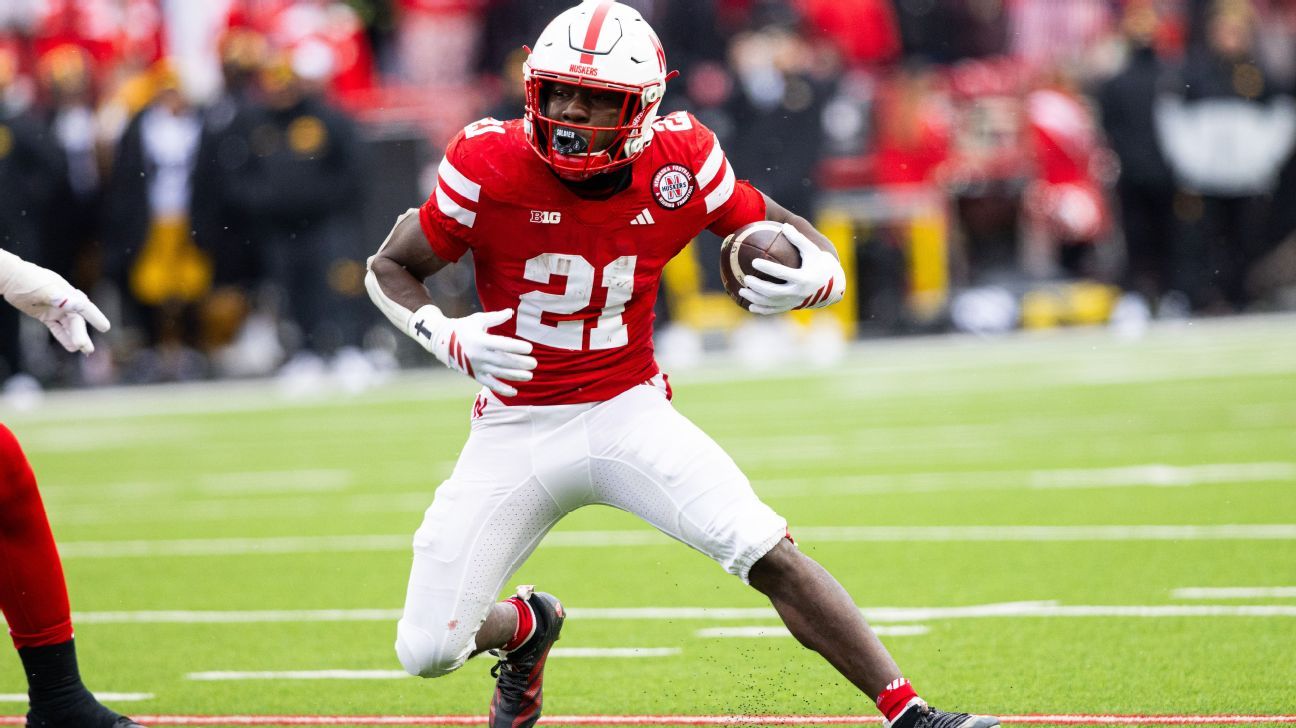
There are a few players who immediately stand out when you watch their teams play. Johnson had that influence when watching Nebraska in 2025. He was an electric runner who was constantly making plays.
I started to dig around on him and became very aware he is a high character individual. There is a lot to like here, yet determining his level of upside will be the key to working out how early he could go.
His change of direction skills are very impressive. He had one of the runs of the season against Maryland — bouncing outside, running to the second level, breaking multiple tackles, cutting back to create even more yardage and then eventually being brought down after an exhausting 50-yard effort.
Johnson’s game appears to be built on shiftiness and quickness, not power or explosion. He is not the type of back who just plows through contact and sets the tone. Neither is he necessarily the kind to win with raw speed, find a crease and be a big-play artist. However, he is slippery to bring down and he has an initial burst that gets him moving.
He has rare ability to dodge tackles and escape into space. He recorded 741 yards after contact which was third behind only Jeremiyah Love and Kaytron Allen. I would note, though, that his yards after contact per carry was a lowly 2.95. So this was more attempt-driven than necessarily being a big tackle breaker.
He can be used very effectively as a pass-catcher (46 catches in 2025). There was clear evidence too of very natural hands and catching the ball away from his body.
Johnson shows no hesitation on the hand-off and gets up field decisively. His cuts are built into his running stride making them seamless if not massively explosive. He makes himself small through the hole to pick through gaps. I like how he sets up his blocks to make the most of certain runs.
I think his lack of size is overstated because he’s muscular and well put together. Plus, we’re living in an era of NFL football where slightly smaller backs are succeeding. However, at 5-10 and 202lbs he doesn’t have a lot of heft. He might have limited value in short-yardage and redzone scenarios.
He ran a 4.56 which is a bit slower than ideal for his size. He jumped a 35.5 inch vertical and a 10-0 broad.
I had a lot of fun watching him. I think he’s a 6.5/10 runner as a prospect. He won’t necessarily provide starter quality but he can play a role in the NFL for sure. He will be worth a pick late on day two or early day three.
Jadarian Price (RB, Notre Dame)
His acceleration and burst hint at major NFL potential, particularly in a zone system. Watching Price run to the boundary, hit the edge with decisiveness and then explode upfield is interesting.
He loves to fly outside, stick his foot in the ground and get vertical. When he bounces outside he doesn’t dance. He gets downhill quickly, breaking through gaps and then the fun starts. Get him into the open field and he can really go. If he breaks into the second level he’ll be a threat to score at any time.
Equally he is patient letting gaps establish without any wasted motion
All of this contributes to his effectiveness as a kick-returner. He averaged 37.8 yards per attempt on kick returns, scoring two touchdowns in 2025.
Playing alongside Jeremiyah Love obviously capped his ability to produce big numbers. Love is one of the better running backs to enter the NFL in a generation and you’re going to have a hard time stealing carries away from him. I think the league will like that Price stuck it out, didn’t transfer and wanted to remain with his team.
He averaged 3.92 yards after contact per attempt which is a good mark. He played at about 5-11 and 210lbs but slimmed down to 203lbs for the combine, running a 4.49. I think Mike Washington Jr running a 4.33 can be deceptive. A 4.49 forty isn’t going to have anyone suddenly pushing Price into the top-20 but it’s more than quick enough to be a positive in his projection to the next level.
Despite being spelled, he had a +20 yard run in eight games last season. He did fumble three times though and along with the rest of the running backs in this class, his pass protection grades are nothing to write home about.
Having only six catches on seven targets in the passing game in his backup role also prevents you from getting a true angle on his third-down capabilities.
I do think he ticks a lot of boxes for being a productive starting NFL running back. Decent size, enough electricity to break to the second level and hit home-runs, explosive traits (35 inch vertical, 10-4 broad), the ability to break through arm tackles and retain his contact balance. He’s not likely to be the next Jonathan Taylor but if you need someone who can start and perform at a high level, I would bet that Price can deliver for you.
Character wise he is another strong personality. He could be very much on Seattle’s radar.
Mike Washington Jr (RB, Arkansas)
A blog favourite during the college season, Washington’s combination of size and speed was always intriguing. Plus, he fits the outside zone system very well.
He ran a 4.33 at 6-1 and 223lbs at the combine, adding a 39-inch vertical and a 10-8 broad jump. Washington’s profile of a dynamic, electric runner combined with top-end explosive traits demanded more attention post-combine in the wider media and he’s been one of the most-talked about players since.
De’Von Achane ran a 4.32 at his combine at 191lbs. Washington is 32lbs heavier than Achane and runs at the same speed. He’s also far more explosive — Achane jumped only a 33-inch vertical and a 9-3 broad.
Achane had flaws, was underestimated by the NFL and has turned into one of the very best backs in the game. This is an opportunity to draft someone in Washington with the same level of speed yet with a far bigger frame and level of explosive power.
He is adept at sprinting to the outside and then turning upfield for big gains. I think he has every chance to be an excellent outside-zone runner. However, he’s also capable of running through contact to get the tough yards. He recorded 644 yards after contact in 2025.
You see the acceleration on tape. He changes direction well too and finishes his runs. There’s a gliding quality to his running style you don’t often see on a physical back like this.
Washington gets to the outside, allows blocks to establish then cuts upfield with explosion. He also hits the hole well and finds gaps up the gut. When he gets to the second level he accelerates and becomes very difficult to stop and there is some home-run hitting potential.
However, he doesn’t make enough defenders miss. He’s a little bit stiff in the open-field to juke away from defenders and tends to run into tackles. He lacks the wiggle and shake you see with Jadarian Price and Jonah Coleman.
He will typically need good blocking to allow his excellent athleticism to capitalise. He is not likely to make magic happen on his own. Execute your blocks and he can make big plays because he’s so big and fast. If you play a team that beat you in the trenches though, he isn’t going to make things happen on his own.
Arkansas played very poorly on defense in 2025 and often were left chasing games. This impacted his ability to put up better numbers.
He had 3.86 yards after contact per carry. His explosive run rate was an above average 18%. His missed tackle forced rate is middle of the pack for this class at 20.4%.
Fumbles are a well publicised issue. He had three for Arkansas last season and four for New Mexico State in 2024. It’s an area teams will look into to work out how fixable the problem is. Again, pass-protection is not a strength at the moment.
I’d also suggest he doesn’t have a classic running back frame — his lower body isn’t quite as thick as you’d usually expect for a 220lber. We’re living in an unorthodox era at the position though.
There simply aren’t many players with this kind of size and speed. You get the sense he’s only scratching the surface of his potential too.
Skyler Bell (WR, Connecticut)
Bell is one of the harder players to get an angle on because the high’s are incredibly high and then you remember the competition level.
He’s 6-0 and 192lbs with massive 10-inch hands. Immediately that grabs your attention. Then he ran a 4.40 at the combine and jumped a 41-inch vertical and an 11-1 broad. These are big-time numbers that demand a return to the tape post-Indy.
You see the vertical on film because he can certainly climb the ladder to high-point in tight coverage. You see very clearly the speed to run away from defenders when he breaks into the open field. You wouldn’t say he has elite suddenness but the quickness is more than good enough for the NFL level.
He can string out a slant and carry it with YAC at an angle, running away from defenders. He shows good concentration to make difficult catches in traffic. Bell made highlight-reel one-handed grabs in 2025. His route-tree was more varied than I expected although scheming also did a good job creating openings for him.
Admittedly there were also plenty of moments on tape where he benefitted from some awful blown coverages.
He’s a willing runner over the middle. He can separate then turn upfield. The intermediate range is where he could make his money because he’s difficult to stick with. He scored seven touchdowns on 10-19 yard passes in 2025. He was very effective in the red zone.
His routes overall show a high level of polish and patience but he will freelance at times. He didn’t get jammed and you wonder how he’ll handle it at his size.
Drops have been a problem and that’s why I’m keeping him in the third round range — 24 drops in four seasons at UConn and Wisconsin is simply too many. That said, four drops in 2025 was his best effort and an improvement.
Romello Height (EDGE, Texas Tech)
The first thing to note was his frame. When he stood next to David Bailey at the combine, he looked like a Terminator. Bailey on the other hand does not have a typical ‘NFL EDGE’ body type.
He was 239lbs in Indianapolis so he’s undersized and will need to be used as an outside linebacker or situational rusher. He has a shade under 33 inch arms but nothing egregious like Cashius Howell. You would hope for amazing testing numbers at his size but a 1.63 10-yard split is very much in the ‘good not great’ category.
Height is explosive though — jumping a 39 inch vertical and a 10-5 broad. He reached a max speed during the season of 18.1mph.
His big selling point is pass-rush win percentage. His mark of 21.8% was second only to Nadame Tucker (playing for Western Michigan) and Reuben Bain. He was fourth for pressures behind only Bain, Bailey and Akheem Mesidor. There’s enough production data here to think Height is worth a second round shot.
He can dip and bend around the edge. His bend and straighten isn’t exactly elite but he’s shown he’s capable of working tackles. He can swipe away contact to disengage and he will shock tackles with his quickness at times. They need to engage him quickly and forcefully or he will win.
Height has shown evidence of a devastating inside move. He can absorb contact and slip free. He just doesn’t have amazing, game-changing angles on his bend or the terrifying quickness to be a truly high pick.
He can execute an effective spin move. He doesn’t have the sand in his pants to win with power. On top of this, he will unsurprisingly have issues vs the run at times.
As a situational rusher working in a rotation, there’s something to work with here. He doesn’t have the profile to go earlier than day two but it’ll be interesting to see where he lands, probably in the #50-75 range.
TJ Parker (EDGE, Clemson)
He had an underwhelming and disappointing 2025 season after showing some promise in 2025. Fair play to him for trying to repair some of the damage by appearing at the Senior Bowl as one of the bigger name attendees.
However, the tape (and Senior Bowl reps for that matter) showed a player with very average get-off and quickness. He tends to prefer to engage contact and use a straight arm to disrupt a blocker then play off that. There’s very little evidence of him attacking the outside shoulder, winning to the point then turning around the arc.
His straight arm is very effective in fairness at the college level. You could especially see in Mobile how it would consistently get the tackles off balance and then his secondary move to disengage and circle round to the quarterback was impressive (he did have losing reps though, including against Carver Willis).
At the next level I’m not sure this is going to consistently work. It’s easy to imagine him walking into contact too often, coming up against a tougher, more physical opponent and stalling out.
You just want to see a bit more twitch on tape. He did run a 1.61 10-yard split at 263lbs which is good. You wish you could see more evidence of that. He ran a max-speed during the college season of 17.4mph.
He’s nearly 6-4, has 33 1/4 inch arms and nearly 10-inch hands. These are good measurables. Other positives include working his hands to disengage well and when he kicked inside I thought he did a decent job extending his arms to keep his frame clean.
I do think he’s slightly one-dimensional at the moment. He had six forced fumbles in 2024 but zero in 2025. In his final year at Clemson he had just two sacks in 11 games before finishing the season with four sacks against South Carolina’s pathetic O-line. He only had 31 pressures in 11 games before recording 10 against South Carolina alone to boost his numbers.
In 2024 he had 51 pressures and 12 sacks in 2024. Why did his production fall off a cliff? He gave an unimpressive explanation at the Senior Bowl, saying Will Heldt basically gathered the production instead.
I can see teams who are desperate for edge rush help considering him between pick #25-50 but I didn’t feel like I was watching a player with tremendous pass-rushing upside.
Keyshaun Elliott (LB, Arizona State)
Hailed for his football character, I really enjoyed watching Elliott’s playing style and noted that twice when pouring over the film.
We know teams value explosive traits at linebacker. He had a 38 inch vertical and 10-5 broad jump so he ticks those boxes. His size (6-2, 231lbs) is very appealing.
Elliott sifts through the line to find his opening and then packs a punch when he takes on the ball-carrier. When offensive linemen try to get to the second level he can dip beyond them to avoid contact.
His pursuit speed is more than good enough when sprinting to the sideline and he will absolute fly to the ball.
He came off the edge at times and had success, recording seven sacks in 2025.
He’s a very fluid mover to navigate through traffic, making it look easy. His patient running style allows the play to develop and then he’s decisive to capture opportunities.
In coverage he’s very much a spot-dropper and not someone who is going to back-pedal with ease. He will be tested here but he’s not a slug by any stretch. Like most linebackers, he’s better moving forwards though.
He works along the line very well and he’s a tenacious hitter who is going to bring a physical edge to a defense. Elliott can take on blocks and disengage, using heavy hands to compete with an edge.
Missed tackles are a problem for him — 67 in four seasons with 16.9% and 16.8% in 2024 & 2025. That is a technique thing and not a want-to problem, so it can be fixed.
If you don’t obsess about coverage ability and you embrace the challenge to tweak his tackling, you will love Elliott. He is a winning football player and you need these types on your team.
There are multiple linebackers in this draft you can say that about. Here’s another.
Chandler Rivers (CB, Duke)
The first thing I wrote down was ‘extremely competitive’. He’s a shade under 5-10 and 185lbs but he played bigger. Unlike with D’Angelo Ponds, I never felt like size was an issue with Rivers.
He shows sparky suddenness in his movements. He’s very instinctive in zone and can read what’s happening effectively and react. He switches in zone with ease, not recklessly freelancing, and he understood his system.
Rivers shows a relentless determination to get to the ball/ball-carrier. He also jams receivers like he’s 15lbs heavier.
He’s a very good blitzer when he kicks inside to the slot. I kept thinking he has the potential to drop and play safety like Coby Bryant. His read/react to the ball-carrier is decisive and he accelerates like a missile. On receiver screens, he regularly ducks the first blocker to make the tackle.
His technique on his back-pedal needs work, it’s side-on and clunky. He could get beat deep without a more natural back-pedal and transition. That, again, might speak to a better fit as a Bryant-esque safety transition where it’d be less of an issue.
You will never ever have to worry about Rivers’ ‘want to’. I do think he can play outside corner even if I’m intrigued by a position change.
He ran a 4.40 forty and jumped a 39 inch vertical and a 10-10 broad. Only having 29 3/8 inch arms are an issue but he only missed six tackles in 2025 (11.8%) which is good for a smaller cornerback. He was also only flagged twice last season. He gave up one touchdown and had two interceptions.
Rivers played 591 snaps at outside corner in 2025, 154 in the slot, 64 in the box and 30 at free safety. His run defense was a 70.8 grade but I thought he performed even better than that based on what I saw.
I really like this player.
Treydan Stukes (S, Arizona)
Another player highly celebrated for his character and leadership, Stukes has good size at 6-1, 190lbs with 32 inch arms. He ran an excellent 4.33 with a 1.50 10-yard split at the combine while also jumping a 38 inch vertical and a 10-10 broad. This is a very interesting physical profile.
At Arizona he played mostly in the slot in 2025 (380 snaps) with a further 197 reps in the box. He only played outside corner four times. I think his best fit will be safety at the next level and he could be a really good one at that.
The first thing you notice is he clearly looks like he does his homework on tape. His mental processing is evident — anticipating developing routes and being in the right place. You especially see his recognition skill on screens and he has the want-to to go and make a play.
He’s physical and loves to mix it up and help set the tone. Range is very much there, as you’d expect with his testing speed. He missed only six tackles in 2025 (10.7%) and his run defense is very reasonable. I like his tackling form and he had no trouble bringing down bigger backs or receivers.
Production wise, he had four interceptions in 2025 and he was at 59% for completions on targets which is impressive for someone playing so often in the slot.
He only gave up four penalties in his entire college career. He very much ticks the ‘smart, tough, reliable’ box.
He just moves so easily for his size. He can switch direction, flip his hips and charge on.
He is an older player but he spent all six seasons at Arizona — which is something the league will like. He will be a 24-year-old rookie. He has an ACL injury in his history that’ll need checking. These things will cap his stock a little bit — but it’s an opportunity to get value on day two.
If you want a playmaking chess-piece who can play in multiple parts of the secondary, this is a player for you. There’s a ton of potential here.