Page 12 of 469

Latest scouting notes on multiple O-liners, D-liners and defensive backs

Chase Bisontis (G, Texas A&M)

He has good listed size at 6-5 and 315lbs but he only has 31 3/4 inch arms. Despite this, he has nearly 10-inch hands.

To me his frame looks narrow and long — does he have the necessary anchor power for the next level? His stance is also very wide and when he gets into this position he loses power. He doesn’t handle quickness well and his angles need to be better.

Bisontis lunges at blocks and reaches, he doesn’t instigate with a powerful punch to the chest and is often a catcher with his blocks — extending his arms out and then connecting outside. This will need fixing.

He tested well at the combine, running a 5.02 forty and he’s an explosive tester (3.03 TEF). He also shows a strong back to arch and anchor against power. He does a good job cutting the hands of interior rushers to drop them to the turf. Bisontis has enough quickness to recover when interior linemen gain position with their first step.

You do seem him get jolted backwards by effective chest punches. Run plays stall immediately sometimes when he’s dislodged. He really operates in a phone booth and there’s very little evidence of effective move blocks. He only had a 66.0 grade as a zone blocker.

I can’t imagine he’ll ever be a ‘people mover’ in the running game in either system.

He gave up 12 pressures and a sack in 2025 and struggled badly vs Miami in the playoffs. To me he just looks like a very average player even with some physical upside. I’m not sure why he’s being touted for the top-40 or why anyone has him graded higher than Emmanuel Pregnon.

Connor Lew (C, Auburn)

He has decent size at 6-3, 310lbs with 32.5 inch arms — although I wish his hands were bigger (only nine inches). He suffered a torn ACL in October and hasn’t tested as he’s recovering.

On tape there’s clear evidence of well executed combo blocks. He will chip off the snap and then reach up and dominate linebackers. He can get out on the pull seamlessly off the snap and engage defensive ends and win.

His hand placement sometimes is a little bit too wide but he will battle and overpower most opponents. He’s just so natural progressing to the next level.

Lew does not appear to be an outstanding athlete —- he’s not really quick or explosive and his game is more predicated on very sound fundamentals and natural ability. Even so, he’s so accomplished on screens and on the move.

He can do such a good job on the move that he looks best suited to a zone system — although surprisingly his zone grade was only 63.8 in 2025 and it wasn’t much better in 2024 (64.2). I think he’s a better run-blocker than this suggests but will concede pass-pro is calling card.

Lew gave up four pressures and two sacks in eight games last season (both sacks vs Texas A&M).

He will turn and subtly take out interior defenders to open up lanes. He can judo toss you out of position if you’re not anchored. He’s very powerful and plays with a strong base and will instigate contact.

He was a team captain at Auburn.

There is a player here and he could provide some value due to the injury. If he tested well and was injury-free he could’ve been a mid-day two pick easily.

Keldric Faulk (DE, Auburn)

He’s an excellent combination of size (6-6, 276lbs) and mobility. He has 34.5 inch arms and 10 inch hands. I wish he’d run at the combine — we only had jumps to go off (35 inch vertical, 9-9 broad). He reportedly ran a 4.67 forty at pro-day but you can always add about 0.10 to those times.

His leadership qualities have been praised and he’s been described as a ‘culture player’.

Faulk can blast into blockers, jolt them off balance and then explode to the ball carrier. He’s very capable of stacking and shedding blocks in the run game. He was simply too big and athletic for some college tackles.

In one game against Baylor he embarrassed the tackle who appeared terrified. He was the best player on the field in that game.

He can be slippery to avoid blockers and get into the backfield. His bend is better than most players his size and good luck chipping him. You can get him on the field early in the NFL as a run defender alone.

Defensive Coordinators will salivate at how they can use him in multiple positions. When I spoke to someone in the league this week they mentioned his ability to line-up in different places being a major positive in the modern NFL.

He uses his hands well and does not get over-aggressive — he’s a very disciplined defender who understands you don’t need to be 100mph every play. He will be an immediate net positive as a run defender, with a 85.5 run-defense grade in 2025 (among the best in class).

Faulk will need guidance to unlock his pass-rushing potential though because his production was awful. His pass-rush win-rate was a flat-out bad 11.6% in 2025. He does not have a good enough assortment of moves at the moment.

It feels like he could be much more of a threat off the edge so why didn’t it happen? He had just two sacks in 2025 after recording seven in 2024. He ended his college career with an eight-game run without a sack.

I’m not sure how easy it is for players his size to make plays on the outside at the NFL level. You therefore need to ask whether he can become a legit inside/out rusher or just a good ‘big end’ versus the run. You can’t really take a player who is just a bigger presence off the edge in round one though.

He doesn’t turn 21 until September so there’s a lot of room for growth here. He’s an easy player to like for what he is. I’m just not convinced he’ll ever be much more than a good run defender who can play across the line. And if you’re taking someone in round one, does he need to be more of a pass-rusher?

Dani Dennis-Sutton (EDGE, Penn State)

He came in lighter than expected at the combine — weighing 256lbs which is about 12lbs lighter than he was listed in college. It seemed to work as he tested well — running a 1.63 10-yard split, a 6.90 three-cone and jumping a 39.5 inch vertical and a 10-11 broad.

He can uncoil from a leveraged position to attack tackles, gain pad-level and burst around the edge. He’s shown he can use a swim move to get off blocks and slip into the backfield.

DDS had reps on tape where he gets to the edge quickly, turns the corner and explodes to the quarterback. He also shocked average tackles with his quickness at times — either by attacking the edge or cutting inside.

Even so — you do see tightness in his movements and he generally lacks a great burst off the snap. His measured max-speed from 0-10 yards in 2025 was just 14.8mph — among the lowest in this draft class.

He showed off a spin move against Michigan State to burst into backfield from the middle of the line. Tight ends will struggle to contain him in the running game and his grade (77.7) is decent versus the run.

He has power in his hands to disrupt and keep him clean and he’s not easily moved off his spot.

He does not possess devastating speed off the edge and his split at his size is very much ‘good not great’. Too often he’s late off the ball.

DDA doesn’t have much of a counter plan and his performances were streaky in 2025. He can probably wear a few different hats for you on the D-line or EDGE if he gets his weight up again.

He had 51 pressures and a win percentage of 15.8% in 2025.

I think he’s a very reasonable player to add to a rotation but is he capable of being unlocked to be more?

Gabe Jacas (EDGE, Illinois)

He hasn’t done any pre-draft testing but is said to have scheduled a personal workout for teams before next month.

He ran a top speed of 18.19mph at the Senior Bowl — the second fastest of all defensive linemen in Mobile. The only faster player was Quintayvious Hutchins who is 30lbs lighter. His max speed over 10 yards in 2025 was 15.6mph — among the best in class. There is speed and quickness to his game that isn’t always obvious on tape.

Jacas comes from a wrestling background. He recorded 12 sacks in 2025, including seven in his final four games. That’s part of the problem though — he got sacks against weaker teams but was anonymous in earlier games. His win percentage was a disappointing 14.9%. He had 41 pressures.

He prefers to run through blockers instead of around them and there’s a lack of a repertoire on show. However, his stack-and-shed ability is impressive. He’s also tenacious and relentless when working to get off blocks

He has shown the ability to dip around the tackle to get to the quarterback — you just want to see more of it. Don’t rely on power all of the time.

His hip movement and ankle flexion are not ideal.

Despite all of this, I think he provides a base-level of ability where he likely won’t be a total wash-out at the next level. He plays with a high-motor, the speed is clearly in his arsenal and he was a team captain who clearly plays with power and intensity.

The questions are all about his upside and ability to deliver more consistently. If he runs well at his work-out he has the exact profile of a day-two pass-rusher.

Tyler Onyedim (DT, Texas A&M)

He has an excellent frame at 6-3 and 292lbs with +34 inch arms and 10 1/8 hands. He jumped a 32 inch vertical and a 9-3 broad at the combine and then ran a 4.92 at his pro-day. You can work with this.

Onyedim had four years at Iowa State before transferring to Texas A&M.

He only managed two sacks in 2025 which is surprising when you consider his physical profile. He does everything fairly well on tape but has the upside to be unlocked into more.

You see him swim away from contact with a dynamic first step to penetrate. He loves to fake to the B-gap then cross to the A with a great arm-over. He’s mobile enough to be effective on stunts and has shown the ability to control blocks as a nose then disengage to make the play vs the run.

He played all across the D-line for A&M. When he gets his hands right he is really good. He has enough power to jolt on contact and the burst to capitalise against off-balance O-liners. He can provide a wide rush at five-technique.

Onyedim showed off a swim move vs Texas to hammer Arch Manning on one play.

He does not have a wide frame, which is why he’s lighter, and it could lead to next-level anchor issues.

It definitely feels like he has legitimate ability to work in a NFL rotation. He is being slept on and these kind of players add genuine depth to your D-line and can chip-in during a long season.

Albert Regis (DT, Texas A&M)

He’s hailed for his locker room presence and leadership and spent five years at Texas A&M. He’s very much a run defender not a sack artist (only three sacks in five years).

He doesn’t have an ideal frame at 6-1, 295lbs with short 31.5 inch arms. He ran a 4.88 forty and a 1.72 10-yard split which is interesting — then jumped a 34 inch vertical and a 9-8 broad. He’s an athlete.

His calling card is to sink low into his stance and win consistently with leverage. It’s impressive. He gets his hands in the right place, stays low and controls his blocks. Often two blockers struggle to dislodge him from his position.

I didn’t see his length as much of an issue on tape and he engaged/disengaged well. Whether all of this translates with his size and length, I am dubious. But the tape is the tape.

You don’t see a ton of pass rush quality but if you misstep and give him a lane he can run. He played 1T, 3T and nose for A&M.

For his size, he does a really good job clogging the middle. He moves easily along slanted blocking but also remains stout front-on. He can create pile-ups in the middle and messes up run attempts regularly. It’s really fun to see how much of a mess he makes things despite not being this hulking nose tackle.

He plays with aggression all of the time. His size and lack of length says he shouldn’t work but he does. You get absolutely everything from him.

I think he can play — the lack of ideal size is countered by his testing being better than expected. I doubt he’s ever going to be this big-name, star nose — but he should get a chance in the NFL and contribute.

Tim Keenan (DT, Alabama)

He’s a 6-1, 327lbs defender with very short arms (30.5 inches) and surprisingly small hands (8 5/8 inches). He ran a 5.31 forty and jumped a 30 inch vertical plus an 8-4 broad. These are not great number.

His 21 bench press reps were also not great for his size and arm length.

Keenan has flashes on tape where you think he can play at the next level but the physical profile is poor. He does show well when he instigates contact with the center and can be the enforcer. He wins leverage battles when he gets his hands right.

He can keep his pad level low in order to anchor down and he had some fun against South Carolina’s lousy O-line, controlling vs the run.

Eight sacks in three seasons speaks to the flashes he had as a pure nose tackle. He had some injury issues this season and his 2024 tape was better.

I think he can step into gaps and then force his way through poorly angled blocks. Alabama has always loved stunts and he even ran some from the inside despite being a massive nose.

He showed an ability to push the pocket and did have 12 pressures in 2025. Plus, 45 pressures in three seasons in the SEC is good for a nose tackle.

Keenan had moments at the Senior Bowl but was also stalled by James Brockermeyer & Jake Slaughter in nose vs center reps.

He feels like a player who can contribute in the NFL but doesn’t necessarily have the profile to be much more than a role player.

Daylen Everette (CB, Georgia)

He has an ideal frame and looks really athletic. He’s well sized (6-1, 198lbs) with 32 inch arms and big 9 5/8 inch hands.

An electric combine showed off his upside. He ran a 4.38 with a 37.5 inch vertical and 10-4 broad, before delivering an impressive on-field session.

He was the fifth fastest player and the second fastest defensive back per GPS testing at the Senior Bowl (20.04mph max speed).

He’s a physical corner who seems to like contact and plays with a sparky edge. He’s a former 5-star recruit.

His long arms often stretch out to deflect balls away — and the Seahawks might have a lot of interest here because they need to replace Riq Woolen’s speed and length. He really does use his length and physicality to good effect to disrupt receiver routes.

Everette has a ton of starting experience for Georgia and was often described as the leader of their secondary.

His quickness is evident in the way he breaks on the football. He closes ground so quickly. His zone grades are good not great though (73.8).

He can deliver a jolting blast to receivers, timing his hits to jar the ball away. He’s very willing in run support. His speed also allows him to be an effective corner blitzer.

There are plenty of reps where you see him living in the hip-pocket of his receiver. He has a swagger to him that most good cornerbacks have. He also doesn’t miss many tackles.

However, he only had five interceptions in his last three seasons (including one in 2025) and he gives up too many plays. He was responsible for three touchdowns conceded last season and he’s given up nine touchdowns in three seasons. Clearly the Woolen comparisons are not limited to his physical profile.

You need to work out whether you can live with the occasional brain-fart in coverage to benefit from the positives. There are traits to die for here and his experience and frame should all prepare him to start in the NFL. In an era where you don’t have a lot of ‘star’ cornerbacks, Everette gives you a chance to add a very capable one. He might drive you crazy too.

He has a reported official visit with the Seahawks.

Ephesians Pyrsock (CB, Washington)

He certainly looks the part at 6-3, 194lbs and 33.5 inch arms. Running a 4.45 forty really helped his stock at that size — as did adding a 39.5 inch vertical and a 10-4 broad. This is the profile of someone you can work with at the next level.

His mentality seems strong too. He only missed six tackles in 2025 which for a cornerback, is pretty good (10.2%). His run defense was an impressive 82.3 grade and it shows on tape. There’s no doubt about his want-to (even if the technique is iffy at times) and as with many of these Washington players, he plays with a competitive edge.

The size and length enables him to compete in contested situations. There’s evidence of recovery speed and he can get on top of routes quickly to take away easy throws. He’s shown he can run across the middle and stick in tricky coverage situations.

However, there are issues too. He gave up five touchdowns in coverage last season and conceded 42 receptions on 73 targets. He dropped some catchable interceptions and only had one in 2025 — which happened to be a total gift. He only had two college interceptions.

His back-pedal and transition are laboured at times and he doesn’t grade well in zone. Indeed, he have up a quarterback rating of 99.3 in zone situations which is comparably poor to the rest of this class.

Still, the profile is intriguing. He was the ninth fastest DB in Mobile (19.6mph) and was faster than Thaddeus Dixon, Colton Hood, Bud Clark and Malik Muhammad. There are tools you can work with and he will not be a high pick — so he’ll be worth a shot at some point, possibly as early as the late third.

D’Angelo Ponds (CB, Indiana)

He’s only 5-9 and 182lbs but somehow he looks smaller on tape. His lack of height legitimately stands out, let’s just get that out of the way.

However, despite this, his tape is still impressive.

He is very explosive with a 43.5 inch vertical at the combine — he didn’t run a forty though and we’ll wait to see if he runs at the Indiana pro-day on Wednesday.

His movements are sharp and he changes direction as well as anyone in this class. He is so difficult to shake off. He’s like an annoying wasp, buzzing around you expertly because he likes your cologne. You try and swat him away, but he persists. And you know you might get stung if you don’t get away from him.

Ponds can carry receivers across the field or stick on an intermediate level, remaining in the hip pocket. He gets his head turned to the football nice and early and trusts his footwork.

He has shown an ability to be instinctive in zone, coming off his man to play the ball. He can play off, track and trail and run deep with fast receivers. His grade in zone (84.6) is among the best in class.

However, size mismatches are inevitable and he will struggle to defend against size. His game against Jeremiah Smith, as good as Smith is, was a struggle. He did his best and had a couple of wins — reaching around Smith’s frame to knock the ball away. But he also had some moments where you can see how size will be a problem.

He can mix things up physically and there’s clear power in his legs. Ponds plays with confidence and a swagger associated with good cornerbacks. He clearly plays with a chip on his shoulder as he’s ultra competitive and sparky.

Tackling against size could be as much of a problem as contested catches for him but he only had an astonishing two missed tackles in 2025 and he only missed 11 tackles in three seasons (two at Indiana, one at James Madison).

His run defense was very decent for his size and position. He gave up 32 receptions on 64 targets in 2025 (50%) with two interceptions.

There is so much to like here but the size has to be considered too. How many top cornerbacks are this size? Does he have to switch to the slot? Can you live with what he is? Can you just settle that some bigger guys will beat him?

The tape is really good but as a projection for the NFL it’s really tricky. If he was 5-11 he would be a first round pick. But he isn’t — and you can’t just dismiss his frame.

Jalon Kilgore (S, South Carolina)

He has a great frame — 6-1, 210lbs, 33 inch arms, 9.5 inch hands. He just looks like a dude, physically and in the eyes.

Kilgore ran a 4.4 at the combine and jumped a 37-inch vertical and a 10-10 broad. That was impressive, arguably better than the tape hints at. You don’t want him isolated covering large areas of space based on the study. He’s not the quickest or most mobile.

His feet can get caught and receivers will get in behind him. He’s the type of player where you want to keep everything in front of him and let him react.

To his credit he made some terrific recovery plays on interceptions and tipped passes. This suggests his ball-tracking ability is very good. He scampers back to the ball, rather than show sudden movements.

He does make occasional good reads in zone to play the ball. He’s very capable of planting a hit on someone. He’s competitive at the catch-point and uses his length well to break-up passes.

There’s untapped potential as a blitzer due to his size and speed. His run defense is very good as you’d expect with his frame. There are not many players who look like this.

I feel like while he isn’t perfect on the back-pedal or with range, there’s a lot to work with here. Can you unlock a role for him to capitalise on what he does well?

Kilgore recorded eight interceptions in three seasons at South Carolina. As I’ve kept saying recently, production at safety often translates. Seven of those interceptions came in his last two seasons. He also had nine PBU’s in 2025 — only 11 defensive backs had more in 2025.

It would be fascinating to see how Mike Macdonald would use a player like this. He looks like a ‘Dark Side’ defender. It’s interesting he’s coming in for an official visit because the most obvious role for him would be the one occupied by Nick Emmanwori. Can he act as another chess-piece from a deeper position?
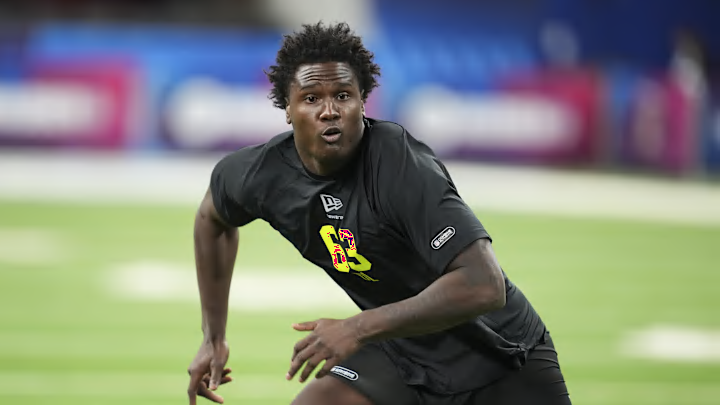
The Seahawks are bringing in Zion Young for a visit — but I’m not convinced

I found it interesting that the Seahawks are reportedly having an official-30 visit with Missouri defensive end Zion Young.

It’s understandable why they’d want to bring him in. Young’s interviews are a little bit strange and in December he was arrested on suspicion of driving while intoxicated, speeding and a failure to properly affix a license plate to his vehicle.

His Head Coach Eli Drinkwitz addressed the issue at the time, saying, “You know, disappointed with the actions of Zion Young, and the decision-making that he had as a team captain and player.”

These official visits are often an opportunity to find out about a person and how they’d fit in your building. Young is certainly someone you can imagine teams will want to meet with to get a better picture of who he is.

Beyond all this though there’s something else I want to discuss — Young’s lack of speed.

We know the Seahawks place a lot of emphasis on defending the run. However, they already have a very stout defensive line in that regard. What they don’t have are enough quick wins off the edge. They don’t have enough speed.

Yes, eventually DeMarcus Lawrence will need to be replaced. There’s still no clarity either on whether he’s retiring or not. That might, in part, be one of the reasons they’re doing their homework on Young.

But even then, I still worry about his lack of speed.

Reportedly he ran a 4.77 forty and a 1.72 10-yard split at his pro-day, weighing in at 267lbs. When you account for pro-days typically providing optimal testing environments, the times are often a little bit quicker than reality. However, let’s just take this 4.77 forty and 1.72 split on face value.

That’s a slower split than LJ Collier managed (1.68) at 283lbs.

Over 10-yards he was also in the same ballpark as the following offensive linemen:

Parker Brailsford — 1.70 (289lbs)
Monroe Freeling — 1.71 (315lbs)
Spencer Fano — 1.72 (311lbs)
Sam Hecht — 1.73 (303lbs)
Max Iheanachor — 1.73 (321lbs)
Micah Morris — 1.73 (334lbs)

Regardless of how physical you are in college, or stout against the run, it’s a hard sell to invest a high pick on a 267lbs defensive lineman whose burst is similar to that of Kansas State’s 303lbs average athlete center Sam Hecht.

Let’s look at max-speed data from GPS tracking for the  2025 college football season. This is how fast players were on the field during games.

Here’s the max speed recorded over 0-10 yards for some of the pass rushers in this draft:

Malachi Lawrence — 16.1
Cashius Howell — 16.0
Gabe Jacas — 15.6
Romello Height — 15.5
Joshua Josephs — 15.2
TJ Parker — 15.2
Zion Young — 15.1
Dani Dennis-Sutton — 14.8

Now let’s look at the number of ‘max speed plays’ (measured at plays over 16mph) the same players made over the course of the 2025 season:

Malachi Lawrence — 17
Dani Dennis-Sutton — 10
Romello Height — 9
TJ Parker — 9
Cashius Howell — 6
Joshua Josephs — 5
Gabe Jacas — 4
Zion Young — 3

So while Dani Dennis-Sutton showed a real lack of burst over the first 10-yards for Penn State, he was still making plays chasing down ball-carriers fairly often, reaching speeds over 16mph. Zion Young is slower than his peers over the first 0-10 yards and he isn’t getting any quicker in his acceleration after.

It was a similar story at the Senior Bowl. Young was the 21st fastest defensive lineman in Mobile, even ranking below multiple defensive tackles. His max speed of 15.04mph was again slower than LJ Collier at his Senior Bowl in 2019 (15.24mph).

Like Collier, Young had an excellent Senior Bowl week. If you watch the cut-ups of his 1v1 reps and scrimmage plays he showed excellent technique, awareness, plenty of counter moves and he looked the part. Collier did exactly the same thing.

Remember Darius Robinson? Two years ago he also had a great Senior Bowl and was taken in the first round by Arizona. He too excelled at Missouri, had strong run-defense grades (81.4) but simply hasn’t been quick enough in the NFL to impact games regularly.

He was the 24th fastest defensive lineman at the 2024 Senior Bowl, with a max speed of 14.31mph. He’s slower than both Collier and Young — but he was also 286lbs in Mobile. Robinson ran a 1.73 10-yard split at his combine, 0.01 seconds slower than Young’s.

It’s not enough to just be really amped, strong and play with your hair on fire. You need burst and you need to be able to challenge with speed.

I would argue if you’re looking for toughness, strength and a grizzled mentality — you’re better off shopping in the veteran market as the Seahawks did with Lawrence, or waiting in the draft. Do you need to spend a top-40 pick on someone whose main calling card is ‘run defense’?

If Lawrence returns, the main thing the Seahawks need to do is replace Boye Mafe. It’s possible they wait until after the draft to do that with a veteran such as Von Miller. They might look at the draft too and the speed numbers speak favourably for Malachi Lawrence and Cashius Howell. If they can provide quick wins in the pass-rush, that can really help bolster this team for 2026.

Again — does an already good run-defending D-line need more of the same? Or does it need to upgrade the area where it’s weakest? And that’s clearly a lack of quick-wins and pure speed.

Lawrence’s run-D grade is only 66.2 and Howell’s is a 73.6. It’s perhaps worth noting that in his final year at Auburn, Derick Hall’s run defense grade was a paltry 60.9. It was only a 69.9 for the Seahawks in 2025. So I’m not sure it’s necessarily the be-all and end-all here — given most people expect Hall to get a contract extension and see him as a core member of the team.

Still, we’ll see what happens. Doug Baldwin retired from the NFL in May, after the draft, possibly at the team’s request to avoid tipping their hand in a 2019 draft where they spent picks on DK Metcalf and Gary Jennings. If Lawrence is planning to call it a day, it might serve the Seahawks to make that announcement after the draft.

That would place a further emphasis on needing someone who can fill the massive void he will leave. I’m still highly suspicious that a rookie is up to the job of replacing Lawrence — particularly one like Young who is hardly a perfect example of ‘smart, tough, reliable’ given his actions in December.

Watching Young’s Senior Bowl stuff is a pleasure. It’s how you want defensive ends to play when it comes to intensity, physicality and repertoire. If he was running a 1.63 split (the same as DeMarcus Lawrence) and had perhaps shown excellent agility too (he hasn’t done any jumps, a short shuttle or three-cone pre-draft) he would be a more tempting proposition with Seattle’s first pick.

Instead he just looks like someone who isn’t quick enough to be interesting and has some baggage attached that he will need to address with all teams.

A final point — the Seahawks would do well to learn from the 2019 experience. They felt obliged to take a defensive end due to the fact they had just traded away Frank Clark two days before the draft. They took Collier when Rashan Gary and Brian Burns were taken off the board early.

As a consequence, they missed out on a bunch of other good players at lesser need positions. It isn’t hindsight to mention now the likes of Deebo Samuel, Elgton Jenkins or Erik McCoy — all blog favourites. And if they’d taken DK Metcalf earlier, that would’ve opened up the possibility of perhaps drafting another blog favourite — Zach Allen — who was selected one pick after Metcalf.

It might be alluring to solve a need like a Lawrence replacement, either for now or the future, by addressing this early. I would rather invest in other positions than use a high pick on someone who feels very similar to Collier, only with a recent DWI arrest attached.

Do you want big plays in your running game? What the data tells us about the 2026 draft class

The Seahawks need a running back. This isn’t a deep running back draft. The remaining veteran options hardly jump out at you. Unless something improbable happens, like trading for Jonathan Taylor, the Seahawks are going to have to find a solution.

But what do they need to add to their backfield?

The main thing they lost when Ken Walker joined the Chiefs was big plays.

An explosive run is typically described as a +10 yard effort. Walker was sixth in the 2025 regular season for explosive runs, behind De’Von Achane, James Cook, Bijan Robinson, Derrick Henry and Jonathan Taylor. However, he recorded his 33 explosive runs on just 221 attempts. Only Achane had a better rate of big plays.

So how can the 2025 draft help fill this void?

Let’s start by looking at explosive run rates for 2025 (the percentage of +10 yard runs a player has within their running attempts):

Jadarian Price – 21.2%
Jeremiyah Love – 19.6%
Mike Washington – 18%
Emmett Johnson – 14.3%
Kaytron Allen – 14.3%
Kaelon Black – 14%
Jonah Coleman – 12.7%
Roman Hemby – 11.3%
Nick Singleton – 9.7%
J’Mari Taylor – 9.5%

The average rate over the last decade for running backs entering the league is 16%. As you can see, only three players are ‘above average’ and many of the big name backs in this class are significantly below that mark.

How significant is this to the Seahawks? Let’s look at some of their recent picks at the position with John Schneider as GM (please note, I have no access to data for Christine Michael):

Chris Carson – 26.5%
CJ Prosise – 23.1%
Zach Charbonnet – 22.7%
Rashaad Penny — 20%
Deejay Dallas — 18.2%
Ken Walker – 17.6%
Kenny McIntosh — 15.9%
Damien Martinez — 15%
Travis Homer — 14.7%

Based on this evidence, it at least looks like something they pay attention to. Kenny McIntosh missed the average mark by 0.1% — but he was a seventh round pick. Travis Homer, a sixth round pick, and Damien Martinez, a seventh rounder, were both further off the average.

Jadarian Price not only leads the 2025 class for explosive run rate, he compares favourably to Penny, Walker and Charbonnet — all players drafted between #27-52 by Schneider.

Let’s move on to another data point — missed tackles forced rate. How good are the 2025 class at forcing people to miss?

Jadarian Price — 28.3%
Jeremiyah Love — 28.1%
Emmett Johnson — 27.1%
Kaytron Allen — 27.1%
J’Mari Taylor — 24.8%
Rashul Faison — 24%
Jonah Coleman — 23.6%
Seth McGowan — 21.1%
Noah Whittington — 20.9%
Demond Claiborne — 20.7%
Mike Washington Jr — 20.4%
Adam Randall — 19%
Jam Miller — 16.9%
Roman Hemby — 16.1%
Kaelon Black — 16.1%
Le’Veon Moss — 15.6%
Nicholas Singleton — 15.3%
Chip Trayanum — 12.6%

Again, Price comes out on top in this category. He’s also well above some of the other bigger names in this class, such as Mike Washington Jr.

Now let’s go back to the list of draft picks for the Seahawks to compare:

Chris Carson – 37.3%
Ken Walker – 33.6%
Deejay Dallas — 31.3%
Rashaad Penny — 29.7%
Kenny McIntosh — 29.1%
CJ Prosise – 27.6%
Damien Martinez — 26.3%
Zach Charbonnet – 25.8%
Travis Homer — 17.7%

Again, either it’s pure coincidence or there’s some evidence here that the Seahawks see value in this kind of data.

Consistently they are taking strong performers in missed tackle rate. Price is #1 in this category in the 2025 draft class. He has a comparable rate to Rashaad Penny and he’s ahead of Zach Charbonnet.

Finally, let’s look at yards after contact per attempt:

Jeremiyah Love – 4.50
Jadarian Price – 3.95
Mike Washington Jr – 3.86
Kaytron Allen – 3.77
Jonah Coleman – 3.58
Noah Whittington – 3.51
Le’Veon Moss – 3.47
Rashul Faison – 3.47
Kaelon Black – 3.47
J’Mari Taylor – 3.39
Roman Hemby – 3.36
Adam Randall – 3.13
Chip Trayanum – 3.08
Demon Claiborne – 3.04
Emmett Johnson – 2.95
Seth McGowan – 2.72
Nicholas Singleton – 2.69
Jam Miller – 2.45

Price is behind his team-mate Jeremiyah Love in this category, but he’s still well ahead of some of the other bigger names in the 2025 draft.

Here are the Seahawks draftees during their final college seasons:

Rashaad Penny — 4.47
Ken Walker – 4.46
Damien Martinez — 4.46
Zach Charbonnet – 4.15
Travis Homer — 4.05
Chris Carson – 4.00
Deejay Dallas — 3.54
Kenny McIntosh — 3.09
CJ Prosise – 2.83

Price’s limited carries at Notre Dame probably cost him here. A couple of extra big runs could’ve really propelled his average. However, at 3.95 it’s still ‘decent’ and second among 2025 runners — even if it’s not at the ideal rates we saw from the two highest picks on the list above, Penny and Walker.

Does any of this guarantee anything relating to the Seahawks? Of course not.

Here’s what it does tell us though:

1. If the Seahawks want to add big plays to their running game there appears to be no better candidate than Jadarian Price

2. In terms of explosive runs, missed tackles forced and yards after contact per run, he compares favourably to some of John Schneider’s previous high picks at running back

3. The alternative options to Price are limited if you want to add big plays to the running game

There’s only one final thing I will mention. There’s been at least some buzz around the Seahawks showing interest in Jonah Coleman at Washington. His 2025 numbers are not that impressive. He did suffer a PCL injury in November.

When you look at his 2024 numbers, it’s a lot more interesting:

19.8% explosive run rate
34.9% missed tackle forced rate
4.34 yards after contact per attempt

These stats, if they were for 2025, would rank him second behind Price for explosive run rate, clearly #1 for missed tackles forced rate and comfortably #2 behind Love for yards after contact per attempt.

If the Seahawks view 2024 as a better reflection of what he is as a player, they are likely to be very interested based on these numbers.

Likewise, Nicholas Singleton at Penn State was a lot more productive in 2024. Here are his stats:

18.4% explosive run rate
19% missed tackle forced rate
3.54 yards after contact per attempt

How I see the first two rounds of the 2026 NFL Draft playing out

My last mock draft earlier in the week was a bit of a cop-out. I didn’t pair anyone with the Seahawks at #32. I only did one round. I planned to do another mock next week but I couldn’t wait.

I’ve been able to do a lot of work in the last 48 hours, including speaking to sources I often check in with at this time of year to get their opinions on certain players. Those conversations have played a big part in this mock.

A full description of every pick is available below the graphics, for both rounds. At the end I offer some detailed thoughts on the Seahawks.

Round one

#1 Las Vegas — Fernando Mendoza (QB, Indiana)
I don’t think Mendoza warrants going first overall. He’s in this spot because he’s viewed as QB1 and he had a tremendously successful season with Indiana. Personally I think the Raiders should continue building their roster up, adding a veteran quarterback and they should avoid being a slave to trying to find a franchise saviour at QB just because they’re picking first overall. Dan Orlovsky’s view that Ty Simpson is a better prospect is not an opinion shared by anyone I spoke to this week in preparing for this new mock.

#2 NY Jets — Rueben Bain (DE, Miami)
The Jets can’t afford to take a project here. They need someone who can come in and elevate performance immediately. My reservations about Bain’s body type and length are not shared by some people in the league. They just see him as an amazing arse kicker who will beat opponents up in the trenches. Aaron Glenn was in Detroit when they took Aidan Hutchinson #2 overall. I just wonder if they’ll see Bain as a similar tone-setter and impact addition to the defense. He would have the ability to play the edge, five-tech, reduce inside for some pass-rushing reps. He might be a safe, solid investment — a ‘double’ rather than trying to hit a home-run.

#3 Arizona — Francis Mauigoa (T/G, Miami)
The Cardinals need to build a foundation in the trenches. They have some pieces but not enough. Mauigoa is not going to let you down as a pick. He is a tone setter who could be very good at right tackle and exceptional at guard. You are not going to regret selecting him. He will be able to start on day one and improve your running game, your physicality and your overall toughness as a team.

#4 Tennessee — Arvell Reese (LB, Ohio State)
You can make a reasonable case for Reese being the best overall talent in the draft, in competition with Jeremiyah Love and Caleb Downs. He does have special qualities as a linebacker and as an EDGE. Running a 4.46 with a 1.58 split also shows he has the quickness to be a threat wherever he lines up. There is an element of projection here though — and the Titans might prefer a more obvious, orthodox ‘EDGE’. Someone has to take a chance on Reese’s upside though and the Titans, after their work in free agency, seem well placed to do so.

#5 NY Giants — Mansoor Delane (CB, LSU)
There was only one question mark with Delane — how fast is he? His processing on the field, his competitive nature, his production were all good enough to be the top corner. Yet he didn’t run at the combine which added to some concern that maybe he wasn’t that fast. Then, at LSU’s pro-day, he ran a reported 4.38. There’s every chance this is a generous time but even then, it means at worst he’s a 4.4 runner. That’s a big tick in the box. The Giants have a huge need at cornerback and might decide to select the clear CB1.

#6 Cleveland — Caleb Downs (S, Ohio State)
Everybody is convinced the Browns are going to take a receiver or an offensive lineman here. Yet they’ve spent the off-season building up their trenches already, there’s not an obvious left tackle worthy of this spot and there are receivers to be had later on. A year ago they took Mason Graham after trading down. Some people viewed Graham as the best player in the draft (rightly or wrongly). I suspect the Browns might do the same thing here, ignoring perceived needs and just taking the best player. It’s quite possible Downs is seen as BPA.

#7 Washington — Jeremiyah Love (RB, Notre Dame)
Love could go earlier but this is the range where the quality backs tend to go these days (see: Christian McCaffrey, Bijan Robinson). Make no mistake, he’s one of the very best players at his position to enter the league in recent history. He’s an outstanding talent and would provide instant excitement and sparkle to the Commanders’ offense.

#8 New Orleans — David Bailey (EDGE, Texas Tech)
I’m not sold on Bailey. He doesn’t have a typical body type for a devastating EDGE, he really only had one big year of production and that was while playing for Texas Tech’s attempt to create the ‘Harlem Globetrotters’ via NIL on defense. His change of direction worries me. But everyone else thinks he’s going to go this early.

#9 Kansas City — Spencer Fano (T, Utah)
I don’t understand why Fano was suddenly appearing way down the list in mock drafts. His testing profile is elite — in terms of athleticism and explosive traits (3.23 TEF). He has a shade under 33-inch arms but he was five times the player Will Campbell was on tape and he went in the top-five last year. There’s absolutely no reason for the Chiefs not to draft him and plug him in as a day-one starter at right tackle. Plus, Kansas City loves to draft for traits.

#10 Cincinnati — Sonny Styles (LB, Ohio State)
I think his combine performance is being counted twice in a lot of recent mocks. I thought his tape was fine. Good not great. Yet his calling card was outstanding testing. I don’t see why, having merely confirmed he’s a great athlete, he was suddenly being bumped into the top-five. I don’t see a big impact player who will influence games enough to justify a top-10 pick. But some people really like him.

#11 Miami — Vega Ioane (G, Penn State)
Some teams reportedly think Ioane is the top offensive lineman in this draft so don’t be surprised if he goes in this range. The Dolphins could do a lot worse than invest in the trenches to kick-start their re-build. A highly athletic, big-bodied interior blocker is a good idea if you plan to pay De’Von Achane and make him the focal point of your offense.

#12 Dallas — Jermod McCoy (CB, Tennessee)
I think McCoy has the same agent as Micah Parsons, which made me question whether they’d do this. Yet I also believe George Pickens also has the same agent and they seem to be keen to hang on to him — so maybe I’m overthinking that angle. This would be a non-ideal scenario for the Cowboys where several preferred options are off the board. I know some people in the league view McCoy as one of only three obvious ‘#1 cornerback’ types in this class.

#13 LA Rams (v/ATL) — Makai Lemon (WR, USC)
Irrespective of his weird combine interviews, Lemon is a quality player. With the way Puka Nacua has been acting recently — part of me wonders if the Rams might try and shift him on. In this scenario they have their pick of the receivers in the draft. Would they take one here, then try and trade Nacua to say the Jets for the #16 pick? At what point is paying Nacua +$42m a year too big a risk, regardless of his talent? And can Sean McVay and Matthew Stafford simply insert Lemon, Carnell Tate or Jordan Tyson into the same role?

#14 Baltimore — Carnell Tate (WR, Ohio State)
I like Tate. His body control, ability to adjust to the ball and consistency are all really good. But he’s a 4.5 runner and he just doesn’t ‘wow’ you enough to think he’s a lock for the top-10. I do think there’s a chance he lasts into the teens and he might not be the first receiver taken. This isn’t an opinion only I share either — people I’ve spoken to have said the same thing. I think he’s being overrated as a nailed-on top-10 type.

#15 Tampa Bay — Akheem Mesidor (DE, Miami)
The Buccs have such a striking need for a pass-rusher, I wonder if this could be a Maxx Crosby spot nearer the draft. If they don’t make a move like that, it’ll be interesting to see if they force the issue here and take the best available EDGE. Meisdor is seen as a very different type of prospect to Bain but the expectation is, despite his age and injury history, he will still go in round one.

#16 NY Jets (v/IND) — Jordyn Tyson (WR, Arizona State)
I’ve only heard positive things about Tyson. It seems he is loved by some, who view him firmly as WR1. The injury history is a concern but he’s going to do a personal workout before the draft. If all goes well there, he could go in this range — if not earlier.

#17 Detroit — Caleb Lomu (T, Utah)
For me, Lomu is the most natural left tackle in the draft. He is the player you can most confidently place at left tackle early in his career. He could go earlier than this for that reason — plus he’s very athletic and an explosive tester (3.08 TEF). You hear very different things about Lomu compared to Monroe Freeling.

#18 Minnesota — Dillon Thieneman (S, Oregon)
Thieneman is an incredible talent who had one of the best on-field combine performances I can recall in 18 years of writing this blog. His upside potential is so high he could go a lot earlier than this. He has special qualities. This would actually be a steal for the Vikings.

#19 Carolina — Kenyon Sadiq (TE, Oregon)
The Panthers aggressively addressed their needs in free agency and can now let the board come to them. In this position they might just think why not take a chance on Sadiq? There are inconsistencies in his game but his testing profile is through the roof. They need more ways to threaten opponents, they need people you have to game-plan for as a defense.

#20 Dallas (v/GB) — Ty Simpson (QB, Alabama)
In 2016 Tony Romo was approaching his 35th birthday. The Cowboys tried to trade up in round one to draft Paxton Lynch (the Broncos beat them to it). Instead, they drafted Dak Prescott. Romo suffered a compression fracture in his back months later, Prescott stole his job and the rest is history. Fast forward to today. Prescott turns 33 in July. He has an injury history. The Cowboys traded for Trey Lance and Joe Milton and appear to at least be entertaining the idea of finding someone who can potentially be the future. If they rate Simpson highly — and there’s plenty of buzz suggesting he will go in round one — they might draft him to plan ahead, allowing him to sit and learn for the next year or two. If Prescott gets injured again, we might see Simpson elevated in the way Prescott was in 2016. There’s also no linebacker worth this pick and the depth at that position should present an attractive option in round three.

#21 Pittsburgh — Emmanuel Pregnon (G, Oregon)
I don’t think many of the national mock drafts appreciate how much the league values explosive traits when it comes to offensive linemen. Pregnon’s testing profile is historically outstanding (3.40 TEF). He also graded very highly and will provide a day-one starter who can perform quickly at a good level. These types of players do not last very long on draft day. Don’t be surprised if he goes a lot earlier than the projections are suggesting.

#22 LA Chargers — Keldric Faulk (DE, Auburn)
Faulk is difficult to place. He is liked. He’s well respected at Auburn for his personality and character. He has good size and should immediately come in and play the run at a decent standard. You can also use him in a number of different ways — and this is what teams are looking for now. However, his pass-rush production was poor in college and he hasn’t produced a full testing profile.

#23 Philadelphia — Blake Miller (T, Clemson)
Miller is so explosive and mobile it wouldn’t be a surprise if he goes earlier than this. As with Pregnon, there simply aren’t many players with his testing profile. In a league constantly desperate for good offensive linemen, this matters. His explosive testing mark is not a million miles away from Lane Johnson’s (3.44 TEF vs 3.36). Tackles like this go in round one.

#24 Cleveland (v/JAX) — Denzel Boston (WR, Washington)
He hasn’t run a forty and personally, I worry about the speed. He’s not as quick as Rome Odunze and he has struggled to translate his game to the NFL. That said, I know Boston is very well liked for his physical playing style, his willingness to get stuck into his blocking and the way he wins contested catches. I think there’s a chance he jumps ahead of some of the smaller receivers because teams will like his make-up, even if there are questions about his quickness.

#25 Chicago — Monroe Freeling (T, Georgia)
So many mocks have Freeling in the top-10 but that’s not the sense I got this week. The feeling seems to be that although he’s highly athletic, explosive and well-sized, Freeling simply isn’t ready to start in the NFL. He isn’t physical enough, isn’t strong enough. He needs technical corrections. I think it’s more likely he goes somewhere where he can be developed and not feel like he needs to start immediately.

#26 Buffalo — Cashius Howell (EDGE, Texas A&M)
He’s a relentless, intense pass rusher with good quickness and the ability to get around the edge. His win percentage is 19.8%. However, his short arms make him a little bit unorthodox and one-dimensional. He might need to be used as a specialist rusher. In that kind of role he can cause problems for opponents but some will question his ability to play early downs — so there will be mixed reviews on his value in round one.

#27 San Francisco — Avieon Terrell (CB, Clemson)
“He’s like his brother” was the comment put to me — and that’s all anyone should need to hear to think Terrell is going in round one. He’s more physical than you’d expect for his size and he can play outside or in the slot. The 49ers should be popping champagne if he lasts to this spot — although they might focus on getting more speed on offense instead.

#28 Houston — Kayden McDonald (DT, Ohio State)
I wanted to see more at the combine because on tape you see flashes of athleticism that teased a great workout. Then he didn’t run or jump and looked sluggish during on-field drills. Even if that upside isn’t there, McDonald is going to be able to come in and secure your run-defense from the interior.

#29 Kansas City (v/LAR) — Chris Johnson (CB, San Diego State)
Johnson looks like a steady player. He will get beat downfield sometimes and the big cushions he gave up in college won’t necessarily work in the NFL. Even so, he’s smart and tough and will give you a competitive cornerback.

#30 Miami (v/DEN) — Max Iheanachor (T, Arizona State)
Iheanachor is explosive (3.12 TEF) and athletic and showed really well at the combine. If the Dolphins want to invest in the trenches as a priority, why not double-dip on the offensive line? It’d be a statement of intent that they want to move away from a finesse, soft underbelly and become a team that can kick your arse. Iheanachor wouldn’t have to start right away and it would give them a chance to have young book-end tackles for the long term.

#31 New England — Malachi Lawrence (EDGE, UCF)
It caught my attention when Todd McShay suggested Lawrence could sneak into the late first round. The teams at #31 and #32 might consider him. Only three pass rushers at the combine ran an elite 10-yard split in the 1.5’s — Arvell Reese, Cashius Howell and Lawrence. His production is very good in terms of win-percentage, he has the length and his GPS tracking shows he is easily the quickest of the pass-rushers in this class. There’s a lot to work with here.

#32 Seattle — Jadarian Price (RB, Notre Dame)
The Seahawks need to replace Ken Walker’s big-play ability in the running game and Price has by far the best explosive run-rate in his class (21.2%) — higher than even Jeremiyah Love (19.6%), clear of Mike Washington (18%) and miles ahead of Emmett Johnson, Jonah Coleman and others. It was mentioned to me this week by someone who is a.) in the league and b.) not known for hot takes that Price could, potentially, have a better career than his Notre Dame team-mate. Just saying. The Seahawks know there’s a big shelf at running back with such a thin group so they might address this here then look at other positions later — particularly if the likes of Johnson, Pregnon, Howell and Lawrence are off the board.

Round two

#33 NY Jets — CJ Allen (LB, Georgia)
The Jets have worked hard to fill a lot of needs so can pretty much let the board come to them. I can imagine Aaron Glenn liking Allen — a thumping downhill attacker who can help add toughness to the defense.

#34 Arizona — TJ Parker (EDGE, Clemson)
He had an underwhelming 2025 but has somewhat recovered his stock at the Senior Bowl and by running a 1.61 10-yard split at the combine. I still think he’s one-dimensional as a pass-rusher and relies too much on playing off a straight-arm move. He doesn’t attack the outside shoulder enough to threaten with speed.

#35 Tennessee — Chris Bell (WR, Louisville)
The Titans eventually need to add more weapons for Cam Ward. Bell has been getting some first round buzz as he recovers from injury and the fact is he’s a different type of player to the receivers already on their roster. He’s big, has major YAC ability and can be both a big-play artist and a safety-net for Cam Ward.

#36 Las Vegas — Omar Cooper Jr (WR, Indiana)
Wouldn’t it be great to reconnect Fernando Mendoza with one of his targets from Indiana? I think perhaps Cooper is being mocked a little bit too high in some places. This feels about his range.

#37 NY Giants — Kadyn Proctor (T/G, Alabama)
He came to Alabama at 380lbs and while he’s managed to get it down to about 360lbs, there’s a feeling you’ll always need to keep an eye on his weight. On top of this, he has to kick inside to guard at the next level. I think there’s every chance he slips out of round one. The Ravens under John Harbaugh regularly took massive offensive linemen.

#38 Houston — Anthony Hill Jr (LB, Texas)
I don’t think Hill is noticeably better than the clutch of other day-two linebackers but there seems to be buzz about him going in the top-40.

#39 Cleveland — Brandon Cisse (CB, South Carolina)
When I asked a source who could be a ‘#1 cornerback’ in this draft, Cisse’s name was mentioned along with Delane and McCoy. His 4.4 forty at 189lbs wasn’t great but he plays with a fire and there’s a profile to work with here.

#40 Kansas City — Peter Woods (DT, Clemson)
His pro-day numbers didn’t live up to expectations and that could easily see him last into the early part of day two. The Chiefs might roll the dice on unlocking what he showed in 2024 for Clemson.

#41 Cincinnati — AJ Haulcy (S, LSU)
He feels like a player the Bengals will like. He’s tough, versatile, comes downhill and hits you in the face but also shows good instinct and a nose for the ball.

#42 New Orleans — KC Concepcion (WR, Texas A&M)
He’s a talented player but the drops will bother some teams. He had 19 in three seasons on 294 targets. That’s simply too many. He also has an injury situation which could see him last.

#43 Miami — Colton Hood (CB, Tennessee)
He’s not going to fit every scheme but in man-coverage he’ll be highly competitive and live in the hip-pocket.

#44 NY Jets (v/DAL) — Keionte Scott (CB, Miami)
My theme for the Jets is ‘get tougher and be harder to beat’. Scott would be another outstanding addition as they try to pull that off. In the slot or at safety, he will run downfield and smack you in the face.

#45 Baltimore — Zion Young (DE, Missouri)
The Ravens add a player who is physical and intense on the field but is a complicated assessment off it. His personality is a bit odd and getting a DWI/speeding arrest just before draft season is absolutely stupid for many reasons.

#46 Tampa Bay — Kyle Louis (LB, Pittsburgh)
Drew Fabianich from the Senior Bowl reminded me recently during our conversation that the Buccs drafted Lavonte David, who was undersized for a portion of his college career, and enjoyed great success. Louis, despite only being 220lbs, plays like he’s 240lbs.

#47 Indianapolis — Gabe Jacas (EDGE, Illinois)
Jacas’ tape is so mixed. Nearly a season’s worth with little in the way of pass-rush but then a late flourish. Great speed numbers on the GPS at the Senior Bowl but less so during the regular season. Now, we don’t have testing numbers. I’m not sure — but some teams will like him.

#48 Atlanta — Chris Brazell II (WR, Tennessee)
He’s just so quick and dynamic and Tua Tagovailoa — if he starts — only really performed in Miami with truly excellent speedsters running routes.

#49 Minnesota — Romello Height (EDGE, Texas Tech)
They need more pass-rush, especially if Jonathan Greenard eventually moves on. Height’s pass-rush win-percentage (21.8%) was third behind only Nadame Tucker and Reuben Bain.

#50 Detroit — Jalen Kilgore (S, South Carolina)
He is really tough and productive. His testing speed was outstanding and he’s a dude. He could go earlier than this. Kilgore is a fun player to watch.

#51 Carolina — Emmanuel McNeil-Warren (S, Toledo)
I thought his tape was average and his testing profile was exactly the same. He misses too many tackles but the length and range will intrigue some. Not my flavour of safety but some people think he goes quite early.

#52 Green Bay — D’Angelo Ponds (CB, Indiana)
The tenacity, performance and success are undeniable but Ponds’ height is going to be an issue for some teams and that will keep him on the board longer than his talent perhaps warrants.

#53 Pittsburgh — Antonio Williams (WR, Clemson)
The Steelers nearly always find value at receiver in this range. Williams’ numbers suffered as Clemson struggled but he definitely has the talent to go in round two.

#54 Philadelphia — Treydan Stukes (CB/S, Arizona)
You can play him in multiple different spots given his physical profile but Stukes is a really intriguing day two prospect who offers so much in the way of production and leadership. I like his fit as a roaming, instinctive, free safety.

#55 LA Chargers — Gennings Dunker (T/G, Iowa)
He just feels like a Jim Harbaugh player. Tough, physical, quirky personality. He could plug in at guard and cover at tackle if needed.

#56 Jacksonville — Caleb Banks (DT, Florida)
Banks has the size, length and athleticism to be a top-10 pick. However, when you’re as big as he is and you keep getting foot injuries, including when you’re just working out at the combine, it’s scary. The medicals could keep him off some boards, we’ll see what happens. Eventually someone will take a shot on him, he’s too good not to.

#57 Chicago — Lee Hunter (DT, Texas Tech)
I think he’s a sack of potatoes personally. His body is shaped like an orange resting on two matchsticks. His embarrassing lack of explosive traits (21.5-inch vertical) highlight the issue. But there are people I really respect who I’ve spoken to this week who think he’s great and will be a really decent one-technique.

#58 San Francisco — Mike Washington Jr (RB, Arkansas)
Having lost Brian Robinson Jr, with Christian McCaffrey getting older, and with the 49ers having spent a couple of day two picks on running backs in the last five years, clearly they are willing to invest in the position. Kyle Shanahan said he wants more speed on offense and they don’t get much quicker than Washington Jr.

#59 Houston — Dametrious Crownover (T, Texas A&M)
Having addressed other needs earlier in the draft, they can afford to plan ahead. Braden Smith turns 30 today and signed a two-year deal in Houston. Why not invest in cover and an heir apparent in the talented, athletic and massive Crownover?

#60 Chicago (v/BUF) — Germie Bernard (WR, Alabama)
Having addressed the O-line and D-line earlier, now the Bears can afford to add a weapon. Bernard isn’t as explosive as DJ Moore but he can pick up the slack left by the trade.

#61 LA Rams — Keith Abney (CB, Arizona State)
It’s all about adding depth for the Rams at this stage and Abney, who is well worth a day two pick, would be someone who could be starting sooner rather than later.

#62 Denver — Jacob Rodriguez (LB, Texas Tech)
Arguably their biggest remaining need after the Jaylen Waddle trade is to add a linebacker. Rodriguez might not have a ton of upside but he’ll get the job done in a defense that will ask him to attack downfield.

#63 New England — Josiah Trotter (LB, Missouri)
Speaking to people over the last 48 hours, I was struck how well liked Trotter is. The feeling is he’s a lot more like his dad than brother Jeremiah is and he could end up being a Nick Bolton type.

#64 Seattle — R Mason Thomas (EDGE, Oklahoma)
In terms of testing and measurables, Thomas doesn’t stand out. However, he very much fits the ‘smart, tough, reliable’ mantra, his motor never stops, his pass-rush win percentage is very good (20.3%) and his run defense grade is very solid for his size (79.4). He can be used as a situational rusher and a linebacker hybrid.

Further thoughts on the Seahawks

They won’t take Jadarian Price that early you idiot!

You might want to consider the following statistics. These are the explosive run rates for running backs in this class. Note that the average rate for drafted running backs in the last 10 years is 16%:

Jadarian Price – 21.2%
Jeremiyah Love – 19.6%
Mike Washington – 18%
Emmett Johnson – 14.3%
Kaytron Allen – 14.3%
Kaelon Black – 14%
Jonah Coleman – 12.7%
Roman Hemby – 11.3%
Nick Singleton – 9.7%
J’Mari Taylor – 9.5%

More than anything, the Seahawks’ offense needs explosive running. They need to replace the big-play threat they lost when Ken Walker departed. The statistics above show that Price can deliver big plays at a high rate, even when working in a timeshare with Jeremiyah Love. He makes the most of his opportunities.

Sources I’ve spoken to this week raved about Price’s toughness, big-play ability and it was even put to me that he could have a better career than Love because he’s a more physically capable player. You might scoff at that suggestion but the source wasn’t some random person sat on his couch eating pizza, I can assure you of that.

The source added he thought Price was an early second round talent and the next running back was some distance behind him (rounds 3-4).

Also, if you don’t think Price at #32 (or after a small trade down) is realistic, consider this. If I’d said to you on the 25th March 2018 that the Seahawks would trade down from #18 and select Rashaad Penny in round one, you wouldn’t have believed that either. I suspect you equally would’ve denied the likelihood of drafting Zach Charbonnet in round two a year removed from using a second round pick on Ken Walker.

The reality is Price offers immediate bang for your buck at a salary cost of around $2.6m as a rookie. His cap-hit by year-four will only be about $4.5-5m. When you need to save money to pay others, this is the kind of move you make.

What would their thinking be?

I strongly suspect the Seahawks were fully armed with a plan once they decided not to pursue keeping Ken Walker at the contract level he received from the Chiefs.

It seems unlikely the team that constantly talks up the running game, and who just appointed San Francisco’s running-game coordinator to lead their offense, are going to ‘hope for the best’ at this position.

I don’t think the plan is to hope some of the players from within this thin group of running backs will be available at #96.

This isn’t to say Jadarian Price is a lock or anything with their top pick. It’s very easy to imagine they’d seriously consider players like Chris Johnson (top graded zone cornerback per PFF), Cashius Howell, Emmanuel Pregnon or Malachi Lawrence. If a better player is available that you ‘have to have’ then you pivot. Maybe, in that situation, you assess your options at #64 and/or #96?

In this mock they aren’t available though, so Price was the choice.

In any draft, you have to work out the positional shelves. This running back class is so lacking in depth, they’ll almost certainly be conscious of that.

I think their ideal plan if they do intend to target Price will be to move down a few spots, gain something like a high fifth round pick, and take him in the late 30’s.

What about at #64?

The depth at cornerback lends itself to going in a different direction at #64. In this projection the likes of Hezekiah Masses, Chandler Rivers, Daylen Everette and Julian Neal are all available — among others. I think you can find a cornerback in round three and even if you somehow miss out, the Seahawks seem to rate their draft-hedge Noah Igbinoghene.

The Seahawks do need to replace Boye Mafe. They haven’t added any extra EDGE rush help so far, unlike the moves they’ve made at cornerback, running back and safety. They could wait until after the draft to check-in with players like Von Miller. I think they’ll do that anyway. After all, they wanted to sign Miller 12 months ago when Mafe was still under contract.

R Mason Thomas is an ideal fit in terms of playing style and character — but not an ideal fit in terms of traits. He’s only 6-2 and 241lbs with 31.5 inch arms. He only ran a 1.63 10-yard split. At his size, it’s not great.

People I spoke to this week questioned what you would want him to do at the next level — act as a situational rusher or maybe convert to linebacker. I actually think the Seahawks might be a decent fit for him. He can be used to just pin his ears back on passing downs. Mike Macdonald has also had success with smaller rushers — Kyle Van Noy was 243lbs coming into the league, ran a 1.62 10-yard split and had the exact same arm length as Thomas.

He has better grades in run defense than TJ Parker and Derrick Moore. Here’s how he compares for pass-rush win percentage:

Nadame Tucker — 28.4%
Rueben Bain Jr — 23.5%
Romello Height — 21.8%
David Bailey — 21.6%
Joshua Josephs — 21.2%
Akheem Mesidor — 20.8%
R Mason Thomas — 20.3%
Cashius Howell — 19.9%
Derrick Moore — 19.8%
Malachi Lawrence — 19.2%
Leyton Crawford — 18.3%
Zion Young — 17.4%
Max Llewellyn — 17.2%
Mason Reiger — 15.9%
Dani Dennis-Sutton — 15.8%
Logan Fano — 15.6%
TJ Parker — 15.5%
Gabe Jacas — 15.2%
Caden Curry — 13.6%
Jaishawn Barham — 13.1%
Anthony Lucas — 12.4%
Keldric Faulk — 11.6%
LT Overton 8.8%

What I think this two-round mock draft shows, perhaps, is that the idea of trading for Jonathan Greenard using #64 perhaps should be re-considered.

Thomas has some interesting qualities and he’d be cheap for four years. That might be the most important thing as you prepare to pay Devon Witherspoon and eventually Byron Murphy in 12 months.

If you have some spending flexibility, think of it like this. R Mason Thomas is not a typical looking NFL edge rusher. As such, if he doesn’t work out, that’s a one contract situation.

Do you take the chance on someone like that and try to save money, or do you embrace acquiring 29-year-old Greenard, knowing he might only have three years left at his best, maximum? It’d be more expensive but you would know what you’re getting in 2026, when you’re looking to capitalise on your Championship window.

It’s hard to give up a second round pick in a trade for a 29-year-old coming off a down year — but not all second round picks are the same. This is the last pick in the round in a thin draft class.

Seattle’s defense does a great job against the run. They don’t get enough ‘quick wins’ though. They need more speed and dynamism off the edge. It’s a question whether they might get that from a veteran trade, rather than relying on the draft class where there is some reasonable pass-rush depth, admittedly. It’s one of the few positions where there are options.

I think it’s an interesting talking point and perhaps it’s something you do closer to the draft when you have a clear picture on whether or not you’ll be able to get an edge rusher you like in the first two days of the draft.

Here are my 32 most intriguing players left on the board for round three (by position, not talent order):

Cole Payton (QB, North Dakota State)
Emmett Johnson (RB, Nebraska)
Skyler Bell (WR, Connecticut)
De’Zhaun Stribling (WR, Ole Miss)
Ted Hurst (WR, Georgia State)
Oscar Delp (TE, Georgia)
Eli Stowers (TE, Vanderbilt)
Billy Schrauth (G, Notre Dame)
Keylan Rutledge (G, Georgia Tech)
Brian Parker (G/C, Duke)
Logan Jones (C, Iowa)
Jaishawn Barham (EDGE, Michigan)
Joshua Josephs (EDGE, Tennessee)
Dani Dennis-Sutton (EDGE, Penn State)
Gracen Halton (DT, Oklahoma)
Darrell Jackson Jr (DT, Florida State)
Domonique Orange (DT, Iowa State)
Tim Keenan (DT, Alabama)
DeMonte Capehart (DT, Clemson)
Christen Miller (DT, Georgia)
Jake Golday (LB, Cincinnati)
Keyshaun Elliott (LB, Arizona State)
Harold Perkins (LB, LSU)
Hezekiah Masses (CB, California)
Chandler Rivers (CB, Duke)
Daylen Everette (CB, Georgia)
Julian Neal (CB, Arkansas)
Jadon Canady (CB, Oregon)
Devin Moore (CB, Florida)
Malik Muhammad (CB, Texas)
Zakee Wheatley (S, Penn State)
Bud Clark (S, TCU)

My latest batch of scouting notes including a linemen, receiver and defensive backs

Billy Schrauth (G, Notre Dame)

Schrauth is a mauling blocker who loves to scrap. I’m not sure how he would fit for the Seahawks’ zone system but I really enjoyed watching his tape.

He’s 6-5 and 310lbs with 33 inch arms and 10 1/4 inch hands. These are all top-notch measurables.

Let’s get the key negative out of the way. He plays with very heavy feet making his lateral movements sluggish and laboured. Despite this, he still more often than not gets into the right position to execute his block.

He is fairly quick when pulling to the edge or reaching up. When he’s moving forwards everything is fine. It’s the lateral stuff that gets him.

I thought he was a combo-blocking dynamo. He regularly steers defenders out of the way to open big running lanes. He is the aggressor more often than not — he isn’t sitting and waiting for you to engage. This is a big thing to look for.

He handles stunts very well and knows how to pass off blocks. He consistently takes good angles on his blocks — something many prospects struggle to do. He can anchor down when needed and shields well. He will bury defenders from time to time.

Schrauth’s hand placement consistently is in the right place to gain leverage. He re-sets his hands when in a battle to stay on his block and usually wins.

His balance is not always great when he has to drop to set in pass-pro. There is genuine stiffness in his hips and that can be a problem.

He didn’t test at the combine due to injury recovery and he has a history here. He missed nine games in 2024/2025.

He only gave up two pressures and didn’t give up a sack last season. He has also been highly praised for his mentality and attitude. Schrauth was a team captain at Notre Dame.

As I said, I’m not sure if he’s a clear fit for the Seahawks. He only had a 72.3 grade as a zone runner. I really like his tape though and I’ll end with this — you can win with this kind of player in the trenches.

Ted Hurst (WR, Georgia State)

Hurst has good size (6-4, 206lbs) with an excellent wingspan and nearly 10-inch hands. When you put on the tape, it was one of the biggest pleasant surprises of the draft season so far.

He shows good tracking ability and wins a lot of contested catches. His routes are run consistently well and he does a good job getting into the right places.

He ran a 4.42 at the combine — adding a 36.5 inch vertical and an 11-3 broad jump. Clearly he has the upside to match the tape.

You see his speed in the way he accelerates quickly to reach his top velocity. He uses long strides to gallop beyond sluggish defenders. You also see a second gear downfield to separate — but it’s tough to judge vs his competition level whether that translates to the next level.

He drops his hips to sink into comeback throws and delivers the deep sell very well. He’s really good in the red zone running his routes, finding the ball and adjusting to make the catch.

Hurst could easily catch a ton of balls just running across the middle — he’s tough to cover in the intermediate range. He also consistently catches the ball away from his body. His body control is as good as some of the top receivers in this draft.

I think he has more YAC potential than he shows on tape and that might be down to his offense.

I would much rather draft Hurst on day two than take one of these receivers being touted for the first round. However, he did drop seven passes in 2025 and had six further drops in 2024. This is something that will need to be considered — how much blame do you apportion to the quarterback?

AJ Haulcy (S, LSU)

He’s well sized (6-0, 215lbs) and plays with an old-school mentality. Haulcy’s a thumper — and is prepared to smack any offensive player he gets near to.

His closing speed to the sideline is good for his size, even if his testing speed (4.52) is average. You see great instincts as he reads the quarterback’s eyes to undercut routes.

Haulcy is also quick to close on throws over the middle and he plays with opportunism — as evidenced by his 10 interceptions across three seasons at Houston and LSU. When everything is in front of him he shows well on tape.

He strangely played mostly free safety in 2025 (484 snaps) with only 134 snaps in the box. It’s not his ideal position. His range is not going to have him roaming the field in space acting as an eraser. When he has to try and do this and get out of his comfort zone his movements look laboured.

Even so, he’s capable of lurking in the tall grass to pop up and play the ball. He also had one hit on the goal line vs Vanderbilt which was pretty special to deny a touchdown.

He missed 16 tackles in 2025 (15.8%) and missed 40 in three seasons. This is an area he must improve. His tackling angles are often poor.

He can attack downfield in the running game and his run defense is solid generally.

I think his willingness to pop opponents, his natural feel for the game and his production will all translate. I’d want him moving forwards a lot more than backwards or side-to-side but there’s no doubting he’s well suited to a very creative zone system that can attack you in multiple ways (see: Seahawks).

He graded consistently well in spells at New Mexico, Houston and LSU. He’s a throwback player with a modern day twist. He is a fit for the mentality of the Seahawks both in terms of personality and playing style. Some people believe he could go in the top-40.

He started out as a quarterback and eventually transitioned to safety. Haulcy claims he reads the game like a quarterback from the safety position and that his experience at QB helps him in his defensive role. He cites Ed Reed as a player he looks up to as an influence.

Brandon Cisse (CB, South Carolina)

He’s only 6-0 and 189lbs with 30 3/4 inch arms. The talk about Cisse was he was an excellent athlete with major upside who just needed some technical work. He didn’t run at the combine and then reportedly managed a time in the 4.4’s at pro-day. This was slower than expected and might hit his stock.

However, I’ve spoken to people worth paying attention to who believe Cisse is one of the few cornerbacks, along with Mansoor Delane and Jermod McCoy, with #1 corner potential in this draft.

He did jump a 41 inch vertical and a 10-11 broad to speak to his explosive traits.

Cisse only had one interception in 2025 and it was a gift — lobbed up for grabs by the quarterback. He has got the kind of twitched up spring in his legs that the top cornerbacks have at his size, backed up his testing in the jumps.

He can sink into his hips, backpedal and stay at top speed. As a forward-moving player he is excellent. He’s an attack dog vs running plays and screens and he can quickly close. His processing for the run is top notch — he’s decisive, he makes his mind up and he gets after the ball-carrier.

You can use him to attack the LOS as a runner off the edge because he plays with a safety mentality at times.

Cisse can jam at the line as well as any corner in this class. He’s currently better in man where he can battle and zone is an adventure at times for him. It looks like a legit processing issue and he gets confused. He struggles to identify his role in the scheme and it leads to botched plays. His grade in zone (72.1) is very much in the ‘OK’ range.

Double moves also cause him problems sometimes — but he only gave up only one touchdown in 2025, plus 18 receptions on 38 targets. He did gave up a 76 yarder in a rough game against Texas A&M.

Cisse has the tools needed to be very good — it’s just about ironing out the issues. The Seahawks might prefer him to be a bit less of a project for a heavy zone-system. But I know there are people out there who really like Cisse.

Keionte Scott (CB/S, Miami)

Scott is an absolute demon working from the slot and his reported testing speed of 4.3 at his pro-day opens up the possibility he can be a high pick.

His physical style of play is emphasised by his fantastic run-defense grade of 91.2. He is an ideal death-backer type player but could also play some more orthodox safety.

However, he’s missed 40 tackles in four years — including 15 (20.3%) in 2025 alone. Simply put, that is too many and a concern, regardless of how good his run defense is.

Back to the physical play — he is very prepared to stick his head in where it’ll hurt. He regularly plays up at the line of scrimmage and gets into the mix with an a linebacker mentality. There’s a play against Louisville where he takes on a tight end, hammers him, then gets a TFL on the running back.

He had five sacks in 2025. You can blitz him and he will get home. He also had 20 pressures in 2025 alone.

He had 489 snaps in the slot, 196 in the box, 62 at the D-line and only six at outside corner.

Scott will chase down and stalk ball-carriers from the backside with a predatory determination. He is a legit LOB/Dark Side mentality fit.

The thing is — where does he fit for Seattle today? They don’t need a physical slot/nickel. Can he play outside corner? Can he play safety? I think he might struggle outside even with his speed. There just aren’t enough reps of him in transition at Miami, back-pedalling and showing the obvious cornerback moves. At safety, roaming around and looking for people to punish, he could be excellent.

He gave up 111 receptions on 166 targets in college — that is also a worry if you’re thinking cornerback. That’s a 66.9% completion percentage against him.

I have no doubt, however, that he has a legit shot to be an impact death-backer in the NFL. His attitude, aggression and love for football will help you win games. He’ll make a living being aggressive and attacking downfield, not by coverage. He’s the kind of player you want on your team if you’re trying to play with a physical edge.

I don’t think Miami makes the National Championship game without his physical brand of play, contemplating their two key pass-rushers.

Scott is an older player and he turns 25 in August — so he might only be a one-contract type.

Things to consider with the Seahawks and the #32 pick

With a month until the draft, we’ve run through various names that could be considered at #32 (or whenever the Seahawks make their first pick).

Chris Johnson’s 91.9 grade in zone is top among cornerbacks. With the Seahawks using zone about 77.5% of the time under Mike Macdonald, he’s a viable candidate. It was reported that he’s taking an official-30 visit to Seattle.

We know the Seahawks had at least some interest in Jalon Walker a year ago. He was an OLB with shorter arms and great character. Cashius Howell similarly fits that description — and his 19.9% win percentage is impressive too.

If the Seahawks want to invest in their offensive line, Emmanuel Pregnon’s remarkable 3.40 TEF score makes him one of the most explosive testers to enter the league in the last decade. The players who tested in a similar way have become top NFL starters. He also has the top grade for zone blocking among all O-liners in the draft.

The Seahawks need a running back and Jadarian Price’s 21.2% explosive run rate is the best in the class — beating even Notre Dame team-mate Jeremiyah Love (19.6%). He’s miles ahead of everyone else, significantly so in the case of players like Jonah Coleman (12.7%) and Emmett Johnson (14.3%). If they want to add a big-play element to their backfield, Price makes sense.

What if these players aren’t available though? It’s not hard to imagine teams like the Chiefs or Dolphins liking Johnson in the late first. Plenty of teams need pass rush in the 20’s. The Steelers badly need a left guard and could take Pregnon off the board. Regardless of how explosive Price is, #32 might be too rich.

What do they do then?

I still think there’s a reasonable chance they explore trade options before the draft. With the owners meeting this weekend, conversations will happen.

In separate reports over the last 72 hours, Tom Pelissero and Jeremy Fowler both made it sound like Maxx Crosby could still be dealt. The Seahawks would have a hard time outbidding other teams — but it’s something to keep in mind.

I am very much in favour of dealing #32 for De’Von Achane if possible but the Dolphins re-working his contract would make a trade nonsensical given it will now cost them $2.5m in dead money to move him, when they’re already in the red for effective cap space.

If no trade is possible, either with these two players or anyone else, they’ll have to take someone with their first pick.

If the obvious candidates are gone, what then?

A couple of things to consider.

Firstly, they might shoot for upside.

I found it interesting that Todd McShay said on his podcast today that there’s buzz Malachi Lawrence could sneak into the late first round. I immediately thought of the Seahawks.

Only Lawrence, Howell and Arvell Reese ran a 10-yard split in the 1.5’s — generally considered the elite range. He has outstanding explosive traits (40-inch vertical, 10-10 broad). He has ideal size (6-4, 253lbs) and length (33.5 inch arms).

On top of this, he had the fastest max speed (18.8mph) per GPS during the college season. His max speed over the first 10-yards (16.1mph) was way ahead of everyone but Howell (16mph). For example — Dani Dennis-Sutton (14.8mph), Zion Young (15.1mph) and TJ Parker (15.2mph) were way off the pace.

He also had 17 ‘high speed’ plays during the 2025 season. Nobody else had more than 10.

This is the kind of profile the Seahawks have looked for.

His win rate was 19.2% in 2025 and 22.7% the year prior. That’s a box ticked too.

Lawrence is far from the finished product but his upside is significant. You are taking a shot on developing him to be more than he’s shown so far, knowing if you pull it off — he has the physical talent to be interesting.

I’d also say, the Seahawks need speed more than anything in their pass-rush arsenal. They are already brilliant at defending the run. They don’t need another slower defensive lineman. They need quick wins. They need someone to replace Boye Mafe, who was a situational rusher. That’s a player like Lawrence.

Don’t be shocked if they decide to roll the dice on his traits and production if Howell is unavailable. Romello Height is another name to keep in mind.

Secondly, they might look at positional flexibility and fit.

Jalon Kilgore is coming to Seattle for an official visit. Everything about him screams ‘Dark Side’. His imposing frame (6-1, 220lbs) combined with his 4.40 speed and length (33 inch arms). His demeanour. His physical style and production (eight college interceptions).

We know Mike Macdonald likes players who can help disguise coverages and pressures. Kilgore can be another chess-piece — capable of playing corner, safety and the slot.

Coby Bryant ran a 4.54 at 6-1 and 193lbs and found a home converting to safety. Kilgore is bigger and faster and could be a fascinating replacement.

I wouldn’t assume just because Ty Okada played well last season that the Seahawks would rule out a pick like this. After all, why else bring him in for a visit?

Kilgore will go earlier than people realise. There aren’t many players with his alpha energy, speed, size and production. I’d bet today that he goes before team-mate Brandon Cisse, who ran a slower than expected forty at his combine.

He feels like a very ‘Macdonald’s Seahawks’ type.

It’s also been reported today that LSU safety AJ Haulcy is taking an official visit to Seattle. He is a player who some, including Greg Cosell, have speculated could work into round one consideration. He also has eight picks in his college career.

Haulcy is a different type of player to Kilgore and only ran a 4.52 — but it’s pretty clear the Seahawks are checking in on the value at safety. If they see Miami’s Keionte Scott as a safety convert, after he reportedly ran a 4.3 today, I wonder if they’ll also have him in for a visit.

These are the kinds of players to have in mind if the Johnson’s, Howell’s and Pregnon’s aren’t there and they have to look elsewhere.

If you missed our live stream earlier, check it out below:

New 2026 NFL Mock Draft — what if the NFL takes the O-line seriously?

Why won’t an early run on offensive linemen happen?

Every year we hear multiple people talk about the desperate need for good blockers. Every year we hear fans complain that their O-line isn’t good enough.

This year we have multiple highly explosive testers with good athleticism and tape. Why won’t they come off the board quickly? Why are they lasting in mock drafts, when flawed players at other positions (some non-premium) are going earlier?

This mock considers the possibility that offensive linemen go early and often. I have eight in the first round in total and four in the top-10.

For the Seahawks, you might see what I’ve done as a cop out given it’s only a first round projection. I want to highlight a possibility though regarding how limited the options might be at #32. I explain more at the end of the piece.

Please read the explanation for any pick you hate before shouting in the comments section. Full blurbs are available below the image:

#1 Las Vegas — Fernando Mendoza (QB, Indiana)
As I’ve noted before, I don’t think Mendoza warrants going first overall. He’s in this spot because he’s viewed as QB1 and he had a tremendously successful season with Indiana. Personally I think the Raiders should continue building their roster up, adding a veteran quarterback and they should avoid being a slave to trying to find a franchise saviour at QB just because they’re picking first overall.

#2 NY Jets — Arvell Reese (LB, Ohio State)
You can make a reasonable case for Reese being the best overall talent in the draft, in competition with Jeremiyah Love and Caleb Downs. He does have special qualities featuring both at linebacker and as an EDGE. Running a 4.46 with a 1.58 split also shows he has the quickness to be a threat wherever he lines up.

#3 Arizona — Francis Mauigoa (T/G, Miami)
The Cardinals need to build a foundation in the trenches. They have some pieces but not enough. Mauigoa is not going to let you down as a pick. He is a tone setter who could be very good at right tackle and exceptional at guard. You are not going to regret selecting him.

#4 Tennessee — David Bailey (EDGE, Texas Tech)
I’m not sold on Bailey. He doesn’t have a typical body type for a devastating EDGE, he really only had one big year and that was playing for Texas Tech’s attempt to create the ‘Harlem Globetrotters’ via NIL on defense. His change of direction worries me. But everyone else thinks he’s going to go this early.

#5 NY Giants — Vega Ioane (G, Penn State)
The Giants don’t have glaring needs at linebacker or safety yet they’re constantly connected to Sonny Styles and Caleb Downs. They do have bigger needs on the interior O-line and at cornerback. I think protecting Jaxson Dart has to be a priority. Some teams clearly think Ioane is the top offensive lineman in this draft so don’t be surprised if he gets top-10 consideration.

#6 Cleveland — Spencer Fano (T/G, Utah)
I don’t understand why Fano was suddenly appearing way down mock drafts. His testing profile is elite — in terms of athleticism and explosive traits (3.23 TEF). He has a shade under 33-inch arms but he was five times the player Will Campbell was on tape and he went in the top-five last year. Could the Browns try him at left tackle and if it doesn’t work, just shift him inside? Yes, they could. He has the foot-speed to do it.

#7 Washington — Jeremiyah Love (RB, Notre Dame)
Love could go earlier but this is the range where the quality backs tend to go these days. Make no mistake, he’s of the very best players at his position to enter the league in recent history. He is an outstanding talent.

#8 New Orleans — Caleb Downs (S, Ohio State)
I’m a huge fan of Downs’ and think he should go earlier than this but again, it’s a non-premium position and we don’t have any testing data. Eventually someone will snatch him off the board though, acknowledging the talent they’d be able to acquire by picking him.

#9 Kansas City — Monroe Freeling (T, Georgia)
The Chiefs love traits. They have consistently targeted players with excellent testing profiles. Freeling is incredibly explosive and big. They could start him at right tackle. They need to add to their O-line and the options might be thin at #29.

#10 Cincinnati — Sonny Styles (LB, Ohio State)
I think his combine performance is being counted twice in a lot of recent mocks. I thought his tape was fine. Good not great. Yet his calling card was outstanding testing. I don’t see why, having merely confirmed he’s a great athlete, he was suddenly being bumped into the top-five. I don’t see a big impact player who will influence games enough to justify a top-10 pick. But some people really like him.

#11 Miami — Mansoor Delane (CB, LSU)
He didn’t do any testing and there were already concerns about his speed. He also has short arms. I am dubious that by the end of this process, Delane will be CB1. I can see others usurping him. If the Dolphins do see him as CB1, they might kick-start their big rebuild by selecting him here.

#12 Dallas — Dillon Thieneman (S, Oregon)
The Cowboys would be in a tough spot. The top linebacker is gone, none of the pass-rushers are worth taking and CB1 has gone too. Jermod McCoy’s agent, I think, is the same agent they warred with over Micah Parsons. Thieneman is an incredible talent who had one of the best on-field combine performances I can recall in 18 years of writing this blog.

#13 LA Rams (v/ATL) — Makai Lemon (WR, USC)
Irrespective of his weird combine interviews, Lemon is a quality player. The Rams have dealt with the slightly odd Puka Nacua and might think drafting Lemon gives them some insurance if they can’t work out a new deal with Nacua. If they can get his contract sorted, they have a dynamic duo for the long-term if they pair him with Lemon.

#14 Baltimore — Carnell Tate (WR, Ohio State)
I like Tate. His body control, ability to adjust to the ball and consistency are all really good. But he’s a 4.5 runner and he just doesn’t ‘wow’ you enough to think he’s a lock for the top-10. I do think there’s a chance he lasts into the teens and he might not be the first receiver taken.

#15 Tampa Bay — Kenyon Sadiq (TE, Oregon)
This isn’t ideal for the Buccs. There are no obvious pass-rusher fits for Todd Bowles’ system. Rueben Bain and Keldric Faulk are not speed demon OLB’s. They might just pivot and take a weapon who will complement what they already have, then check-in on the pass-rush options in round two.

#16 NY Jets (v/IND) — Jermod McCoy (CB, Tennessee)
Ideally the Jets would get a receiever here but Jordyn Tyson’s injury flags are a growing concern. Jermod McCoy has his own flags but unlike Tyson, doesn’t appear to have suffered any recent setbacks. Some teams will see McCoy as CB1 and the Jets might think they’re getting a steal here.

#17 Detroit — Caleb Lomu (T, Utah)
For me, Lomu is the most natural left tackle in the draft. The player you can most confidently place at left tackle early in his career. He could go earlier than this for that reason — plus he’s very athletic and an explosive tester (3.08 TEF).

#18 Minnesota — Rueben Bain (DE, Miami)
Everyone seems to have forgotten that we’re only about two months removed from several reports noting that many teams had given Bain a day-two grade, with some thinking he had to kick inside. He’s since done no testing and had his short arms confirmed. Name me another pass-rusher with his profile who is excelling in the league? Yet we really think he’s going in the top-10? Not for me.

#19 Carolina — Avieon Terrell (CB, Clemson)
The Panthers aggressively addressed their needs in free agency and can now let the board come to them. Terrell is an excellent player who could start off working in the slot for Carolina. He can play outside though and he just has a very natural flow to his game, plus he’s more physical than you’d expect for his size.

#20 Dallas (v/GB) — Ty Simpson (QB, Alabama)
Ok, let’s consider why I’ve done this. In 2016 Tony Romo was approaching his 35th birthday. The Cowboys tried to trade up in round one to draft Paxton Lynch (the Broncos beat them to it). Instead, they drafted Dak Prescott. Romo suffered a compression fracture in his back months later, Prescott stole his job and the rest is history. Fast forward to today. Prescott turns 33 in July. He has an injury history. The Cowboys traded for Trey Lance and Joe Milton and appear to at least be entertaining the idea of finding someone who can potentially be the future. If they rate Simpson highly — and there’s plenty of buzz suggesting he will go in round one — they might draft him to plan ahead, allowing him to sit and learn for the next year or two. And if Prescott gets injured again, we might see Simpson elevated in the way Prescott was in 2016. There’s also no linebacker worth this pick and the depth at that position should present an attractive option in round three.

#21 Pittsburgh — Emmanuel Pregnon (G, Oregon)
I don’t think many of the national mock drafts appreciate how much the league values explosive traits when it comes to offensive linemen. Pregnon’s testing profile is historically outstanding (3.40 TEF). He also graded very highly and will provide a day-one starter who can perform quickly at a good level. These types of players do not last very long on draft day. Don’t be surprised if he goes a lot earlier than the projections are suggesting.

#22 LA Chargers — Kadyn Proctor (T/G, Alabama)
Proctor’s tape, when you really dig into it, is better than you’d think watching the odd Alabama game on TV. That said, his weight will be need to be monitored and there’s a strong chance his best position will be guard. Jim Harbaugh could slot him at guard and carry some insurance at tackle if the Chargers suffer more injury woe there. Proctor is tough to place — he could go earlier than this but it wouldn’t be a shock if he lasted into the 30’s either.

#23 Philadelphia — Blake Miller (T, Clemson)
Miller is so explosive and mobile it wouldn’t be a surprise if he goes earlier than this. As with Pregnon, there simply aren’t many players with his testing profile. In a league constantly desperate for good offensive linemen, this matters. His explosive testing mark is not a million miles away from Lane Johnson’s (3.44 TEF vs 3.36). Tackles like this go in round one.

#24 Cleveland (v/JAX) — Omar Cooper Jr (WR, Indiana)
They need a weapon. Cooper’s stock has steadily risen as the process has gone on. I wouldn’t take him this early but if Jordyn Tyson’s injury situation keeps him on the board, it could be that Cooper benefits the most.

#25 Chicago — Keldric Faulk (DE, Auburn)
There are lots of things to like about Faulk in terms of run defense, flashes of agility at his size and he’s said to be a culture-setter as a person. Yet his production was poor in college (11.6% win percentage) and he didn’t test at the combine aside from the jumps. That likely keeps him on the board into the 20’s.

#26 Buffalo — Cashius Howell (EDGE, Texas A&M)
He’s a relentless, intense pass rusher with good quickness and the ability to get around the edge. His win percentage is 19.8%. However, his short arms make him a little bit unorthodox and one-dimensional. He might need to be used as a specialist rusher. In that kind of role he can cause problems for opponents.

#27 San Francisco — Jordyn Tyson (WR, Arizona State)
Eventually someone is going to say ‘OK — we’ll roll the dice on the medicals’. The 49ers, despite their long history with injuries recently, just signed Mike Evans and Christian Kirk. They don’t necessarily need a day-one impact receiver. They can afford to bring Tyson along slowly and if he gets healthy — they would have a chance to own a legit top-15 player in this class at a value range. Someone will take the gamble but it might be later in round one.

#28 Houston — Kayden McDonald (DT, Ohio State)
I wanted to see more at the combine because on tape you see flashes of athleticism that teased a great workout. Then he didn’t run or jump and looked sluggish during on-field drills. Even if that upside isn’t there, McDonald is going to be able to come in and secure your run-defense from the interior.

#29 Kansas City (v/LAR) — Chris Johnson (CB, San Diego State)
Johnson looks like a steady player. He will get beat downfield sometimes and the big cushions he gave up in college won’t necessarily work in the NFL. Even so, he’s smart and tough and will give you a competitive cornerback.

#30 Miami (v/DEN) — Max Iheanachor (T, Arizona State)
Iheanachor is explosive (3.12 TEF) and athletic and showed really well at the combine. If the Dolphins want to invest in the trenches late in the first round, this could be their man. He wouldn’t have to start right away and it would give them a chance to have young book-end tackles.

#31 New England — Akheem Mesidor (DE, Miami)
Having had surgery on both feet and given he’ll be a 25-year-old rookie, Mesidor might last. Yet his production (20.8% win percentage) and ability to start quickly could still make him appealing in round one. Don’t be surprised if he lasts into day two though.

#32 Las Vegas (v/SEA) — Chris Bell (WR, Louisville)
TRADE: Raiders trade up from #36 to #32
In this kind of scenario, I find it really hard to imagine who the heck the Seahawks would target. I’ll discuss this in more detail below. I don’t think it’ll be easy to trade down in this draft due to the overall lack of quality so this might be a token gesture move. Bell is recovering from a knee injury but has been increasingly touted as a possible late first round option. I do think his YAC ability and size could be very useful for a rookie QB.

Thoughts on the Seahawks

I still think there’s a chance the Seahawks trade their first round pick before the draft. The latest owners meeting is next weekend. All of the GM’s and coaches will be together in the same place.

Think back to 2019. Frank Clark was traded to the Chiefs two days before the draft. Deals can still happen late in the day. As we get closer to the draft, there will be enough information gathered to make a call. The Seahawks will know what their options are at #32 and they will be able to weigh-up trading options.

I cannot stress enough — if the board fell like this mock, the options are not good at #32. It’s a tremendous struggle to think what they’d do.

It’s why I found some of the reaction to the idea of trading for De’Von Achane so baffling. You will not be able to draft anyone who is 1/10th as talented as Achane, even if you need to give him a new contract within 12 months (or franchise tag him). It’d be a no-brainer to make that deal, which is now unlikely given the way Miami adjusted his contract (it would cost the Dolphins $2.5m in dead money to trade him and they’re already in the red when it comes to effective cap space).

I suspect the Seahawks would’ve been interested too. Yet when you trade a lesser player (Jaylen Waddle) for a first and a third round pick, it makes it difficult to work out a reasonable deal for one of the better playmakers in the NFL.

Could Maxx Crosby become available again? Possibly so — at least according to Tom Pelissero on Rich Eisen this week. Will other teams be able to comfortably outbid the Seahawks though?

I do think this could end up being a very similar draft to 2014 for the Seahawks. They moved around and filled some holes but no single player stuck with the team beyond Justin Britt. They’ll be able to fill some holes again but there might be a lot of sighing in the draft room over three days in April — unless they can find a trade partner beforehand.

Who could they consider if they’re forced to keep #32?

I think we need to be mindful of flexible players.

A year ago they made a big move for Nick Emmanwori. He’s been a great chess-piece for the Seahawks, giving them the flexibility to basically play a base defense that is very much like nickel.

Jalon Kilgore might be too similar to Emmanwori but they’re bringing him to Seattle for an official-30 visit. It’s not impossible he could be used as a safety with some versatility. Or, do they think his size (6-1, 210lbs) length (33 inch arms) and speed (4.40) make him a candidate to replace Riq Woolen? He doesn’t have the same quickness — so it’s not a direct comparison. Kilgore does look and play like a fit for ‘the Dark Side’ though.

The Seahawks were connected to interest in Jalon Walker a year ago if he fell into range. He was a hybrid player who played some linebacker yet could also rush.

Walker is 6-1, 243lbs and had only 32-inch arms. Cashius Howell is 6-2, 253lbs and has 30 1/4 inch arms. Both players have the kind of character fit that would be appealing to the Seahawks. If Howell lasts to #32, could he be considered?

It might also be worth considering Jaishawn Barham on day two. Like Walker, he was a linebacker/EDGE hybrid.

Chris Johnson’s grades in zone and his personality will no doubt appeal — and he has a visit planned for Seattle. Out of all of the cornerbacks in the draft, his 91.9 grade in zone coverage is the best. Hezekiah Masses (90.0) isn’t far behind, so he could be an alternative on day two if Johnson is off the board by Seattle’s pick.

Some people think Jadarian Price is worth a pick in the late first or early second round. Others think he’s firmly a late second rounder. I’ve gone back and forth on whether the Seahawks would think he’s worth a high pick.

I’m eager to see if Gennings Dunker does the bench press at his pro-day tomorrow so we can complete his TEF profile. He jumped a 32.5 inch vertical and a 9-0 broad. If he manages 27-reps or more on the bench press, he’ll score above a 3.00.

I think Emmanuel Pregnon’s testing profile demands he be considered. Is he a personality fit though? I think that remains to be seen. It’ll be interesting to see if they get him in for a visit.

I don’t know how the Seahawks will view Caleb Banks’ injury situation or his inconsistent effort. However, there are very few humans with his physical profile or talent. Being the size that he is and having persistent foot injuries is a big red flag. If you can find a level of comfort with everything, there could be an opportunity here.

I also think maybe I need to consider that the Seahawks like Noah Igbinoghene, Rodney Thomas II, D’Anthony Bell, Connor O’Toole, Maxen Hook and others enough to open up other possibilities. They can’t be forced into needs. Their ability to develop players and fill spots, particularly in the secondary, might be a factor.

It has felt like the Seahawks are open for business, it’s just that the right trade offer hasn’t come along so far. There’s still plenty of time for that to change.

Should the Seahawks wait in the draft to address the cornerback position?

I’ve long had a feeling that we’re living through an era of NFL football without many top-end cornerbacks. I wanted to see if this was actually true, so I took a look at last year’s ‘NFL top-100’ as voted on by the players.

I appreciate it’s not a great list and often there’s a lot of arguing about who isn’t included. It feels like in this instance though it served a purpose.

Only six cornerbacks were listed in the top-100. For comparison, 10 running backs and 16 receivers were named.

Every single one of the six cornerbacks was a former first round pick and three were taken in the top-10. The average draft position of the six was #13 overall.

Not included among the six, you might be surprised to know, was Devon Witherspoon. He was PFF’s top graded cornerback for the 2025 season. He was also a top-10 pick, selected 5th overall.

Another high-profile cornerback, Sauce Garnder, also wasn’t listed in the top-100. The former #4 overall pick was traded to the Colts for two first round picks in-season.

If you add these two players to the six on the list, the average draft position drops to between 10th and 11th overall.

The point I suppose I’m making here is it’s very difficult to find obvious star cornerbacks unless you’re picking very early in the draft. There aren’t many Richard Sherman’s out there at the moment. Plus, as the passing game in the NFL has adapted, along with the rules, it’s arguably harder for cornerbacks to impact games in the same way. Is it becoming a ‘damage limitation’ rather than a ‘playmaking’ position? And is that impacting whether it deserves ‘premium’ position status?

Incidentally, in five of the last six seasons, the interceptions leader in the NFL was a safety not a corner.

As such, the Seahawks might find it challenging to find a great cornerback in this class without that high pick. So are they better off just looking for good scheme fits — whether that’s at #32, #64 or #96?

Mike Macdonald used zone coverage 77.5% of the time in 2025 as the Seahawks won the Super Bowl. Here’s a list of the highest graded zone cornerbacks in college football last season based on grading percentile:

Devon Marshall — 99%
D’Angelo Ponds — 98.1%
Jermod McCoy — 95.2%
Hezekiah Masses — 93.1%
Chris Johnson — 90.8%
Chandler Rivers — 90.1%
Avieon Terrell — 83.5%
Jadon Canady — 82.7%

And here are players with weaker grading percentiles:

Mansoor Delane — 61%
Malik Muhammad — 59.6%
Brandon Cisse — 53.2%
Keith Abney — 48.2%
Colton Hood — 47.1%

Now let’s look at passer rating when targeted in zone (the lower the number the better):

Julian Neal — 55.1
D’Angelo Ponds — 55.4
Devon Marshall — 56.0
Hezekiah Masses — 57.6
Devin Moore — 61.2
Keith Abney — 61.3
Mansoor Delane — 65.7
Chris Johnson — 66.3
Chandler Rivers — 67.2
Jadon Canady — 71.8
Avieon Terrell — 81.3
Brandon Cisse — 81.8
Malik Muhammad — 82.7
Colton Hood — 83.9
Jermod McCoy — 94.2

Finally, here’s coverage yards conceded per snap in zone:

Jadon Canady — 0.677
Avieon Terrell — 0.670
D’Angelo Ponds — 0.710
Julian Neal — 0.736
Malik Muhammad — 0.779
Chandler Rivers — 0.830
Devon Marshall — 0.647
Hezekiah Masses — 0.853
Mansoor Delane — 0.872
Keith Abney — 0.905
Brandon Cisse — 1.101
Jermod McCoy — 1.238
Chris Johnson — 1.269

Granted — this data along with a 2025 NFL top-100 list is not enough to base a full opinion on what the Seahawks should or shouldn’t do at cornerback in this draft. I think it does present an angle though.

For example, I don’t think there’s a massive gap between Chris Johnson, Colton Hood, Hezekiah Masses and Chandler Rivers. The first two players are largely expected to go in the top-45. The second two are not.

If you can acquire a player at #64 or potentially even at #96 who is both highly graded in zone coverage and has a low passer-rating when targeted in zone, is that a better use of resources than spending #32 on, say, Chris Johnson? Yes, unless of course you think Johnson is a vastly superior talent.

It’s all food for thought when you consider there could be alternative positions, for example running back, EDGE or offensive line, where there’s going to be a more significant talent gap the longer you wait to address each position.

Making the most of a draft class is in part understanding the various ‘shelves’ or talent tiers and acting accordingly. There’s a very reasonable chance the Seahawks take a cornerback with their top pick. I think there’s also a compelling argument to be made for waiting, addressing something else first and using the cornerback depth to your advantage.

It was also interesting to hear John Schneider say they’ve been trying to sign Noah Igbinoghene for a couple of years, before adding him recently. It perhaps speaks to their belief that they can coach up the former first round pick, hedging against the draft if they do want to wait on the position. They successfully turned around Josh Jobe’s career. Perhaps they can do the same for Igbinoghene? He’s only 26 after all.

You want to make sure you come out of this draft with a corner. It’s a decent group. It just doesn’t necessarily have to be your top priority in part because of the depth.

I’d also keep an eye on Jadon Canady. I really liked his tape. He was a slot cornerback at Oregon but as with Coby Bryant, could he transition to play some safety?

Here are my scouting notes on Canady:

Quality slot cornerback prospect. He’s 5-10, 181lbs with 30 inch arms. Canady shows great vision, reads the field and frequently hides in the tall grass before playing the ball.

He covers well on a mid/deep range and makes quick decisions. He has a level of field IQ which is impressive. He’s a very sharp player. His closing speed is very good. He avoided rubs in the slot and works through bodies to track his man.

Canady stalks passes into the flat. When he runs downfield he can pack a punch as a tackler. He’s very sticky in coverage and has a feisty and competitive element to his game. He regularly plays the ball. His transitions are smooth when backpedaling.

He missed only six tackles (12.2%) in 2025. At his size, in the slot, that’s impressive. He recorded two interceptions in 2025 and gave up only one TD. The longest reception he gave up in 2025 was 11 yards.

His run defense is very solid for his size. He might be able to offer versatility and play safety. His tenacity on the field suggests so, as does his awareness.

Teams only completed 17 receptions against him from 37 targets and he was only flagged twice in 2025.

He transferred from Tulane to Ole Miss to Oregon. Canady didn’t run at the combine but managed a 4.38-4.42 forty at his pro-day.

« Older posts Newer posts »

© 2026 Seahawks Draft Blog

Theme by Anders NorenUp ↑