You’re going to hear a lot of people say the scouting combine doesn’t matter. For me, it’s one of the best events in the football calendar.
A case in point… did anyone know a great deal about a running back from East Carolina until he showed up at the combine in 2008? He ran in the 4.2’s and suddenly was being talked about as a possible first round pick. That guy was Chris Johnson. The fact he ran such a blistering time wasn’t enough exclusively to qualify him as a first rounder, but it motivated a heck of a lot of people to go and find some East Carolina game tape. And it just so happens he looked the part. It’s no surprise he recorded a 2000-yard season even if he’s since gone a bit off the rails. The combine raised Johnson’s profile and everyone was better for it.
Some drills like the gauntlet (where receivers are actively encouraged to catch and drop a series of passes) are completely pointless and waste everyone’s time. That aside, how often do you get an opportunity to put some of college football’s best players together and compare them side by side?
You might have two talented edge rushers with similar grades on your draft board. What if one runs a significantly faster 10-yard split at the combine? That’s vital information there.
We get to measure and test the players specifically, receiving crucial information via measurements, speed and physical prowess. How many times has a school exaggerated on a players height or weight? How many times has a prospect boasted about being able to run a specific time but then failed to live up to expectation?
And most importantly it gives the teams the opportunity to conduct mass interviews with multiple players. We don’t get to hear most of the detail there, but a few bits and pieces will be leaked to the media. It always happens.
Yes, tape will always be the most important factor in judging these players, but the combine is here to stay and that’s a good thing.
The schedule and groupings remain the same as previous years. The different positions are split as follows:
Arrived on Wednesday: Group 1 (kickers, special teams, offensive linemen), Group 2 (offensive linemen), Group 3 (tight ends)
Arrive today: Group 4 (quarterbacks, wide receivers), Group 5 (quarterbacks, wide receivers), Group 6 (running backs)
Arrive on Friday: Group 7 (defensive linemen), Group 8 (defensive linemen), Group 9 (linebackers)
Arrive on Saturday: Group 10 (defensive backs), Group 11 (defensive backs)
Each positional group goes through the following schedule:
Day one: Registration, hospital pre-exam and X-rays, orientation, team interviews
Day two: Measurements, medical exams, media interviews, team interviews
Day three: NFLPA meeting, psychological testing, bench press, team interviews
Day four: On-field workouts
It basically means the special teams players and offensive lineman work out on Saturday. The quarterbacks, receivers and running backs on Sunday, the defensive lineman on Monday and the defensive backs on Tuesday.
You can see a complete list of the participants here.
The offensive linemen and tight ends were weighed and measured today. D.J. Fluker showed up 16lbs lighter than the Senior Bowl (339lbs vs 355lbs). He was probably told by many teams to drop weight. Even though he pulled off 355lbs without too much excess weight, if he wants to play tackle in the NFL he has to get lighter. The one thing Fluker struggles with is the speed rush, which is exactly what he’s going see time and time again at the next level. He has to get lighter on his feet to play tackle, or he’ll have to kick inside to guard.
Chance Warmack was a more modest than expected 6-2 and 317lbs, while fellow top-15 guard prospect Jonathan Cooper came in at 6-2 and 311lbs. According to Tony Pauline, several teams have Cooper rated above Warmack: “He’s much better blocking in motion compared to Warmack and a natural fit for a zone blocking scheme. Teams have referred to Cooper as ‘special’ and they feel in time he can add weight, which will only improve his run blocking.” Neither Cooper or Warmack is going to last very long. Top-15? Probably.
Luke Joeckel (6-6, 306lbs), Lane Johnson (6-6, 303lbs) and Eric Fisher (6-7, 306lbs) all have textbook size to play the left tackle position. They could be all gone by San Diego at #11.
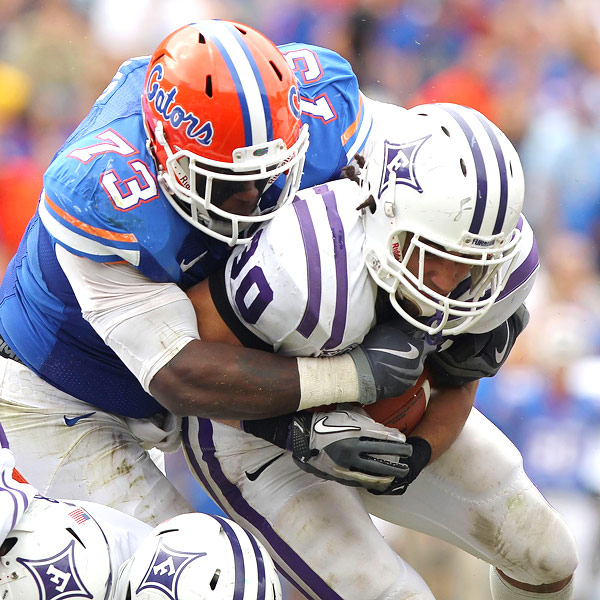
Zach Ertz measured at 6-5 and 249lbs. If he runs as well as expected on Saturday, he could go in the top-20. There’s been some hand-wringing about the length of his 34-inch arms, but considering he’ll be more of a receiver than an in-line blocker, I’m not too concerned here. Tyler Eifert (6-5, 250lbs) and Gavin Escobar (6-6, 254lbs) both look the part. Jordan Reed is shorter and smaller at 6-2 and 236lbs but it’s worth noting how similar he is to another former Gator — Aaron Hernandez (6-2, 245lbs). Reed will feature in the same role as Hernandez and won’t be used as an orthodox tight end.
Joseph Fauria came in at 6-7 and 259lbs with nearly 11-inch hands. Them’s some big hands. Travis Kelce measured at 6-5, 255lbs.
Injury news
We already knew Keenan Allen, Kawann Short, Matt Barkley and Eddie Lacy wouldn’t work out, but nobody expected Jarvis Jones to bail. Jones suffers with spinal stenosis, an issue that ended his time at USC — not to mention several promising careers in the NFL. Apparently he’s going to focus on his pro-day on March 21st and no reason has been given for his unwillingness to perform at the combine. I can’t see this going down particularly well. Meanwhile, Dee Milliner will undergo shoulder surgery after the combine. He’s suffering with a torn labrum.
John Schneider speaks
The Seahawks GM conducted a press conference at the combine today. You can see all 17:08 minutes of it by clicking here.
Here are a few things to keep an eye on regarding Seattle’s more prominent needs…
Receivers/tight ends
Without any big name receivers guaranteed to go in the top ten, there could be a lot of jostling for draft position this weekend. Cordarrelle Patterson has the chance to propel himself into the top-15. He’s technically quite poor, takes bad angles when trying to catch the ball and hasn’t got the greatest hands, but he’s one of the more dynamic players to enter the league in the last few years. If he runs a 4.3-4.4 or even faster, he’ll be rising on many boards. He’s incredibly elusive on tape, it’ll be interesting to see if that translates to superb straight-line speed.
I think Steadman Bailey will run a quicker time than people expect — probably a quicker time than team mate Tavon Austin. Bailey could be a legit 4.4 guy. Austin needs to prove he’s quick given his complete lack of size. I remember Dexter McCluster running a surprising 4.58 in Indianapolis and despite going in round two, he hasn’t had an impact for the Chiefs. Austin could run a similar time, don’t rule it out. And if he does, there could be some concern he’ll just end up being another undersized ineffective player who needs manufactured production.
At West Virginia, they were constantly trying to find ways to get him the ball in front of the defense. His best quality isn’t speed, it’s elusiveness and the ability to make people miss. He wasn’t a great deep threat for the Mountaineers — that guy was Steadman Bailey. In the end they just put Austin at tailback, something that isn’t going to happen at the next level. I doubt he runs a 4.35 like DeSean Jackson. And given his size, a lack of pure speed will be concerning. Fun player to watch in college, but will his game translate?
DeAndre Hopkins won’t shine and will probably run a 4.5. This isn’t his forte though and he deserves to go in round one regardless of anything happening this weekend. Terrance Williams lacks Hopkins’ technical qualities, but he’s a burner. He should run an electric time. Markus Wheaton has track speed and even beat Oregon’s D’Anthony Thomas in a recent 100m sprint. He will clock a fast time. Robert Woods needs to prove he can fly but I’m not optimistic he’ll do a great deal to help himself this week. Da’Rick Rogers will be a fascinating test case, both in terms of what teams think of his interview technique and his ability to flash as an athlete. Chris Harper at Kansas State is a bit hit and miss on tape, but he’s another player I’ll be watching.
There are three tight ends who should perform very well — Ertz, Escobar and Reed. Ertz proved he can get downfield against Wisconsin in the Rose Bowl and will look the part running in shorts in Indianapolis. Escobar will run well for his size and could be a first round pick himself. Reed has maybe the biggest opportunity to get his name out there. I remember one catch he made against Texas A&M where he turned on the jets and exploded up-field. I’ve not seen a guy with his size move like that before. How fast can he run? 4.4’s? Keep an eye on his forty yard dash.
Linebackers
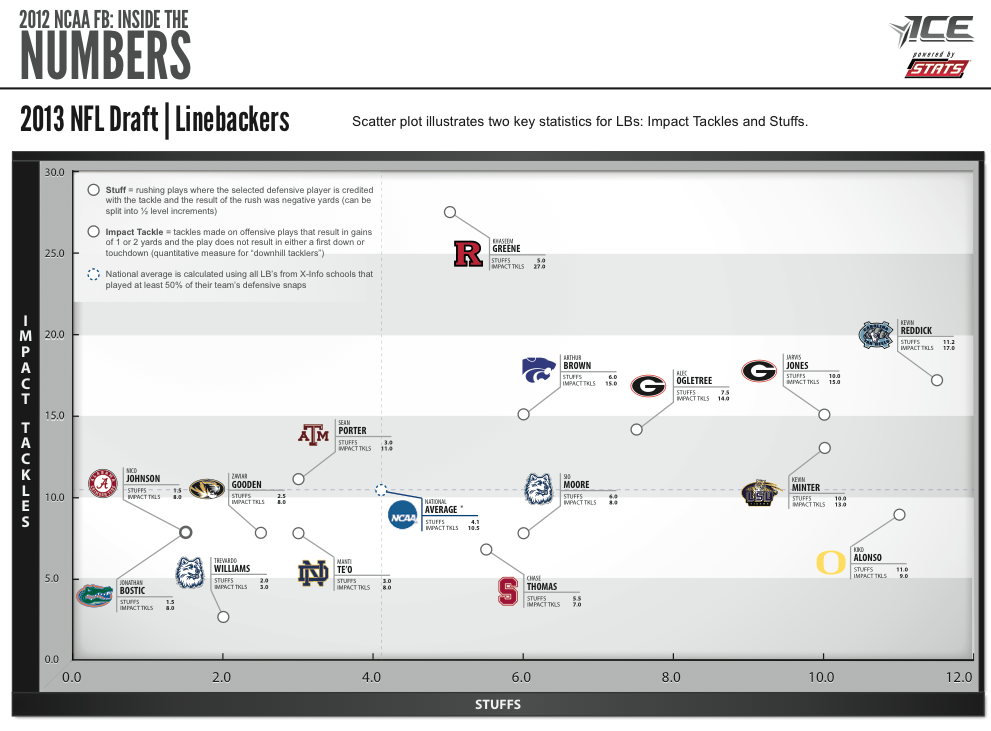
Really we’re looking for guys that run above average times and flash plus agility and cover skills. The Seahawks want speed in the front seven. Presuming Leroy Hill isn’t re-signed, they’re probably going to draft a WILL at some point. I suspect Sio Moore, Zaviar Gooden and Jelani Jenkins will all perform well enough to be in contention as mid-round options.
Gooden is the one I’m most interested in. He really looked the part at the Senior Bowl, flying around the field yet still managing to show solid instincts. He looks like a supreme athlete. Who knows where his stock will be if his momentum continues to build. Right now he’s the player I’m focused on the most if the Seahawks don’t draft a linebacker in the first two rounds.
Alec Ogletree will put on a clinic. I have no doubt about that. He’s a naturally gifted athlete and should test well in every department. He also needs a big show to make up for the off-field concerns that continue to linger. So while people are lining up to declare he’ll drop out of round one, I think he’ll do enough in Indianapolis to convince one of Tampa Bay, Cincinnati or St. Louis to take a chance.
For the Seahawks, I’ll be keeping close tabs on Khaseem Greene and Arthur Brown. Both players are athletic enough to impress and flash the necessary speed to be a possible first round WILL. Greene is thicker set and won’t get into the 4.4 range, but he should run a solid 4.5. After all, he has the same bloodlines as Ray Graham. Brown could edge Greene for straight-line speed but is he quite the same kind of impact player? He also had to switch from the WILL back to MLB at Kansas State because he felt more comfortable inside. He was also quite homesick during his time in Miami, provoking his move back to Kansas. Greene on the other hand will be a day one leader and should wow anyone who interviews him in Indianapolis.
Defensive lineman
Depending on how healthy he is, Dion Jordan could put on a masterclass. It’ll be interesting to see exactly how much he weighs — there have been some concerns that he played as low as 230lbs this season at 6-7. He needs to hold his weight and still flash the kind of physical upside that makes you salivate watching tape. Chip Kelly for some reason had him dropping into coverage so often. He’s not bad at it, it’s just you’d like to see him rushing the passer pretty much every down. It certainly impacted his production with just five sacks in 2012. He could be one of the stars of this years combine. I think he’s a top-ten lock.
Ziggy Ansah will be right there alongside Jordan ready to bolster his stock. He’ll test brilliantly in every drill. Ansah is technically raw but he’s a beast. This should be fun to watch.
Barkevious Mingo needs a big weekend. I watched four LSU games over the last few days and came away bitterly disappointed with his tape. He’d flash every now and again, but where’s the spark? The consistency? He doesn’t dominate enough despite playing on a solid LSU front line. His production was poor in 2012 and he’s not an obvious scheme fit at 3-4 OLB or 4-3 end. He might ‘only’ be a LEO. He needs a super-quick ten yard split.
Bjoern Werner won’t test particularly well but shouldn’t see his stock hampered too much — he’s still a pure 4-3 end and should look to re-gain the weight he lost last summer. Damontre Moore’s stock has dropped a bit since the end of the season and he needs to recapture some momentum. Alex Okafor, Margus Hunt, John Simon, Datone Jones, Corey Lemonier… the defensive end groupings will be unmissable. There’s so much to be gained or lost this weekend. Keep an eye on the all-important ten-yard splits, not just the forty yard dash times.
It’s hard to get much out of watching the defensive tackles work out. Again, the ten-yard splits are vital. But the rest? Not so much. I suspect Sheldon Richardson and Sharrif Floyd will both have work-outs that confirm their standings among the top-ten picks. Richardson in particular might run a faster than time than any defensive tackle in recent memory. Monitor the big guys to see how they move — Montori Hughes, Brandon Williams, Sylvester Williams, Johnathan Hankins, Jonathan Jenkins, Jesse Williams. The Seahawks might want to keep size along that defensive line if they don’t re-sign Alan Branch, but whoever they draft will need to be an upgrade on what they already had. That means better athleticism and pass rushing potential.
On Jesse Williams, it’s been suggested he could be this years bench-press specialist. He won’t run particularly well and might struggle in some of the movement drills, but he always looked strong on tape. Let’s see if he’s this years answer to Stephen Paea. That’s the player he compares most to.
Cornerbacks
In each draft so far, the Seahawks have taken a corner later on. This will no doubt be the case again this year. They just seem to like stock piling secondary talent. Look out for any tall, lean defensive backs who run well and appear to be able to play physical. I’m going to monitor Blidi Wreh-Wilson, Dee Milliner, Xavier Rhodes, Leon McFadden, Robert Alford, Will Davis, Terry Hawthorne, Tharold Simon, Greg Reid and Johnthan Banks.
Out of the group, Mississippi State’s Banks looks like the most likely ‘Seahawks’ type corner. The only problem is, he’s a possible first or second round pick. And I’m not convinced the Seahawks will draft a corner that early, especially given their success rate without spending high picks at corner. It’s almost certain they’ll take one at some stage, though.
The other positions
Menelik Watson could be the offensive lineman who benefits the most this week. He’s got a little Bruce Campbell to his game, but he’s a lot more technically polished despite how relatively new he is to the game. Expect the three big name tackles to impress — Eric Fisher, Luke Joeckel and Lane Johnson. Jonathan Cooper is a big time athlete. Watching the running backs perform in the forty yard dash is always entertaining. Eddie Lacy won’t compete and this year lacks the ‘star’ power of previous seasons. Still, it’s a decent crop of runners and I’ll be keeping a close eye on Montee Ball, Andre Ellington, Giovani Bernard, Stepfan Taylor, Joseph Randle, Zach Stacy, Ray Graham, Rex Burkhead, Jawan Jamison and Jonathan Franklin.
Small school prospects
A few unknown types put themselves in the public eye during the combine and it shouldn’t be ignored. A case in point — guys like Mark LeGree didn’t do a great deal in the pro’s, but a good combine placed him on Seattle’s radar. John Schneider and Pete Carroll appear happy to take on the occasional project from a smaller programme. It’s difficult for us amateurs to identify those players due to limited access to live coverage and game tape. But you never know who might emerge in Indianapolis. Kip made a post highlighting some potential targets earlier in the week.